
If you have ever asked why AI tweets sound generic, the honest answer is not that the model is broken or that you prompted it wrong. It is that a language model, by design, writes toward the statistical average of everything it has read, and the average tweet is bland. This guide is the fix-oriented companion to our diagnostic pieces on why AI tweets sound the same and why AI drafts sound the same, so we will keep the diagnosis short and spend most of our time on what actually moves the needle: the manual repairs everyone repeats, and the durable one almost nobody delivers.
Why do my ChatGPT tweets sound generic in the first place?
A tweet from ChatGPT, Claude, Gemini, or Grok is not a creative act in the way yours is. It is a prediction. The model looks at the words so far and picks the token most likely to come next based on patterns across a vast amount of internet text. That is a beautiful trick for coherence and a terrible one for personality, because the most likely next word is, almost by definition, the least surprising one.
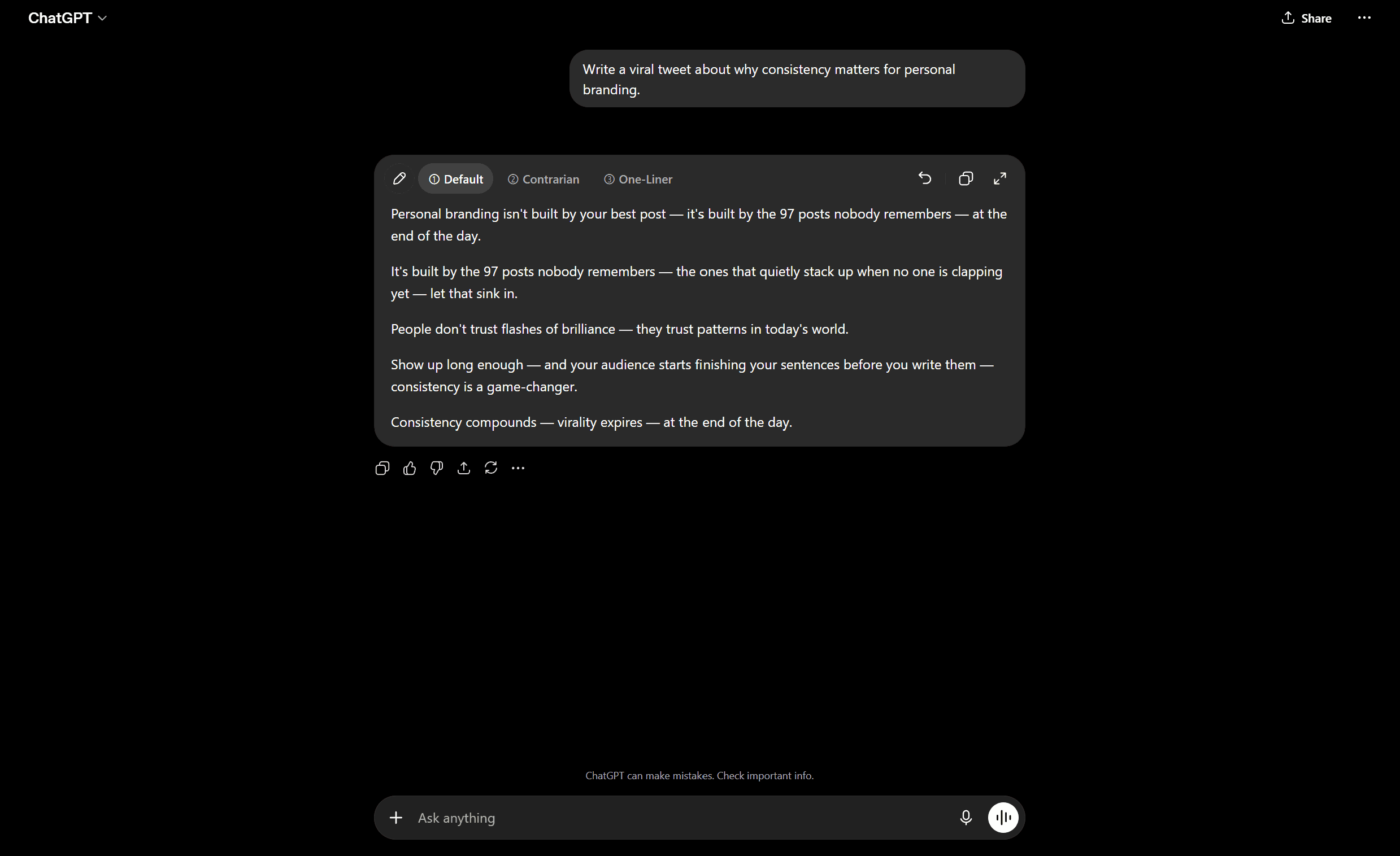
The statistical average problem: next-token prediction explained
Imagine every tweet ever written about "consistency and growth" poured into one bucket. Now ask for the single most representative sentence in that bucket. You would not get anyone's real voice. You would get the center of gravity: "Consistency is key to building an audience." That sentence is technically true, grammatically clean, and completely dead. Next-token prediction pulls hard toward that center on every word, which is exactly why your ChatGPT tweets sound robotic even when the grammar is flawless. The model is not trying to sound like you. It is trying to sound like the average of everyone, and the average has no edges, no specifics, and no opinions worth arguing with.
Why the most common topics get the most generic phrasing
There is a cruel twist here. The more common your topic, the more generic the output. Ask for a tweet about productivity, personal branding, or morning routines and you are asking the model to draw from the most crowded corner of its training data, where the averaging effect is strongest. That is why all your ChatGPT posts sound the same across different prompts: you keep landing in high-density regions where the safe, smoothed-over phrasing dominates. Niche, specific, weird topics get slightly fresher language simply because the model has fewer worn grooves to fall into. The lesson is not to avoid common topics. It is that on common topics you have to supply the specificity the model will not.
What are the tell-tale signs a tweet was written by AI?
Readers cannot name the statistical-average problem, but they feel it instantly. The feeling comes from a small set of repeatable tells. Once you can spot them, you can strip them, and the tweet stops reading as machine output. Here is the pattern, with the generic version beside a blunt rewrite so the contrast is doing the teaching.
| The AI tell | Generic AI version | Blunt, voice-matched rewrite |
|---|---|---|
| Filler opener | In today's fast-paced world, building an audience matters more than ever. | Nobody owes you attention. You earn it one useful tweet at a time. |
| Hedging | It's worth noting that consistency can potentially help with growth. | Post daily for 90 days. Then decide if it works. Not before. |
| Cliche vocabulary | Leverage this robust, seamless framework to delve into audience growth. | Here is the exact 3-step thing that got me my first 1,000 followers. Steal it. |
| Uniform rhythm | Great writers read a lot. Great writers write daily. Great writers edit hard. | Great writers read constantly. They also write when it's boring, then cut the parts they love. |
| Sycophantic reply | This is such an incredible and insightful take. Thanks so much for sharing! | Point 2 is the one everyone skips. Learned that the hard way in 2023. |
Filler openers and hedging phrases
The single loudest tell is the throat-clearing opener. "In today's world," "When it comes to," "In an era of," and "Let's be honest" are the model warming up because it was trained to be helpful and complete rather than sharp. Hedging is the same instinct pointed at claims: "can potentially," "it's worth noting," "in many cases," "arguably." Both exist because the model is optimizing to never be wrong, and a tweet that is never wrong is also never memorable. Cut the first sentence and cut every hedge, and most AI tweets improve before you change a single real word.
Uniform sentence rhythm and over-polish
Humans write in bursts. We run long, then stop short. We start a sentence with "And." We leave a fragment because it hits harder. Models smooth all of that out into an even, medium-length cadence where every sentence is roughly the same weight, which reads as tidy and lifeless. Over-polish is the visual version of the same problem: perfectly balanced clauses, every list item the same length, a neatness that real people rarely produce at speed. If a thread reads like it was proofread by a committee, that evenness is the tell, not any single word.
The cliche vocabulary: delve, robust, seamless, leverage
Some words are statistically overrepresented in AI output because they are safe, formal, and common in the training text. You already know them when you see them. Keep this list somewhere you can paste it into a prompt, because banning the vocabulary is one of the highest-leverage edits you can make:
- delve, dive into, unpack, explore
- robust, seamless, streamlined, cutting-edge
- leverage, utilize, harness, unlock
- elevate, empower, supercharge, game-changer
- in today's world, in the ever-evolving landscape, in an era of
- it's worth noting, arguably, that being said, at the end of the day
- tapestry, testament, realm, journey, navigate
None of these words are wrong on their own. The problem is density. When four of them appear in a single tweet, the reader's brain files the whole thing under "machine," and no clever hook survives that verdict. For a deeper treatment of stripping these patterns across formats, our de-AI playbook for making AI writing sound human goes line by line.
Why do my ChatGPT replies on Twitter sound fake?
Replies have their own specific failure, and it is not genericness so much as fakeness. Ask a model to reply to someone and it defaults to a warm, agreeable, slightly breathless register: "This is such a great point, thank you for sharing!" That tone exists because the model was trained to be polite and encouraging, but on Twitter it reads as a bot or a bootlicker. Real replies disagree, add a specific detail the original missed, or tell a one-line story. They do not congratulate the poster for existing.
The sycophantic, too-enthusiastic tell
The sycophancy tell is the exclamation-mark reply that agrees with everything and contributes nothing. The fix is to force the reply to earn its place: react to one specific line, add a fact or a number, or gently push back. "Point 2 is the one people skip" beats "Amazing thread!" every time because it proves you read the thing. If you write a lot of replies, we cover the mechanics in how to use AI to write Twitter replies that sound like you, including how to keep a reply short enough to feel offhand rather than composed.
Why do ChatGPT tweet hooks sound cringe?
Hooks are where AI output goes from generic to actively embarrassing. Ask for a "scroll-stopping hook" and the model reaches for the viral templates it has seen thousands of times, the ones that were fresh in 2021 and are now a punchline. The cringe is not random. It is the averaging effect applied to a genre that rewards novelty, which is the worst possible match.
Retire these formats, or at least never use them straight from the model:
- "Unpopular opinion:" followed by an extremely popular opinion.
- "Nobody is talking about this" about a thing everybody is talking about.
- "I studied 100 top creators so you don't have to."
- "Here's a thread that will change how you think about X forever."
- "Let that sink in." and "Read that again."
- The fake-vulnerable open: "3 years ago I was broke. Today..."
A hook works when it is specific and true, not when it follows a shape. "I deleted 4,000 followers on purpose last month. Best decision of the year" beats any template because it could only be your tweet. If you want a bank of angles that are not worn out, our guide to AI hook prompts for Twitter and LinkedIn also explains why every hook formula goes stale and how to keep ahead of the decay.
Fix 1: Feed the model your own past tweets
The most effective single fix for genericness is to give the model something specific to imitate: your own past tweets. When you paste real examples into the prompt, you drag the output away from the global average and toward your personal one. The model still predicts the likely next word, but now "likely" is conditioned on how you actually write, so the punctuation, sentence length, and word choice start to resemble yours instead of everyone's.
How many writing samples do you actually need?
For a one-off pasted prompt, five to ten of your best recent tweets is the practical sweet spot. Fewer than five and the model does not have enough signal to lock onto your patterns. More than ten in a single prompt gives diminishing returns and eats context you could spend on the actual instruction. Pick tweets that are unmistakably you, not your most viral ones, because virality often comes from a topic rather than a voice, and you want the voice.
Here is the honest limitation, though. Re-pasting three or four sample tweets into ChatGPT is the manual, per-tweet version of the right idea, and it decays fast. The model forgets between sessions, so tomorrow you paste again. It forgets between chats, so every new thread starts from the average. You end up re-teaching your voice on every draft, which is exactly the friction that makes people give up and post the generic version. A tool built for this learns your whole Twitter history once and keeps writing in it by default, so you are not re-uploading yourself every morning. We will get to that after the manual fixes, because the manual fixes are still worth knowing. Our step-by-step on making ChatGPT write tweets in your voice covers the pasting method in full if you want to run it by hand.
Fix 2: Write specific prompts with audience, angle, and context
A vague prompt produces a vague tweet, and "write a tweet about productivity" is about as vague as it gets. The model has no audience, no angle, and no constraint, so it falls back to the average. The fix is to remove the model's freedom to be generic by supplying the three things it cannot invent: who you are talking to, the single point you want to make, and one real detail. The more you specify, the less room there is for the smoothed-over middle. Paste this and fill the brackets:
You are drafting a tweet in my voice. Here are 8 of my recent tweets, study the sentence length, punctuation, and words I actually use: [paste 8 tweets]. Topic: [X]. Audience: [who it's for]. Angle: the one specific thing I want to say: [angle]. Rules: no filler opener, no hedging, no words like delve, robust, seamless, leverage, or elevate. Include exactly one concrete detail (a number, a name, a date, or a moment). Vary the sentence length. Give me 3 options, each under 280 characters, no hashtags.
The "one concrete detail" line is the quiet workhorse. A number, a name, a date, or a moment cannot be averaged, so it forces the model off the center of gravity and onto something that could only be your tweet.
Fix 3: Keep a banned-word list
The banned-word list from earlier is not just a reading aid. It is a prompt ingredient. Paste it into every request as a hard constraint, because telling the model what to avoid is more reliable than hoping it avoids it on its own. Keep your list in a note and add to it every time a word makes you wince in your feed. Over a few weeks you will build a personal blocklist that is more useful than any generic one, because it targets the specific tells your particular topic attracts. This is the cheapest fix on the list and one of the most effective, since so much of the robotic feeling lives in a small number of overused words.
Fix 4: Edit like a human, read aloud, keep the rough edges
No prompt gets you all the way there, so the last manual fix is editing, and the best editing tool is your own mouth. Read the tweet aloud. Anywhere you stumble, hesitate, or feel your face do a small cringe, rewrite until it sounds like something you would actually say. Then, and this is the part people skip, put a rough edge back in. Real writing has a fragment, an aside, a slightly-too-casual word, a sentence that starts with "Anyway." The over-polish is a tell, so deliberately roughing up one line makes the whole tweet read human. If you want a free second opinion before posting, our voice tone analyzer flags where a draft still reads flat, and the humanize AI text tool can loosen an over-stiff line, though we will be honest about the limits of humanizers in a moment.
How do you humanize an AI-generated Twitter thread?
A single tweet is easy to fix. A thread is harder, because the tells compound across ten tweets and any inconsistency in voice becomes obvious when the tweets sit next to each other. Here is the workflow for rescuing an AI thread that already exists.
- Step 1
Strip the openers
Delete filler intros like "In today's world" from every tweet and start each one on its first real claim.
- Step 2
Cut the cliches
Remove delve, robust, seamless, leverage, and any word you would not say out loud to a friend.
- Step 3
Break the rhythm
Vary sentence length across the thread. Follow a long line with a three-word one so it does not read as even.
- Step 4
Add a specific
In each tweet, swap one vague noun for a real number, name, date, or moment that could only be yours.
- Step 5
Read it aloud
Say every tweet out loud. Anywhere you wince, rewrite it until it sounds like you, then keep one rough edge.
Vary sentence length and respect the character limit
Threads live and die on rhythm. If every tweet is a tidy two-sentence block of equal weight, the thread reads as a machine emitting paragraphs. Make some tweets a single punchy line and let others run to the full character limit. The variation is what signals a person typing in real time rather than a template being filled. Watch the character count too: a tweet that ends mid-thought because it hit the limit is fine and even human, but one that ends on a comma because the model did not plan for the cutoff is a tell.
Keep one voice across every tweet in the thread
The subtle thread-killer is drift. Tweet one is casual, tweet four goes corporate, tweet seven picks up an exclamation-mark reply tone, and the reader senses that no single person wrote all of it. Consistency of voice across the whole thread is what a pasted-samples prompt struggles with most, because you are re-rolling the dice on each tweet. The durable alternative is to draft the whole thread in your voice from the start, so that humanizing becomes light editing rather than a rescue operation on every tweet. That is the difference the next section is about.
The faster fix: an AI Twitter tool that writes in your voice
Every manual fix above shares one weakness: you do it again on the next tweet, and the one after that. There is an AI Twitter tool built to write in your voice by default so you stop re-teaching it, and it is the category VoiceMoat sits in. VoiceMoat is an AI social media tool for Twitter and LinkedIn that helps you create, schedule, reply to, and analyze posts, and because its writing partner audenAI learns your Twitter voice from your own past tweets, the drafts it produces read like you instead of the generic statistical average.
Disclosure: VoiceMoat is our own product, so treat this section as the maker's pitch and judge the before-and-after example on its own. One clarification while we are here, because search engines confuse the two: VoiceMoat is a social media marketing platform for Twitter and LinkedIn, not the VoiceMod voice-changer, and audenAI models writing patterns, not audio. Nothing here touches how you sound out loud. It is about how your posts read.
How VoiceMoat and audenAI skip the statistical average
The reason pasted-sample prompts decay is memory. audenAI is trained once on your own past tweets, learning the rhythm, vocabulary, hook patterns, structure, and punctuation you already use, and then it drafts new posts in those patterns by default. So the generic average is never generated in the first place, instead of being edited out afterward. Honestly, that is the whole trick: you fix the problem at generation time rather than at editing time. Concretely, that means voice-matched drafting in VoiceMoat Studio for tweets and threads, reply drafting in Engage that avoids the sycophantic tell, plus scheduling and analytics around it, across both Twitter and LinkedIn. It is not magic and it is not a different model doing something exotic. It is the same next-token prediction, conditioned on you from the start rather than on the internet's average.
- 0: 38
- 25: 55
- 50: 68
- 100: 79
- 200: 88
Why a humanizer tool cannot give you a consistent voice
Humanizer and paraphraser tools like QuillBot and HumanizeAI have a real but narrow job. They take AI text and swap the obvious tells for less obvious ones. What they cannot do is give you a voice, because they have no idea who you are. A humanizer trades the generic AI voice for a different generic voice, one tweet at a time, with no memory of your last post and no model of your patterns. That is genuinely useful for loosening a single stiff line, and our own humanize AI text tool exists for exactly that. But it is a rescue, not a voice. A voice-trained approach is the opposite: it starts in your patterns and stays there across replies, hooks, and full threads, so consistency is the default rather than something you rebuild every time.
Before and after: a generic tweet vs a voice-matched one
Adjectives are easy to distrust, so here is the contrast doing the work instead. Same idea, two outputs. The first is a flat ChatGPT default. The second is the same idea drafted by audenAI after it has learned a user's past tweets, labeled so you know what produced it.
Generic ChatGPT default: "In today's fast-paced world, consistency is key to growing your audience on Twitter. By showing up every day and providing value, you can unlock incredible growth. Remember, success doesn't happen overnight!"
VoiceMoat output (audenAI, trained on the user's tweets): "I posted every day for 6 months and my follower count barely moved. Then I changed one thing: I stopped explaining and started arguing. Engagement tripled in 3 weeks. Consistency is the floor, not the strategy."
Notice what changed. The opener is gone. The cliches are gone. There is a real number, a real turning point, and an actual opinion you could disagree with. Nobody read that and thought "bot." That is the difference between editing the average out and never generating it. For a broader head-to-head on when a general assistant is enough and when a voice-trained tool earns its place, see why AI drafts sound the same, which is the companion diagnosis to this fix guide.
So: AI tweets sound generic because models write the statistical average, the manual fixes work but you pay for them on every draft, and a voice-trained tool moves the fix to generation time. If you would rather not police banned words and re-paste samples forever, connect your account, let audenAI learn your last tweets, and draft your first voice-matched tweet free in VoiceMoat Studio (paid plans from $35/mo).