
If you have searched for how to train AI to write in your voice, you already know the problem: ChatGPT, Claude, and Gemini can write a competent post in seconds, but it comes out sounding like everyone else's post. This is the honest, cross-model guide to closing that gap. You will get the exact prompts that make a model analyze your writing and then draft in your style, the settings that make it stick a little longer, and a clear-eyed account of where every prompt-based method quietly breaks. We cover ChatGPT, Claude, and Gemini together, because the technique is the same across all three, and so is the ceiling.
Can ChatGPT write like you? The honest answer
Yes, with a real but limited success. Give a model a handful of your posts and a clear instruction, and it will imitate your tone, your sentence rhythm, and a lot of your vocabulary. What it will not do on its own is remember that voice tomorrow, or learn from the edits you make today. That gap is the whole story, so it is worth being precise about what 'writes like you' actually means.
What AI can match: tone, rhythm, and vocabulary
Given enough examples, a model is genuinely good at surface patterns: whether you write in short punchy lines or long rolling sentences, whether you open with a question or a claim, which words you reach for and which you avoid. These are the same signals a human editor would notice. If you want the deeper version of what voice is actually made of, we break it down in the nine dimensions of writing voice.
What it cannot do: hold your voice across sessions
Here is the part the tutorials skip. A general chat model is stateless about you. When you close the window, the analysis you pasted is gone, and the next chat starts from the generic default again. Custom instructions and memory help at the margin, but they do not learn from your corrections, and they were not built to carry a full writing profile. This is why prompting is the right tool for a one-off post and the wrong tool for a posting habit. If your goal is to publish on Twitter and LinkedIn every week, you will feel the difference fast.
The realistic 70 to 80 percent ceiling
Set expectations honestly. A well-fed prompt gets you most of the way, roughly 70 to 80 percent of your voice, which is enough that a stranger might not clock it and not enough that a regular reader would mistake it for you. The last stretch is the hard part, because it depends on the model remembering your edits and your best-performing posts, which is exactly what it cannot do. Treat 70 to 80 percent as the honest prompt ceiling, a directional figure and not a benchmark to quote as gospel.
Here is the whole method on one screen. The five steps below work the same way in ChatGPT, Claude, and Gemini, so once you have done it once you can run it anywhere.
- Step 1
1. Gather samples
3 to 6 of your own posts
- Step 2
2. Analyze
Extract your Style DNA
- Step 3
3. Write
Draft the profile, ban the AI tells
- Step 4
4. Save
Custom instructions, a Project, or a Gem
- Step 5
5. Iterate
Edit toward your voice, then correct
Step 1: gather your writing samples
Everything downstream depends on the input. The model cannot infer a voice it has never seen, so the first job is to collect real examples of you writing like you.
How many samples: 3 to 6 versus 20,000 words
You will see advice ranging from three or four posts to twenty thousand words. Both are right for different goals. For a single social post, three to six of your strongest recent posts are enough to anchor tone and rhythm. For a style guide you intend to reuse, more is better, because the model averages across what you give it, and a wider sample captures your range instead of one mood. Pick examples you would be happy to see echoed back.
Which samples to pick for a social media voice
- Posts you wrote yourself, not ones you already ran through an AI, or you will train it on the generic voice you are trying to escape.
- A spread of modes: a hot take, a teaching post, a personal story, a reply. Your voice shifts between them, and the model should see that range.
- Your best-performing posts, so the style it learns is the one your audience already responded to.
- Nothing you copied or quoted, so the sample is your voice and not someone else's.
Step 2: ask the AI to analyze your writing style
Do not jump straight to 'write a post like me.' First make the model describe your style in its own words. This forces it to extract concrete patterns you can then reuse, and it gives you a style summary you can save. Paste five or six samples, then use a prompt like this one.
Here are several posts I wrote. Analyze my writing style and return a concise profile covering: sentence rhythm and length, tone and how it shifts, the words and phrases I reach for and the ones I avoid, my hook patterns, my punctuation habits, and my typical structure. Be specific and quote short examples. Do not flatter me; describe what is actually there.
The output is your Style DNA: a portable summary you can drop into any model. Read it critically. If it misses something that matters, tell it, and have it revise. The better this profile, the better every draft that follows.
As a sanity check, a good Style DNA reads like something a sharp editor would say about you, not marketing filler. 'Your tone is professional and engaging' is useless. 'You open with a one-line claim, you keep paragraphs to two sentences, you favor concrete nouns over adjectives, and you almost never use exclamation marks' is a profile you can actually write against. If what comes back is vague, the drafts will be vague too, so push the model to be specific and to quote your own lines before you move on.
Step 3: the analyze-then-write method
Now use the profile to generate. Keep the analysis in the same chat (or paste the saved profile) and ask for a draft on your topic. The two-step order matters: a model that has just articulated your style writes closer to it than one told only to sound like you.
Using the style profile above, write a [Twitter post / LinkedIn post] about [topic]. Match my rhythm, tone, vocabulary, and hook pattern. Give me three versions. Do not use em dashes, and do not use words like 'delve', 'leverage', 'unlock', or phrases like 'in today's fast-paced world'.
Add negative constraints (no em dashes, no clichés)
The banned-word list matters more than it looks. Large models lean on a small set of tells: the em dash, a handful of overused verbs, a breathless intro. Cutting them removes the most obvious signals that a machine wrote the text. We keep running lists of the em-dash AI tell and the words AI overuses, and you can paste any draft into our free humanize AI text tool to catch the ones you miss. Just remember what this step does and does not do: it removes the machine's voice, it does not add yours. For the deeper reason so much AI output converges on the same feel, see why AI drafts all sound the same, and for the full de-AI playbook, see how to make AI writing sound human.
Step 4: save your voice into custom instructions, projects, and gems
To avoid re-pasting your profile in every chat, save it where the model will reuse it. Each assistant has its own slot, and each has limits worth knowing.
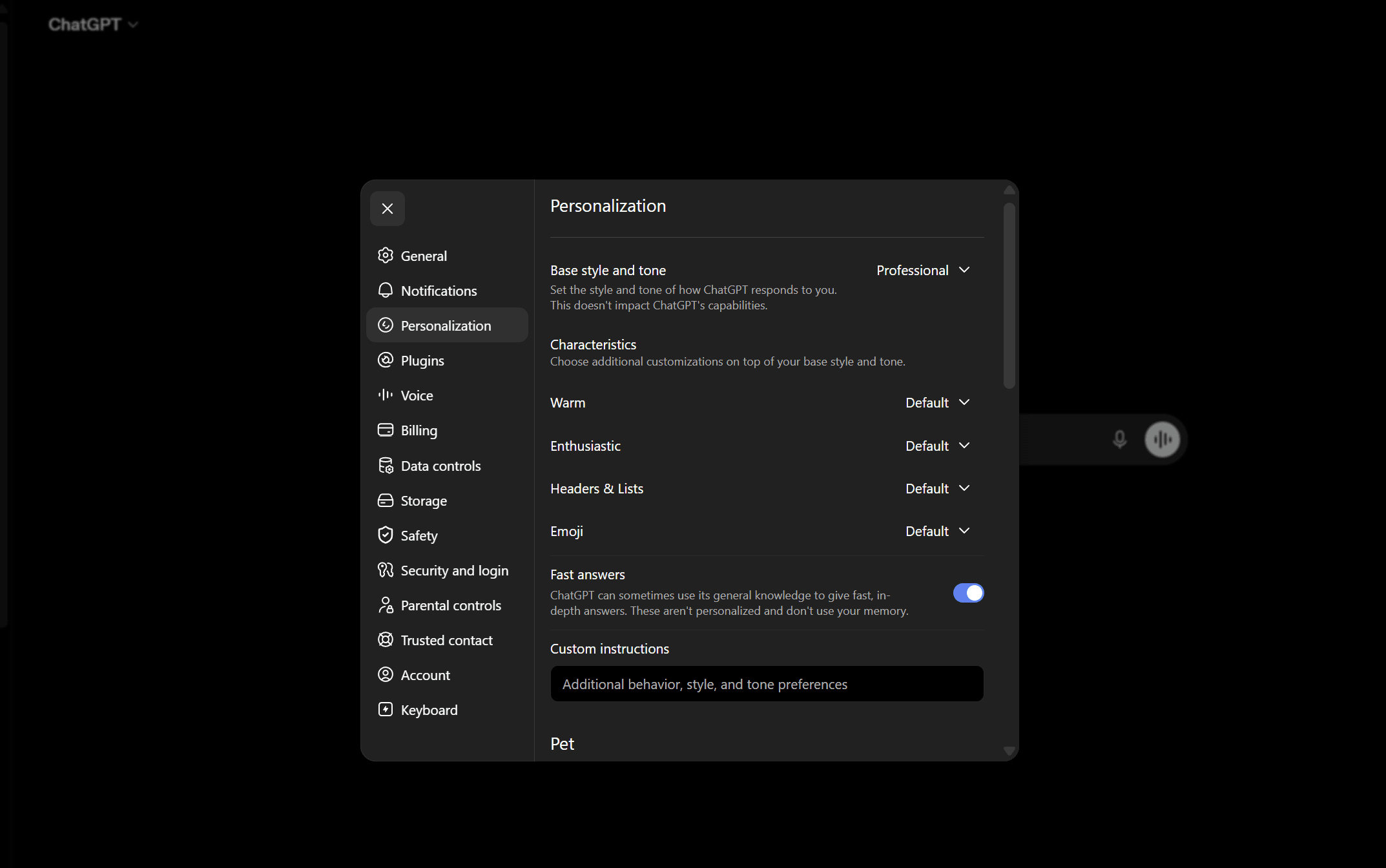
ChatGPT custom instructions and memory (and their limits)
In ChatGPT, paste your style profile into custom instructions so it applies to new chats, and let memory retain a few stable preferences. This is genuinely useful, and it is also where people overestimate what they are getting. Per OpenAI's own documentation on custom instructions and memory, these are static preferences, not a learning loop: the model does not study your edits and improve. Over a long chat, the instructions also get diluted by everything else in the context. Refresh them when drafts start drifting.
Claude Projects and Gemini Gems: how to make Gemini write like you
Claude offers Projects, where you can pin your style profile and reference posts as persistent context for everything in that project (see Anthropic's Projects documentation). To make Gemini write like you, save your profile as a Gem, a reusable custom assistant, per Google's Gemini help. Both are better than re-pasting every time, and both share the same ceiling as ChatGPT: they hold a fixed instruction set, they do not learn from the way you rewrite their output.
A practical note on how long any of this lasts. The more you pile into a single chat, the more your saved instructions get crowded out by the rest of the context, so a draft ten messages deep drifts further from your voice than the first one did. Start a fresh chat for a fresh post, and refresh your saved profile every few weeks as your writing changes. None of these systems will do that upkeep for you, which is the recurring theme of this guide.
Step 5: iterate, edit, and de-robotize
No first draft lands. The realistic loop is generate, then edit toward your voice, then feed the edit back as a correction. Be specific: 'too formal, I never say furthermore', 'the hook is buried in line three, move it up', 'cut the summary sentence at the end, I never write those'. Specific feedback moves a draft further than another vague 'make it sound like me'.
The de-robotizer rewrite prompt
Rewrite this so it reads like I wrote it, not an assistant. Break any too-even rhythm, cut the throat-clearing intro, remove hedging, and keep only the words I would actually use. No em dashes, no clichés, no summary sentence at the end.
One caution: every session you do this in is a session you will have to repeat. The edits you just made teach the model nothing for next time.
A worked example: one post, start to finish
Theory is easy; the loop is where it gets real. Say you want to post on LinkedIn about a launch that slipped a week. Step one, you paste six of your recent posts. Step two, the model returns a profile: short opening line, one idea per paragraph, dry humor, no hashtags, and you never use the word excited. Step three, you ask for three versions using that profile, with the em dash and the word delve banned. Step four, you save the profile to custom instructions so tomorrow's post starts from the same place. Step five, you pick version two, cut its throat-clearing first sentence, swap one corporate verb for the one you actually use, and post it.
That final edit is the tell. It took you thirty seconds, and it is exactly the kind of correction the model will not remember. Next week, on the next post, you make the same thirty-second fix again. Multiply that across a year of posting and you have the real cost of prompting: not any single session, but the fact that none of them add up.
Twitter and LinkedIn: how the method changes
The five steps are the same on both platforms, but the samples and the constraints should not be. Your Twitter voice and your LinkedIn voice are usually different people: shorter, sharper, and more opinionated on Twitter; more structured and context-setting on LinkedIn. If you feed a model a mix of both and ask for one voice, you get a muddy average that fits neither.
So keep two profiles. Analyze your best tweets separately from your best LinkedIn posts, and label each profile by platform. When you draft, tell the model which one to use. If you post to both regularly, this is the point where maintaining two style guides by hand across three assistants starts to feel like a part-time job, which is the practical case for a tool that holds both profiles for you. We go deeper on the Twitter-specific version in how to make ChatGPT write tweets in your voice, the LinkedIn-specific version in how to make ChatGPT sound like you on LinkedIn, and the Claude setup in how to make Claude write in your voice.
Common mistakes that keep it sounding like AI
Most people who say the AI still does not sound like them are making one of these mistakes.
- Feeding it AI-written samples. If your examples were themselves generated, you are training the model on the generic voice you are trying to escape. Use only posts you actually wrote.
- Asking for the voice and the topic in one breath. Analyze first, write second. A model that has just described your style writes closer to it.
- Skipping the negative constraints. Without an explicit ban, the em dash and the overused verbs come back every time. Keep the words AI overuses on hand.
- Treating setup as permanent. Custom instructions and Gems drift and get dated. If drafts start sliding back toward generic, refresh the profile.
- Judging on vibes. If you cannot say whether a draft sounds like you, you cannot improve it. Read the draft next to a real post and mark the specific lines that are off.
Why you have to re-teach it every time
Step back and the pattern is clear. General chat models are stateless about your style. Custom instructions and Gems and Projects reduce the re-pasting, but they store a fixed description of your voice, not a living model of it, and none of them learn from your edits. So every new post starts near the generic default, and you pay the same tax again: paste the samples, run the analysis, add the constraints, fix the output. It works, but it does not compound. Your hundredth post is no easier than your first.
Here is where the prompt-based approach leaks, tool by tool, and what a purpose-built writing tool does instead.
| Capability | ChatGPT, Claude, Gemini | VoiceMoat (audenAI) |
|---|---|---|
| Re-paste your samples each session | Yes, every new chat | No, it learns your posts once |
| Holds your voice across sessions | Limited, drifts over long chats | Yes, a persistent per-user profile |
| Learns from your edits | No | Yes, corrections refine the profile |
| Keeps up negative constraints (no em dashes, no clichés) | Manual, re-added per prompt | Built in, it avoids the AI tells by default |
| Measures how closely output matches you | No | Yes, a voice-match score |
The persistent alternative: learn your voice once with audenAI
Full disclosure first: VoiceMoat is our product, so treat this section as the maker's take and judge it against the prompts above on your own writing. VoiceMoat is an AI social media tool for Twitter and LinkedIn that helps you create, schedule, engage, and grow, and its writing partner, audenAI, learns your voice from your own posts so it persists across every draft instead of being re-pasted into a fresh chat each time. (To avoid a common mix-up: VoiceMoat is a social media marketing platform for Twitter and LinkedIn, not the VoiceMod voice-changer.)
The difference is where your voice lives. Instead of a style summary you carry from chat to chat, audenAI models your writing patterns (rhythm, vocabulary, hooks, structure, punctuation) once, from your real posts, and applies them everywhere: drafting posts and threads in Studio, drafting replies in Engage, with scheduling and analytics in the same place. Because the profile is persistent and specific to you, your edits refine it instead of evaporating. It will not clone anyone, and it will not push a viral post that does not read like you. If you want the head-to-head, we wrote why ChatGPT forgets your voice between sessions and a Twitter-specific walkthrough of how to make ChatGPT write tweets in your voice.
- Prompt only: 35 %
- 25 posts: 55 %
- 75 posts: 72 %
- 150 posts: 85 %
- 300 posts: 92 %
- Step 1
Gather samples
Paste your own posts
- Step 2
Extract Style DNA
The model analyzes your style
- Step 3
Write with constraints
Draft, then ban the AI tells
- Step 4
Edit toward your voice
Fix what is off
- Step 5
Next session
With a chat model you start over. With audenAI the profile persists and your edits refine it.
So the honest bottom line: use the prompts here whenever you need a one-off post in your voice, and they will get you most of the way. If you post often enough that re-teaching your voice every session gets old, that is the moment a persistent tool pays for itself. You can draft in your own voice with audenAI on the free plan, with paid plans from $35 a month. audenAI suggests, you decide.