If you are asking what the best AI tool for personal branding is, the honest answer is that it depends on whether you need a productivity layer or a voice layer. Most AI tools will write for you. Almost none of them write like you. That distinction felt minor two years ago. In 2026, with feeds more saturated than ever and audiences quicker to spot generated content, it is the difference between a personal brand that compounds and one that blends into the noise. This is a layer-by-layer roundup of the tools worth knowing, organized by the part of your brand stack each one actually fixes, with the honest limits of each named plainly. (Disclosure: VoiceMoat is our own product; we have placed it by what it does rather than at the top by default, and named where it falls short. Named-tool note: ChatGPT, Claude, and the others are named as the tools people actually use; audenAI, the brain inside VoiceMoat, is named as a product, never as a backend model.)
What makes an AI tool good for personal branding?
Most tool roundups optimize for feature checklists. This one is written for solo creators, founders, and thought leaders running a personal brand without a content team, which changes what matters. Three criteria do most of the work.
- Style learning, not prompt-following. Does the tool adapt to your actual writing history, or does it just follow whatever prompt you hand it each session? This is the clearest signal of whether a tool is built for personal branding or merely marketed toward it.
- Platform support that matches where brands are built. Native drafting, thread formatting, and scheduling for the platforms that matter (Twitter and LinkedIn), not a copy-paste afterthought.
- Ease of use for one person. Speed to real output matters more than enterprise configuration depth a solo creator will never use.
The first criterion cuts across the other two. Generic AI output is the single biggest risk for a personal brand: when your posts start sounding like everyone else's, the follows, replies, and shares quietly drop even if your posting frequency holds. The mechanism behind that sameness is in why all AI-written tweets sound the same, and the strategic stakes are in authenticity as a moat. For using AI on the engagement side (comments, connection requests, and DMs), see using AI for LinkedIn engagement.
The personal-branding AI stack at a glance
A personal brand has more than one layer, and no single tool covers all of them well. Here is the stack, organized by the job each tool is actually built to do.
| Tool | Layer | Best for | Where it falls short |
|---|---|---|---|
| VoiceMoat (ours) | Voice-trained writing | Solo creators on X whose voice is a business asset | Text only; Twitter and LinkedIn; not a visual or audio tool |
| ChatGPT and Claude | Thinking and drafting | Brainstorming, repurposing, fast first drafts | No memory of how you write; output drifts to a neutral register |
| Jasper | Team brand-voice settings | Content teams producing branded output at scale | Configures a voice profile; does not learn from your writing |
| Canva | Visual identity | Post graphics, banners, a consistent visual system | Not a writing tool at all |
| ElevenLabs | Audio (voice cloning) | Podcasts, voiceover, audio newsletters | Niche; adds nothing to a text-only brand |
| Typefully | Drafting and scheduling | Clean composing and reliable multi-platform publishing | Assists phrasing; does not train on your voice |
| Hypefury | Scheduling and auto-engagement | Hands-off queues, auto-reposts, autoplugs | Template-based help; does not train on your voice |
| Blotato | Multi-platform creator stack | Native posting to 9+ platforms and repurposing | AI trained on viral patterns, not your voice |
The writing and voice layer
This is the layer that decides whether your content sounds like you, and it is the one most tools get wrong, because writing for you and writing like you are different problems.
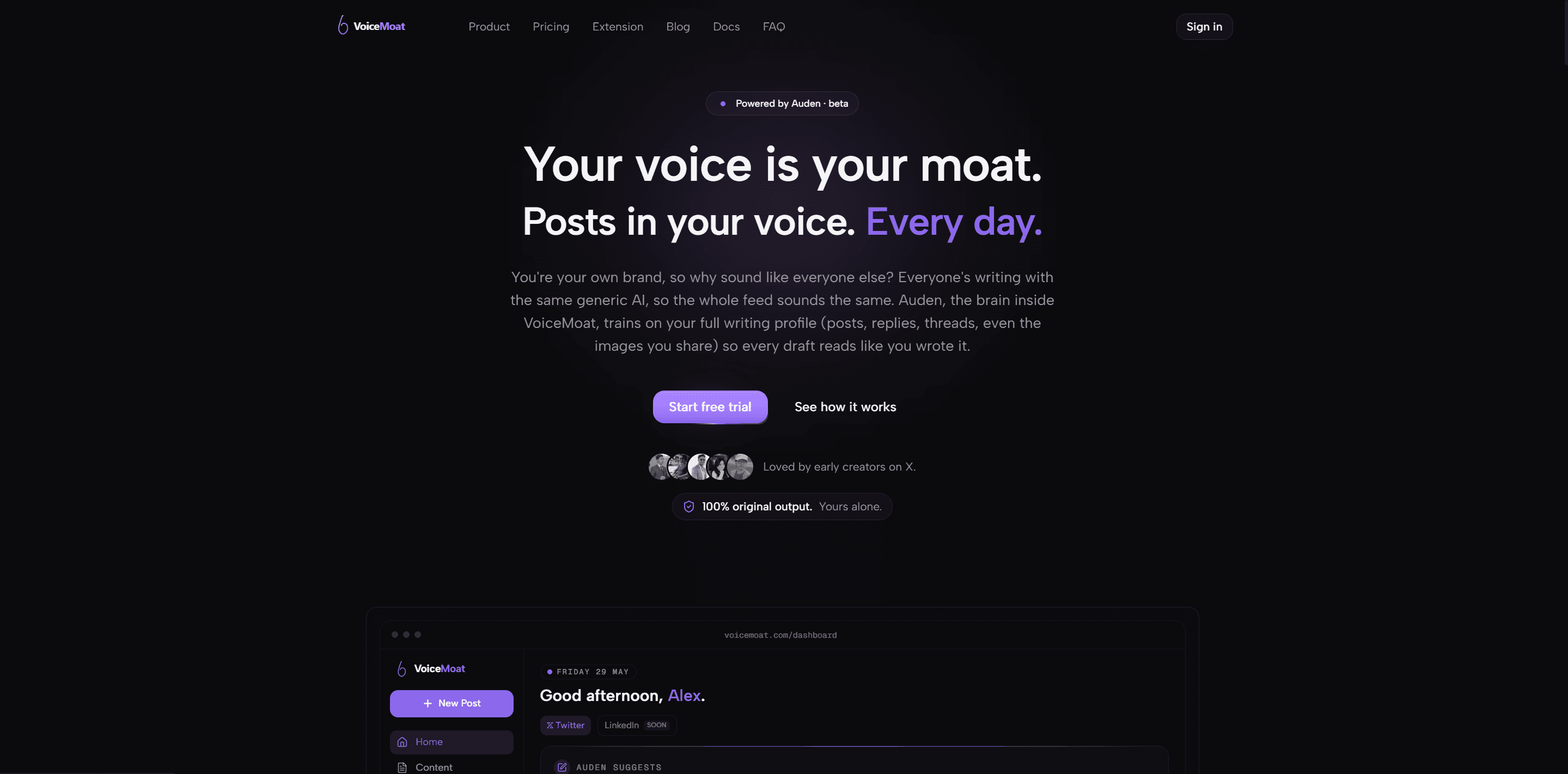
VoiceMoat: built around how you actually write
Disclosure first, since it is our tool: we are putting it in the voice layer rather than at the top of an overall ranking, because the honest claim is narrow, not 'best tool overall.' VoiceMoat is built to solve the voice problem specifically. At its core is audenAI, the brain inside VoiceMoat, which trains on your existing content rather than on a prompt you write at setup. Instead of asking you to describe your tone in an onboarding form, audenAI reads how you already write (your posts, replies, and threads) and builds a model from that, across the 10 signals of voice: cadence, hooks, tone, rhythm, vocabulary, structure, length, openers, references, and sign-offs. The deeper framework is in the 10 signals of voice, and the step-by-step of training it is in how to train AI on your writing style.
The differentiator is measurement. Every draft VoiceMoat generates comes back with a voice match score against your established style, with 80 percent as the ship-ready floor and drafts below it refused rather than handed to you to fix. We are not aware of an equivalent voice-scoring mechanism tied to your own content history in the other tools here, which is what turns authenticity from a gut-check into something you can monitor before you publish. VoiceMoat also covers drafting, queue scheduling, content brainstorming, and a creator-analysis view for studying how others in your space write. It runs from a free plan (one voice profile, with the voice match score included, no credit card) up through paid tiers at $35, $69, and $150 a month as volume and the number of voice profiles you need grow.
Where it falls short, plainly: VoiceMoat covers Twitter and LinkedIn but not visual or audio content. The full LinkedIn tool stack for the other layers is in the best AI tools for LinkedIn personal branding. It is a writing tool, not a visual one, and it does not generate audio. And it models each person's voice individually, so it fits agencies and teams that keep every client distinct (team seats on Enterprise) rather than accounts that want one shared brand voice. If your brand voice is a core business asset and other AI tools have felt generic, it is the most direct fix for that specific problem; if your bottleneck is visuals or audio, the right tool is elsewhere in this list.
ChatGPT and Claude: flexible power tools with a voice gap
ChatGPT and Claude are fast, flexible, and genuinely useful for a personal brand, but the value is in the work before the post, not the post itself. Brainstorming hooks, repurposing long-form content into draft posts, outlining, pressure-testing whether an idea has legs: these are tasks where 'gets me 80 percent of the way there fast' matters more than 'sounds exactly like me,' and both tools excel. Claude's longer context handles feeding in a piece of content and pulling several repurposed angles; ChatGPT's breadth makes it a strong thinking partner.
The gap is voice consistency. Custom instructions and memory help, but they capture your description of your voice, not your voice, and the output settles into a polished, neutral register that sounds competent rather than distinctive. That is a property of a general-purpose model, not a flaw you can prompt away. The full category comparison is in ChatGPT vs specialized AI tools for personal branding, and the head-to-head between the two assistants is in Claude vs ChatGPT for content writing. Use them in your stack as a thinking and drafting layer; do not lead with them if your voice is the asset you cannot afford to dilute.
Jasper: brand-voice settings are not brand-voice training
Jasper is a legitimate content platform, strongest for marketing teams producing branded output at scale, with a deep template library and solid collaboration features. For personal branding it runs into a structural mismatch. Its brand control, now packaged as Jasper IQ (which it describes as an intelligence layer that embeds your brand voice, style guides, and audience profiles into every output), is something you configure, not something it learns from your existing writing. As its own brand voice guide frames it, admins set the rules once and every generation follows them. That can tell you whether a post aligns with the persona you configured; it cannot tell you whether the post sounds like you rather than like your settings. For a multi-contributor team that is a useful guardrail. For a solo creator it is the wrong shape, and the gap tends to surface a few weeks in, once the output sounds like a well-configured profile instead of a person.
The visual layer: Canva
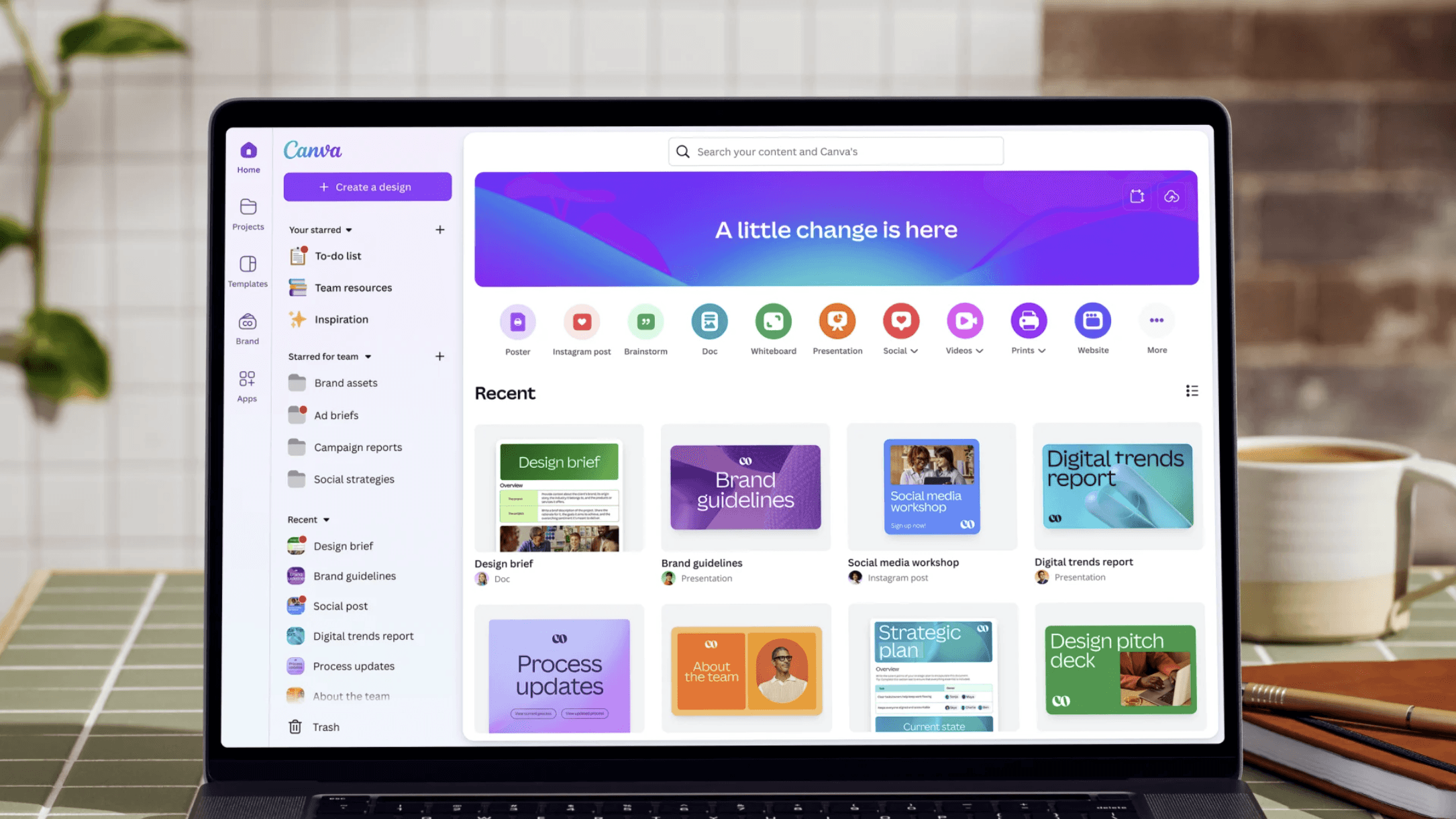
A personal brand in 2026 is not only what you say; it is how your content looks. Canva does not compete with the writing tools here, and that is the point: consistently styled post graphics, banners, and media-kit layouts build recognition that text alone cannot. Its AI-assisted features (Magic Design templates from a brief, background removal, image generation) make visual consistency achievable for someone who is not a designer. The most underused part is the Brand Kit, which stores your colors, fonts, and logos so every design pulls from the same system, turning Canva from a one-off design tool into a visual-consistency system. The free plan is generous; the Pro tier adds Brand Kit depth and more AI features. The strongest solo stack pairs a voice-trained writing tool with Canva: your writing sounds like you, your visuals look like you.
The audio layer: ElevenLabs
If your brand extends into podcasts, audio newsletters, or short-form video with voiceover, ElevenLabs keeps your spoken voice consistent at scale. Its core product is audio voice cloning: you provide recordings, it trains a model, and you generate speech from text in your own cloned voice, with a fast clone built from a short sample and a higher-fidelity option for longer, more consistent content. For creators scripting podcast intros or narrating video, it removes hours of recording time and keeps episode-to-episode delivery recognizable. It is a niche tool with a clear use case: if your brand is entirely text-based, ElevenLabs adds nothing to your stack, so evaluate it on your content format, not general feature appeal. (Audio voice cloning is its own category, distinct from the writing-voice training in the rest of this list.)
The scheduling and distribution layer: Typefully, Hypefury, and Blotato
These tools handle distribution well and voice barely at all, which is fine as long as you use them for the job they are built for. None of them trains on how you actually write, so treat this layer as the one that ships your content, not the one that creates your voice.
Typefully: the cleanest composer and scheduler
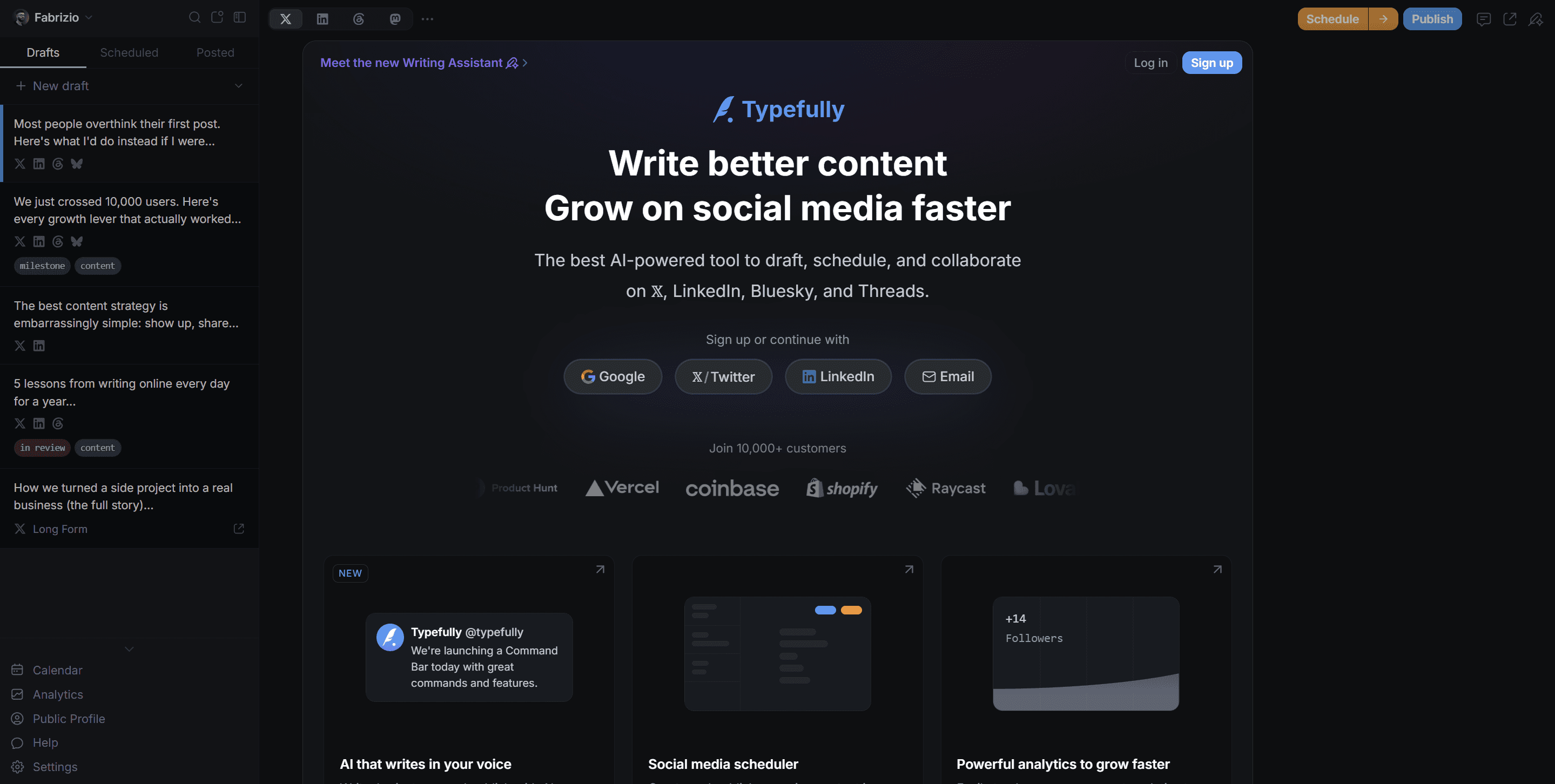
Typefully is the cleanest option for creators who want a distraction-free composer. It started X-first and now publishes to LinkedIn, Threads, Bluesky, Mastodon, and Instagram, with reliable queue scheduling, best-time posting, and performance analytics. Its AI assists with phrasing and thread continuation, which is a drafting aid, not a model of how you write, so the voice work still has to happen somewhere else. If you already read like yourself and just need clean drafting and distribution, it is excellent; the honest head-to-head is in VoiceMoat vs Typefully.
Hypefury: scheduling with built-in auto-engagement
Hypefury is the scheduler for hands-off distribution: auto-reposting to hit prime time, automatic cleanup of those reposts, autoplugs that promote your newsletter or offer under a post that is performing, and auto-DM campaigns, across X, LinkedIn, Threads, Bluesky, Instagram, and more. Its content help is template-and-inspiration based (handpicked viral posts and templates you customize) rather than generation from scratch, and it does not train on your writing. Strong for automation, not for reading like you; the comparison is in VoiceMoat vs Hypefury.
Blotato: a multi-platform creator stack
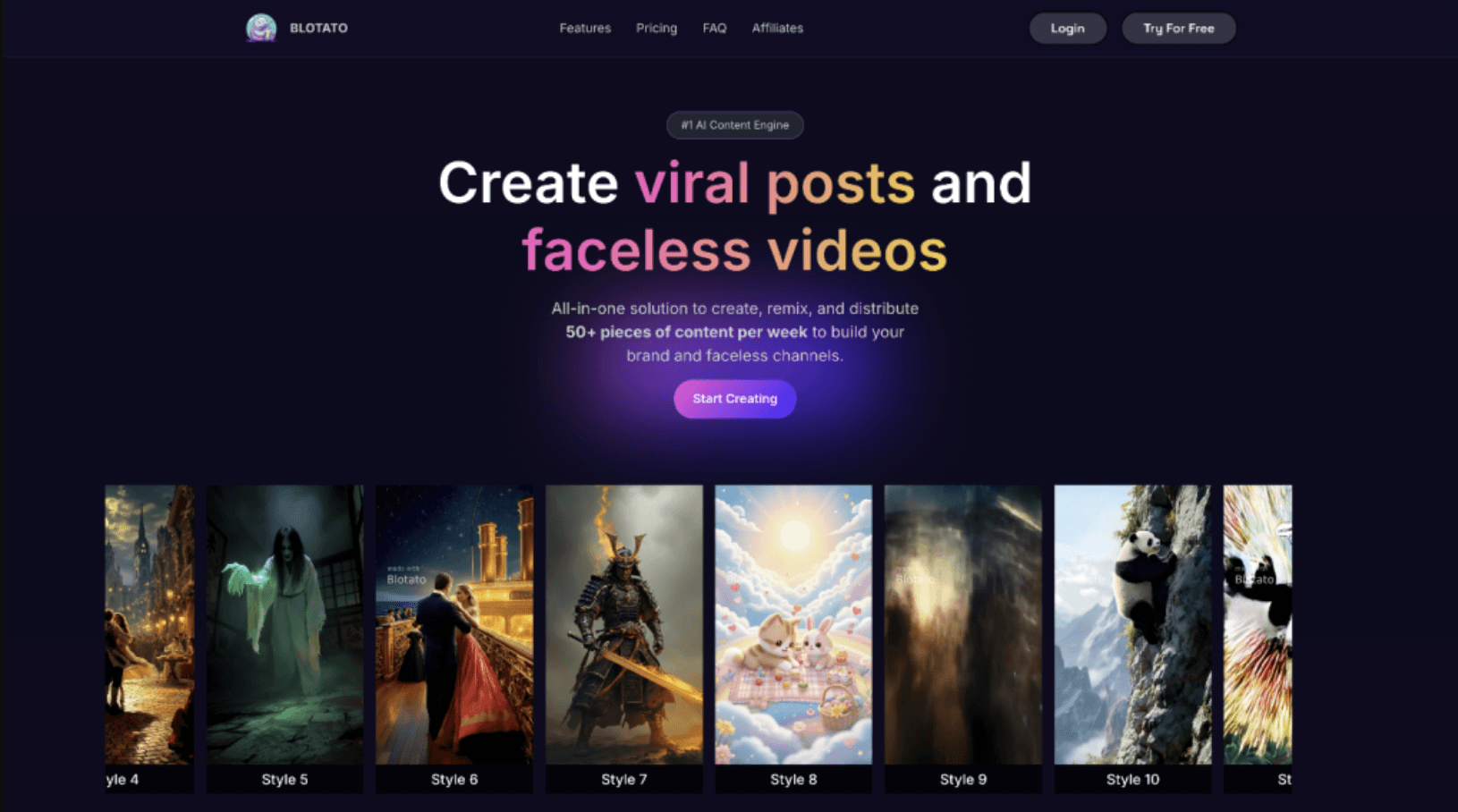
Blotato is the broadest of the three: native publishing to nine-plus platforms (X, LinkedIn, Threads, TikTok, Instagram, YouTube, Facebook, Bluesky, and Reddit), repurposing across formats, carousel and short-video creation, and an AI Coach that grades content against viral patterns. Its writing AI is explicitly fine-tuned on what performs rather than on a generic model, which is a real distinction, but it is the same one Postwise and Tweet Hunter make: trained on viral content, not on your voice. So it is strong for multi-platform reach and weak for sounding like you specifically. The practical combination across this layer: draft and manage voice in a voice-trained tool, then export to one of these schedulers for formatting and distribution.
What separates a personal-branding AI from a generic writing assistant?
After all of the above, the clearest conclusion is not about features. A generic AI writing assistant makes you more productive; a real personal-branding AI makes your output more distinctly you. Those are not the same thing, and treating them as equivalent is why creators end up disappointed by the tool they chose. Volume without voice does not compound into a brand; it just adds more content that sounds like everyone else's. Three capabilities define a genuine personal-branding tool: style training on your actual content history (not a prompt or a settings panel), a way to measure whether a specific draft matches your style before you publish, and output that evolves with your voice over time rather than staying frozen at your initial setup. The fuller framework is in personal brand voice: a framework for creators.
This matters because your brand voice is the one thing a competitor cannot copy. They can write about the same topics, post at the same frequency, and use the same platforms; they cannot replicate the specific way you think and communicate. A consultant who sounds more like themselves in every post builds more trust than one who posts more often in a voice that does not feel like anyone. Trust is the conversion mechanism, and voice is the trust mechanism. Tools that make your voice more distinct over time are compounding assets; tools that push everyone toward the same polished middle quietly do the opposite.
How to build your stack: the first 3 steps
Every tool here is useful for something; the question is which ones map to your situation and which part of your stack is most broken. Whatever you pick, the setup is the same three steps, and the first one is the one most people skip.
- Step 1
Audit your real voice
find two or three posts that sound most like how you actually think, not your most polished ones
- Step 2
Run a 30-day single-platform test
pick one platform, commit to consistent posting with your chosen tool, measure what resonates
- Step 3
Check for drift every two weeks
read five recent AI-assisted posts aloud; if they stop sounding like you, the tool is not learning your voice
The first step is the most important and the least exciting, which is why it gets skipped. Those representative posts are the anchor for everything downstream, whether you are training a voice-trained tool on them or building custom instructions for a general assistant. Without that anchor you are configuring tools against a description of your voice rather than the real thing. For the X-specific deep roundup of writing-and-growth tools, the companion is the 10 best AI Twitter tools in 2026: an honest roundup; for the broader writing-tools comparison (long-form, SEO, marketing copy, and editing tools, not just personal branding), see best AI writing tools in 2026: ranked and compared.
The bottom line
The best AI tool for personal branding is the one that makes your voice stronger, not the one that replaces it. Most tools here are genuinely useful for parts of the stack: Canva for visuals, Typefully for X distribution, ElevenLabs for audio, ChatGPT and Claude for brainstorming and draft speed. None of them address the voice-authenticity problem the way a style-trained, voice-scored tool can. If you are a solo creator, founder, or thought leader building a real brand on X, start with a tool that learns from how you already write. The AI that follows your prompts makes you more productive; the AI that trains on your writing makes your brand more durable, and only one of those compounds. If that is the layer you want to fix first, start with audenAI. audenAI suggests. You decide.