ai and voice
How to tell if AI really writes like you: a 7-test check for LinkedIn and Twitter
·
19 min read
·
By Prateek Singh, founder of VoiceMoat
Key takeaways
To tell if an AI tool really writes like you, test it against posts it has never seen, on topics you have already written about, and judge both how the drafts read and what they say.
Your voice has two halves: style (rhythm, openings, length, words, habits) and stance (the views you hold, the stories you tell, the numbers you would cite). Most "in your voice" claims cover only style.
Seven tests cover it: style read, stance read, made-up details, platform switch, sameness, a blind test with people who know your writing, and whether a fix you make twice sticks.
An AI detector is the wrong tool for this. It guesses whether a machine wrote something, not whether you would have.
Run the same briefs on every tool you are comparing, and write the results down. A free trial is enough time to do it.
To tell if an AI tool really writes like you, test it against your own posts that it has never seen: give it topics you have already written about, then check how its drafts read, what they say, whether anything is made up, and whether people who know your writing can pick yours out. Almost every AI tool for LinkedIn and Twitter now says it writes "in your voice"; almost none shows you how to check, so this guide gives you a test you can run on any of them, ChatGPT and Claude included.
It takes an afternoon, no technical skill, and a few posts you are proud of. (Disclosure: we make VoiceMoat, the Personal Brand OS for LinkedIn and Twitter, which runs two of these checks on every draft. It appears near the end, with its limits. The test itself works on any tool, including ours.)
Why is "in your voice" so hard to check?
Search "AI that writes LinkedIn posts in my voice" and page one is a row of tools making the same promise in slightly different words: writes in your voice, sounds like you, reads like you on your best day. The promise is easy to make because nobody has agreed what it means or how to measure it.
Look at how the tools say they learn you and the methods barely overlap:
Pasted samples. Some ask for 3 to 5 posts, some for 5 to 10.
Your post history. Others connect to your profile and read what you have published, with minimums from 10 posts to 20 or more.
An interview. A few run a short questionnaire about your tone, audience and opinions.
Preset settings. Some let you pick a tone from a menu. One even lets you import another creator's style.
Your edits. A handful say they keep learning from the changes you make.
Then there are the numbers. Product pages show "voice match" percentages in the nineties next to a draft, without saying what was compared, against what, or how. A number you cannot reproduce is decoration.
And there is a quieter problem: most advice tests the wrong thing. "Does it sound human?" is not the same question as "does it sound like me?" A post can read as perfectly human and still be nothing you would ever write. If you want to know whether a tool writes like you, you have to test it against you.
What is your writing voice made of?
Your voice on LinkedIn or Twitter has two halves, and a good test checks both.
Style is how a post reads. It is the part you could measure with a ruler:
how long your sentences run, and how much that varies,
how you open a post (a flat statement, a number, a question, a one-word line),
how long your posts are, and where you break lines,
the words you reach for, and the words you never use,
punctuation, emoji and capital letters,
and the absence of stock AI phrasing.
Stance is what a post says. It is the part only you know:
the views you keep coming back to,
the stories you actually tell,
the numbers you would cite,
the framings you avoid,
and the claims you would never make.
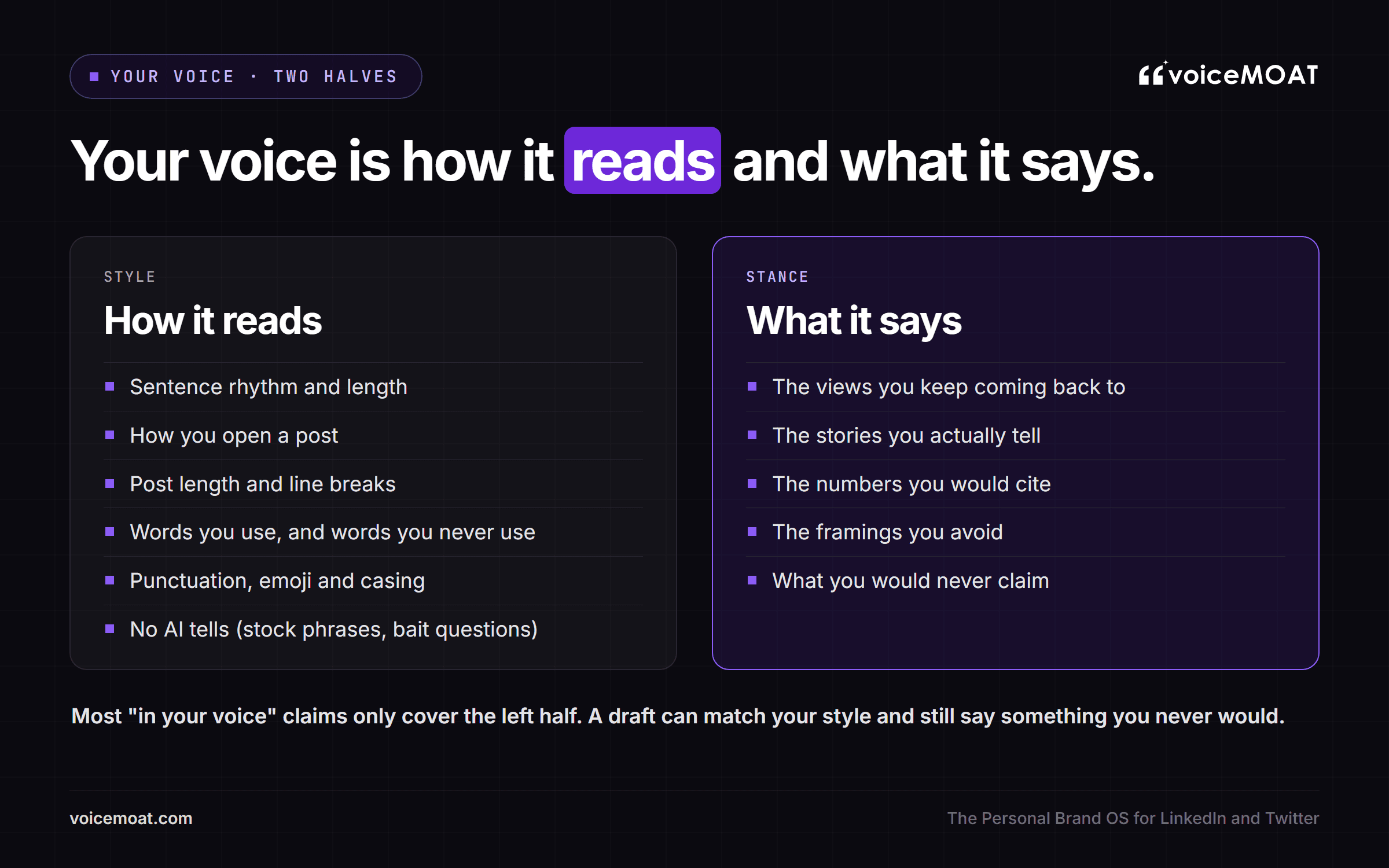
Most "in your voice" claims only cover style.
Most "in your voice" promises cover the first half. Tools copy rhythm, openings and vocabulary well, because those are visible in any sample you paste. Stance is harder, because a sample shows what you said once, not what you believe or what you would refuse to say. That is why a draft can match your style perfectly and still argue the opposite of your view, or tell a story that never happened to you. The people who read you most will notice the second problem long before they notice the first.
There is a third layer: platform. Most people write shorter and sharper on Twitter and fuller on LinkedIn. One averaged voice fits neither. If you want the full list of what makes writing recognisably yours, we keep one here: the 10 signals that make writing unmistakably yours.
Why does AI drift toward the average?
Because that is what these models are built to do. Three findings explain most of what you see in an AI draft.
Chatbots have a house style. A 2025 study in PNAS by researchers at Carnegie Mellon compared chatbot writing with human writing across genres. Instruction-tuned models used present participle clauses at 2 to 5 times the human rate and nominalizations at 1.5 to 2 times, and some versions used words like "tapestry" and "camaraderie" about 150 times as often as people do. The gaps did not close in larger models, and the models did not adjust their style to the context they were writing in (Reinhart et al., PNAS).
Copying one everyday writer is hard, even with samples. In a 2025 study, researchers gave GPT-4o five real samples of a person's writing and asked it to write a new piece in that person's style. An authorship check judged the imitation to be by the same author 95% of the time for news articles, but only 64% of the time for Reddit posts and 19% for blog posts. Giving the model anywhere from 2 to 10 examples changed little, and the imitations kept slipping into a generic tone (Wang et al., EMNLP Findings 2025). Most LinkedIn and Twitter posts are informal, everyday writing, much closer to a blog or a forum post than to a news report.

AI copies formal writing far better than everyday writing. Source: Wang et al., EMNLP Findings 2025.
Prompting does matter. Another 2025 study found that few-shot prompts matched an author's style far better than asking cold, and that the prompting method mattered more than the size of the model. But even its best imitations stayed statistically more predictable than the human writing they copied (Jemama and Kumar, 2025). Pasting samples helps. It does not finish the job.
AI pulls everyone toward the middle. A study of more than 880,000 texts published in Nature Human Behaviour in August 2026 found that rewriting with a language model cut the variation in writing complexity by 21% to 50%, and made the writers' personal traits harder to identify from their text (Sourati et al., via Springer Nature). An earlier study in Science Advances found that stories written with AI ideas were rated more creative, but were also more similar to each other than stories written without them (Doshi and Hauser, 2024).
You can see the result in the feed. Originality.ai classed 81.2% of 5,000 long LinkedIn posts in its July 2026 sample as likely AI-written (Originality.ai); the company sells an AI detector, so read that as a direction, not a precise count. LinkedIn has responded. In May 2026 it said posts that look AI-generated and lack a clear perspective are less likely to be shown beyond your own network (LinkedIn), and members can now mark a post as "Seems like AI slop". In August 2026, LinkedIn's chief product officer said posts it classifies as AI slop now get 40% fewer views than a few weeks earlier (Hari Srinivasan on LinkedIn). LinkedIn's own guidance is plain: AI help is fine, but your post "should still reflect the member's own voice, perspective, and experience" (LinkedIn Help).
Readers are less forgiving still. In a 2026 experiment with 547 people, text written with AI was rated less trustworthy and less authentic, and that held for social media posts as well as work email (Sahebi, Formosa and Bankins, 2026). Reading like everyone else is no longer neutral.
More on why this happens on each platform: why AI LinkedIn posts read the same and why AI tweets read the same.
Before you test: set up a fair test
A fair test needs an answer key the tool has never seen. Without one, a tool can pass by echoing posts you gave it.
Pick your best recent posts on each platform. Recent matters: your voice moves over time, and a tool that copies who you were in 2023 is not writing like you now.
Hold back five per platform. Do not paste them, do not let the tool read them. They are your answer key.
Give the tool everything else it asks for. Samples, profile access, an interview: set it up the way its makers recommend. If you are testing ChatGPT or Claude, set them up properly first; our guide to training AI on your voice covers that.
Write five briefs. One for each held-back post, describing its topic in a sentence, the way you would brief a ghostwriter. Use the same briefs for every tool.
Write two short lists. Five views you hold, in one line each, and five things you would never post: phrases, claims, framings.
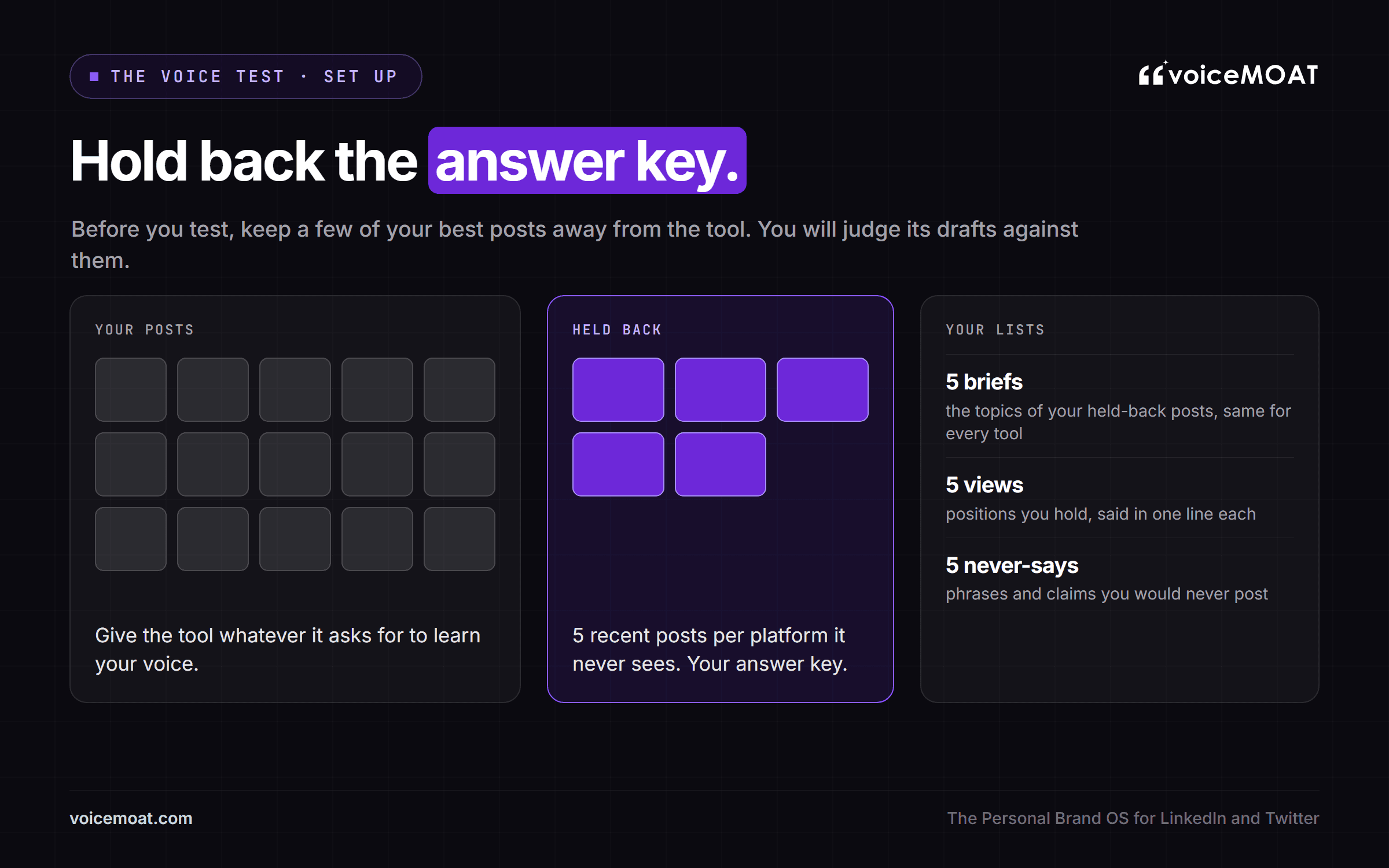
Hold back the answer key: posts the tool never sees.
Keep everything in one document: briefs, drafts, your held-back posts and your notes. You will want to compare tools side by side, and memory is a bad judge after the fifth draft.
The seven tests
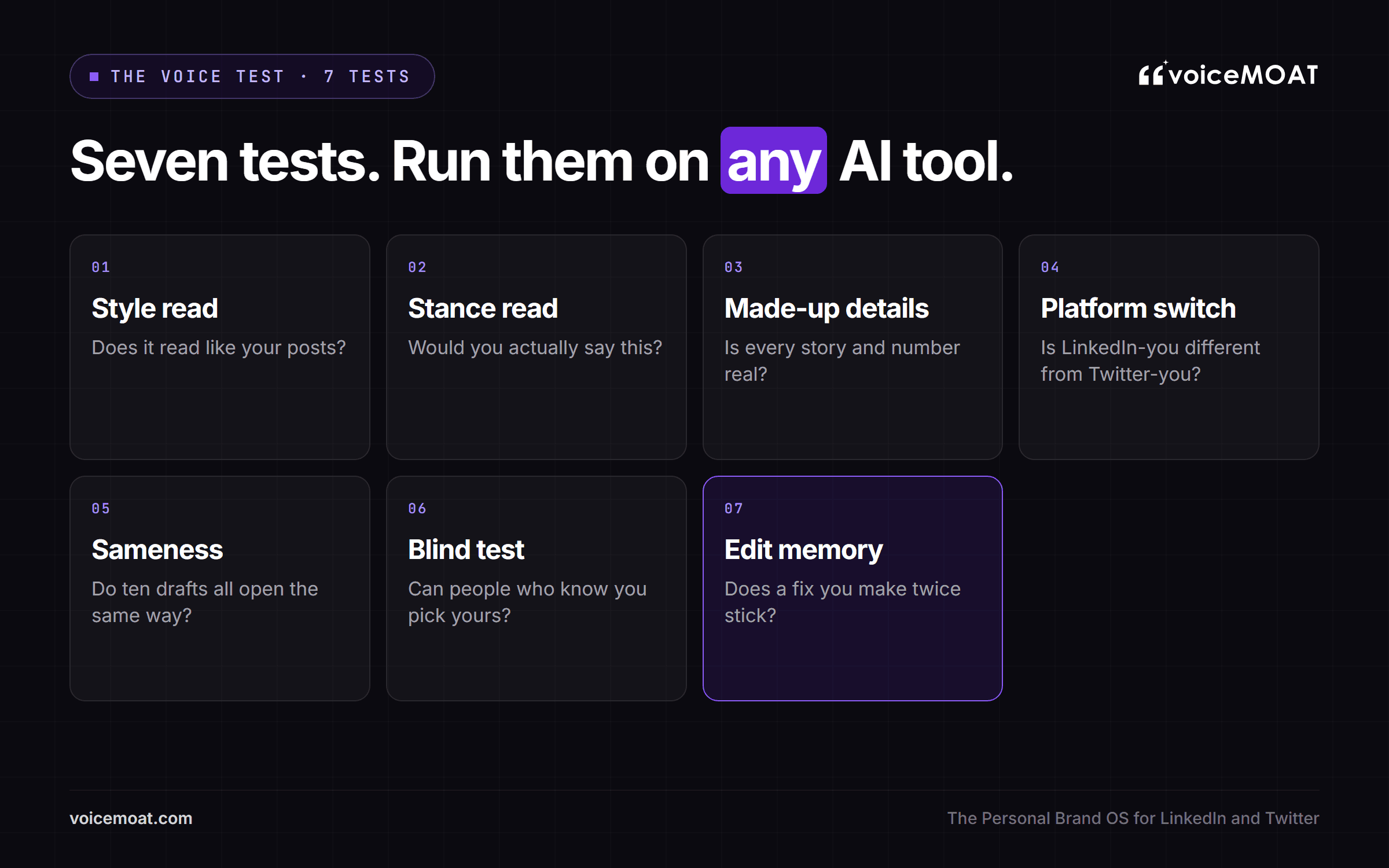
Seven tests you can run on any AI tool, including ChatGPT and Claude.
Run all seven on each tool. Each one checks a different way a draft can fail to be you.
Test 1: The style read
Put each draft next to your held-back post on the same brief and compare habit by habit: opening line, sentence length, post length, line breaks, the words used, punctuation and emoji. Mark each habit as a match or a miss. Then read the draft for stock AI phrasing: the "it's not X, it's Y" turn, the bait question at the end, the tidy list of three, words you have never used in your life.
Pass if most habits match and nothing reads like a stock AI line. If you want a reference list of the usual giveaways, we keep a checklist of AI tells.
Test 2: The stance read
Pick a brief where your view goes against the usual advice in your field: you think cold outreach still works, or that posting daily is overrated, or that hiring for culture fit is a mistake. Ask for a draft without stating your view in the brief.
Then read every line and ask one question: would I say this? A tool that only learned your style will drift to the safe, popular position, because that is what most of the internet says. A tool that learned what you think will take your side.
Pass if the draft takes your position, and no line says something you would argue against.
Test 3: Made-up details
Highlight every story, number, name and date in every draft. Then check each one: did this happen, is the number real and where is it from, is this a person you would name in public, is the date right?

One invented detail is a fail.
This is the test that matters most, because it is the one with consequences. A post that reads slightly off costs you a little attention. A post that tells a story that never happened, or cites a number you cannot source, costs you trust with exactly the people who know you best. AI tools invent specifics to make a post feel personal: the client you lost, the 40% lift, the mentor's advice.
Pass if every story, number, name and date is real, or the tool asked you for it instead of inventing it. One invented detail is a fail.
Test 4: The platform switch
Give the tool one idea and ask for two drafts: a LinkedIn post and a tweet (or a short thread). Compare each with your own posts on that platform.
You are checking two things. First, whether each draft reads like you on that platform, not just the right length. Second, whether one voice leaks into the other: LinkedIn-style throat-clearing in a tweet, or Twitter shorthand in a LinkedIn post.
Pass if each draft reads like you on that platform, and the two differ in the ways your own posts differ.
Test 5: Sameness
Ask for ten drafts on ten different topics. Lay them side by side and look only at their shapes: how each one opens, how it is structured, how it ends.
Your own posts vary. Some open with a number, some with a sentence fragment, some with a question. A tool that has learned one "you" template will reuse it every time: same hook shape, same three-part body, same closing question. The opposite failure exists too: a tool that overplays your quirks until every draft reads like a caricature of you.
Pass if the openings and shapes vary about as much as yours do, and none of the drafts reads like an impression of you.
Test 6: The blind test
This is the closest thing to a real-world verdict. Take five of your held-back posts and five of the tool's drafts on the same briefs. Strip names and dates, match the formatting, shuffle them, and number them.
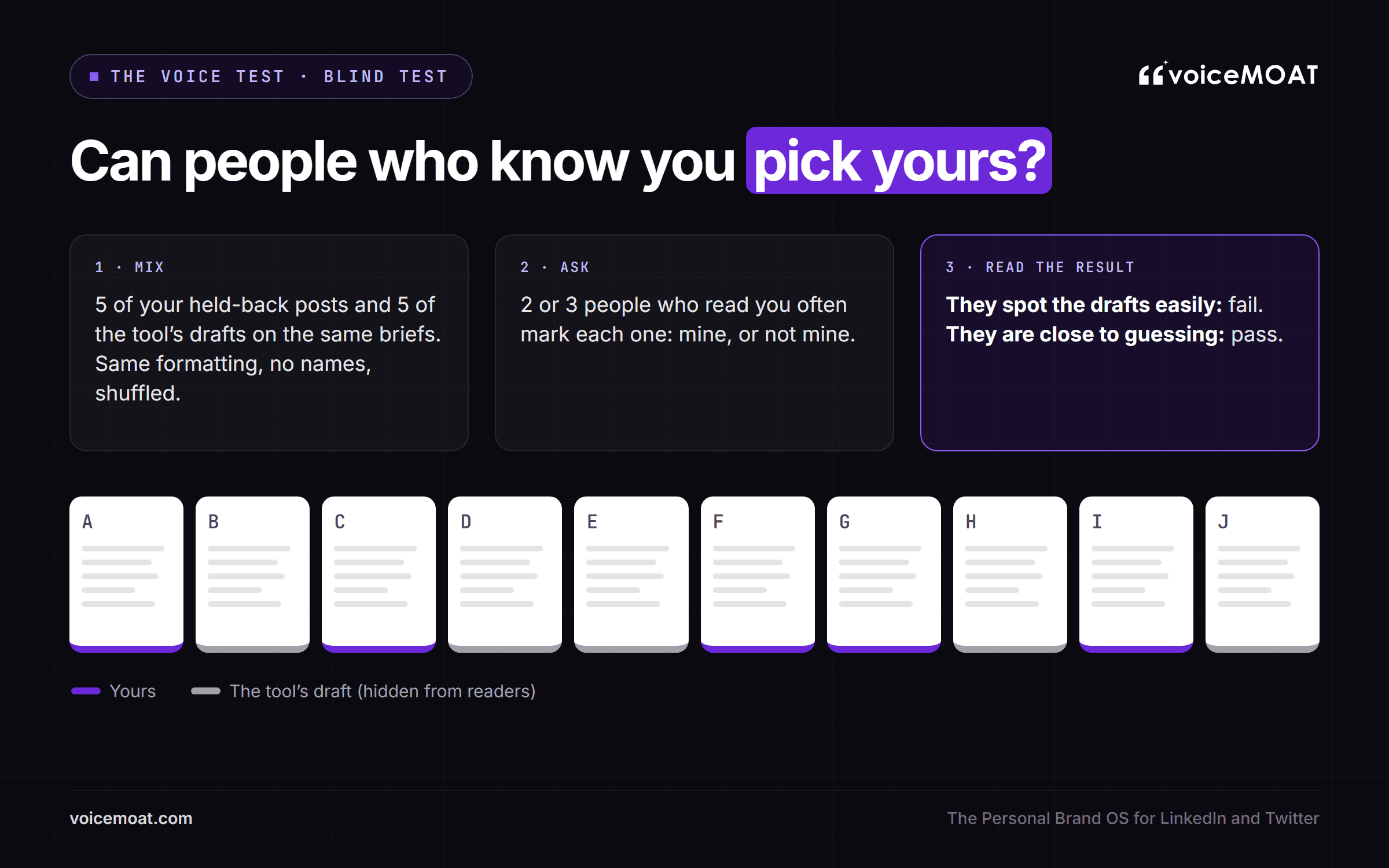
If people who know you are close to guessing, the tool passes.
Give the set to two or three people who read you often: a colleague, a client, a friend who follows you. Ask them to mark each one "mine" or "not mine", and to point to the line that gave each one away.
Pass if they are close to guessing. If they spot the drafts easily, the tool fails, and their reasons ("you'd never say 'unlock'", "you don't do lists") are the most useful notes you will get from the whole test. Strangers are no use here. Of course a stranger cannot tell; the question is whether the people who know your writing can.
Test 7: Edit memory
Many tools say they learn from your edits. Check it.
Ask for a draft, make one specific correction (cut the closing question, swap a word you never use), and save or post it the way the tool expects. Ask for another draft on a different topic and make the same correction. Then ask for a third draft.
Pass if the third draft already has the fix. Then check again in a new session a few days later: a fix that disappears when you open a new chat was never learned.
Score it
Use the same briefs for every tool, and write the results down in one table.
Test | What to do | Pass if |
|---|---|---|
Style read | Compare each draft with your held-back post on the same brief, habit by habit | Most habits match, and nothing reads like a stock AI line |
Stance read | Brief it on a topic where your view goes against the usual advice | It takes your side, not the safe default |
Made-up details | Highlight every story, number, name and date | Every one is real, or the tool asked you for it |
Platform switch | One idea, one draft for LinkedIn and one for Twitter | Each reads like you on that platform |
Sameness | Ten drafts on ten different topics | Openings and shapes vary the way yours do |
Blind test | Shuffle 5 of yours with 5 drafts for people who read you | They are close to guessing |
Edit memory | Make the same fix twice, then ask for a new draft | The third draft already has the fix |
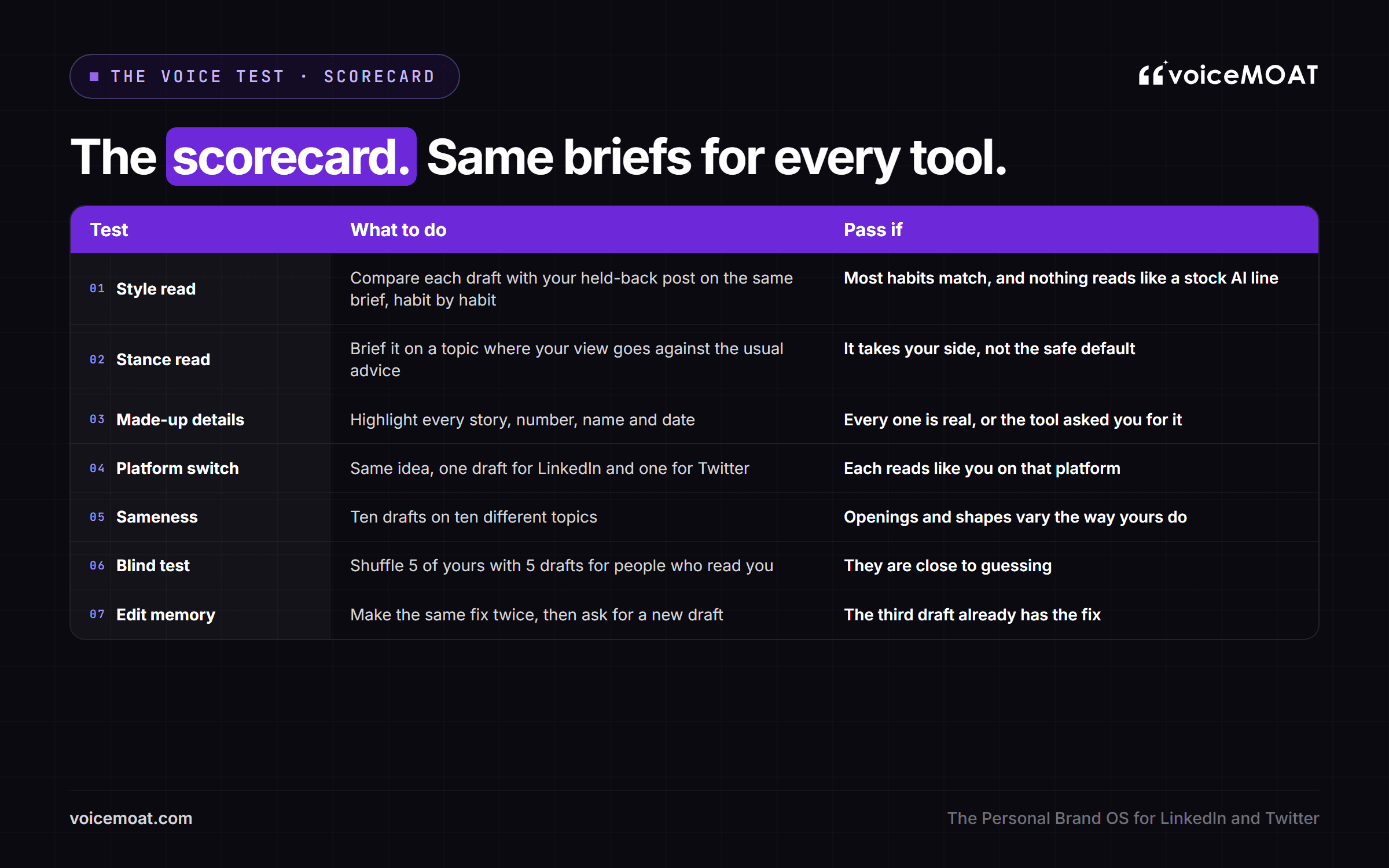
Run the same briefs on every tool you are comparing.
Weigh the results, do not just count them. Failing the made-up details test outweighs passing the other six: a tool that invents stories needs a line-by-line fact check on every draft, which defeats the point. Failing the stance read is next: it means you will be rewriting arguments, not polishing sentences. Style misses are the cheapest to live with, because you can fix them in a minute.
Why an AI detector is the wrong test
It is tempting to paste a draft into an AI detector and take a "human" score as a pass. Do not. A detector answers a different question: whether a piece of text looks like machine writing in general. It knows nothing about you.
People are not much better at that question than detectors are, which is the point. In six experiments with 4,600 participants, people judged whether 7,600 self-presentations, from job applications to dating profiles, were written by a person or by AI. They were right 50% to 52% of the time, about as good as a coin flip. They leaned on cues such as first-person pronouns, contractions and talk of family, which AI can produce as easily as anyone (Jakesch, Hancock and Naaman, PNAS 2023).
Experience changes that. A 2025 study found that people who often use AI to write are strong detectors: a majority vote of five such readers misclassified only 1 of 300 articles (Russell, Karpinska and Iyyer, 2025). That is why the blind test above uses people who read you, not strangers and not software. LinkedIn takes the same view: its chief product officer has said that AI and slop are not the same thing, and that he wants feedback from real people rather than from an AI detector that gets it wrong (Hari Srinivasan on LinkedIn).
A draft can score as human and still be nothing you would write, and your own writing can be flagged. Detectors are useful for one thing in this process: if a draft is flagged, it usually has the generic patterns you were going to catch in the style read anyway. For the full picture, see how AI detectors performed in our tests, or run a draft through our free AI detector.
What ChatGPT, Claude and Gemini actually keep about your writing
If you are testing a general assistant rather than a dedicated tool, it helps to know what each one actually holds on to between chats. From each company's own help pages, read on 16 October 2026:
Assistant feature | What it keeps | Where it stops |
|---|---|---|
ChatGPT custom instructions | One field you write: up to 1,500 characters on Free and Go, up to 5,000 on paid plans | A description of your voice, not your posts |
ChatGPT memory | Can draw on past chats, saved memories, custom instructions and files | OpenAI says it does not keep every detail; ChatGPT decides what is relevant |
ChatGPT projects | Chats, files and instructions kept together; project instructions override your global ones | Only inside that project |
Claude projects | Each project has its own chat history and knowledge base; free accounts can make up to 5 | Only inside that project |
Claude instructions and skills | Instructions for Claude, project instructions, and skills that can apply communication patterns from your own writing | You build and maintain them yourself |
Gemini Gems | A name, instructions and optional knowledge files | From November 2026, Gems on personal Google accounts move to skills |
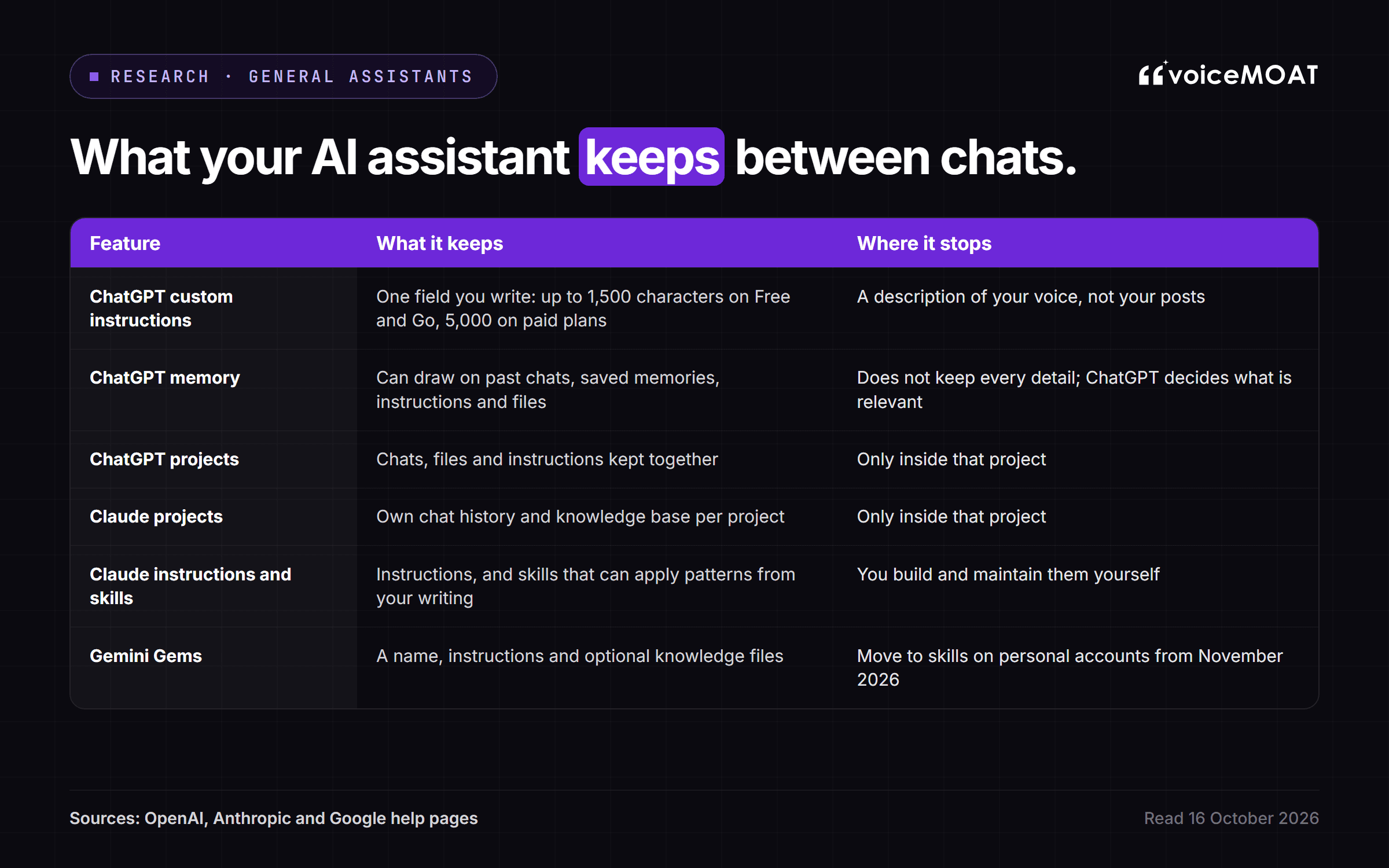
What each assistant keeps between chats, from each company's help pages.
Sources: OpenAI, custom instructions, memory and projects; Anthropic, personalization features and projects; Google, Gems. Claude's separate "styles" help page is no longer online, so check the current options in your own account.
Every one of these can hold a good setup. What you still do yourself: keep a separate setup for LinkedIn and Twitter, write down your views and never-says, check each draft for invented details, and repeat a correction until it sticks. The seven tests tell you how well your setup is working.
Step-by-step setups: make Claude write in your voice and make ChatGPT write like you on LinkedIn.
Red flags when a tool says it writes in your voice
None of these proves a tool is bad. Each is a reason to run the tests above before you trust it:
A match percentage with no definition. Ask what was compared with what. If there is no answer, ignore the number.
It learns your voice from a questionnaire alone. You describing your voice is not your voice. People are poor judges of their own habits.
It offers to copy someone else's style. Useful for practice, but it is the opposite of writing like you.
One voice for every platform. If you write differently on LinkedIn and Twitter, a single profile will average you.
No way to tell it what you would never say. Without that, it will drift to the popular position.
It writes personal stories without asking. If a draft includes an anecdote you never gave it, it made it up.
"Never needs editing." Every draft needs a human read, and any tool that tells you otherwise is selling time it cannot give you.
Your edits go nowhere. If it cannot show you what it learned from your changes, assume it learned nothing.
How VoiceMoat checks every draft
Disclosure again: this is what we build. VoiceMoat is the Personal Brand OS for LinkedIn and Twitter, and audenAI, the AI inside it, learns how you write from your own posts, kept separately for each platform. We built two of the tests above into every draft, because we got tired of running them by hand.
Style is a count of the writing habits a draft matches next to your own posts, such as sentence length, post length, opener style, emoji use, filler words, line shape, AI tells and drift. It shows as "N of M checks match", with a line from your own posts next to any habit that is off. It runs as you type and is free on every plan that trains a voice.
Stance reads each line against your stories and views, a list audenAI builds from your posts and you confirm. A draft comes back On voice, Check one line, or Off voice, with the flagged line underlined and a reason such as "a story you haven't told". It never rewrites anything on its own. A Stance check costs 1 credit.
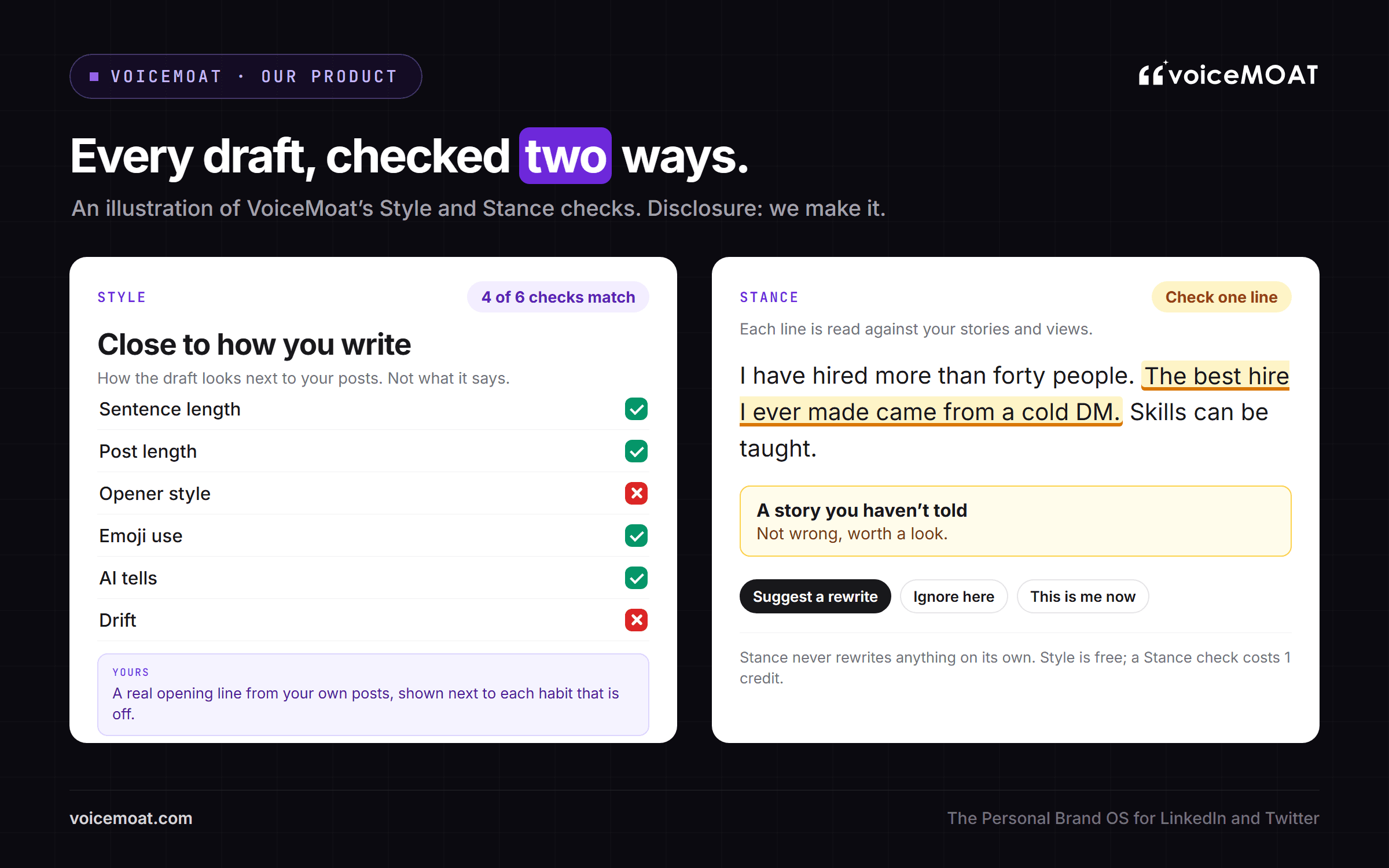
Illustration of VoiceMoat's two checks. Disclosure: we make VoiceMoat.
A few more parts map to the tests above. Personal stories and numbers come from your own list or from what you tell audenAI, and posts and threads drafted in Studio, plus every Growth Autopilot post, are checked for made-up details before you see them; replies are not (test 3). When two of your edits point the same way, audenAI suggests a rule, such as "cut the closing question", which you can keep or dismiss, and it also learns from the drafts you rewrite heavily and what you publish (test 7). At each re-train it reads how you make a point, the references you come back to and your humour, and shows them in Voice Lab's "How you think" card, so you can check its read of your stance yourself (test 2).
What it does not do: replace the blind test. Checks tell you how a draft compares with your posts; only the people who read you can tell you whether it reads like you. Run test 6 on us too. More on how the two checks work: why we check Style and Stance.
The short version
Most tools can copy how you write. Fewer know what you think, and some will invent a story to fill the gap. Hold back a few posts, use the same briefs for every tool, and check style, stance, made-up details, platforms, sameness, a blind read and edit memory. If a tool passes all seven, it writes like you. If it fails the made-up details test, nothing else matters.
Frequently asked questions
Can AI write LinkedIn posts in my voice?
It can come close on style: rhythm, openings, length and word choice are easy to learn from your own posts. Matching what you actually think, and not inventing stories or numbers, is harder and varies a lot by tool. Test it before you post: hold back a few of your posts, brief the tool on the same topics, and compare.
How many posts does an AI need to learn my voice?
Tools ask for anything from 3 to 20 or more. More matters less than range: posts that show how you open, argue, tell stories and end, on each platform you use. Leave out posts someone else wrote for you and posts you wrote with an older AI tool, or it will learn those instead.
Can ChatGPT learn my writing style?
Partly. Custom instructions hold a description of your style (up to 1,500 characters on Free and Go, 5,000 on paid plans), memory can draw on past chats, and projects keep files and instructions together. OpenAI says memory does not keep every detail. In a 2025 study, GPT-4o given five samples of an everyday writer's blog produced imitations judged to be by the same author only about one time in five. Paste real examples, keep them in a project, and test the drafts.
Is there an AI that can mimic my voice?
If you mean your writing voice, yes: several tools learn from your posts, and the seven tests above tell you how close each one gets. If you mean your speaking voice, that is a different technology (audio voice cloning) and not what this guide covers.
How do I make AI writing sound like me?
Give it real material: your own posts, the views you hold, the stories you tell, and a list of things you never say. Then edit its drafts and keep editing the same things until it stops making the mistake. If it never learns, change tools.
Does AI adapt to my writing style over time?
Only if it keeps what you change. Many tools start each session fresh. Run the edit memory test: make the same fix twice and see whether the third draft has it, then check again a few days later.
Can people tell if my LinkedIn post was written by AI?
Strangers often cannot: in a PNAS study, people judged AI-written self-presentations about as well as a coin flip, 50% to 52% of the time. People who use AI a lot, and people who know your writing, notice far more. LinkedIn also lets members mark a post as "Seems like AI slop", and says generic, AI-looking posts are less likely to reach beyond your own network.
Does LinkedIn penalise AI-written posts?
LinkedIn says it judges whether a post adds value, not how it was made. Posts that look AI-generated and lack a clear perspective are less likely to be shown beyond your network, and in August 2026 LinkedIn said posts it classifies as AI slop get 40% fewer views. Using AI to help is fine; the post still has to read like you and say what you think.
Is a voice match percentage reliable?
Only if the tool tells you what it compared and how. A single number usually blends many different things, which is why it can be high for a draft that argues the opposite of your view. Look for checks that show their working: which habit is off, which line, and why.
Should I use an AI detector to check my voice?
No. A detector guesses whether text looks machine-written in general. It does not know you. Use a blind test with people who read you instead.
AI disclosure
Written and fact-checked by Prateek Singh, founder of VoiceMoat. VoiceMoat is the publisher's own product and is disclosed as such; research and statistics are from the sources linked in the article, read on 16 October 2026, and product details reflect VoiceMoat as of October 2026.
Keep reading

Brand
What is a Personal Brand OS? The five jobs it has to do
A Personal Brand OS is one system that runs the five jobs of a personal brand on LinkedIn and Twitter, from one shared memory of how you write and what has worked. What it means, what each job involves, what the platforms allow, and how to tell a real one from a stack of tools.
20 min read
·

AI and Voice
How to train AI to write in your voice: the cross-model guide
You can get ChatGPT, Claude, or Gemini to write in your voice, but only partly and only for one session, because chat models forget your style between chats and never learn from your edits. This is the honest cross-model guide: the analyze-then-write prompts that work, the settings that make them stick, the negative-constraint list that kills the AI tells, and the persistent alternative for anyone who posts regularly.
19 min read
·

AI and Voice
Why Every AI LinkedIn Post Sounds the Same (and How to Break the Pattern)
AI LinkedIn posts sound the same because general models return the statistical average: safe, agreeable, template-shaped English with no memory of how you write. Here is the template, the tells by model, and the durable fix.
18 min read
·

AI and Voice
AI detection tools tested: what Originality.ai, GPTZero, ZeroGPT, Copyleaks, and Winston AI actually catch in 2026
AI detection tools in 2026 are caught between a real use case (catching unedited AI-drafted content) and a real failure mode (false-positive flagging long-form essayists and AI-edited human writing). Originality.ai, GPTZero, ZeroGPT, Copyleaks, and Winston AI each claim high accuracy, each catches a subset of what they claim, and the false-positive problem is the central honest observation. Here is the skeptical-honest read.
10 min read
·

Craft
Voice match score: why VoiceMoat checks Style and Stance instead
A voice match score measures how closely a draft matches the way you write. VoiceMoat used to show it as one 0 to 100 number; now every draft gets two checks instead: Style, how it looks next to your own posts, and Stance, whether it says what you actually say. Here is why one number was not enough, what each check looks at, and how to read them together.
9 min read
·
From the Twitter algorithm series
The Twitter/X algorithm in May 2026: why voice wins under the new transformer
Read ›