
VoiceMoat vs ChatGPT is the comparison that surfaces when a creator who has been using ChatGPT to write their social posts starts to wonder whether a purpose-built tool would do it better. The honest read in 2026 is that the two sit in different categories that get conflated at the writing-the-post layer. ChatGPT is a general-purpose assistant trained to be helpful at everything for everyone. VoiceMoat is a voice-trained writing partner built to draft social content in one specific creator's voice. Both are genuinely good at what they are for. The right answer depends on whether your bottleneck is having a capable generalist on tap, or shipping a consistent, recognizable voice post after post. This piece walks the head-to-head on voice personalization, output quality, ease of use, and long-term brand consistency, with pricing verified as of June 2026. (Named-LLM note: ChatGPT is the explicit subject here. audenAI, the brain inside VoiceMoat, is named as a product, never as a backend model.)
Named-competitor exception applies. ChatGPT and VoiceMoat are the explicit subjects of this comparison. The deeper educational companion, on why a general model cannot hold your voice and what the alternative does differently, is at ChatGPT vs specialized AI tools for personal branding: this page is the branded head-to-head, that one is the mechanism. The sibling comparisons in the corpus are at how Buffer compares on Twitter, VoiceMoat vs Typefully, and VoiceMoat vs Tweet Hunter, and the general-assistant-versus-general-assistant analogue is Claude vs ChatGPT for content writing.
VoiceMoat vs ChatGPT at a glance
Here is the head-to-head before the detail.
| ChatGPT | VoiceMoat | |
|---|---|---|
| Category | General-purpose AI assistant | Voice-trained writing partner |
| How it learns your voice | A prompt or saved memory you write | Trains audenAI on your full profile (100 to 200 pieces, 10 signals) |
| Voice measurement | None | A voice match score on every draft |
| Built for | Everything, for everyone | Social content in your voice (Twitter and LinkedIn) |
| Setup | Open and prompt | Train once, then draft |
| Best at | Breadth: research, code, brainstorming | Drafts that sound like you, held steady |
| Pricing | Free, or $20/mo (Plus) | Free, or $35 to $150/mo |
What ChatGPT actually is (and what it does best)
ChatGPT is the most popular general-purpose AI assistant in the world, and for good reason. It is trained to be helpful across almost any task: research, coding, summarizing, planning, brainstorming, and yes, drafting social posts. Its writing is fluent, clean, and well-structured, and with custom instructions and its Memory feature it can hold some context about you across chats.
Pricing as of June 2026 (per ChatGPT): a genuinely useful Free tier at $0, then Plus at $20 a month for the full feature set, with higher Pro tiers above that. For most creators the relevant choice is Free or Plus.
What ChatGPT is best at: breadth. Nothing in the voice-tool category comes close to its range. If you want one tool that can research a topic, outline a thread, rewrite an email, and debug a script, ChatGPT is the generalist that does all of it. It is also the fastest possible start: there is no training step, you just open it and type.
What ChatGPT is not built for: holding one specific voice. Because it is trained to serve everyone, its default register is a neutral, agreeable average, and a prompt only nudges it for a draft or two before it drifts back. It has no way to measure how close a draft sounds to you. The full mechanism is in ChatGPT vs specialized AI tools for personal branding; the short version is that a prompt describes your voice, it does not train a model on it.
What VoiceMoat actually is (and what it does best)
VoiceMoat is a voice-trained writing partner whose one job is drafting social content in your specific voice. The brain inside it is audenAI, trained on your full profile of 100 to 200 of your own posts, replies, threads, and images across the 10 signals of voice (cadence, hooks, tone, rhythm, vocabulary, structure, length, openers, references, and sign-offs; the canonical reference is the 10 signals of Voice DNA). Because your writing is what audenAI generates from, the default output is your register, not a helpful-assistant average. It also refuses the common AI vocabulary cluster at the model level and surfaces voice-matched reply drafts inline on x.com through its Chrome extension.
Pricing as of July 2026 (verified on voicemoat.com): a Free tier, Creator at $35 a month, Pro at $69 (the most-popular plan), and Enterprise at $150 (the higher-fidelity audenAI Deep tier). Every draft comes back with a voice match score against your baseline, and 80 percent is the ship-ready floor.
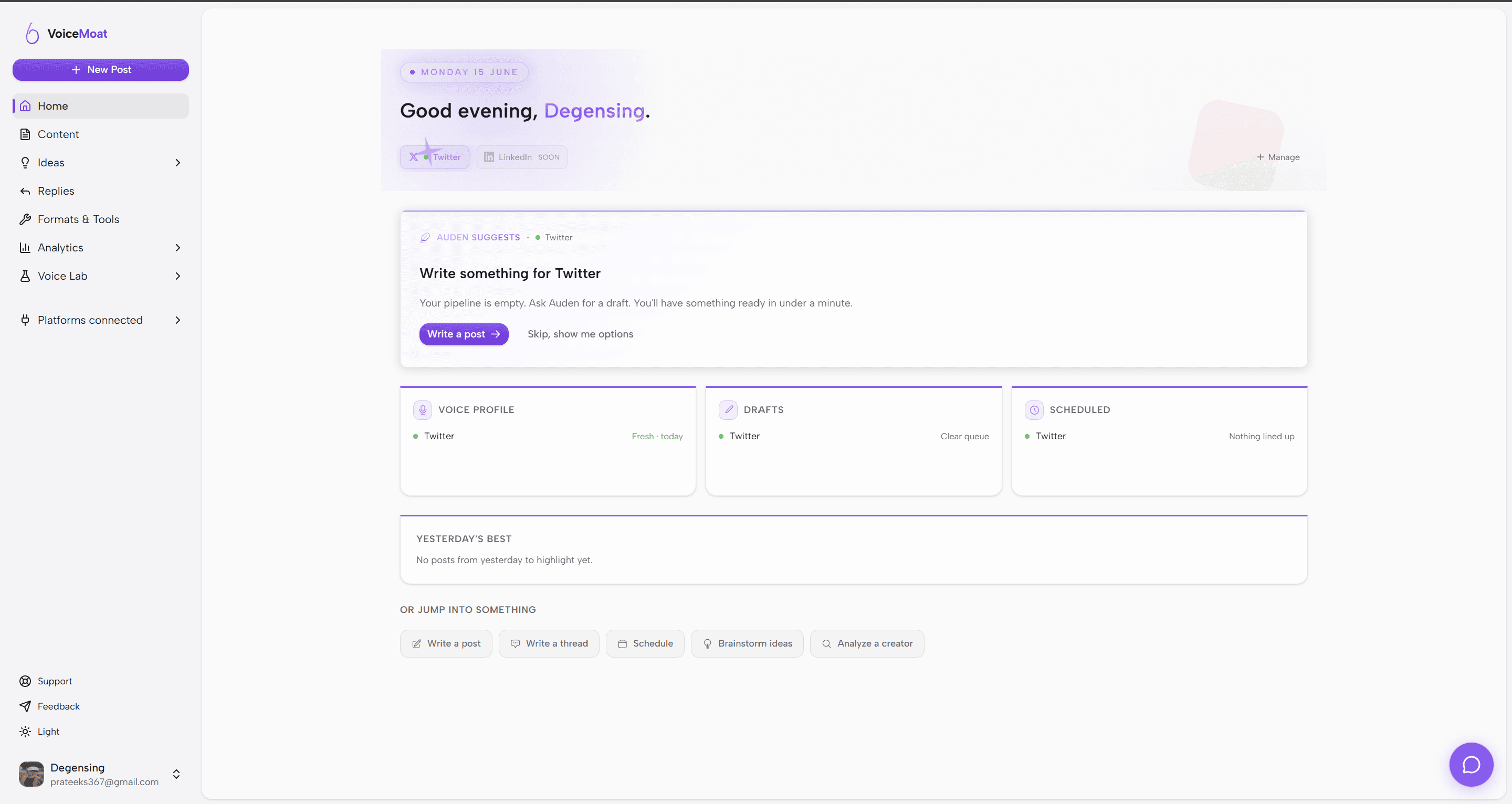
What VoiceMoat is best at: drafting in your voice with measurement. The voice-training depth and the per-draft score are the core product, and they are exactly what a general assistant has no equivalent for. It is focused on Twitter and LinkedIn and individual-creator-first by design.
What VoiceMoat is not built for: being a generalist. It will not write your code, research your competitors, or answer arbitrary questions. It does one thing, voice-faithful social content, and trades breadth for depth on it.
Voice personalization: which sounds more like you?
This is the dimension the whole comparison turns on, and it is the clearest win for VoiceMoat. With ChatGPT, voice personalization means writing a prompt or saving notes in Memory, both of which are descriptions of your voice that the model loosely follows. With VoiceMoat, personalization means a model trained on your actual writing across 10 signals, with a score telling you how close each draft landed. One approximates your voice for a draft or two; the other is anchored on it and measures the result. If your social content has to be recognizably yours, this is the difference that matters most.
Output quality: how good are the drafts?
On raw quality this is closer than the voice gap suggests, and it is fair to say so. ChatGPT writes clean, well-structured, fluent content, and for many tasks that is more than enough. VoiceMoat's drafts are also well-structured, but the quality that counts for a personal brand is not just fluency, it is whether the post reads like you. So the honest read: ChatGPT and VoiceMoat are comparable on structural quality, and VoiceMoat pulls ahead on voice-faithful quality, the kind that makes a reader recognize you before the byline.
Ease of use: which is less work?
Ease of use cuts both ways. ChatGPT is the easier start: there is no setup, you open it and type. But the ongoing workflow is heavier, because you re-supply your voice every session and edit the generic out of every draft. VoiceMoat front-loads the effort into a one-time training step, after which drafting is a short loop: generate, check the voice match score, ship. For an occasional post, ChatGPT's open-and-type is easier. For daily posting, VoiceMoat's train-once-then-draft is the lighter ongoing load.
Long-term brand consistency: which holds up over months?
Over months, this is where the gap widens. ChatGPT has no memory of your voice as a model, so every session starts from the same average and drifts back to it, which means your published voice wobbles unless you police every draft. VoiceMoat generates from a fixed baseline and scores against it, so the voice that ships in January still reads like the voice that ships in June. For a personal brand, where recognition compounds, consistency is not a nice-to-have, it is the entire asset. This is the dimension a general assistant structurally cannot win.
The scorecard
Here is the head-to-head across the four dimensions, scored on a simple 1 to 5 scale.
Voice personalization
Output quality
Ease of use (ongoing)
Long-term brand consistency
- Voice personalization: ChatGPT = 2, VoiceMoat = 5
- Output quality: ChatGPT = 4, VoiceMoat = 4
- Ease of use (ongoing): ChatGPT = 3, VoiceMoat = 4
- Long-term brand consistency: ChatGPT = 2, VoiceMoat = 5
Read it honestly: ChatGPT holds its own on raw output quality and is genuinely easy to start, while VoiceMoat wins decisively on the two dimensions that decide a personal brand, voice and consistency.
Pricing head-to-head
Neither tool is expensive, and price is rarely the deciding factor. Here is the side by side.
| ChatGPT | VoiceMoat | |
|---|---|---|
| Free | $0 (limited daily use) | $0 (1 voice profile) |
| Entry paid | $20/mo (Plus) | $35/mo (Creator) |
| Mid | Not applicable | $69/mo (Pro) |
| Top | Higher Pro tiers | $150/mo (Enterprise, audenAI Deep) |
| What you pay for | General-purpose breadth | Voice training plus a score on every draft |
The number that does not show up on either pricing page is the editing tax. With ChatGPT, the real cost of a voice-faithful post is the time you spend rewriting the generic draft, every post. At low volume that is nothing; at daily volume it is hours a week, which is the cost VoiceMoat is designed to remove.
Who should choose ChatGPT, and who should choose VoiceMoat?
The decision is about fit, not which tool is 'better'.
| Choose ChatGPT if | Choose VoiceMoat if |
|---|---|
| You want one tool for many jobs | You want one tool that nails your voice |
| You post occasionally | You post consistently and voice matters |
| You do not mind editing every draft | You want drafts that need light edits, not rewrites |
| Your personal brand is a side note | Your personal brand is a business asset |
| Breadth is your priority | Recognizable, consistent voice is your priority |
The verdict: which AI wins for social media?
So which AI wins for social media? It depends on the job. For the broad work around your content, research, brainstorming, the occasional post, ChatGPT is the better generalist and a great tool to have open. But for the social content that ships under your name and has to read like you, post after post, VoiceMoat wins, because it is the only one of the two with a trained model of your voice and a score to keep it honest. The shortest version: use ChatGPT to think, use VoiceMoat to read like yourself. In a feed where most content is now machine-written, that is the difference that compounds, because your voice is your moat. If you want to put it to the test, start with audenAI. audenAI suggests. You decide.