Here is the short answer. ChatGPT is a general-purpose assistant that you steer with prompts. A specialized AI tool for personal branding, like VoiceMoat, is a system built around a model of your own writing. For one-off content, ChatGPT is genuinely enough. For a personal brand you post under every day, the gap shows: a prompted assistant reaches for its trained average, while a specialized tool is anchored on your voice and measures how close each draft actually lands. This guide compares the two honestly, on output quality, customization depth, and long-term brand coherence, and it shows exactly where each one wins. (Named-LLM note: ChatGPT, Claude, Gemini, and Grok are named here as the general-purpose tools people actually use. audenAI, the brain inside VoiceMoat, is named as a product, never as a backend model.)
What is a personal brand voice, and why does general-purpose AI flatten it?
Start with what a personal brand voice actually is, because it is the thing this whole comparison turns on. Your personal brand voice is the consistent, recognizable way you write: the words you reach for, the rhythm of your sentences, the way you open and close, the references you make, the jokes you do and do not tell. It is not your topic, and it is not your formatting. It is the texture that makes a post identifiably yours before anyone sees your name. That texture is what compounds into a brand, because recognition is what turns a reader into a follower and a follower into trust.
General-purpose AI is built to flatten exactly that texture. ChatGPT is trained to be a helpful assistant for everyone, which means its center of gravity is a neutral, agreeable, broadly competent register that offends no one and sounds like no one. That is the right design for a general tool and the wrong starting point for a personal brand. When you ask it to write as you, you are pulling against that center of gravity with a prompt, and the moment your instruction loosens, it slides back. This is why so many creators describe the same experience: the AI draft is fine, it is clean, and it is somehow not them. We dug into the mechanics of that sameness in why AI tweets sound the same. If you are picking a single assistant for LinkedIn, the head-to-head is at the best AI assistant for writing LinkedIn posts.
What is the real difference between ChatGPT and a specialized AI tool?
The difference is not the quality of the underlying model. It is what the tool is built around. ChatGPT is general-purpose: it is trained to be helpful at everything, for everyone, which means its default voice is a fluent, agreeable, slightly corporate average. You can push it toward your style with a prompt, but you are steering a general model, not running one that knows you. A specialized personal-branding tool inverts that. It starts from your writing: it reads your full profile, builds a model of your patterns, and generates from that baseline instead of from the internet's average. ChatGPT asks you to describe your voice every session. A specialized tool learns it once. That single architectural difference is what every comparison below comes back to. The same difference, framed as the levels of personalization from a generic prompt to a trained voice model, is in personalized AI content.
A useful way to hold the distinction is renting versus owning. With ChatGPT you rent a voice impression for the length of a prompt, and the lease expires the moment the model's trained average reasserts itself, which is why you re-paste your instructions session after session. With a specialized tool you own a trained model of your voice that persists across every draft, because it was built from your writing rather than borrowed for a conversation. Renting is cheaper and faster to start. Owning is what compounds when the voice is the asset.
Here is the side-by-side at a glance.
| ChatGPT (general-purpose) | Specialized tool (VoiceMoat) | |
|---|---|---|
| Built for | Everything, for everyone | Writing in your voice |
| How it learns your voice | A prompt or saved memory you write | Trained on your full profile (100 to 200 pieces) |
| Voice model | None. Steered at prompt time | A per-user model (audenAI) across 10 signals |
| Consistency | Drifts to its average across a session | Anchored on your baseline every draft |
| Measurement | None. You eyeball it | A voice match score on every draft |
| Setup | Build a prompt, re-paste often | Train once, then draft |
| Cost | Free, or $20/mo for Plus | Free, or $35 to $150/mo |
Can ChatGPT actually write in your brand voice?
Yes, partly, and it is worth being fair about this. With a well-built prompt, custom instructions, and ChatGPT's memory turned on, ChatGPT can produce content that carries your topics, a rough approximation of your cadence, and the structural moves of good writing. People build remarkably detailed systems to get there. If you want the full hands-on method, we wrote it step by step in how to make ChatGPT write tweets in your voice. The honest ceiling, established in that guide, is that prompted voice imitation tops out around 30 to 40 percent of your real voice on the first draft, and it degrades as the session runs.
The reason is structural, not a matter of prompt skill. A pasted sample or a saved instruction is a description of your voice sitting in the context window. It is not the thing the model generates from. Each token ChatGPT writes is sampled from a distribution that is mostly its trained average and only slightly nudged by your examples. So the model can follow your rules for a draft or two, then the average reasserts and the writing slides back to fluent-assistant default. ChatGPT's memory helps it remember facts about you, your niche, your preferences, the topics you cover, but memory stores discrete notes, not a trained model of how you actually write. This is also why the choice between assistants does not fix voice: as Claude vs ChatGPT for content writing found, both drift toward their own trained average, just with slightly different default registers.
What does ChatGPT do better than a specialized tool?
To keep this honest, here is where ChatGPT genuinely wins, because a comparison that pretends the general tool has no advantages is not worth trusting. ChatGPT is a generalist, and breadth is its superpower.
- Breadth: it researches, codes, summarizes, plans, and answers almost anything. A voice-first tool is deliberately narrow by comparison.
- Zero setup: there is no training step, so you can open it and get a usable draft in seconds.
- Cost to start: the free tier is genuinely useful, and Plus is $20 a month for the full feature set.
- Flexibility: when you deliberately want to write in a register that is not your usual voice, a general model is easier to push around.
None of that is in dispute, and if breadth is what you need, ChatGPT is the better buy. The case for a specialized tool is not that ChatGPT is weak. It is that breadth and voice consistency are different jobs. The tool built to do everything is not the tool built to sound like one specific person, post after post, and personal branding is the second job, not the first.
Why does a saved ChatGPT prompt still drift back to generic?
To see why, look at what people actually do. A popular community prompt on r/ChatGPTPromptGenius turns ChatGPT into a 'Twitter content strategist': a full framework for hooks, body structure, formatting, CTA placement, and engagement psychology. It is genuinely good work, and it is exactly the kind of mega-prompt creators paste in to sound less generic. Here is the user journey it produces.
- Step 1
Find a mega-prompt
a framework like the r/ChatGPTPromptGenius 'Twitter strategist'
- Step 2
Customize it
answer its questions: topic, audience, tone, length
- Step 3
Generate a draft
structured, but in the model's default voice
- Step 4
Rewrite by hand
spot the tells, cut clichés, add your voice back
- Step 5
Save it to memory
and hope it sticks next time
- Step 6
It drifts back
the average reasserts, so you repeat the loop
Notice what the prompt optimizes: structure. Hook templates, line breaks, where to put the link, how many emojis. Those are rules, and ChatGPT follows rules well. What the prompt cannot supply is the part that makes writing recognizably yours. The clearest evidence is that the prompt's own author says so. In the post's own words, the framework is explicitly not 'a replacement for genuine insights' and not 'a shortcut that eliminates the need for your unique voice'; it gives you the structure, and you provide the substance (r/ChatGPTPromptGenius). That is the whole point. A prompt is a set of instructions about writing. Your voice is a pattern across everything you have already written.
This is where the 10 signals matter. A specialized tool does not prompt a general model with rules. It trains a model of you across the measurable dimensions of voice: cadence, hooks, tone, rhythm, vocabulary, structure, length, openers, references, and sign-offs, read across your Voice DNA. A prompt can name a couple of those. It cannot reproduce them, because they live in the statistical texture of your actual writing, not in a paragraph of instructions. Here is what each approach can and cannot carry.
| What a saved prompt encodes (rules) | What audenAI's 10 signals capture (you) |
|---|---|
| Hook templates, line breaks, CTA placement | Your cadence, rhythm, and sentence length |
| 'Avoid clichés' and 'be authentic' instructions | Your actual vocabulary and references |
| The same framework everyone who copies it gets | A model trained on your 100 to 200 pieces |
| No measure of whether the draft sounds like you | A voice match score on every draft |
Put simply: a prompt makes ChatGPT's average sound more structured. It does not make it sound like you, and saving it to memory does not change that, because memory stores the instruction, not a model of your writing. The drift is not a bug you can prompt your way out of. It is the cost of starting from a general model instead of from your own profile.
Why is generic AI content now a brand liability?
Even if a prompted ChatGPT got you to a passable generic draft, generic is no longer a neutral outcome. It is a competitive problem, because almost everyone now has the same tool producing the same shapes. The adoption numbers make that concrete.
Zoom out from marketers to the open web and the saturation is just as clear. A Graphite study of 65,000 articles found that 52 percent of new web articles are now AI-generated, with AI-written pieces first overtaking human-written ones in late 2024 (a result Axios reported the same week). Originality.ai's ongoing study puts AI-generated content at roughly 17 percent of Google's top 20 results. When the median piece of content is machine-written and machine-shaped, the writing that stands out is the writing that is unmistakably one specific human. Sounding like the AI average is not safe anymore. It is how you disappear. We made the fuller case in authenticity as a moat and tracked the platform shift in the state of AI content on X in 2026.
What does generic AI content actually look like?
It helps to see the difference, not just describe it. Here is a constructed example, not lifted from anyone's real posts, of the same idea written two ways: the generic AI default, and a voice-matched version. Watch the texture, not the topic.
In today's fast-paced digital landscape, building a personal brand is more important than ever. Here are five game-changing tips to elevate your presence and unlock your full potential. Consistency is key. Authenticity matters. Engage with your audience. Provide real value. Stay true to yourself. Remember: your brand is your story.
· Generic AI default (constructed example)
I spent two years posting into the void before anything clicked. The thing that changed it: I stopped writing like a brand and started writing like the person my friends actually text. One specific story beats five tips every time. Nobody has ever screenshotted a listicle.
· Voice-matched (constructed example)
Same topic, opposite texture. The first is fluent, well-structured, and forgettable: it could have come from anyone, because it came from the model's average. The second is specific, has a point of view, and carries a cadence you could pick out of a feed. A prompt can push ChatGPT toward the second version, but it is fighting the pull toward the first the whole way, and it loses a little more of that fight with every draft in the session. A tool trained on your writing starts from the second version, because the second version is what your profile looks like. If you want the field guide to the tells in that first paragraph, we cataloged them in the words AI overuses.
How do specialized tools keep your brand voice consistent?
A specialized personal-branding tool solves the drift problem by changing what the model generates from. Instead of prompting a general model and hoping your instructions outweigh its average, it trains on your full profile and makes your writing the baseline. Here is what that journey looks like, and why it does not loop.
- Step 1
Train audenAI once
your full profile, 100 to 200 pieces, 10 signals
- Step 2
Draft in your voice
generated from your baseline, not the average
- Step 3
Voice match score
every draft scored, 80% is ship-ready
- Step 4
Ship
no mega-prompt to re-paste next time
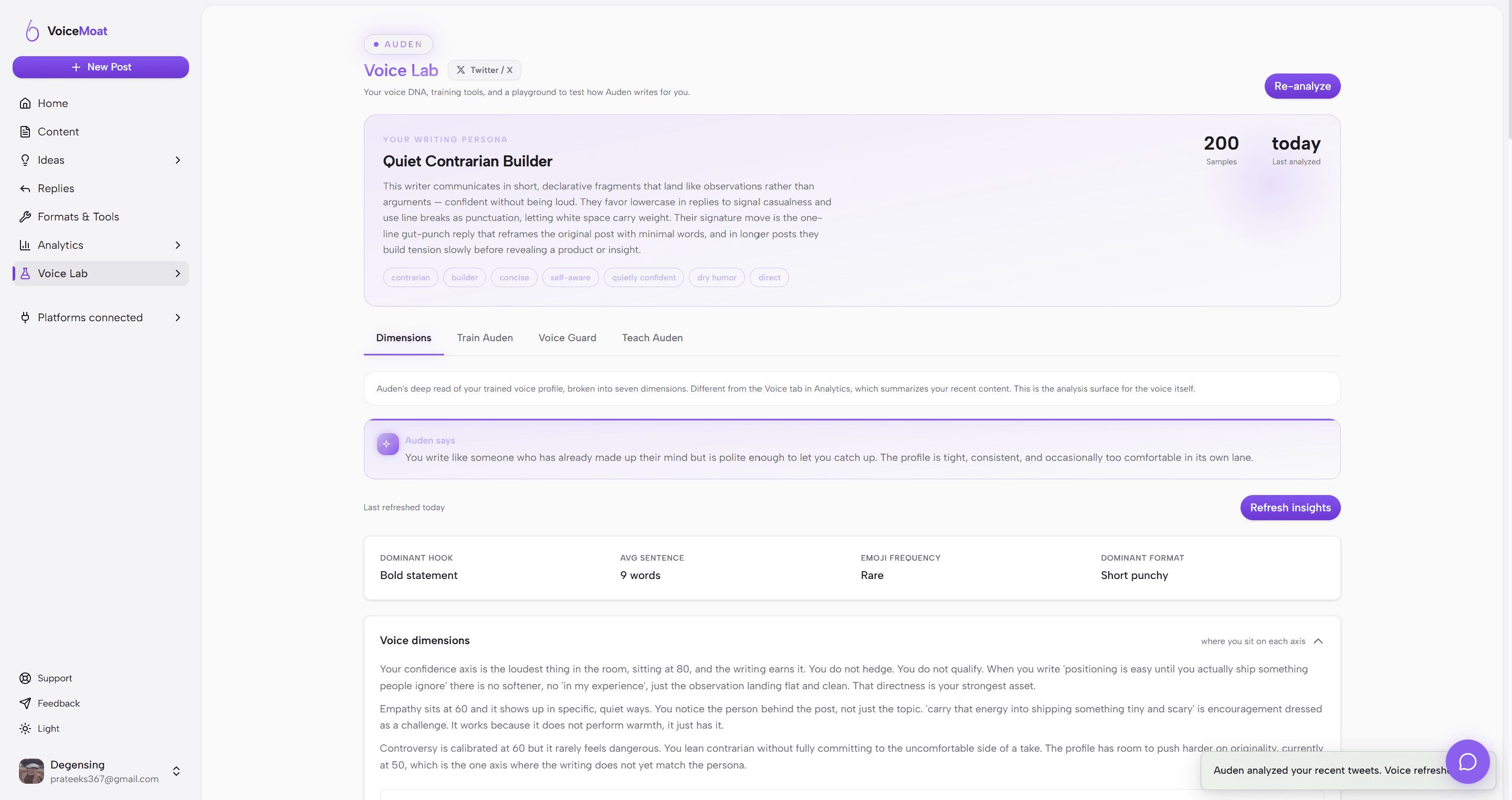
Three things make this hold where a prompt cannot. First, audenAI, the brain inside VoiceMoat, is anchored on your profile, so your voice is what it generates from rather than a description it was handed. Second, every draft comes back with a voice match score against your baseline, so the gap ChatGPT leaves you to eyeball is measured on the page, and drafts below your floor are refused at the model level instead of handed to you to fix. Third, the common AI tells (the over-used vocabulary, the symmetric hooks, the em-dash signature) sit on a taboo list by default. This is voice training on your own writing, not voice cloning, and not a general model wearing a costume. If you want the technical version of how that training works, it is in how to train AI on your writing voice.
How many of your posts does it take to learn your voice?
A reasonable question at this point: if the whole advantage is full-profile training, how much writing does that take? The honest answer is that it works on what you already have. VoiceMoat trains audenAI on 100 to 200 of your existing pieces, your posts, replies, threads, and the images you share, which is a body of writing most active creators have produced without ever thinking of it as training data. You are not writing new samples for the tool. You are pointing it at the back catalog you already published. That is the opposite of the ChatGPT approach, where you paste a handful of examples into a prompt and the model sees a thin slice. A few examples describe your voice. A few hundred pieces define it, which is exactly why one drifts and the other holds. The richer the profile, the more stable the baseline, and because the training is a one-time step rather than a per-post chore, the cost is paid once. If you want the mechanics, how to train AI on your writing voice walks through it.
ChatGPT vs a specialized tool on quality, customization, and coherence
The brief for this comparison is three dimensions: raw output quality, how deeply you can customize, and whether your brand voice stays coherent over months. Here is an honest read on each, scored on a simple 1 to 5 scale for the two approaches.
Output quality (structure)
Customization depth (your voice)
Long-term brand coherence
Measurement of voice match
Set-and-forget consistency
- Output quality (structure): ChatGPT (general) = 4, Specialized tool (VoiceMoat) = 4
- Customization depth (your voice): ChatGPT (general) = 2, Specialized tool (VoiceMoat) = 5
- Long-term brand coherence: ChatGPT (general) = 2, Specialized tool (VoiceMoat) = 5
- Measurement of voice match: ChatGPT (general) = 1, Specialized tool (VoiceMoat) = 5
- Set-and-forget consistency: ChatGPT (general) = 1, Specialized tool (VoiceMoat) = 4
Read it honestly. On raw structural quality, ChatGPT is genuinely strong: it writes clean, well-formatted content, and a good prompt makes it better, which is why both approaches score well there. Where it falls away is everything downstream of structure. Customization stops at description, because you cannot hand it a model of your voice, only notes about it. Long-term coherence suffers because every session starts from the same average and drifts. And there is no measurement at all: ChatGPT cannot tell you how close a draft sounds to you, so you cannot manage what you cannot see. A specialized tool trades nothing on structure and wins on the dimensions that compound for a personal brand: your actual voice, held steady, and measured.
What does each approach really cost?
Price is the easy part of the cost; the editing tax is the part people forget. On subscription alone, ChatGPT Plus is $20 a month, and VoiceMoat runs from free to $35, $69, or $150 a month depending on volume and how many voice profiles you need. But the real cost of the ChatGPT route is not the $20. It is the per-post editing tax: the time you spend on every single post rewriting a generic draft into your voice, plus the time spent maintaining and re-pasting the mega-prompt. At one or two posts a week, that tax is trivial, and ChatGPT is the cheaper choice outright. At daily volume it compounds into hours a week, and those hours are exactly what a trained, scored tool is built to give back. So the honest comparison is not subscription versus subscription. It is your subscription plus your editing time versus a subscription plus much less of it.
Does using ChatGPT for content hurt your reach or get you flagged?
This is the fear underneath the question, so it is worth answering directly. Platforms do not reliably detect AI text and penalize it on sight; that is not how reach works. What does affect you is the audience. Generic, machine-shaped content earns less attention because readers have learned the shapes and scroll past them, and X has openly experimented with labels and prompts around AI content. So the risk is not a secret algorithmic penalty for using AI. It is the visible, compounding cost of sounding like everyone else: lower engagement, weaker recognition, and a slower climb. Using a tool is not the liability. Shipping the average is. We went deeper on whether readers can tell in can your audience tell you are using AI.
When is ChatGPT the right choice, and when do you need a specialized tool?
This is not an argument that ChatGPT is bad. For a lot of people it is the right tool, and the honest version of this comparison says so plainly.
| Choose ChatGPT if | Choose a specialized tool if |
|---|---|
| You post occasionally, not daily | You post consistently and volume matters |
| You enjoy the editing pass and treat AI as a sparring partner | You want drafts that need light edits, not rewrites |
| Your personal brand is a side note | Your personal brand is a business asset |
| You mostly need brainstorming and reformatting | Voice consistency at scale is the point |
| You do not mind re-prompting every session | You want to train once and stop prompt-engineering |
The dividing line is whether voice is your audience-facing asset. If it is not, prompt ChatGPT and keep your money. If it is, the per-post editing tax and the constant drift start eating the hours the tool was supposed to give back, and that is the moment a trained, scored, voice-first system pays for itself. If you want to pressure-test that for your own case, evaluating VoiceMoat in 3 days is a structured way to do it, and the wider field is mapped in our honest roundup of the best AI tools for X in 2026. You can also keep both: many people brainstorm in ChatGPT and draft for real in a voice-first tool. For the direct, branded version of this decision, the head-to-head is at VoiceMoat vs ChatGPT.
Isn't a specialized tool just ChatGPT with extra steps?
It is a fair question, and the answer is no, for a specific reason. A specialized tool is not a general assistant you prompt with a longer set of instructions. It is built around a per-user voice model, a scoring system, and quality gates that a chat interface does not have. The difference is not how many steps sit between you and a draft; it is fewer steps, because the voice work happens once at training time instead of every session at prompt time. ChatGPT asks you to re-supply your voice as context, forever. A specialized tool holds it as a model and measures every draft against it. That is a different category of product, not the same product with a wrapper. And to be explicit, because the brand rule matters: this is about general-purpose assistants versus a purpose-built system, so audenAI is named as a product here, never as a backend model.
Will it sound like me, or like a copy of me?
One more worry worth naming, because it is the flip side of the whole pitch: if a tool trains on your writing, does it just clone you into something static and a little uncanny? No, and the distinction matters. Voice training is not voice cloning. A clone tries to reproduce fixed outputs; a voice model learns your patterns, the cadence and vocabulary and structure underneath your writing, and drafts new content that moves the way you move. You stay in the loop: audenAI suggests, you decide, you edit, and the model updates as your writing evolves, so the baseline does not freeze in the past. It is the difference between a tool that impersonates you and a tool that writes alongside you. The point was never to take your hands off the keyboard. It was to stop fighting a general model's average every time you sit down to post.
The bottom line
ChatGPT is a capable, general-purpose writing assistant, and for occasional content it is more than enough. But personal branding is not occasional content. It is the same voice, held consistent, post after post, until your audience can recognize you in a single line without your name attached. That is precisely what a prompted general model cannot deliver, because it generates from its average and drifts back to it, and it is exactly what a specialized tool is built for: trained on your full profile across 10 signals, drafting from your baseline, and scoring every draft for voice match. Use ChatGPT to think. Use a voice-first tool when the voice is the point. Because in a feed where most content is now machine-written, your voice is your moat. If you want to put a specialized tool to the test, start with audenAI. audenAI suggests. You decide.