The short version
LinkedIn replaced the model that ranks the Feed. A transformer sequential ranker took over from a DCNv2 ranker across the majority of Feed traffic, published February 2026.
‼️ The 150-billion-parameter model widely blamed for the reach collapse was never deployed. LinkedIn's head of Feed AI: "Is 360Brew used as part of your ranking system? Short answer: No!"
Hashtags do not affect distribution, and LinkedIn has said so in one sentence: "Nope! Hashtags do not impact distribution so no need to include them."
The link penalty attaches to the preview card, not to links. Across 566,957 posts, an attached card had 414 median impressions against 858 for a plain URL in the post body and 786 for no link at all.
‼️ Putting the link in the first comment has never been measured. The largest study says outright that it did not measure it.
The best time to post is unknown. Six large datasets disagree, two of them naming the same days as both best and worst.
LinkedIn publishes no "see more" truncation point, so the familiar 210 and 140 character figures are not LinkedIn's.
‼️ Whether editing a post hurts reach is unpublished in both directions, and this page says so rather than guessing.
How to read this page. LinkedIn does not open-source its ranking, so unlike a page about an algorithm you can read, this one cannot check every claim against a file. Instead every answer below carries an evidence grade, and the grade is the point. ‼️ Where nothing has ever been published, the answer says so instead of borrowing a number from a guide that invented one. Five of the eleven answers rest on a precise absence in LinkedIn's own documentation.
The evidence grade printed under every answer on this page. Read the grade before you act on the answer.
Grade | What it means | How far you should trust it |
|---|---|---|
A | LinkedIn's own published research, or an on-record statement from a named LinkedIn executive | The strongest evidence available about LinkedIn anywhere |
B | LinkedIn's own product or policy documentation | Authoritative on what the product does, silent on ranking effects |
C | Third-party measurement with a stated sample size and date | Real data about that sample, not a platform law |
D | Widely repeated, never sourced by anybody | ‼️ Treat as folklore, and note that we say so |
Why are my LinkedIn impressions going down?
Most likely because the ranking system changed, not because your posting did. In February 2026 LinkedIn published that a transformer sequential ranker replaced its previous DCNv2 ranker across the majority of Feed traffic. It reads each viewer's interaction history rather than leaning on who follows whom, so follower count predicts distribution less than it used to.
The paper states the new ranker has been "serving the majority of LinkedIn's Feed traffic for over three months" at a scale of 1.2 billion members.
LinkedIn measured its own gain against the model it replaced as +2.10% time spent and +3.52% likes, comments or reshares. ⚠️ Those are platform-wide figures, not per-creator ones, and they say nothing about what happened to any individual account.
‼️ LinkedIn has published no figure for how much any individual's reach changed. Every "reach is down 47%" number in circulation comes from private vendor datasets that readers cannot open, not from LinkedIn.
LinkedIn's VP of Product Management describes it as ordinary variance: distribution and reach "naturally fluctuate based on what you're posting, things like the topic, timing, format, and even what your audience is engaging with that day".
LinkedIn also states it does "not factor in gender, age or other demographics of the poster into content ranking".
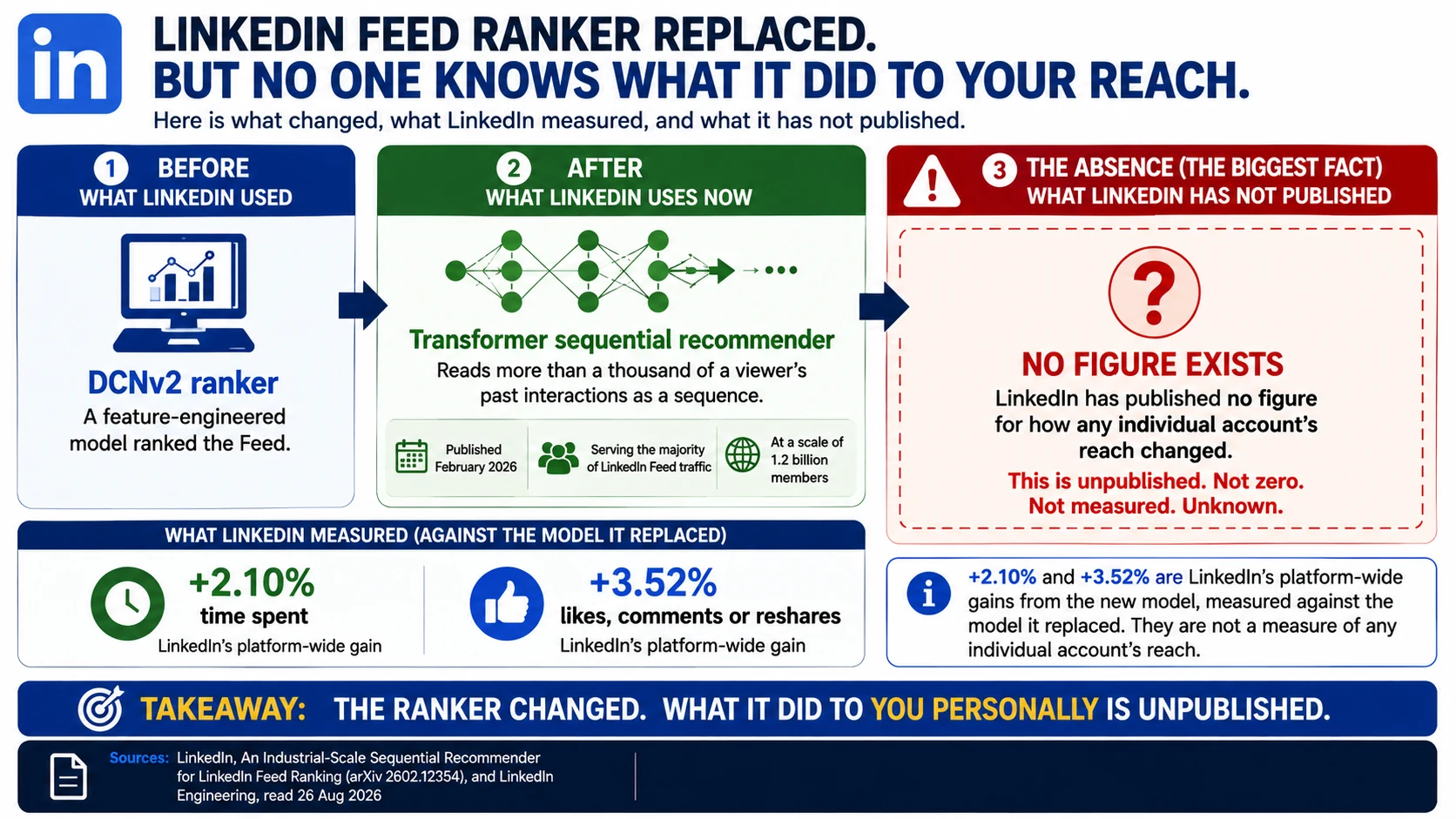
The ranker changed, and what it did to any individual account is unpublished rather than measured at zero. Source: LinkedIn, An Industrial-Scale Sequential Recommender for LinkedIn Feed Ranking (arXiv 2602.12354), and LinkedIn Engineering, read 26 August 2026.
If your own numbers are what you actually want to understand, our free LinkedIn engagement rate calculator works out your rate against a denominator you choose, with no sign-up. For what the new ranker actually is, see how the algorithm works below.
Evidence grade: A. LinkedIn's own published research plus an on-record statement.
Sources: the Feed SR paper, LinkedIn's feed architecture post, LinkedIn's 2025 feed questions.
How does the LinkedIn algorithm work?
In two stages. LinkedIn first retrieves candidate posts using embeddings generated by a large language model, then ranks them with a transformer that reads more than a thousand of your past interactions as a sequence. It optimizes for long dwells, likes, comments and shares. Your profile, the content and your activity all feed it.
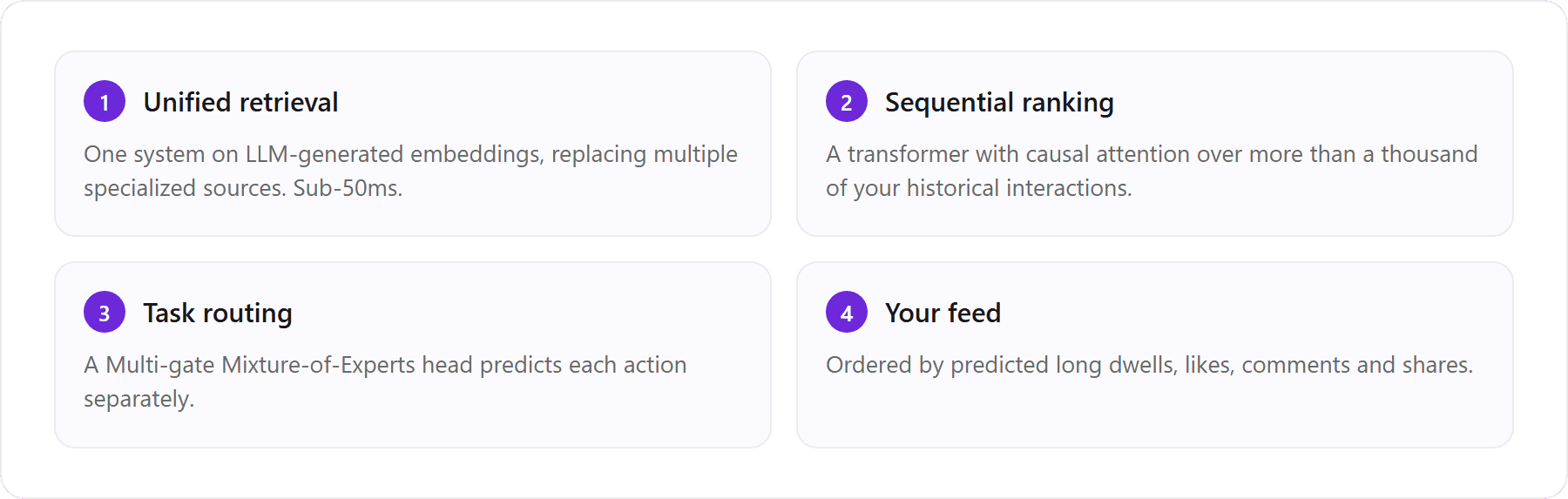
The two-stage feed described in LinkedIn's engineering post of 12 March 2026. Retrieval narrows the field, ranking orders what survives.
LinkedIn's help documentation names three signal families. Identity: "your professional background such as who you are, where you work, what your skills are". Content: "how often a post is viewed or engaged with", what it is about, recency, language, and "how constructive or professional the conversation is". Activity: "what you've reacted to, commented on, or shared".
‼️ There is a naming inconsistency you should know about. LinkedIn's February 2026 paper calls its ranker "Feed SR". Its March 2026 engineering post calls the ranking model the "Generative Recommender". LinkedIn nowhere states whether these are the same system, and this page is not going to assume they are.
Dwell time is real and documented, but the number is not. LinkedIn's engineering team describes a skip threshold it calls
Tskip, and ‼️ has never published its value in seconds. Any guide quoting a specific dwell threshold invented it.LinkedIn states plainly that "Feed distribution isn't influenced by payments from third parties to LinkedIn, except for promoted (paid) content, which is clearly labeled".
⚠️ None of these documents mentions links, hashtags, post length or posting frequency as ranking factors. That silence is load-bearing for several answers below.
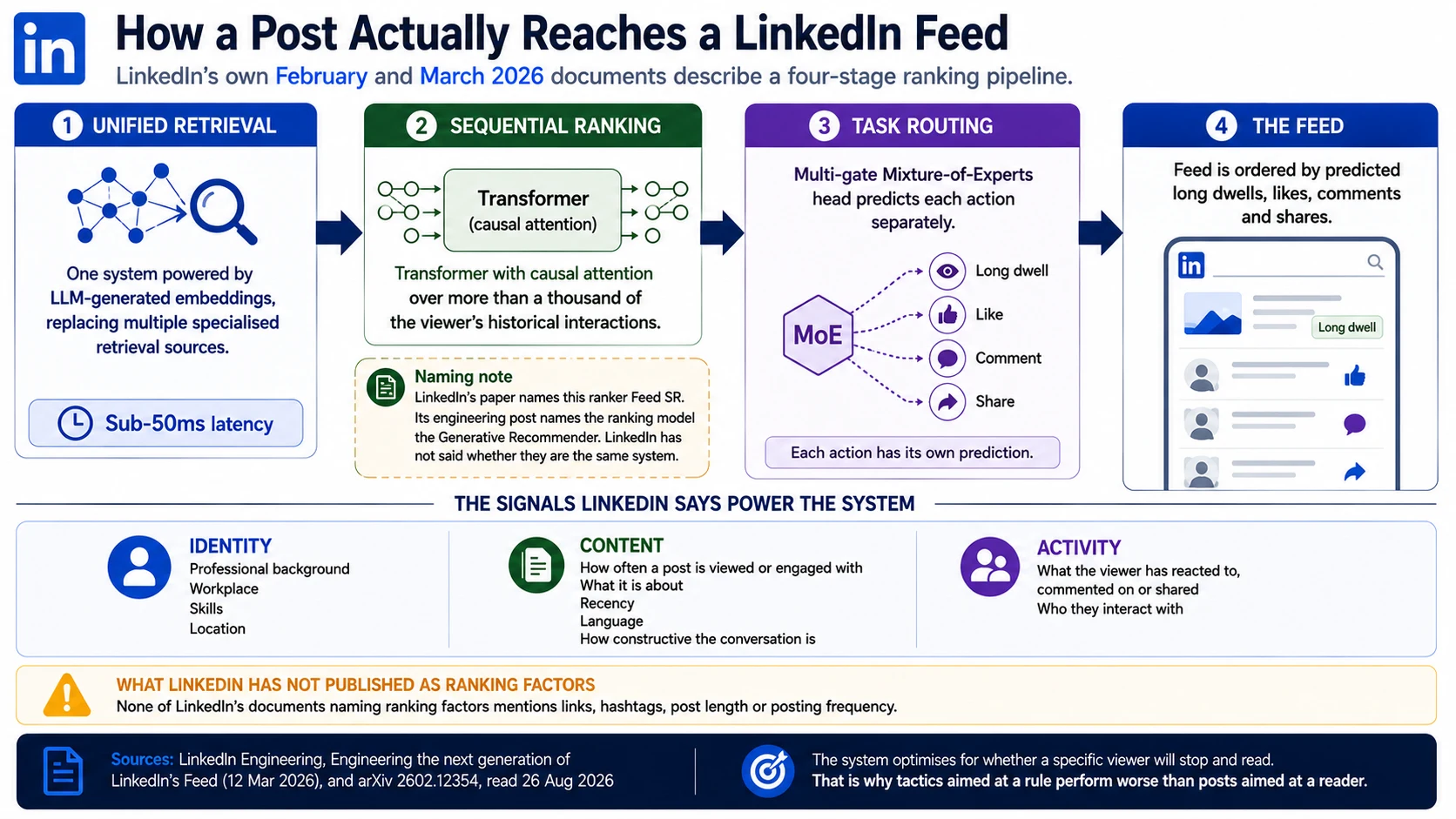
The system predicts whether a specific viewer will stop and read. ‼️ LinkedIn's paper names this ranker Feed SR and its engineering post names the ranking model the Generative Recommender, and it has never said whether they are the same system. Source: LinkedIn Engineering, 12 March 2026, and arXiv 2602.12354, read 26 August 2026.
Evidence grade: A, with one caveat marked above. LinkedIn's own engineering publications and help documentation.
Sources: LinkedIn's feed architecture post, the Feed SR paper, LinkedIn on feed relevance, LinkedIn on dwell time.
Did the LinkedIn algorithm change in 2026?
Yes, and it is documented. LinkedIn replaced the Feed ranker and published the details in February and March 2026. It is not the change most guides describe. The 150-billion-parameter model widely blamed for the reach drop was never deployed, and the person who runs LinkedIn's Feed AI has said so on the record.
What actually changed: a transformer sequential recommender replaced a DCNv2 ranker, and a unified retrieval layer on LLM-generated embeddings replaced multiple specialized retrieval sources.
On 360Brew, quoted in full: "Is 360Brew used as part of your ranking system? Short answer: No!" LinkedIn tested it "with a small group of members and ultimately decided it wasn't the right fit for the platform and shut down the test".
‼️ The 360Brew paper was removed from arXiv, but read the notice before repeating the word withdrawn. It states the paper was removed "as the submitter did not have the right to agree to the license at the time of submission". That is a licensing removal, not a retraction of the findings. Descriptions of the research as discredited overstate it in the opposite direction.
So two opposite errors circulate about the same paper: that the model runs your feed, and that its science was retracted. ⚠️ Neither is supported by the documents.
The practical consequence of the real change is that a ranker reading each viewer's interaction sequence weights relevance to that viewer more heavily than the size of your following.
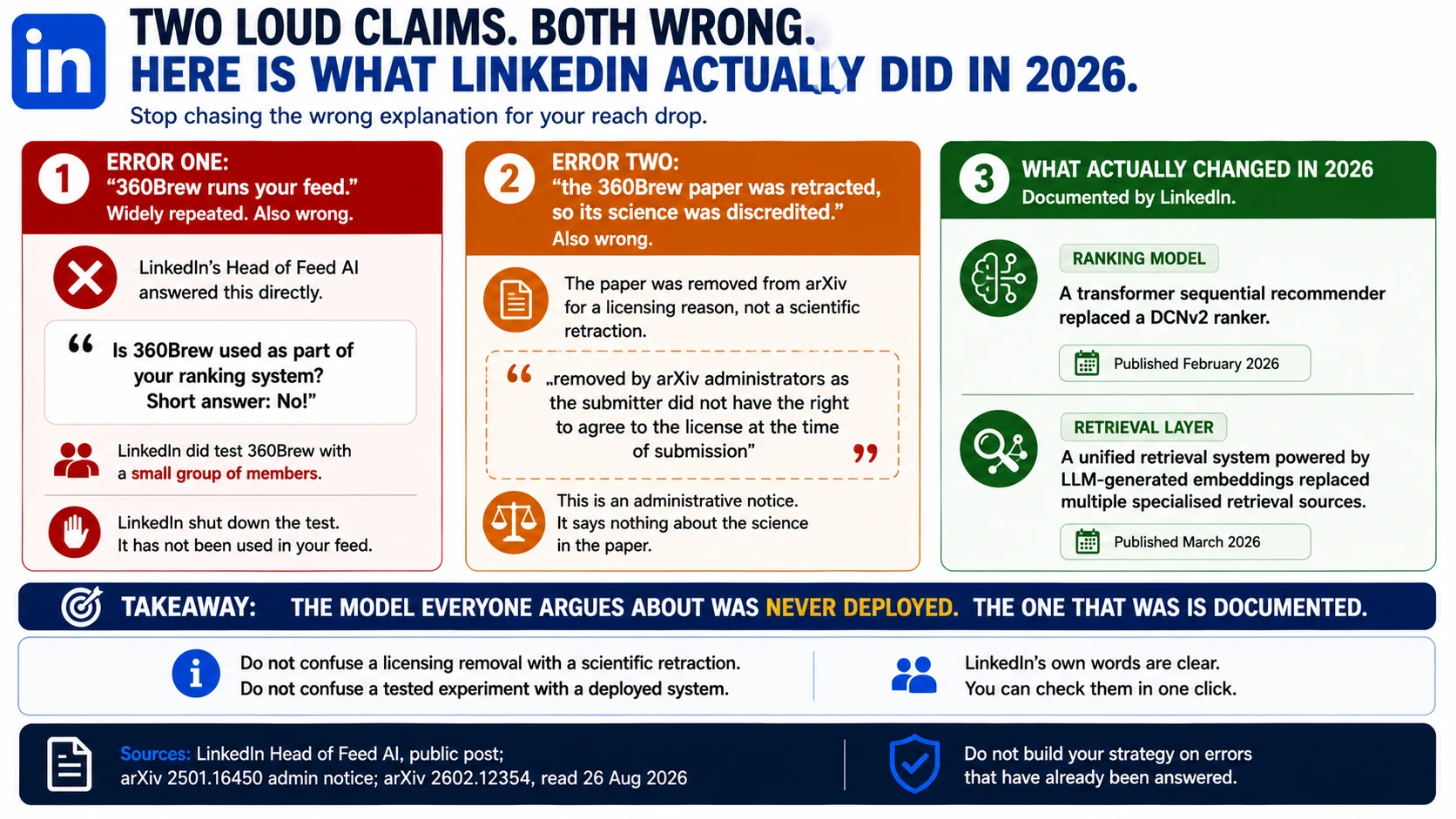
The model everyone argues about was never deployed, and the one that was is documented. ‼️ A licensing removal is not a scientific retraction. Source: LinkedIn Head of Feed AI public post, the arXiv 2501.16450 admin notice, and arXiv 2602.12354, read 26 August 2026.
Evidence grade: A. A named LinkedIn executive on the record, plus the arXiv record itself.
Sources: the on-record statement, the 360Brew arXiv record, the Feed SR paper, LinkedIn's feed architecture post.
Does LinkedIn penalize posts with links?
Not the way it is usually described. No LinkedIn document that lists ranking factors mentions links at all. The largest public measurement found the gap is about the preview card rather than the link: an attached card had 414 median impressions, while a plain URL inside the post text had 858, against 786 for posts carrying no link.
Median impressions by where the link sits, across 566,957 posts published over twelve months to June 2026, reshares and deleted posts excluded. ⚠️ The source does not state whether these are personal profiles or company pages.
Where the link is | Posts measured | Median impressions | Median likes |
|---|---|---|---|
Attached preview card | 32,927 | 414 | 6 |
Plain URL in the post body | 69,166 | 858 | 20 |
No link at all | 464,864 | 786 | 19 |
‼️ A plain URL slightly outperformed no link at all. If a rule penalized links, that result could not happen.
Three separate LinkedIn sources enumerate what the Feed considers, and none of them names links: the feed relevance help page, the March 2026 engineering post, and LinkedIn's own December 2025 feed questions article.
The familiar "6x more reach without links" figure comes from a 60-day test in early 2021 that compared 177 posts carrying links against just 7 without. The publisher disclosed that imbalance itself, arguing it made the test tougher rather than weaker.
‼️ That same test found the engagement rate went the other way, at 4.12% for linkless posts against 4.19% for posts with links. That half of the result is almost never quoted alongside the 6x.
The claim that links cost roughly 60% of reach has no study, sample or date behind it. Following its citation trail ends at an uncited sentence on a marketing blog.
‼️ On putting the link in the first comment, there is no measurement at all. The 566,957-post study states plainly that it "did not measure it" and that it would not "hand you a number we do not have". Every percentage attached to that tactic was invented downstream.
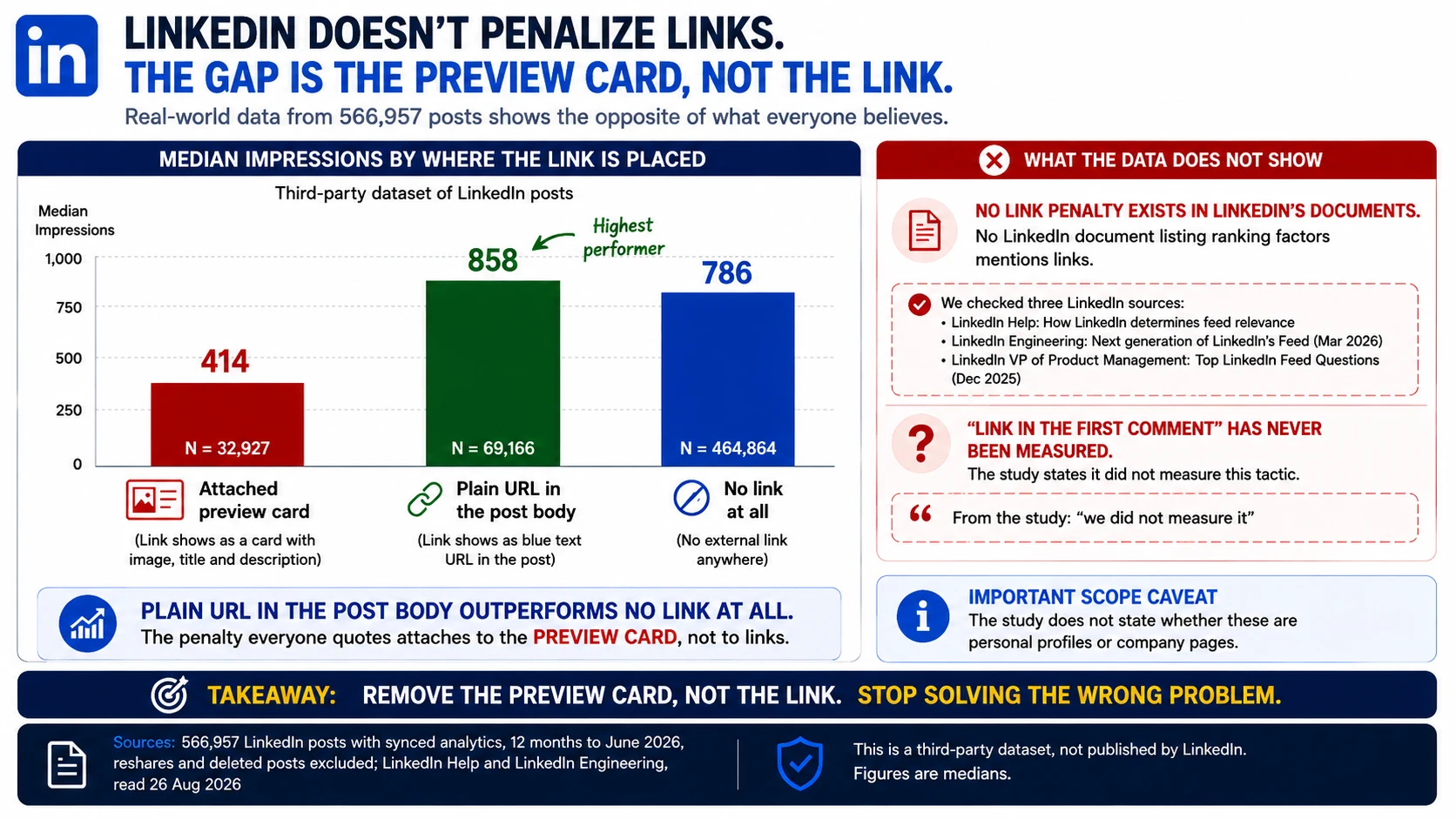
The measured gap attaches to the preview card, not to the link. ‼️ The first-comment tactic was not measured by this study at all. Source: 566,957 LinkedIn posts with synced analytics, twelve months to June 2026, reshares and deleted posts excluded, read 26 August 2026.
The reasonable read is that a preview card changes what the post is, not that a rule punishes it. If you are formatting posts around this, our free LinkedIn text formatter handles the layout without needing a workaround.
Evidence grade: B for the absence, C for the measurement, D for the 60% claim.
Sources: LinkedIn on feed relevance, LinkedIn's 2025 feed questions, the 566,957-post link study, the 2021 linkless experiment.
Do hashtags work on LinkedIn?
No, and LinkedIn has said so directly. Asked whether hashtags help reach, LinkedIn's VP of Product Management answered: "Nope! Hashtags do not impact distribution so no need to include them." That is an on-record answer from the person who runs the product, published in December 2025.
⚠️ This is one of very few LinkedIn questions with a direct answer from LinkedIn itself. Most of the others on this page are not so lucky, which is worth remembering when a guide sounds equally confident about all of them.
No LinkedIn document that lists ranking factors mentions hashtags, which is consistent with the statement above.
The "use 3 to 5 hashtags" convention was never sourced to LinkedIn by anyone. It is a house style that spread.
Hashtags still function as ordinary text a reader can see and as searchable words. What they do not do, per LinkedIn, is change distribution.
‼️ Nothing here says hashtags hurt you either. The published position is that they are neutral for reach, so the cost of using them is aesthetic rather than algorithmic.
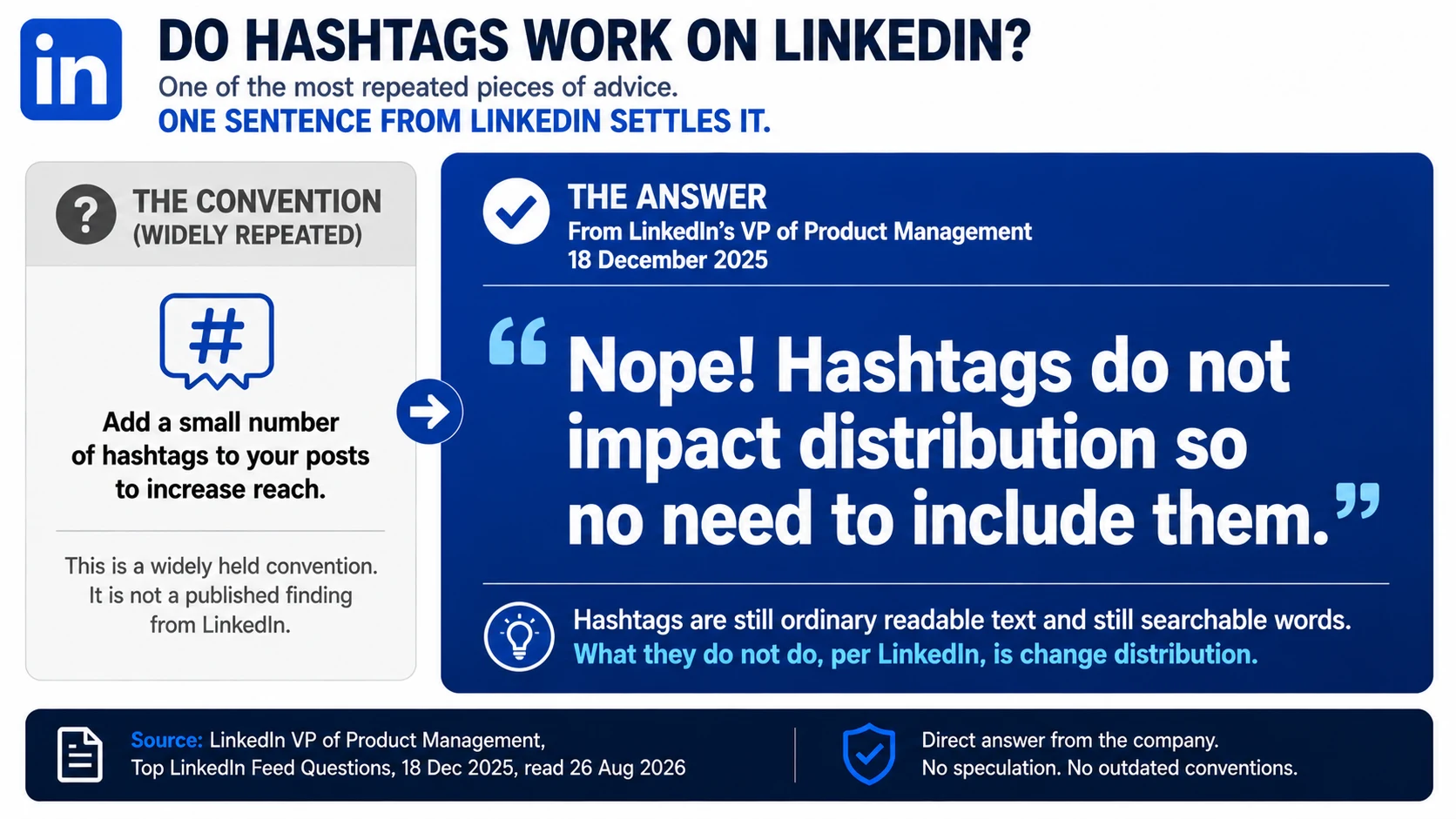
One sentence from LinkedIn's VP of Product Management settles a question thousands of guides answer with a number. Source: Top LinkedIn Feed Questions, 18 December 2025, read 26 August 2026.
Evidence grade: A. A direct, quotable statement from a named LinkedIn executive.
Sources: LinkedIn's 2025 feed questions, LinkedIn on feed relevance.
What is the best time to post on LinkedIn?
There is no reliable answer, and the reason is worth more than a guess would be: the large published studies contradict each other outright. Six datasets disagree on the best hour and even on the best day. Two name Monday and Tuesday among the best days to post. A third names exactly those two days as the worst.
Six timing studies, read on 26 August 2026. ⚠️ Note the last two columns: most of them do not tell you when the data was collected or whose posts it covers.
Source | Best time | Best days | Sample | Date range | Profiles or pages |
|---|---|---|---|---|---|
Buffer | 3pm to 8pm | Wed, Thu, Fri | 4.8M+ posts | not stated | not stated |
Hootsuite | ‼️ 4am to 6am and 8am to 9am | Tue, Wed | 1M+, all platforms | not stated | not stated |
Metricool | 9am to 12pm | Mon, Tue, Wed | 673,658 posts | not stated | Both, and splits them |
Sprout Social | 11am to 5pm | Tue, Wed, Thu | ~2B engagements, all platforms | Nov 2025 to Feb 2026 | not stated |
Hopper HQ | 9am to 10am | Mon, Tue, Thu | not stated | not stated | not stated |
Buffer, on the same days | ‼️ names Mon and Tue the worst |
‼️ One of the six gives two different overall best times on the same page, four hours apart, one in its summary box and one in its body text.
Four of the six state no date range at all, so there is no way to know whether you are reading last quarter or three years ago.
Four of the six never say whether they measured personal profiles or company pages, which are ranked and consumed differently. Only one separates them.
They are not even measured on the same clock. Some normalize to the reader's local time zone; at least one reports in UTC, which moves its answer by hours depending on where you are.
⚠️ Each study is honest about its own sample. The failure is in how they are quoted, as though any of them established a platform-wide law.
LinkedIn's own guidance names "timeliness of the topic", not a clock time. A ranker built on each viewer's interaction history further weakens the premise that one hour suits everyone.
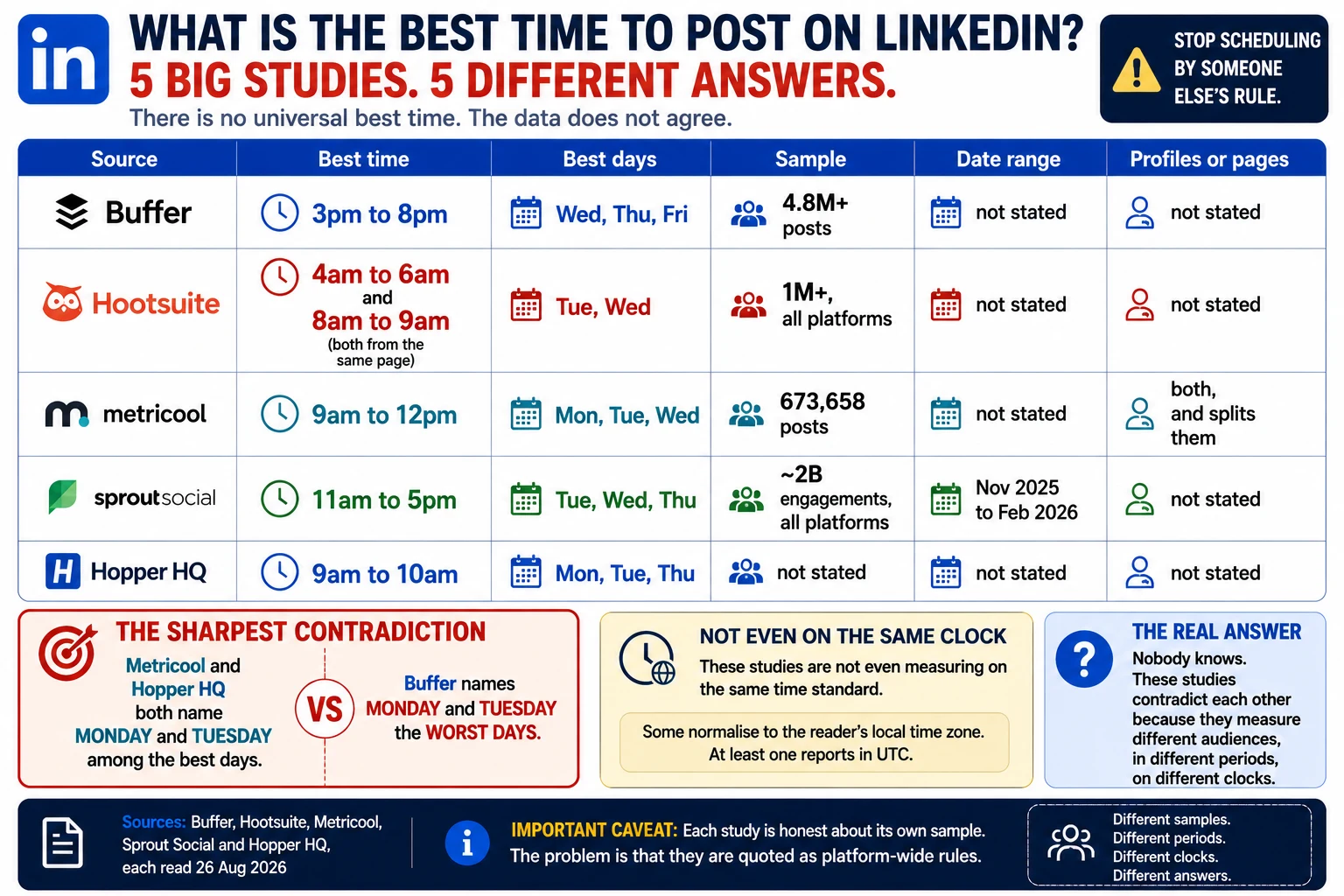
Five studies, five answers, and they are not even measured on the same clock. Each is honest about its own sample; the problem is that they are quoted as platform-wide rules. Sources: Buffer, Hootsuite, Metricool, Sprout Social and Hopper HQ, each read 26 August 2026.
The defensible read is that timing is a second-order lever and consistency is a first-order one, which is the argument we make in a personal brand posting schedule.
Evidence grade: C, and the contradiction is the answer. Six third-party datasets, most without a stated date or scope.
Sources: Buffer, Hootsuite, Metricool, Sprout Social, Hopper HQ, LinkedIn's 2025 feed questions.
How often should I post on LinkedIn?
LinkedIn's own published guidance is 2 to 5 posts a week, stated in December 2025. It adds one qualifier that almost every guide drops: space posts out "when on very similar topics". So the stated concern is topic similarity, not raw frequency.
LinkedIn, verbatim: "Aim to publish between 2-5 posts per week".
And on spacing: "focus on quality and consider spacing out posts to give each breathing room when on very similar topics".
‼️ LinkedIn attaches a claim that members who post twice per week see up to five times more profile views, and publishes no sample size and no method for it. We are quoting it because LinkedIn said it, and grading it accordingly. It is guidance, not a measurement you can check.
The popular claim that posting often "trains the algorithm to suppress you" has no published source. ⚠️ Nothing in LinkedIn's material describes an account-level frequency penalty.
What the documents do support is that similar posts compete for the same viewers, which is an argument about cannibalization between two of your own posts rather than about a penalty on your account.
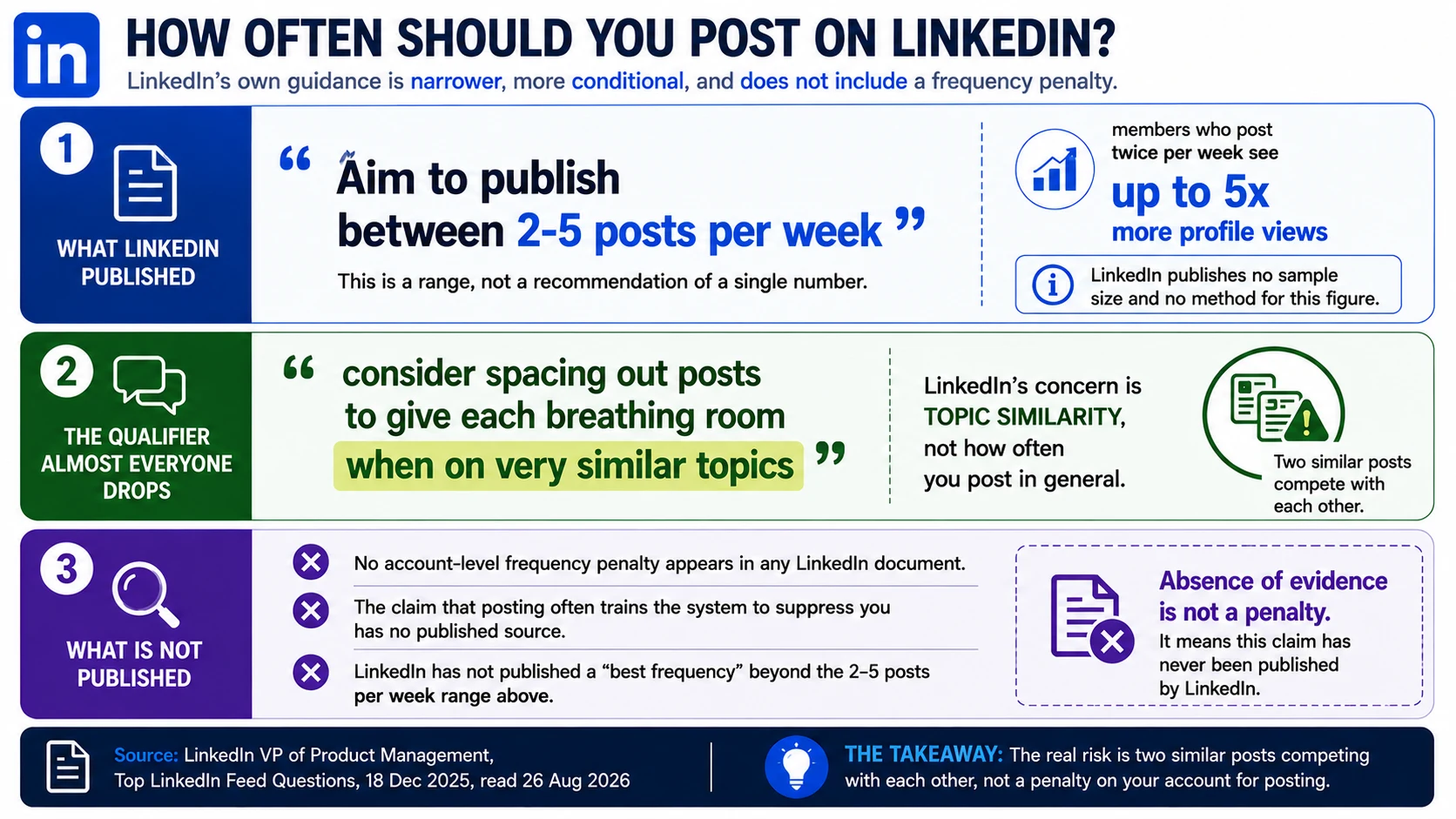
The real risk LinkedIn names is two similar posts competing with each other, not a penalty on your account for posting. ‼️ Absence of a published frequency penalty is not the same as a measured absence of one. Source: LinkedIn VP of Product Management, Top LinkedIn Feed Questions, 18 December 2025, read 26 August 2026.
Evidence grade: B for the guidance, D for the five-times claim inside it.
Sources: LinkedIn's 2025 feed questions, LinkedIn on feed relevance.
What are impressions on LinkedIn, and how are they different from members reached?
An impression is a display. Members reached is a person. LinkedIn defines impressions as the "number of times your post was shown on LinkedIn", and members reached as the "number of distinct members and Pages that saw your post", which "does not include repeat views". Both are estimates, and LinkedIn says so.
LinkedIn's own definitions of its post metrics, quoted from its help documentation.
Metric | LinkedIn's definition |
|---|---|
Impressions | "Number of times your post was shown on LinkedIn" |
Members reached | "Number of distinct members and Pages that saw your post. This number is an estimate and does not include repeat views" |
Reactions | "The number of times members or Pages reacted (i.e. liked) your post" |
Reposts | "The number of times members and Pages shared your post to their feed" |
Saves | "The number of times members saved your post" |
Video views | "The total number of times your video was watched for two or more continuous seconds, including replays" |
‼️ The widely quoted technical definition is from the wrong page. The rule that an impression requires at least 50 percent of the post on screen for 300 milliseconds appears in LinkedIn's company Pages analytics documentation. The personal post analytics page carries no such threshold. People quote it as though it covers both.
LinkedIn states directly that "the numbers in your post analytics are estimates and may not be precise", which is worth remembering before reading anything into a small change.
One member seeing your post five times is five impressions and one member reached. A widening gap between the two means repeat exposure to a smaller group.
⚠️ Saves is a reported metric, which is not the same as a ranking weight. No LinkedIn source assigns a weight to saves, despite the frequently repeated claim that a save is worth five likes.
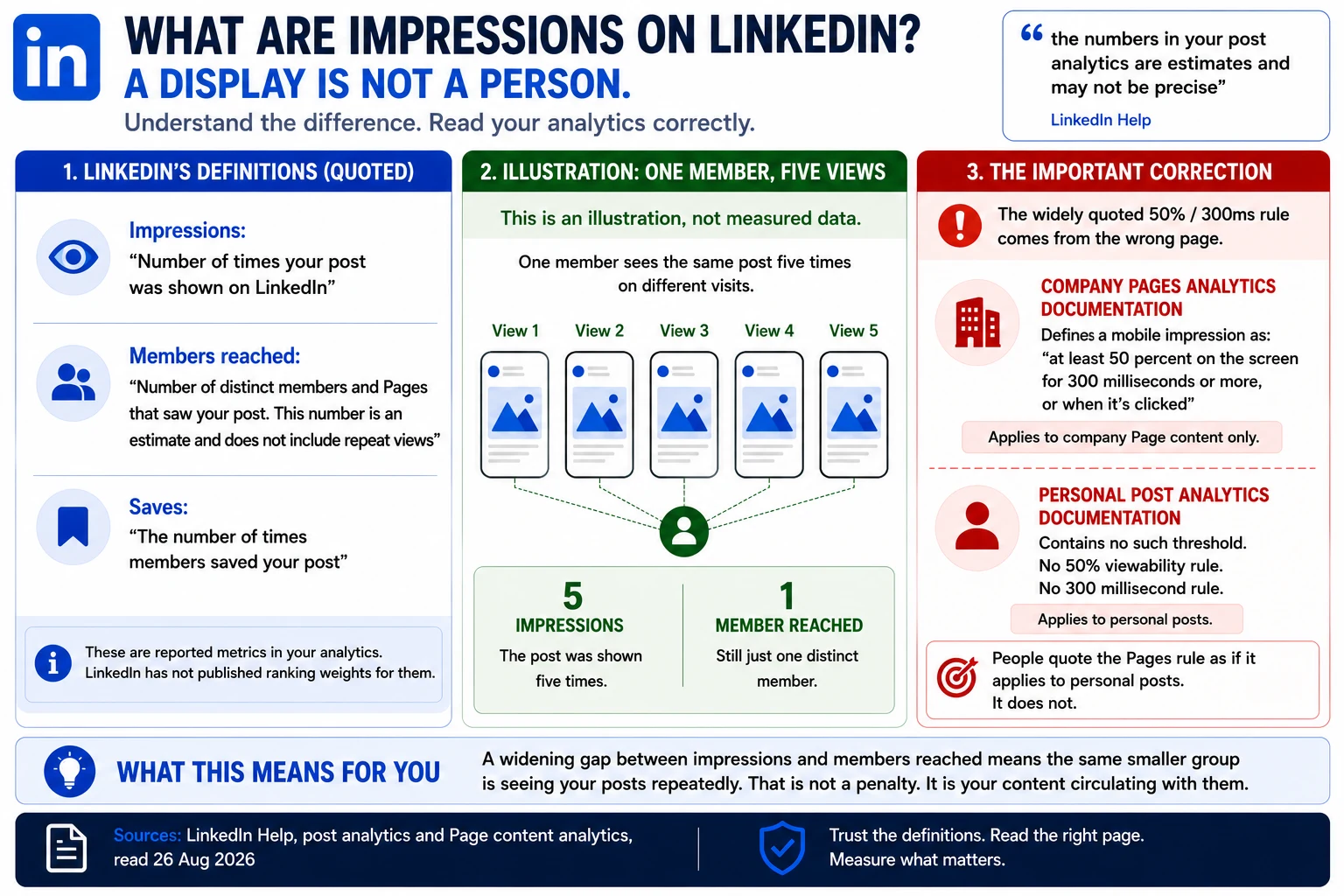
A display is not a person, and a widening gap between the two means the same smaller group is seeing your posts repeatedly. ‼️ The viewability rule everyone quotes is documented for company Pages, not for personal posts. Source: LinkedIn Help, post analytics and Page content analytics, read 26 August 2026.
Evidence grade: B. LinkedIn's own product documentation, quoted verbatim.
Sources: LinkedIn on post analytics, LinkedIn on Page content analytics.
How long should a LinkedIn post be?
The hard limit is 3,000 characters, stated by LinkedIn. On the best length, the strongest dataset available covers 372,126 personal-profile posts and finds engagement rising with length up to about 2,500 characters, from 2.10% under 400 characters to 2.67% at 2,001 to 2,500.
Median engagement rate by character count, from 372,126 personal-profile posts published September 2025 to February 2026 with at least one impression. ⚠️ These are medians, not means, and the spread across the whole range is well under a percentage point.
Characters | Share of posts | Median engagement | Median impressions |
|---|---|---|---|
1 to 400 | 17.3% | 2.10% | 575 |
401 to 700 | 14.2% | 2.24% | 825 |
701 to 1,000 | 17.6% | 2.31% | 964 |
1,001 to 1,300 | 16.7% | 2.44% | 1,046 |
1,301 to 2,000 | 23.1% | 2.61% | 1,106 |
2,001 to 2,500 | 6.8% | 2.67% | 1,174 |
2,501 to 3,000 | 4.3% | 2.62% | 1,400 |
LinkedIn, verbatim: "The character limit for a post is 3,000 characters".
‼️ LinkedIn publishes no "see more" truncation point anywhere. The familiar "210 characters on desktop, 140 on mobile" figures are one vendor's observation, not a LinkedIn figure, and the real cutoff moves with screen size and device.
⚠️ The differences are small. The gap from the worst band to the best is 0.57 percentage points on a median. Treat length as a weak lever, not a formula.
Impressions keep climbing in the longest band even as engagement rate dips slightly, so the two metrics do not agree about where the optimum is.
This is the one dataset here that states its scope: personal profiles, not company pages. ⚠️ Format benchmarks published elsewhere are frequently business pages only and cannot describe a personal profile.
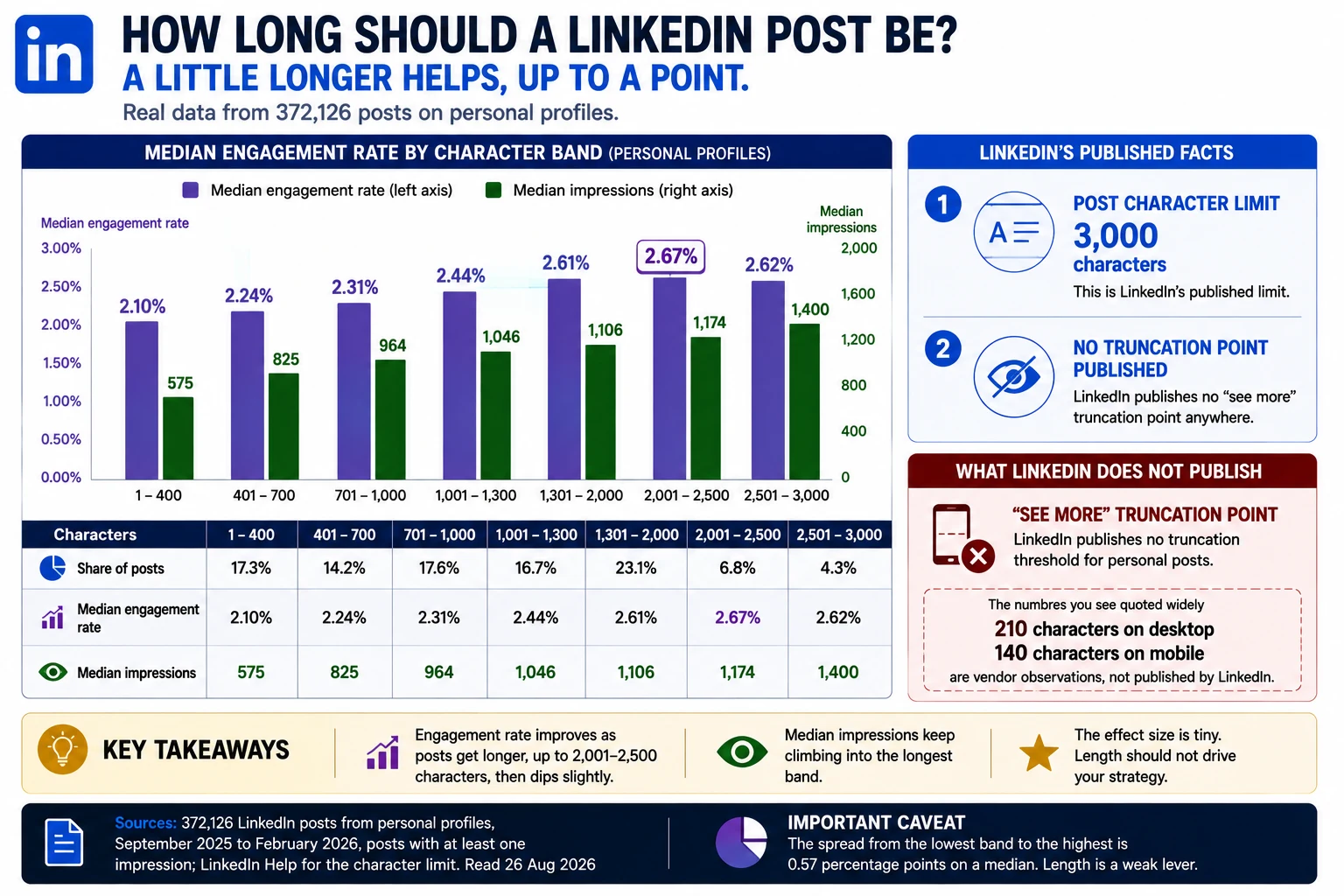
The whole spread from lowest band to highest is 0.57 percentage points on a median, so length is a weak lever. Sources: 372,126 personal-profile posts, September 2025 to February 2026, and LinkedIn Help for the character limit, read 26 August 2026.
If you want to see where your own post breaks before you publish it, our free LinkedIn text formatter shows the layout as written.
Evidence grade: B for the limit, C for the length data, D for the truncation figures everyone quotes.
Sources: LinkedIn on posting, the 372,126-post length study.
Does editing a LinkedIn post affect reach?
Nobody has published an answer, in either direction. LinkedIn documents that you can edit a post's text and that an "Edited" label appears, but it has never stated whether editing changes distribution. No study with a stated sample and method exists either. Anyone quoting a percentage here is quoting nothing.
What LinkedIn does document: the text of a post can be edited, "The word 'Edited' will appear next to your post", and shared rich media "can't be replaced".
‼️ That last point is the only documented cost, and it is real. Changing an image or a document is not an edit. It requires deleting the post and creating a new one, which loses everything the original had accumulated.
The claims in circulation range from a 10% reach penalty, to a penalty only after the first hour, to no penalty at all. None of them cites a dataset.
⚠️ Anecdotes about a post dying right after an edit are not evidence either. Reach on a normal post decays anyway, so an edit made a few hours in will always be followed by a decline whether or not it caused one.
‼️ This page is not going to invent a number to fill the gap. If the answer matters to your decision, the honest position is that it is unknown, and a decision that depends on it is a decision resting on nothing.
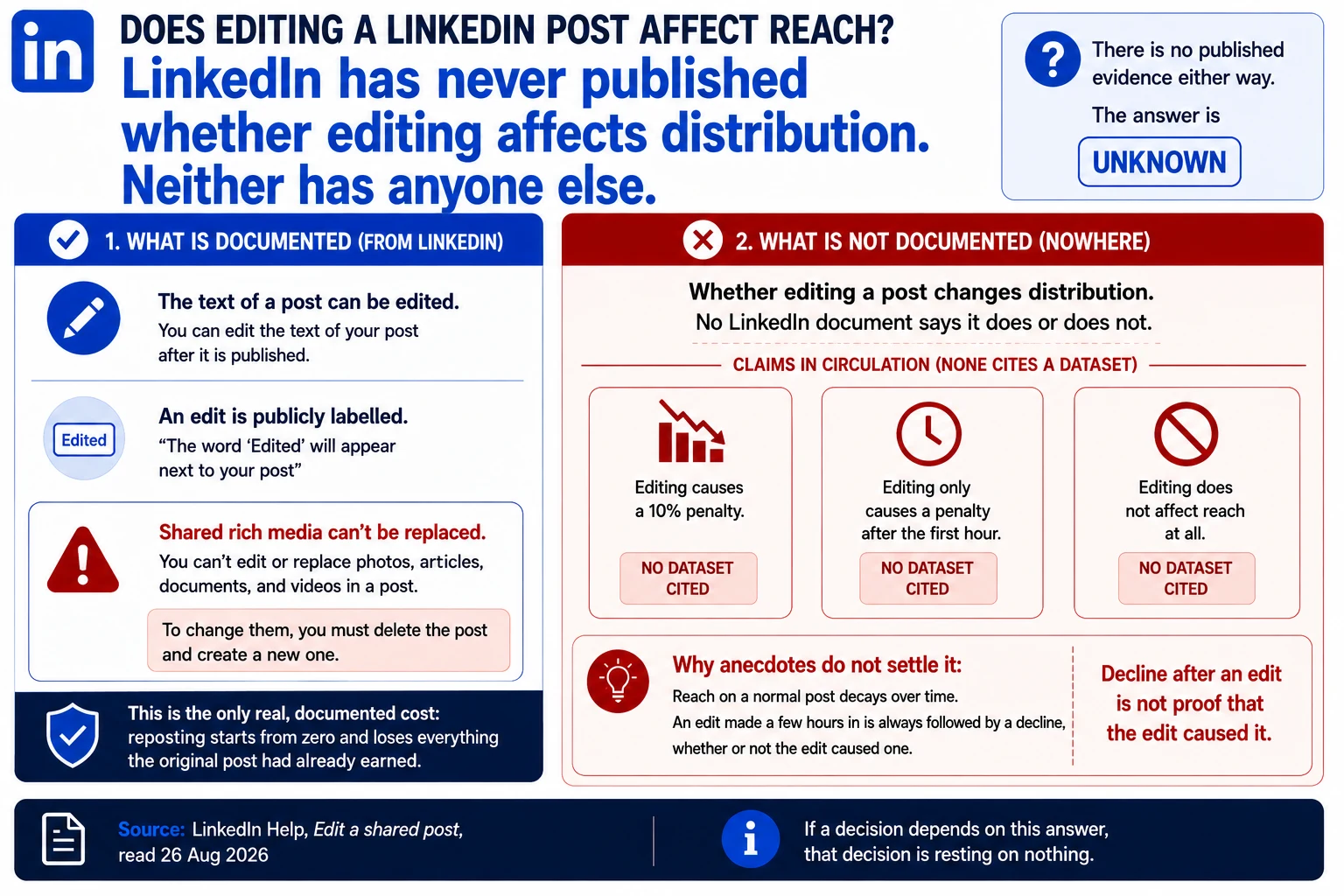
The answer is unknown, and unknown is not the same as zero. ‼️ The only documented cost is that replacing an image means deleting and reposting, which loses everything the original post had earned. Source: LinkedIn Help, Edit a shared post, read 26 August 2026.
Evidence grade: B for the mechanics, D for the reach effect. Nobody has published it.
Sources: LinkedIn on editing a shared post, LinkedIn on feed relevance.
Does LinkedIn penalize AI-generated content?
No LinkedIn policy penalizes AI-assisted writing. The Professional Community Policies require disclosure of synthetic media that depicts a person saying or doing something they did not, which is a rule about fabricated depictions of people rather than about drafting help. LinkedIn's stated preference for human experience is a separate thing from a penalty.
The policy, verbatim: "Do not share synthetic or manipulated media that depicts a person saying something they did not say or doing something they did not do without clearly disclosing the fake or altered nature of the material." ⚠️ That is about deepfakes, not about a drafted post.
LinkedIn's VP of Product Management on AI: "AI is best used to augment your expression. Think of AI as a tool, not a crutch", alongside "professionals want to hear from real professionals about real experiences".
What the policies do name is inauthentic engagement: "Don't do things to artificially increase engagement with your content. Respond authentically to others' content and don't agree with others ahead of time to like or re-share each other's content." That is the rule engagement pods break, and it has nothing to do with how a post was drafted.
LinkedIn does say it "may limit the visibility of certain content, label it, or remove it entirely", ⚠️ but never in connection with AI-assisted writing.
‼️ Specific claims that AI posts get some multiple less reach have no published source. No LinkedIn document describes detecting or demoting AI-assisted text.
We build an AI writing product, so treat our reading of this with the scepticism it deserves and check the two policy links below yourself. Our own position, for what it is worth, is that the distinction LinkedIn draws is the right one: the tools worth using help you say what you actually know, and the failure mode is publishing something you could not have said.
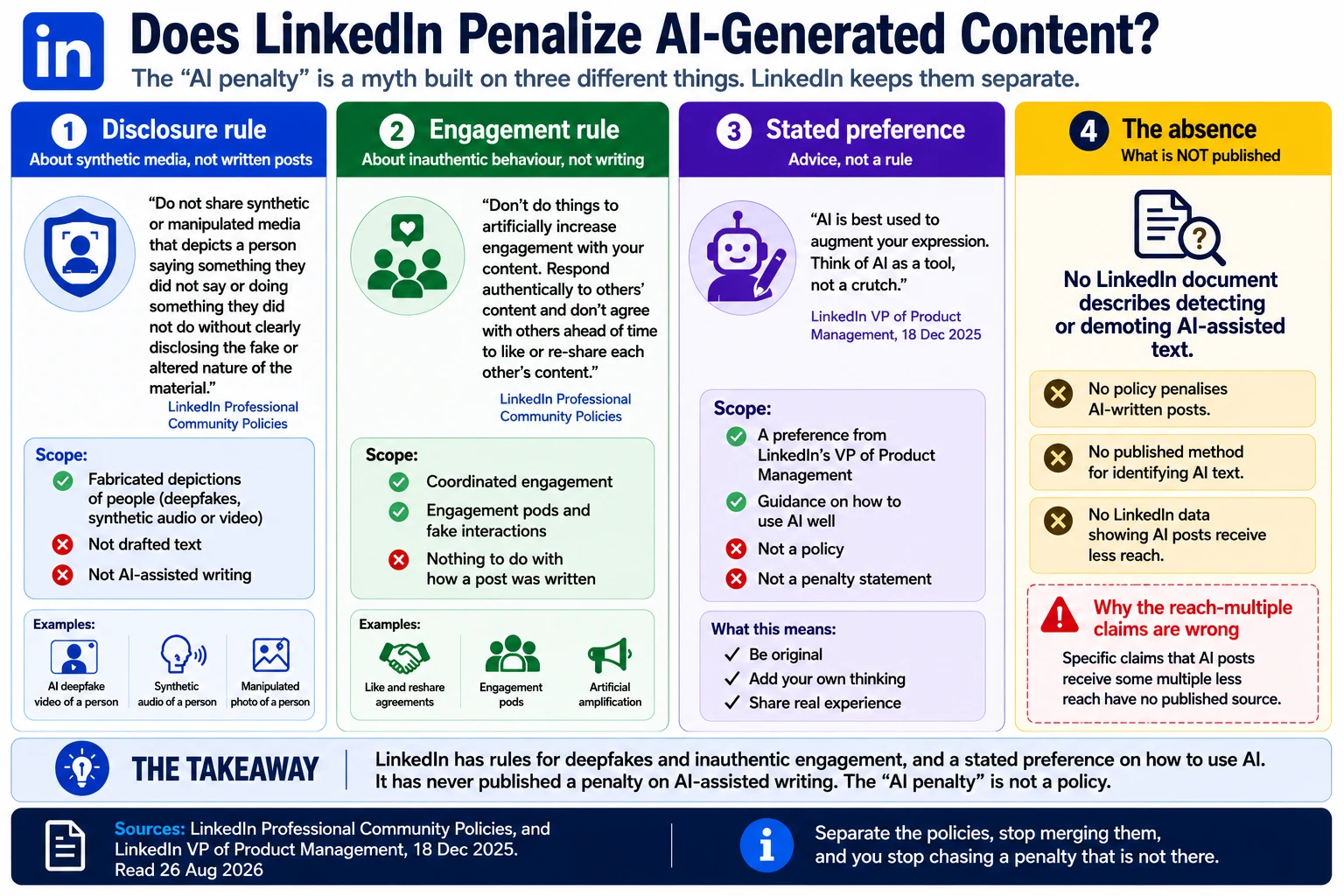
The rule people fear is about deepfakes, the rule that would actually catch them is about engagement pods, and the rest is a preference rather than a policy. Sources: LinkedIn Professional Community Policies, and LinkedIn VP of Product Management, 18 December 2025, read 26 August 2026.
Evidence grade: B for the policy, D for the penalty claims.
Sources: LinkedIn's Professional Community Policies, LinkedIn's 2025 feed questions, the inauthentic engagement statement.
What this page could not answer
Three of the eleven answers above rest on the fact that nothing has been published, and one more quotes a LinkedIn figure that LinkedIn itself does not support with a sample. This section exists because a page that only reports what it found would be hiding half of what it learned.
No search volume exists for any question on this page. Every free keyword source was blocked or rendered its numbers in a way that could not be read, so the questions were chosen from live autocomplete capture, community recurrence and where existing answers are weakest.
LinkedIn's ranking is not open. Unlike Twitter/X, whose scoring weights are published and can be read line by line in our Twitter/X answers, nothing equivalent exists for LinkedIn. No page can tell you what a comment is worth relative to a like here, and any page that does is guessing.
The dwell threshold is documented but its value is secret. LinkedIn names a skip threshold and has never published the number.
‼️ Whether the two ranking systems LinkedIn described in February and March 2026 are the same system is not stated anywhere. We have quoted both and left the question open rather than closing it for you.
Choosing a tool is a different question from beating a feed. What the third-party tools cost, and which of them can even connect to a given platform, is answered in our social media tools answers. Whether a ghostwriter may post from your account, and what Google says about AI-written text, are in our content writing answers.
⚠️ Everything above was read on 26 August 2026. Ranking systems change, and the February and March 2026 material is recent enough that it may not stay current. If you are reading this much later, open the linked sources rather than trusting the summary.
Evidence grade: this section is the grading.
Researched and written by Prateek Singh. Every quotation here was read directly from the source document on 26 August 2026 and is linked at the point it is used. Where no source exists, the answer says so rather than estimating.

AI and Voice
Every social MCP connector reaches both platforms. That is not the hard part
We were going to write that connecting one assistant to both Twitter and LinkedIn was rare. It is not. More than twenty connectors do it and several are free, so channel coverage is table stakes and every roundup ranking them by it is measuring the wrong thing. Here is what actually differs between them, and the one thing we read enumerated tool lists for six of them to confirm nobody does at all.
11 min read

AI and Voice
Why your Claude writing skill doesn't sound like you
There are dozens of free Claude skills for writing, and almost all of them do the same thing: strip out phrases that read as machine-written. That is subtraction, and it leaves you sounding like nobody in particular rather than like yourself. The handful that actually learn a voice from your own writing have a fraction of the users. Here is the difference, why a skill cannot post anything no matter what it says, and where the file actually goes on every surface.
13 min read
AI and Voice
Hootsuite alternatives in 2026, priced from the vendors' own pages
Hootsuite starts at $99 per user a month, not $19. Here is what the realistic alternatives cost, read off each vendor's own pricing page in both billing positions, plus the clause in Hootsuite's terms that its pricing page does not mention.
10 min read

AI and Voice
Taplio alternatives in 2026, priced from the vendors' own pages
Four LinkedIn tools people move to from Taplio, priced from each vendor's own pricing page rather than from each other. Includes the arithmetic on Taplio's Pro tier, which does not add up, and one name still on every recommendation list that has quietly shut down.
11 min read
AI and Voice
Later alternatives in 2026, and the caps that actually move you up a tier
Later is one of the cheapest majors on headline price. What moves you up a tier is not the price, it is the 30-posts-per-profile cap and the user count. Here is what the alternatives cost, read off each vendor's own page in both billing positions.
10 min read