The short version
A reply is weighted 5.0 against a like at 0.5, so 10x. A reply from someone who follows you back is weighted 20.0, because a mutual-follow boost of 15.0 is added on top.
Sharing by copied link is weighted 20.0, the joint-highest positive signal in the model. A repost is 1.0. The standard "please RT" ask targets the weakest share signal there is.
Profile clicks are weighted 0.0. They contribute nothing to ranking, despite being standard advice everywhere.
No bookmark signal exists in the published weights at all.
There is no link penalty in the ranking code. Opening a link is weighted +0.2 and a click +0.4, both positive.
Being muted costs you nearly twice what being blocked does, at -58.8 against -31.2.
‼️ The weights multiply your PREDICTED PROBABILITY of each action, not raw counts, so the ratios do not mean what they look like. The file says so explicitly.
How to read this page. Every number below was read from the published algorithm files on 26 August 2026 and links to the file it came from. ⚠️ One honest limit, raised repeatedly by engineers reviewing the release: nobody outside the company can verify that the published code is what runs in production. Treat it as the best available evidence, not as proof.
Am I shadowbanned on Twitter?
Almost certainly not in the way the word implies. There is no shadowban flag, suppression term or penalty switch anywhere in the published ranking weights. What does exist is a set of very large negative weights: a report scores -234.0 against a post and a mute -58.8. A sudden reach collapse is far more often those signals than a secret ban.
No term named shadowban, suppression, penalty or throttle appears in the published weight file.
The negative signals are real, and they are the heaviest numbers in the model: Report -234.0, MuteAuthor -58.8, NotInterested -43.2, BlockAuthor -31.2.
Twitter/X does run visibility filtering as a separate stage, before and after scoring. ‼️ Its criteria are not published, which is the honest reason this question never quite goes away.
Replies and reposts carry a structural discount even to your own followers, so "my replies get no views" usually has a documented cause rather than a hidden one.
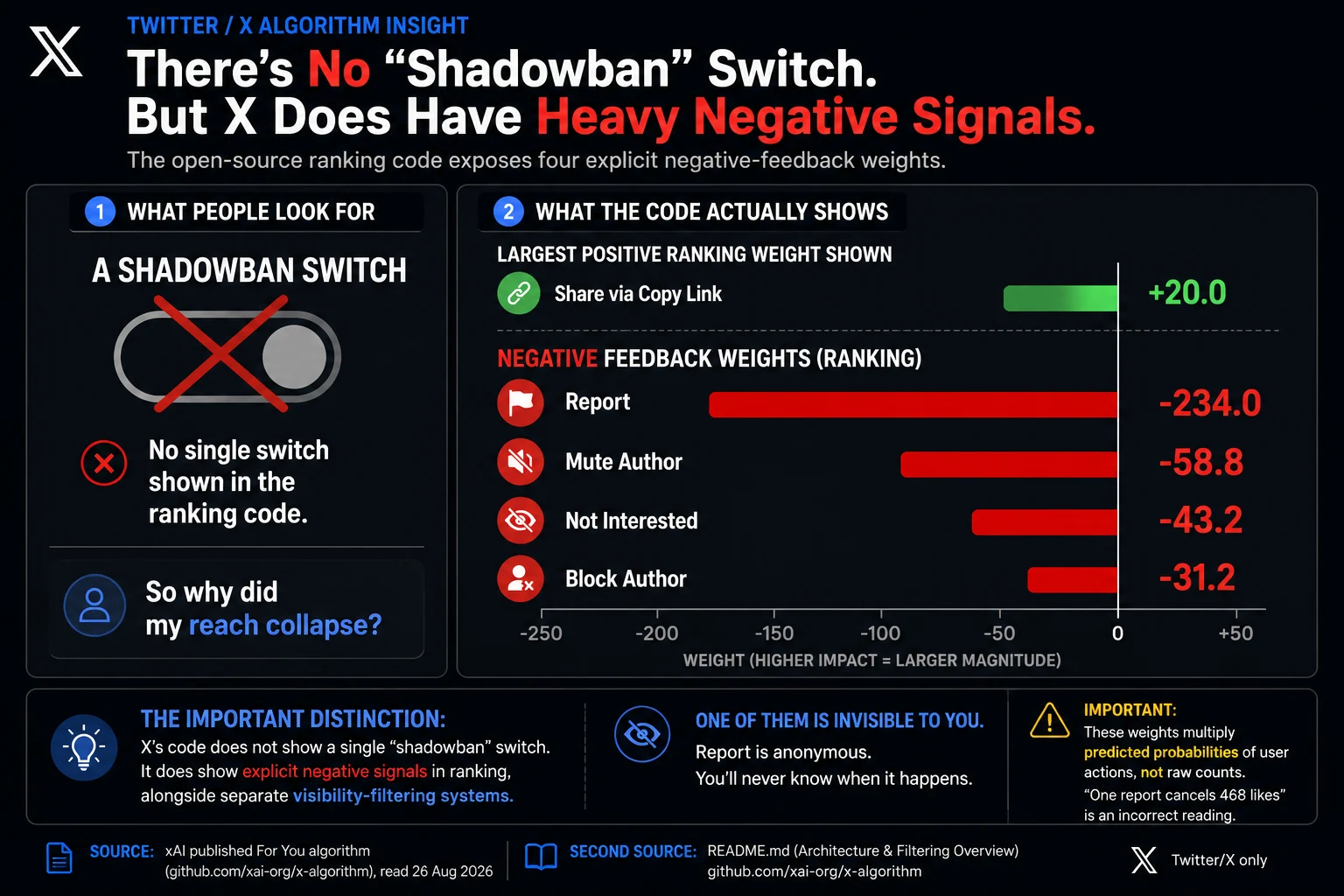
There is no shadowban switch in the published ranking code. There are four negative weights, and the heaviest is a report at -234.0 against a largest positive signal of +20.0. Source: xAI published For You algorithm, read 26 August 2026.
If you want to check your own account rather than guess, our free shadowban checker runs the public tests with no sign-up. For what a sudden drop usually is, see what actually hurts your reach below.
Sources: the published scoring weights, the pipeline and filter list.
How does the Twitter/X algorithm work in 2026?
It is a pipeline, not a single score. Twitter/X gathers candidate posts from three sources in parallel, filters them, predicts how likely you are to take each of about twenty actions on each post, multiplies each probability by a published weight, sums the result, then reorders the winners for variety.
The stages a post passes through before it reaches a For You feed.
Stage | What happens |
|---|---|
Query hydration | Your recent engagement history and preferences are loaded |
Candidate retrieval | Thunder holds recent posts from accounts you follow. Phoenix finds posts from accounts you do not follow, using vector embeddings. SimClusters groups accounts and posts into clusters |
Pre-scoring filters | Duplicates, blocked content and posts older than 48 hours are removed |
Scoring |
|
Reranking | VMRanker applies diversity reranking so you do not get ten near-identical posts |
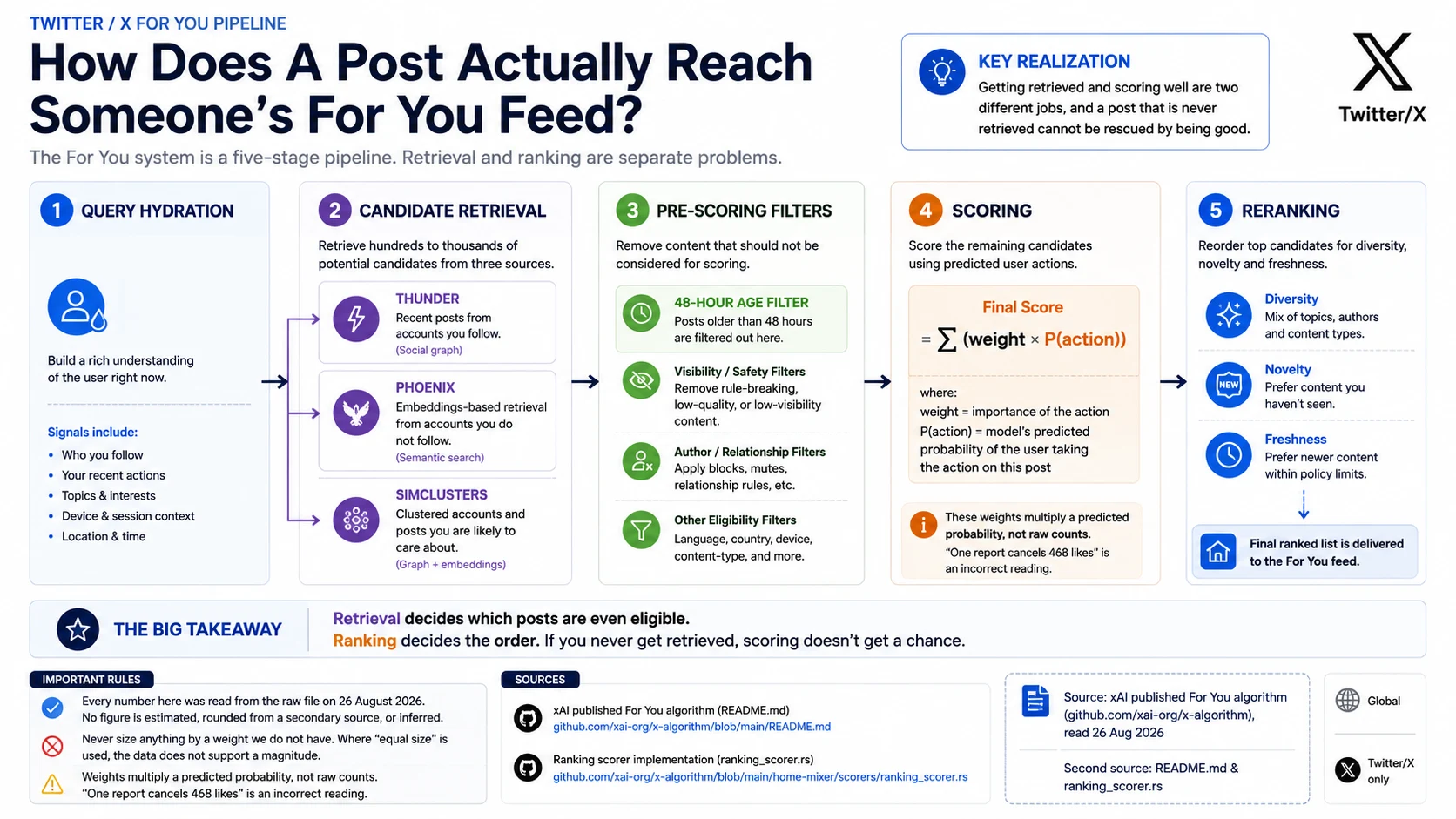
Retrieval decides which posts are eligible. Ranking decides the order. A post that is never retrieved never reaches scoring at all. Source: xAI published For You algorithm, read 26 August 2026.
The practical consequence is that getting retrieved and scoring well are two different problems. A post Phoenix never surfaces for a given viewer cannot be rescued by any amount of ranking strength. We break the pipeline down further in our Twitter/X algorithm series, and the retrieval half specifically in how Phoenix decides who sees you.
Sources: the pipeline documentation, the scorer.
How do I get more followers on Twitter?
Following you is itself a ranking signal. FollowAuthor carries a weight of 4.0, eight times a like. So a post the model expects to win you a follower is scored far more highly than one it expects to be liked, which makes "who would follow me after reading this" a better test than "who would like this".
FollowAuthor 4.0 sits above Share at 2.0 and Retweet at 1.0, and eight times Favorite at 0.5.
New accounts get a real, specific head start: below 1,000 impressions and 1,000 followers, a post under 24 hours old is lifted toward feed slots 15 to 16.
⚠️ That head start keys off impressions, not follower count alone, and it expires as you grow.
Reaching non-followers runs through Phoenix retrieval, which matches on what a viewer engages with. Being clearly about something beats being generally good.
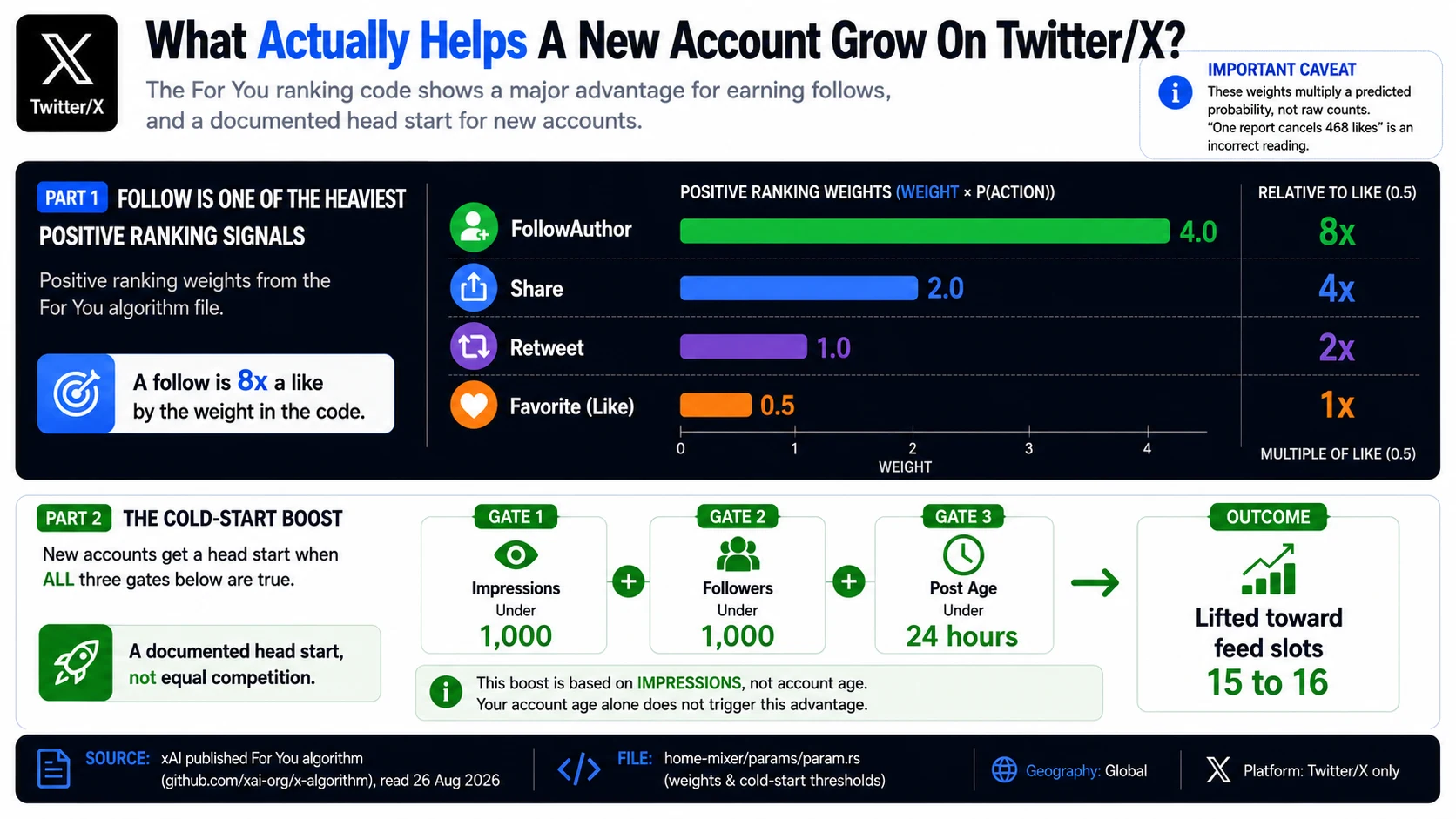
A follow is weighted eight times a like, and the cold-start boost keys off impressions rather than account age. Source: xAI published For You algorithm, home-mixer/params/param.rs, read 26 August 2026.
The uncomfortable implication is that the strategies aimed at profile visits are aimed at a signal worth nothing. See do profile clicks help. Our Twitter growth playbook covers the parts that are not algorithmic.
Sources: the published scoring weights.
What are impressions, and how do they differ from reach?
An impression is one appearance of your post on someone's screen. Reach is the number of unique people who saw it. One person seeing your post three times is three impressions and one reach. ‼️ This distinction is why published engagement-rate benchmarks disagree by more than a hundredfold.
Two widely cited benchmarks that are not comparable, because they do not divide by the same thing.
Source | Figure | Divided by | Dataset |
|---|---|---|---|
Rival IQ, 2024 | 0.029% median | Followers, stated explicitly | Brand accounts across industries |
Buffer | 3.56% median on text posts | ⚠️ Not stated in the article | 18.8M posts across 71,000 accounts |
Rival IQ defines engagement rate as likes plus retweets plus replies, divided by followers, and reports a median of 0.029% with a top quartile at 0.08%.
Buffer reports 3.56% for text, 3.40% images, 2.96% video, 2.25% links, from a genuinely large first-party dataset, but does not state its denominator.
‼️ Do not compare the two numbers. A rate measured against impressions and a rate measured against followers are different quantities that happen to share a name.
Before quoting any engagement-rate benchmark at yourself, check what it divides by. If the source does not say, it cannot be used as a target.
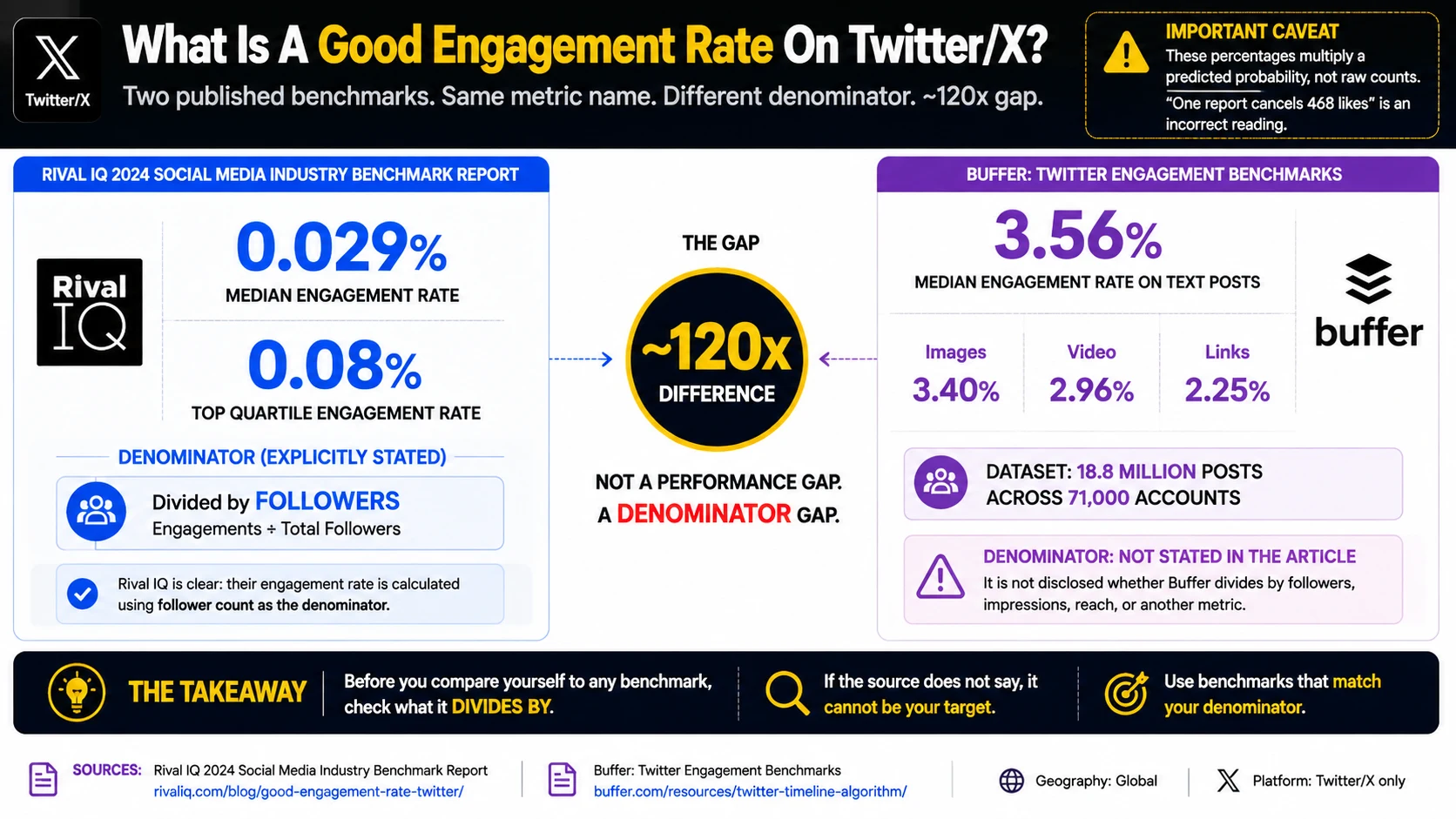
A roughly 120x gap between two published benchmarks, caused by the denominator rather than by performance. Sources: Rival IQ 2024 Social Media Industry Benchmark Report; Buffer, 18.8 million posts across 71,000 accounts.
We pulled the corroborating benchmarks together, including where the reports disagree, in is Twitter engagement down, and what the data actually shows.
Sources: Rival IQ engagement rate benchmark, Buffer's 18.8M post study.
When is the best time to post on Twitter?
There is no single best time, and the published algorithm contains no time-of-day term at all. What it does contain is a hard 48-hour age filter: posts older than that are removed before scoring. Timing matters because of who is awake and because of that window, not because of a magic slot.
No hour, day or schedule parameter appears anywhere in the published weight file.
Posts older than 48 hours are filtered out before scoring. There is no long tail in the ranked feed.
The cold-start boost for newer accounts is tighter still, at 24 hours.
⚠️ The published best-time charts are averages across millions of accounts. Your audience's pattern is the only one that matters, and it is in your own analytics.
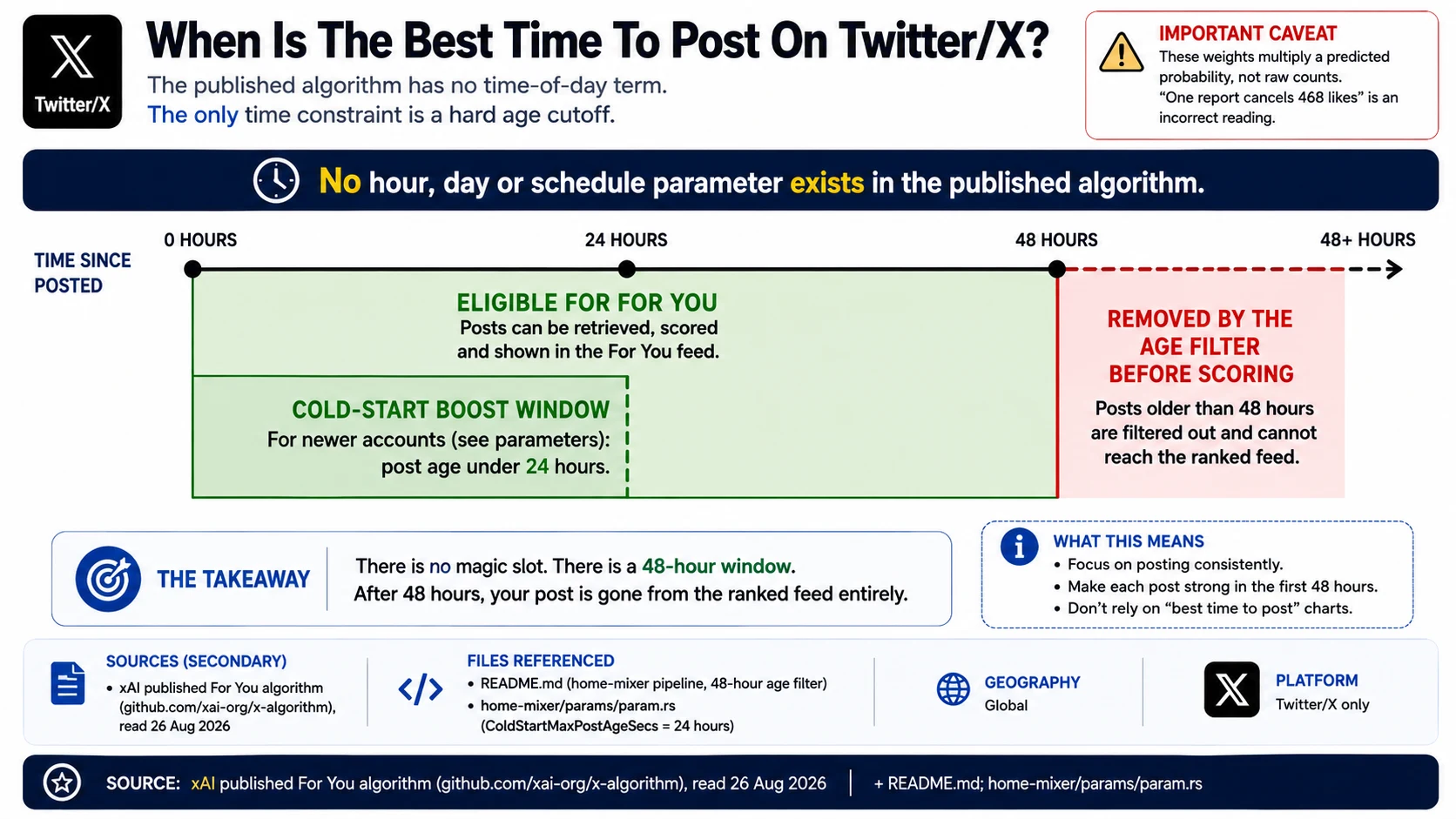
There is no magic posting slot in the published algorithm. There is a 48-hour eligibility window, and a tighter 24-hour cold-start window for newer accounts. Source: xAI published For You algorithm, read 26 August 2026.
Sources: the pipeline and filter list, the published parameters.
How much is a reply worth compared with a like?
Ten times, and twenty times if you follow each other. A reply is weighted 5.0 and a like 0.5. When the viewer and the author follow each other, a boost of 15.0 is *added* to the reply weight, taking it to 20.0 and tying the highest positive signal in the whole model.
Positive weights, read from the published parameter file on 26 August 2026.
Signal | Weight | Signal | Weight |
|---|---|---|---|
Share via copied link | 20.0 | Click | 0.4 |
Reply from a mutual follow | 20.0 (5.0 + 15.0) | Open link | 0.2 |
Reply | 5.0 | Video open | 0.07 |
Quote | 5.0 | Dwell | 0.05 |
Share via DM | 5.0 | Photo expand | 0.05 |
Follow author | 4.0 | Profile click | 0.0 |
Share | 2.0 | Bookmark | not in the file |
Repost | 1.0 | ||
Like | 0.5 |
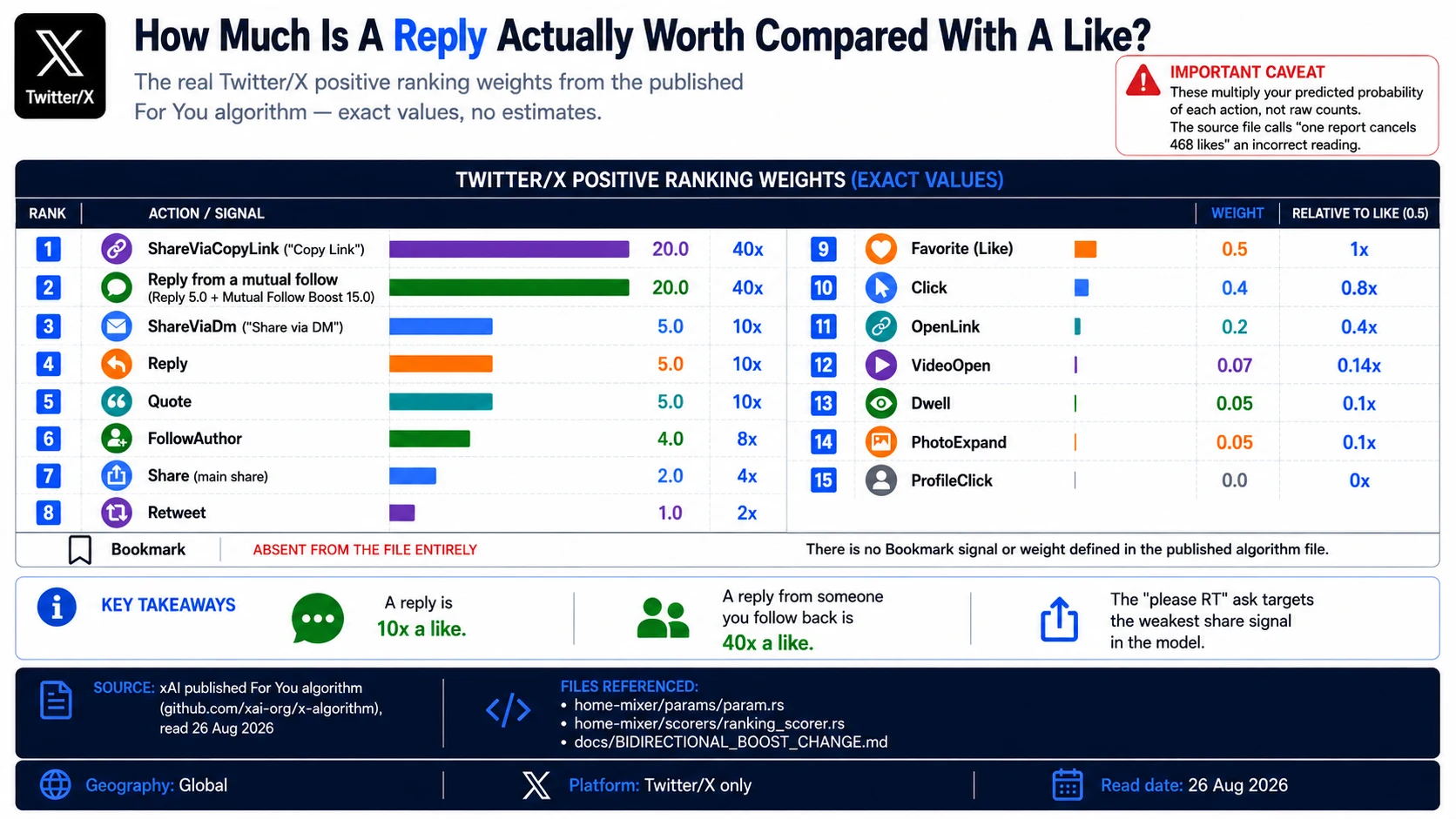
A reply is weighted ten times a like, and forty times if you follow each other. Bookmark does not appear in the published file at all. Source: xAI published For You algorithm, home-mixer/params/param.rs, read 26 August 2026.
‼️ The caveat that kills the arithmetic. The file states these weights multiply your *predicted probability* of each action, not raw counts. It calls out the specific misreading by name: it would be wrong to see that a report weighs 468 times a like and conclude that one report cancels 468 likes. Every "a reply equals 27 likes" claim circulating online makes exactly that error.
The mutual-follow boost has a documented history: it launched at 20.0 on 13 July 2026 and was cut to 15.0 on 24 July, after Twitter/X found it was crowding out wider conversation. It applies to original posts only, never replies or reposts. What it is really telling you is in our reply strategy piece.
Sources: the published scoring weights, how the boost is applied, the boost changelog.
Do links reduce your reach on Twitter/X?
Not in the ranking code, and yes in the data. There is no link penalty term anywhere in the published weights, and both link-related actions are positive: opening a link scores +0.2 and a click +0.4. But Buffer's study of 18.8 million posts found link posts really do underperform. The effect is real. The mechanism is not what people say.
OpenLink+0.2 andClick+0.4 are both on the positive side of the sum.No link penalty, demotion or URL filter exists in the published weights or the documented filter list.
Buffer's observational data still shows links as the weakest post type at 2.25%, against 3.56% for text, on the same dataset and the same definition.
‼️ So the honest reading is that links underperform because of learned behavior, not a coded rule. The model predicts you are less likely to engage with a link post because historically people are, and that prediction is what lowers the score.
⚠️ The widely quoted "50 to 90% link penalty" is not supported by anything in the published file.
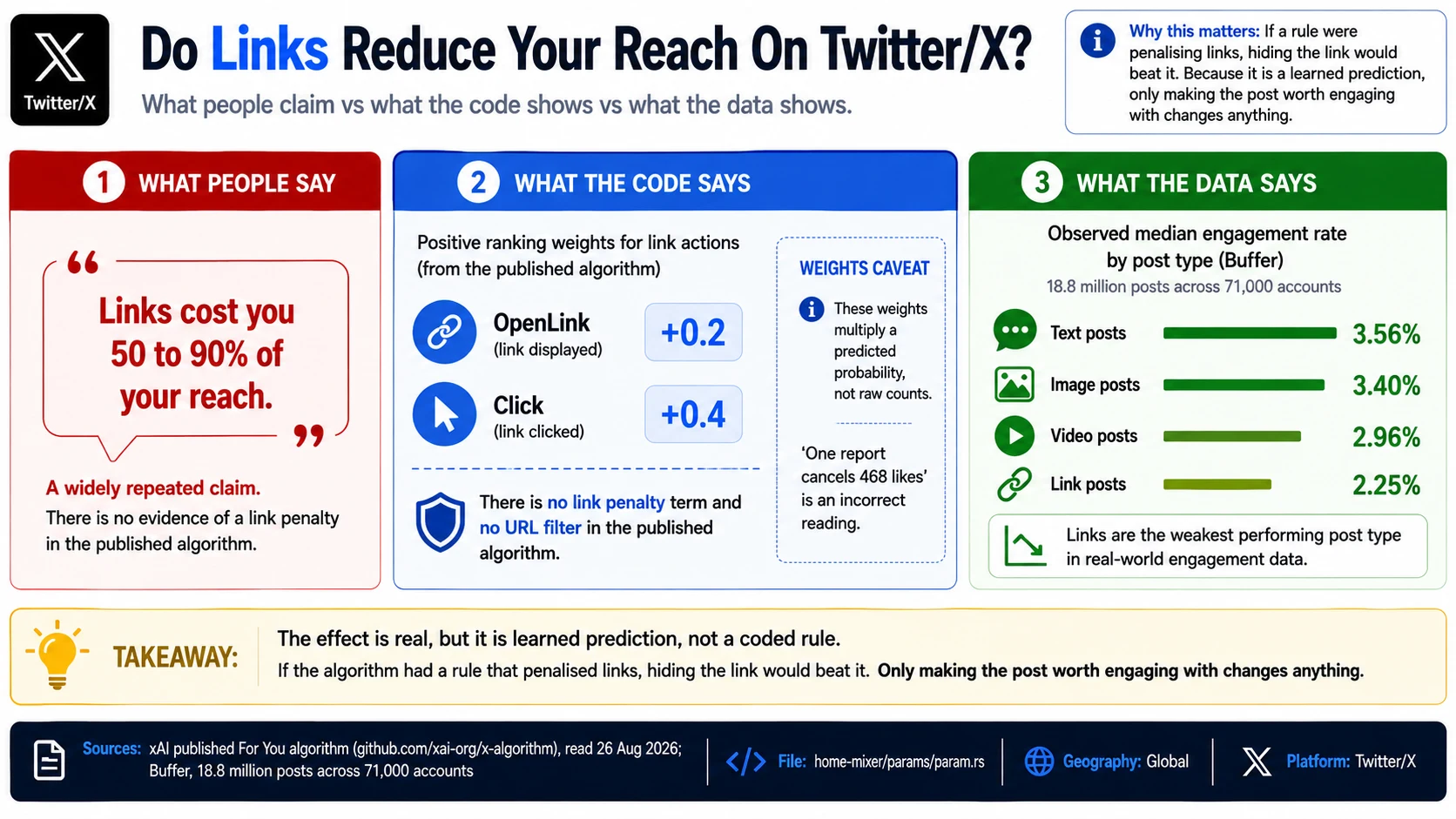
No link penalty exists in the ranking code, yet link posts still perform worst in observed data. The effect is learned prediction, not a coded rule. Sources: xAI published For You algorithm, read 26 August 2026; Buffer, 18.8 million posts across 71,000 accounts.
The practical difference matters. If a rule were penalizing links, hiding the link would beat the rule. If the cause is a learned prediction, then making the post worth engaging with regardless of the link is what changes the outcome.
Sources: the published scoring weights, Buffer on links on Twitter, the filter list.
Do bookmarks and profile clicks help your reach?
Neither does anything for ranking. ProfileClick carries a weight of exactly 0.0, and there is no bookmark signal in the published weights at all. Both are among the most confidently repeated pieces of Twitter/X advice, and the published file supports neither.
ProfileClickWeightis 0.0. The action is tracked and predicted, and contributes nothing to the score.No bookmark term appears in the parameter file or the scorer. The widely quoted "bookmarks are worth about 10x a like" has no basis in the published code.
⚠️ Absence from the published weights is not proof the platform ignores bookmarks entirely. It does mean the claim has no published support, and nobody quoting a multiplier can show you where it comes from.
So a "bookmark this thread" call to action is, on the published evidence, doing nothing for distribution.
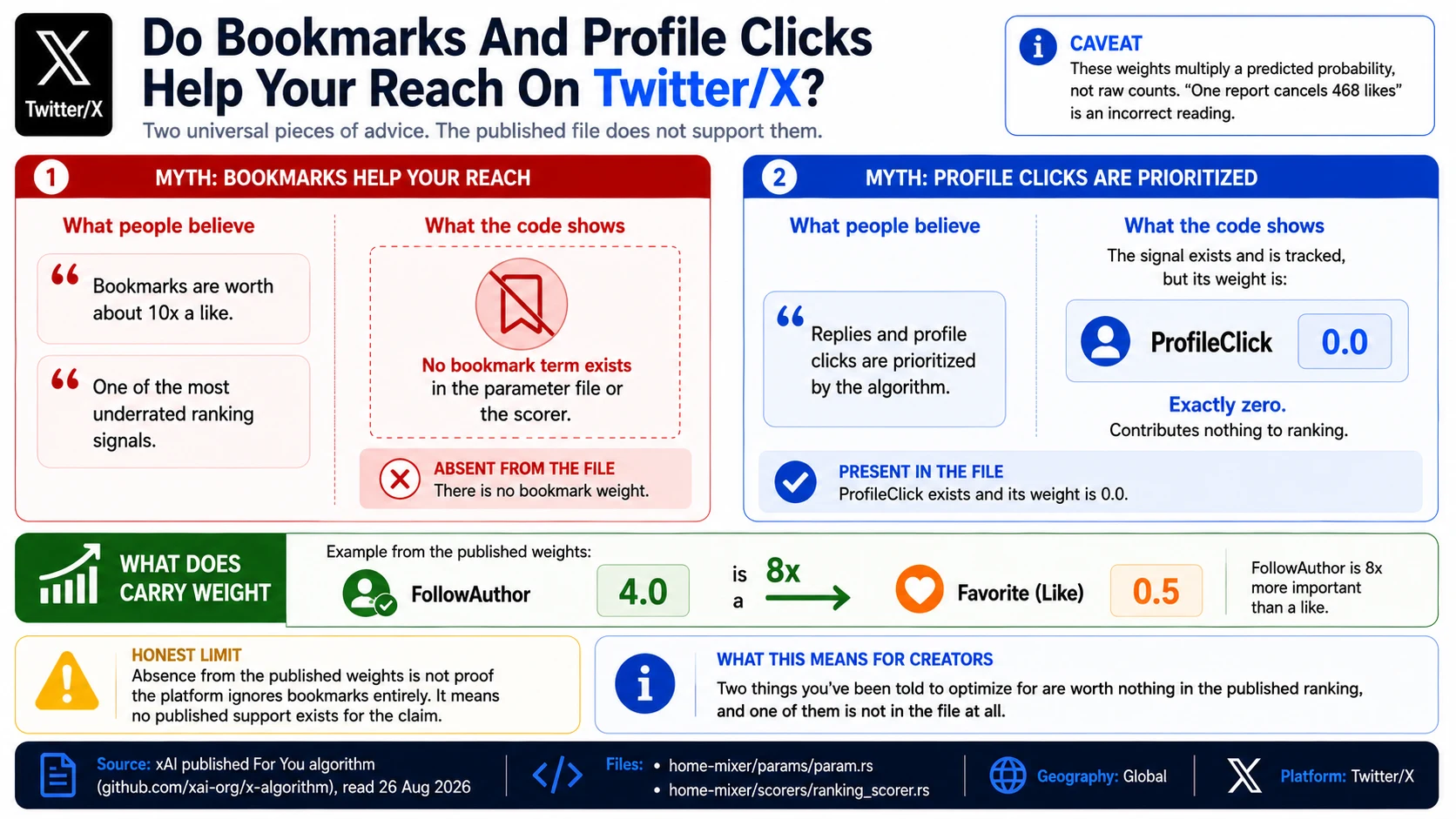
Bookmarks are absent from the file entirely, which is different from being weighted zero. ProfileClick is present and weighted exactly 0.0. Source: xAI published For You algorithm, read 26 August 2026.
This is worth pausing on if your strategy is built on driving profile visits. The action that *does* carry weight is a follow, at 4.0. See how to get more followers.
Sources: the published scoring weights, the scorer.
How many times a day should I post on Twitter?
The algorithm does not count your daily posts. It applies a decay within a single viewer's feed: your second post to that person is multiplied by 0.5, and successive posts decay toward a floor of 0.25. So extra posts are never blocked, they just compete from further behind for the same reader.
Repeated-author decay, computed from the published formula (1 - floor) x decay^position + floor with decay 0.5 and floor 0.25. Per viewer, per ranking pass, not per day.
Position in that viewer's feed | Multiplier applied |
|---|---|
Your first post | 1.0, full weight |
Your second | 0.625 |
Your third | 0.4375 |
Your fourth | 0.34375 |
Fifth and beyond | Approaches the 0.25 floor and never goes below it |
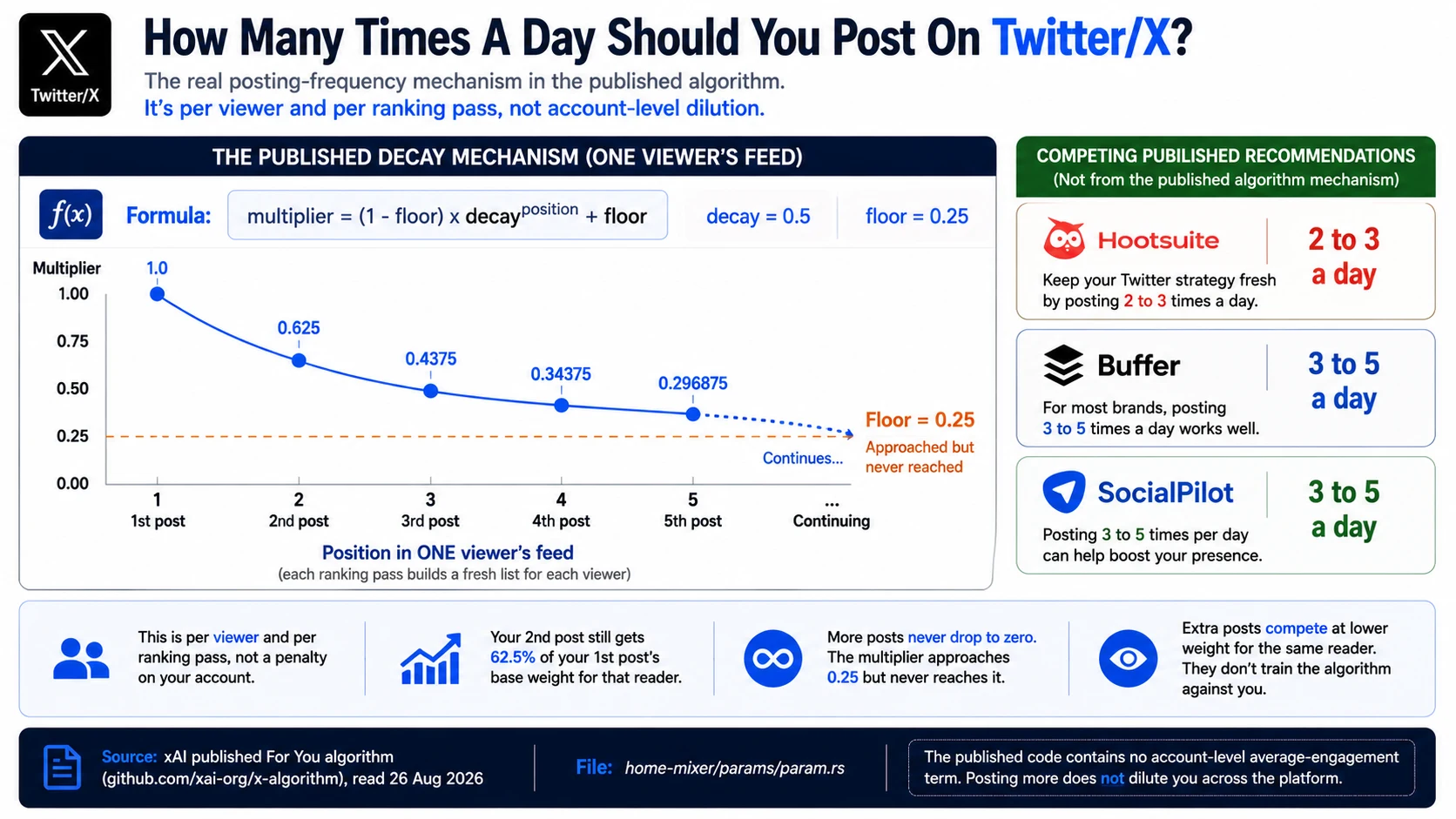
Your second post still carries 62.5 percent of your first post's weight for that reader, and the multiplier never reaches zero. Source: xAI published For You algorithm, home-mixer/params/param.rs, read 26 August 2026.
‼️ The popular explanation is wrong even though the advice is right. Posting more does not "train the algorithm to show your content to fewer people" at account level. There is no account-level dilution term.
The decay is per viewer and per ranking pass, so it does not accumulate against you across the day.
Because the floor is 0.25 rather than zero, a fourth post is still eligible. It competes at about a third of full weight, and later ones settle just above a quarter. The decay never reaches zero.
⚠️ Published advice ranges from 2-3 to 3-5 posts a day, and none of it is sourced to this mechanism.
The reasonable read is to set cadence by what you can sustain at quality, which is the argument we make in what actually compounds on Twitter.
Sources: the published parameters, the scoring adjustments.
What actually hurts your reach the most?
Negative signals, and by an enormous margin. A report is weighted -234.0, against the largest positive signal at 20.0. The genuinely counterintuitive part: being muted costs you nearly twice what being blocked does, at -58.8 against -31.2.
Negative weights, read from the published parameter file. Compare against the largest positive signal, 20.0.
Signal | Weight | What it means |
|---|---|---|
Report | -234.0 | By far the heaviest number in the model |
Mute author | -58.8 | A silent action, and worse than a block |
Not interested | -43.2 | The explicit "show me less" tap |
Block author | -31.2 | Visible, and the *least* damaging of the four |
Not dwelled | -0.02 | Shown and scrolled past without being read |
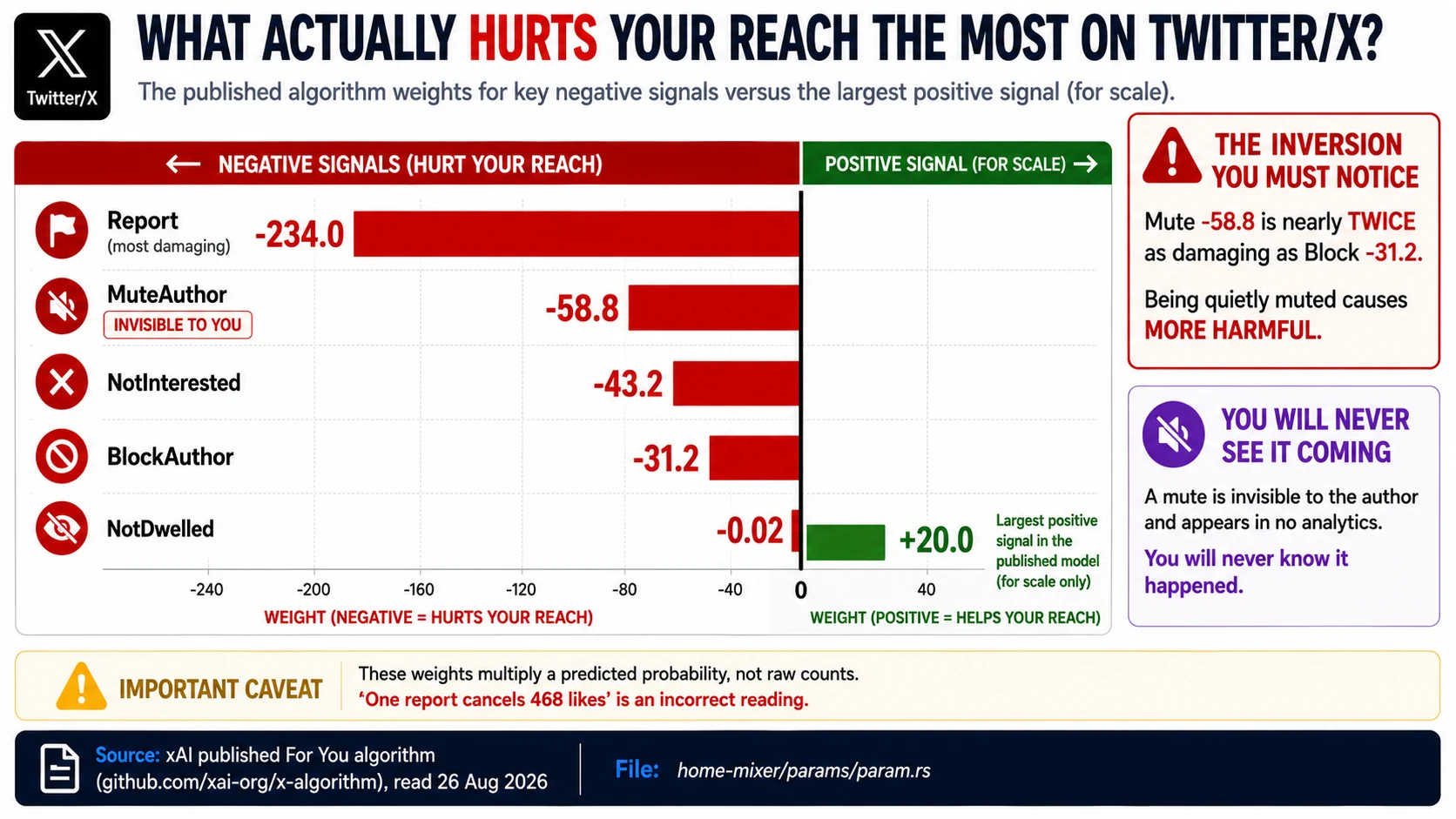
A mute at -58.8 costs nearly twice a block at -31.2, and it is invisible to you. Source: xAI published For You algorithm, home-mixer/params/param.rs, read 26 August 2026.
‼️ Mute is the signal to worry about. It is invisible to you, it costs nearly double a block, and nothing in your analytics reports it.
This inverts the usual advice. Avoiding the behavior that makes people quietly mute you matters more than any posting tactic.
NotDwelledat -0.02 is small individually, but it fires every time someone scrolls past without reading, which is most impressions.⚠️ Remember the caveat: these multiply predicted probabilities, so a single report does not literally erase 468 likes.
Sources: the published scoring weights, the scorer.
Every number on this page exists because xAI publishes the scoring weights. No equivalent file exists for LinkedIn, so the same questions there have to be answered a different way, from LinkedIn's own research and documentation with the gaps marked. That is what our LinkedIn answers do. What the third-party tools actually cost is in our social media tools answers, and the questions about the writing itself are in our content writing answers.
Researched and written by Prateek Singh. Every weight and threshold quoted here was read directly from the published algorithm files on 26 August 2026 and is linked at the point it is used.

Growth
Twitter search ban: what the platform actually documents, and what it does not
A Twitter search ban is the one part of a "shadowban" that can actually be verified: your posts stop appearing in search. This is what Twitter's own documentation says about it, how to test it by hand in under a minute, the six behaviours Twitter names as causes, and why nobody can tell you how long it lasts. Plus the distinction almost every guide misses, between enforcement that Twitter applies to you and ranking that simply does not favour you.
12 min read

Growth
Personal brand posting schedule for X and LinkedIn in 2026
The best posting schedule for a personal brand is not a magic time slot. It is a repeatable system: the right frequency, the data-backed time windows, a content mix per platform, and enough consistency that both algorithms and audiences start to expect you. Here is that system for X and LinkedIn in 2026, with frequency and timing tables, a sample weekly calendar, a 4-week ramp, and the honest reason most schedules quietly collapse.
16 min read
Growth
Social media monetization: how to turn your audience into income
Social media monetization runs on a handful of proven paths: sponsored content, digital products, services, paid communities, and affiliate revenue. The path matters less than the asset underneath all of them, the trust your audience places in your voice. Here is how each works and why voice comes first.
13 min read
Growth
The reply guy playbook: how to use AI for Twitter replies (without sounding like a bot) in 2026
The short answer: use AI for replies the voice-rich way (voice-trained drafts you edit and ship at 5 to 10 a day), never the voice-corrosive way (automation at 30 to 100 a day). Reply automation at scale is voice-corrosive at the structural level; the audience pattern-matches automated reply patterns within scrolling distance and the writer's reputational capital collapses faster than any other content failure mode. The conviction-led playbook for AI-assisted Twitter replies in 2026 that does not sound like a bot: the voice-corrosive-versus-voice-rich split in reply tooling, the inline Chrome extension workflow that keeps the writer in the loop, three illustrative reply examples clearly labeled constructed, the bot-shape self-check, and the operational discipline that compounds reputational capital instead of collapsing it.
22 min read

Growth
How to repurpose tweets into LinkedIn posts (without sounding generic) in 2026
Cross-platform repurposing fails most often when the writer optimizes for LinkedIn's surface conventions and loses the voice that made the X content land. The tactical, example-rich playbook for repurposing tweets into LinkedIn posts in 2026: three structural moves (format conversion 280-char to 3000-char native, tone calibration without LinkedInfluencer cliches, audience-context adjustment from feed-scrolling to professional reading), illustrative before/after transformations clearly labeled constructed, and the voice-fidelity discipline that holds across both platforms.
13 min read