The short version
‼️ These tools bill by six different units: per channel, per brand, per social set, per social account, per seat, and per workspace with unlimited users. A cheap tool and an expensive one swap places as your setup changes.
About a third of the prices on the pages that rank are wrong, and nearly all the wrong ones are the same mistake: a discounted annual rate printed as the monthly price.
Nine of eleven vendors default their pricing page to annual billing, which is why that mistake is so easy to make.
Buffer is $5 per channel billed yearly and $6 billed monthly. Sprout starts at $79 per seat yearly and $99 monthly. Sendible is $30 yearly and $35 monthly.
‼️ Genuinely free plans exist at Buffer, Metricool and Publer. Hootsuite, Sprout, Later and Sendible are trial-only.
Publer's free plan cannot connect Twitter/X at all, and it says why: "Due to the Twitter / X Enterprise API cost". Metricool's free plan excludes LinkedIn and Twitter.
‼️ Hootsuite's terms say that if you cancel you "must continue to pay for the rest of your plan term" and "are not entitled to a refund".
The famous claim that scheduling kills your reach was about LinkedIn's own native scheduler, not third-party tools. Its author says he had not tested those.
Read this before you read anything else. We sell a competing product. VoiceMoat is a personal brand operating system for Twitter and LinkedIn, so we have an interest in what you conclude here. ‼️ This page therefore never recommends a tool. It publishes prices taken off each vendor's own pricing page, shows what each billing model costs at different sizes, works the arithmetic in the open so you can check it, and stops there. Where we could not verify something, it is not on the page.
How much does a social media management tool cost?
There is no useful single answer, because these tools do not bill by the same thing. Six different units are in use: per channel, per brand, per social set, per social account, per seat, and per workspace with unlimited users. The published "from $X" price tells you almost nothing until you know which unit it multiplies.
What each vendor actually charges for, read from its own pricing page. The entry price is meaningless without the unit next to it.
Tool | Billed by | Entry price | What that entry price buys |
|---|---|---|---|
Buffer | Channel | $5/mo yearly, $6 monthly | One channel. Multiply by every account you connect |
Metricool | Brand | $20/mo yearly, $25 monthly | Up to 5 brands at that price |
Later | Social set | $18.75/mo yearly | One social set, meaning one profile per supported platform |
Publer | Social account | $4/mo yearly | One social account. Multiply by each |
Sprout Social | Seat | $79/seat yearly, $99 monthly | One person, 5 social profiles |
Hootsuite | Seat | $99/user yearly | One person, up to 10 social accounts |
Sendible | Workspace | $30/mo yearly, $35 monthly | One workspace, 6 profiles, ‼️ unlimited users |
‼️ The monthly versus annual trap is why published prices are so often wrong. Nine of the eleven vendors checked default their pricing page to annual billing. The number on the card is the discounted rate, and articles copy it and write "/month" beside it.
Buffer is the clearest example. Its page opens on yearly and shows $5 /month, with $60 billed yearly underneath. Switch the toggle to monthly and the same plan is $6.
Only Sendible and Hypefury default to monthly, out of everything checked.
Sendible is the outlier that matters for teams. It states "Unlimited users on all plans" and bills by workspace, while Sprout and Hootsuite bill per person.
⚠️ A "from" price also hides the cap. Sprout's $79 seat allows 5 social profiles. Hootsuite's $99 seat allows up to 10 social accounts. Later's cheapest plan allows 30 posts per profile per month.
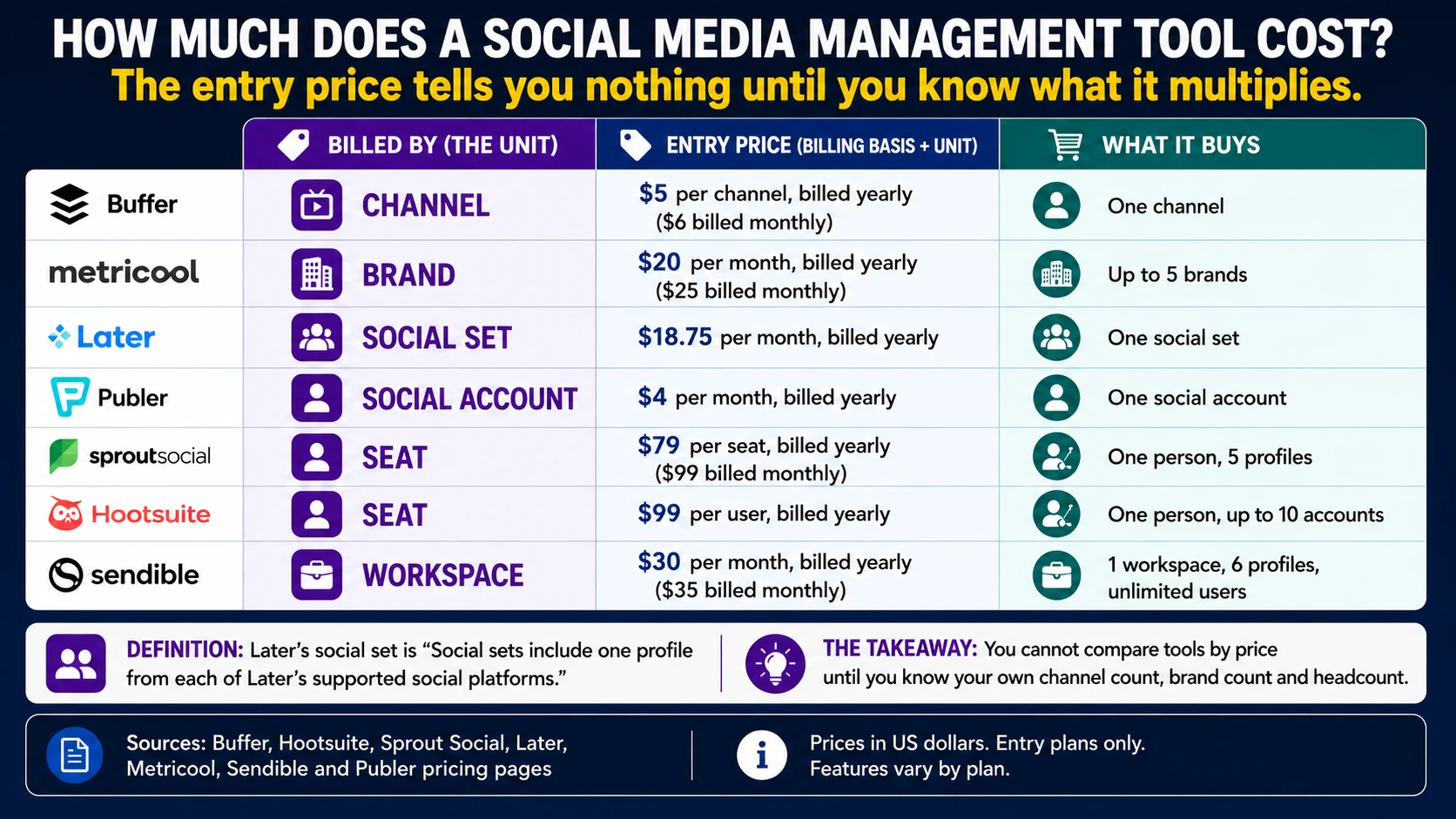
The entry price tells you nothing until you know what it multiplies. Sources: Buffer, Hootsuite, Sprout Social, Later, Metricool, Sendible and Publer pricing pages.
We keep plan-by-plan breakdowns of the two most-searched tools, at Buffer pricing and Hootsuite pricing. For what the arithmetic does at different sizes, see the cheapest option below.
Sources: Buffer, Hootsuite, Sprout Social, Later, Metricool, Sendible, Publer.
Is Hootsuite worth it?
That depends on facts most articles get wrong, so start with the real ones. Hootsuite starts at $99 per user billed annually, not $199 or $249. There is no free plan, the trial is 14 days, and the entry tier is capped at 10 social accounts. Whether that is worth it turns almost entirely on how many people need a login.
Hootsuite's published plans, read from its own pricing page. Prices are per user and the page displays annual billing.
Plan | Price | Social accounts |
|---|---|---|
Standard | $99 per user/mo | Up to 10 |
Professional | $199 per user/mo | Unlimited |
Advanced | Up to $399 per user/mo | Unlimited |
Enterprise | Custom | Unlimited |
‼️ Four separate pages that rank for this question state the entry price as $199 or $249. Hootsuite's own FAQ says "Paid plans start at $99 for a Standard plan".
No free plan exists. Hootsuite announced in April 2021 that it was changing how many accounts and messages its Free plan allowed, and today the pricing page offers a 14-day trial and nothing free.
Because it bills per user, cost scales with headcount rather than with how many accounts you run. Three people on Standard is $297 a month, for the same 10 accounts one person would get for $99.
⚠️ Before subscribing, read the cancellation terms in what happens if you cancel below. They are stricter than most.
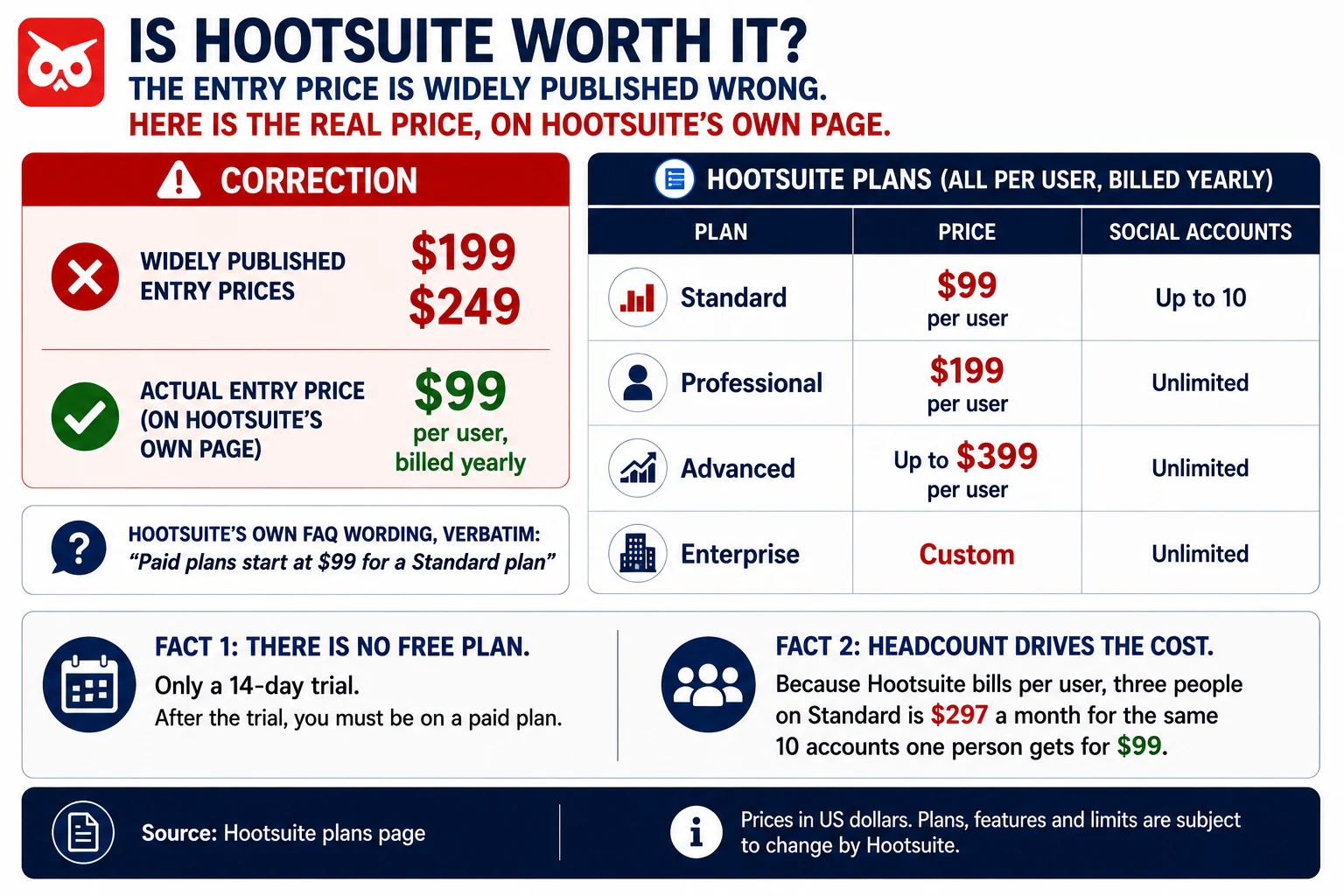
The real entry price is $99 per user billed yearly, capped at 10 social accounts. Source: Hootsuite plans page.
Sources: Hootsuite plans, Hootsuite on its Free plan.
Which social media tools are actually free, and which are just free trials?
Three of the tools checked have a genuinely free plan: Buffer, Metricool and Publer. Hootsuite, Sprout Social, Later and Sendible are trial-only, at 14 or 30 days. ‼️ And two of the three free plans exclude major platforms, which is the part nobody prints.
Free plans and trials, read from each vendor's pricing page.
Tool | Free plan? | What the free plan allows | Trial |
|---|---|---|---|
Buffer | Yes | 3 channels, 10 scheduled posts per channel, 100 ideas, 1 user | 14 days on paid plans |
Metricool | Yes | 1 brand, 20 posts a month. ‼️ Excludes LinkedIn and Twitter | n/a |
Publer | Yes, "free forever" | 1 user, 3 social accounts. ‼️ Excludes Twitter/X entirely | n/a |
Hootsuite | No | n/a | 14 days |
Later | No | n/a | 14 days |
Sendible | No | n/a | 14 days |
Sprout Social | No | n/a | 30 days |
‼️ Publer says plainly why Twitter/X is excluded: "Due to the Twitter / X Enterprise API cost, we can only support Twitter / X accounts on a paid subscription basis." Its free plan lists "3 social accounts (except 𝕏)".
Metricool's free plan covers "all your brands' social networks (except LinkedIn and Twitter)", and sells Twitter/X as an add-on on its entry paid tier.
⚠️ So "free" and "free for the platform you actually use" are different questions, and only one of them gets answered in comparison articles.
Buffer's free plan is the least restricted of the three, at 3 channels with 10 scheduled posts per channel, with no platform carved out.
A trial is not a free plan. Sprout's 30 days is the longest found; most are 14.
Sources: Buffer, Metricool, Publer, Hootsuite, Later, Sendible, Sprout Social.
If I cancel, do I still have to pay?
With Hootsuite, yes. Its terms state that if you cancel or downgrade "you must continue to pay for the rest of your plan term" and "you are not entitled to a refund". Plans also renew automatically by default. ‼️ No comparison article that ranks for these tools mentions this.
Hootsuite Terms of Service, section 24, verbatim: "If you cancel (or downgrade) paid Self-Serve Services, you must continue to pay for the rest of your plan term" and "you are not entitled to a refund".
Section 22, verbatim: plans "will renew automatically at the end of the term (which may be monthly or annually, depending on the plan you chose when you purchased the Self-Serve Services), and we will automatically bill you on renewal unless you cancel or downgrade".
‼️ Read together, those two clauses are the real cost of an annual plan. Committing to a year is not a discount decision, it is a twelve-month liability, and the annual price is what makes it attractive.
Section 25 does provide a refund in one direction: if Hootsuite terminates your access "for no reason", it will refund the services you have not yet received. If it terminates you for breaking the rules, it will not.
⚠️ This is one vendor's terms, not the category's. We checked Hootsuite's because it is the most-searched. Read the terms of whichever tool you are about to buy, not this paragraph.
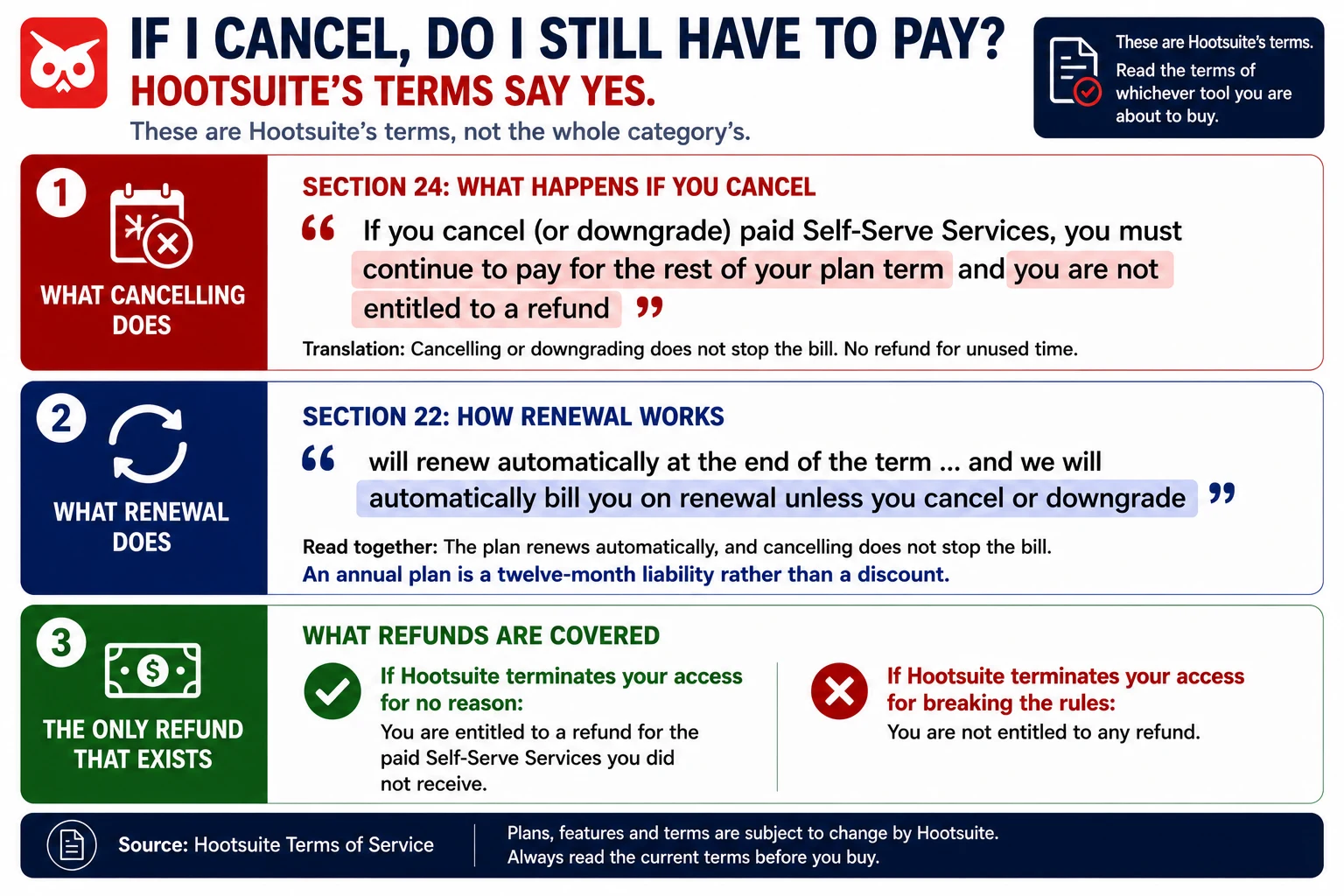
Cancelling does not stop the bill, and the plan renews by default. ⚠️ These are Hootsuite's terms, not the whole category's. Source: Hootsuite Terms of Service.
Sources: Hootsuite Terms of Service.
Do scheduled posts get less reach?
The claim everyone repeats was never about third-party tools. The viral version says explicitly: "stop using LinkedIn's native scheduler", and its author adds of third-party tools, "I haven't tested their engagement impact, yet." A commenter relaying LinkedIn's product team answered: "No, scheduling a post doesn't impact engagement, but timing does matter."
The original post is about LinkedIn's own built-in scheduler, and recommends third-party tools such as Buffer and Sprout as one of its three alternatives. ‼️ It is routinely quoted as evidence against the exact tools it recommends.
The rebuttal in the thread, quoted verbatim: "No, scheduling a post doesn't impact engagement, but timing does matter. Aim to schedule posts when your audience is most active."
Other named commenters disputed the original on method rather than data. One: "This is probably wrong. It's correlation and not causation." Another asked for data and said he had not seen the effect in his own posts.
⚠️ Percentages do circulate, including an 8 to 15 percent figure described by the practitioner quoting it as from 2023 and no longer applicable. None of them comes with a published sample or method, so this page is not repeating them as findings.
‼️ No platform has published data on this. For what the platforms do publish about ranking, see our Twitter/X answers and LinkedIn answers, where the sources are named. For the questions about the writing itself rather than the tool, see our content writing answers.
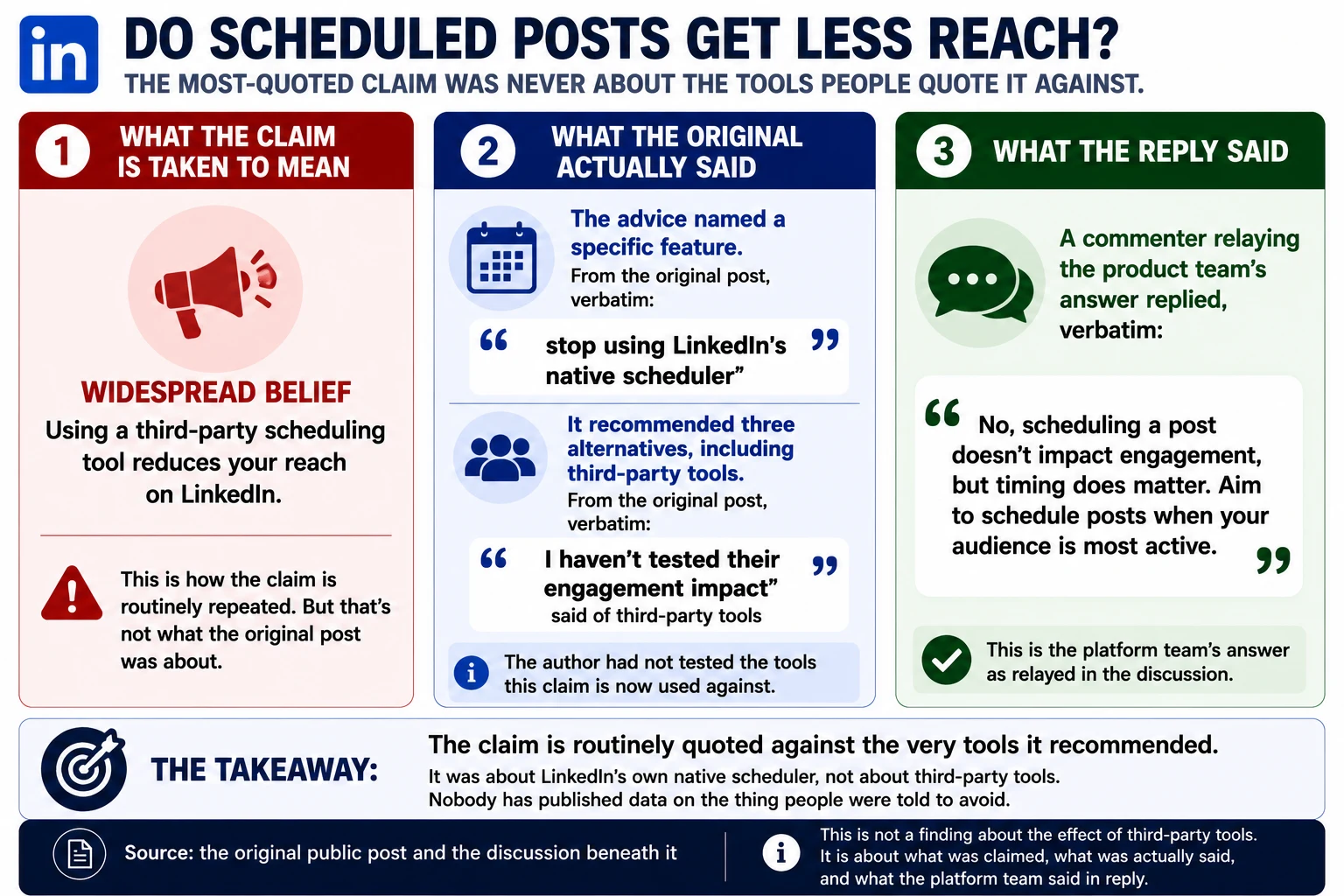
The claim is routinely quoted against the very tools it recommended. Source: the original public post and the discussion beneath it.
Sources: the original claim and the thread beneath it.
Will connecting a third-party tool get my account restricted?
On LinkedIn the written policy is stricter than common practice. LinkedIn does not permit third-party software that scrapes, changes the look of, or automates activity on the site, and says members using such tools "risk having their accounts restricted or shut down". Its API terms separately list automated posting as a prohibited use.
LinkedIn's "Prohibited software and extensions" page, verbatim: "We don't permit the use of any third party software, including 'crawlers', bots, browser plug-ins, or browser extensions that scrape, modify the appearance of, or automate activity on LinkedIn's website."
And the consequence, verbatim: "Any member who uses tools for such purposes is in violation of the User Agreement. This means that they risk having their accounts restricted or shut down."
LinkedIn's API Terms of Use, in its list of prohibited uses at section 3.1: "Use the Content or the APIs to automate posting on the LinkedIn Services."
‼️ And here is the honest gap. The word "scheduling" does not appear anywhere in those API terms. LinkedIn runs a separate partner program with its own additional terms, and major schedulers operate openly. LinkedIn has never published where scheduling your own post ends and "automating posting" begins.
⚠️ We are not a neutral party on this question. VoiceMoat posts to LinkedIn, so read the two policy links above yourself rather than taking our reading of them.
Neither page names any permitted tool, and neither distinguishes a scheduler from a scraper.
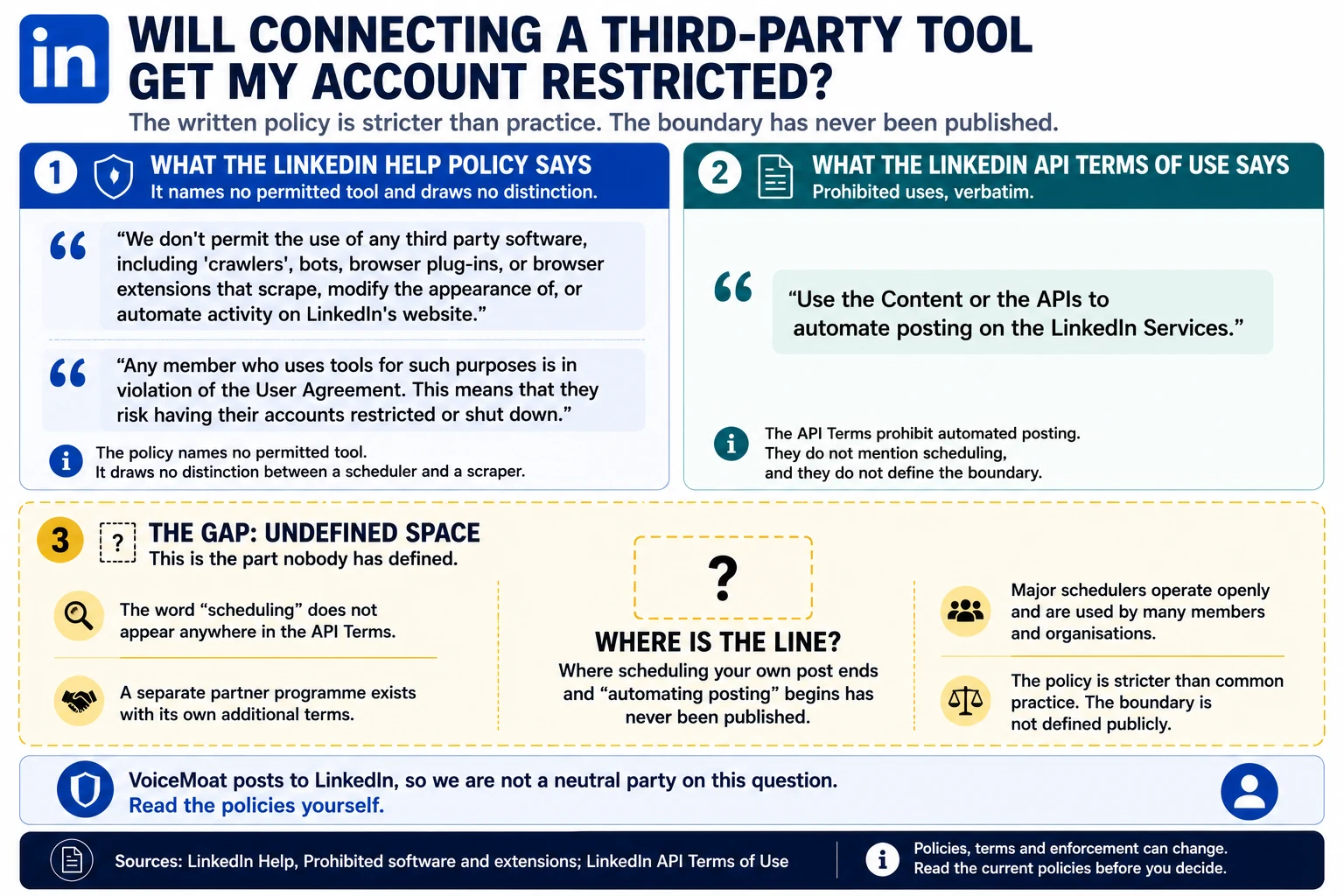
The written policy is stricter than common practice, and where scheduling ends and automating begins has never been published. ⚠️ VoiceMoat posts to LinkedIn, so read the policies yourself. Sources: LinkedIn Help and the LinkedIn API Terms of Use.
Sources: LinkedIn on prohibited software, LinkedIn API Terms of Use.
Buffer vs Hootsuite: what is the actual difference?
They bill by opposite things, and that decides it more than any feature. Buffer charges per channel, so cost grows with how many accounts you connect. Hootsuite charges per user, so cost grows with how many people log in. One person with many accounts and a team with few accounts get opposite answers.
The same two tools at three different setups, using each vendor's published prices at annual billing.
Setup | Buffer | Hootsuite |
|---|---|---|
1 person, 3 channels | $15/mo (3 x $5) | $99/mo |
1 person, 10 channels | $50/mo (10 x $5) | $99/mo |
3 people, 10 channels | $50/mo per channel cost | $297/mo (3 x $99) |
Buffer has a free plan at 3 channels. Hootsuite has none, only a 14-day trial.
Buffer's entry paid tier is $5 per channel billed yearly and $6 billed monthly. Hootsuite's is $99 per user, with the page displaying annual billing.
‼️ The crossover is roughly 20 channels for a single user, at which point Buffer's per-channel model passes Hootsuite's flat per-seat price. Below that, Buffer is cheaper for one person; above it, Hootsuite is.
⚠️ The table above compares price, not capability. Hootsuite's tiers include features Buffer's entry plan does not, and this page does not rank them.
Hootsuite's Standard tier caps at 10 social accounts, so the third row would need its Professional tier for more.
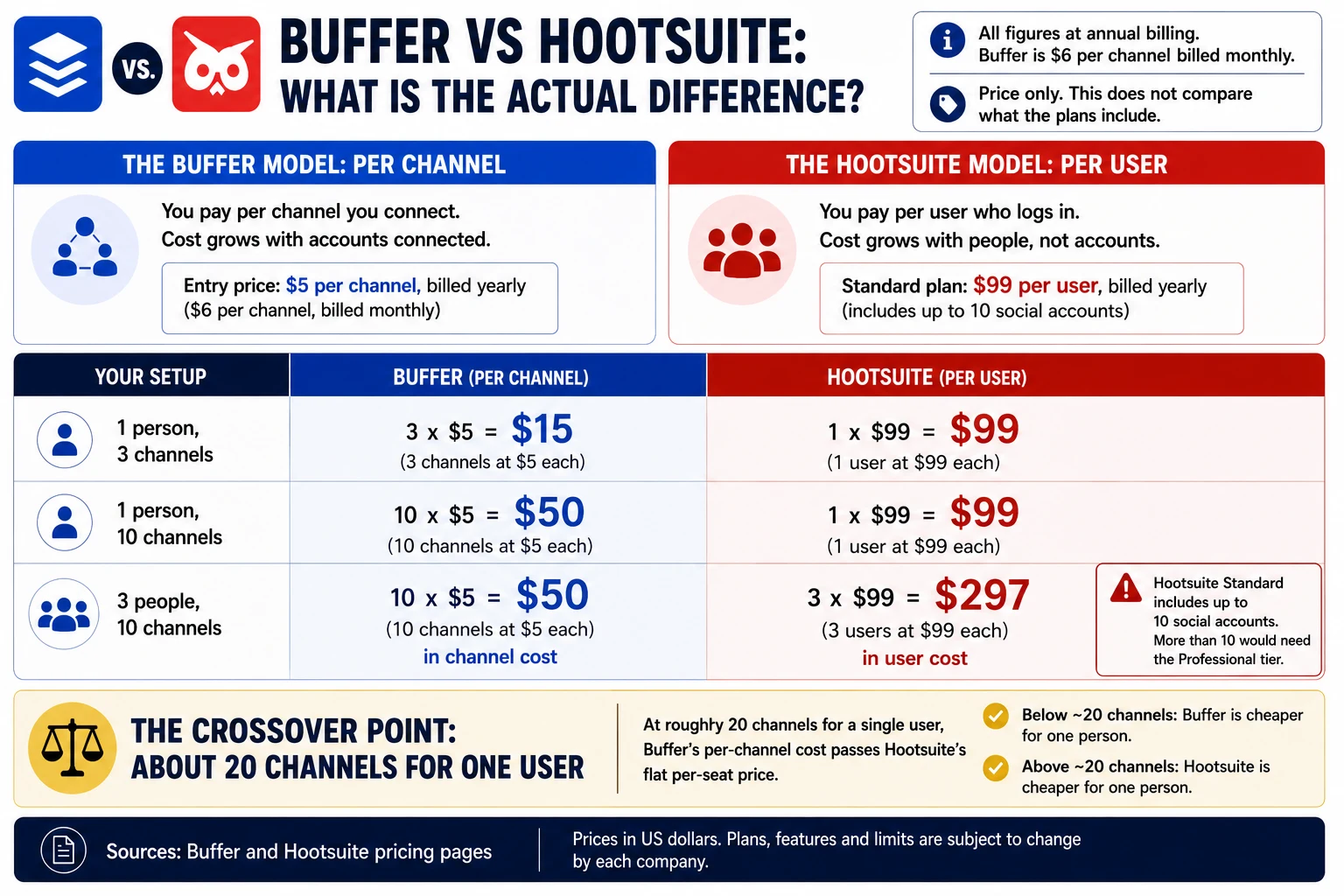
Buffer grows with accounts connected, Hootsuite grows with people logging in, and they cross at roughly 20 channels for one user. ⚠️ Price only, at annual billing. Sources: Buffer and Hootsuite pricing pages.
Sources: Buffer pricing, Hootsuite plans.
What is the cheapest social media management tool?
It changes with your setup, and it changes a lot. Buffer is cheapest at three channels. Later is cheapest at eight. At three people the picture changes again, and three of the four cluster within four dollars of each other while the fourth costs ten times as much. Any article naming one winner has quietly assumed a configuration it did not tell you about.
The same three setups priced across the tools, using each vendor's published annual-billing figures. The arithmetic is shown so you can check it.
Setup | Buffer | Later | Sendible | Sprout Social |
|---|---|---|---|---|
1 person, 3 channels | $15 (3 x $5) | $18.75 | $30 | $79 |
1 person, 8 channels | $40 (8 x $5) | $18.75 (1 social set) | $84 (needs 18 profiles) | $299 (needs unlimited profiles) |
3 people, 8 channels | $80 (Team, 8 x $10, unlimited team members) | $82.50 (Scale, 4 users) | $84 (Plus, unlimited users) | $897 (3 x $299) |
‼️ The inversion is the point. Buffer is the cheapest of the four at three channels and more than double Later's price at eight, because Later's "social set" bundles one profile per supported platform into a single unit.
‼️ At three people the row tightens to almost nothing. Buffer's Team tier, Later's Scale tier and Sendible's Plus tier land at $80, $82.50 and $84 for the same eight channels, by three completely different routes. Sprout costs $897 for the same job.
⚠️ Watch the tier, not just the tool. Buffer's cheap $5 rate is its Essentials plan, which includes one user account; three people need Team at $10 per channel. Later's $18.75 allows one user, and three people need its Scale tier.
⚠️ Cheapest is not best and this page is not saying it is. Sprout at $299 a seat buys a different product. The point is only that the price ordering is not stable.
Free is genuinely an option at small scale, if your platforms are covered. See which tools are actually free above.
⚠️ Two vendors served local-currency pricing rather than US dollars during research, so they are not in this table rather than being converted.
Sources: Buffer, Later, Sendible, Sprout Social.
Which tool handles multiple accounts, a team, or an agency best?
Ask one question first: does the tool charge per person? That single fact moves the bill by an order of magnitude at team size. Sendible states "Unlimited users on all plans" and bills by workspace. Sprout Social and Hootsuite bill per seat. At ten people that is the difference between one bill and ten.
How each tool scales with people, as published on its own pricing page.
Tool | Charges per person? | What scales the bill instead |
|---|---|---|
Sendible | ‼️ No. "Unlimited users on all plans" | Workspaces and profiles. 1 workspace and 6 profiles at entry |
Sprout Social | Yes, per seat | Seats. $79 to $399 each |
Hootsuite | Yes, per user | Users. $99 to $399 each |
Buffer | Partly | Channels first. Essentials is $5 each with 1 user account; Team is $10 each with unlimited team members |
Later | Partly | Social sets. Entry allows 1 user, the next tier 2, the next 4 |
Metricool | No | Brands. Up to 5 at the entry price |
‼️ A ten-person team on a per-seat tool pays ten times the sticker. Hootsuite Standard at $99 becomes $990 a month. Sprout Essentials at $79 becomes $790.
Sendible's entry tier is $30 a month billed yearly with unlimited users, but it caps at 1 workspace and 6 profiles, so agencies scale by buying workspaces instead of seats.
Metricool bills by brand, up to 5 at its entry price, which suits someone managing several clients but few people.
⚠️ Approval workflows, client permissions and reporting are what agencies usually actually need, and those sit on higher tiers everywhere. This section compares billing shape, not agency features.
For platform-specific tooling, our Twitter tools and LinkedIn tools lists cover a different set from the general suites priced here.
Sources: Sendible, Sprout Social, Hootsuite, Buffer, Later, Metricool.
Will this tool still support the platform I need next year?
Not necessarily, and this is the risk nobody prices. Tools have dropped Twitter/X support outright when the API economics changed. Make removed its Twitter/X integration entirely. Publer keeps Twitter/X off its free plan and says why. A tool's platform list is a snapshot, not a guarantee.
Make removed its Twitter/X integration, in its own words, "due to x's api policy requirements and pricing that prevent us from providing a reasonable integration to our customers". New scenarios were blocked from 3 April 2025 and existing ones stopped working on 30 May 2025.
Zapier removed its Twitter integration on 31 August 2023, citing "Twitter's decision to change its API policy and pricing", with view-only access for a further month. Its help article is now titled "X (Twitter) integration is back on Zapier".
‼️ Publer prices the same problem rather than dropping it: "Due to the Twitter / X Enterprise API cost, we can only support Twitter / X accounts on a paid subscription basis." Its free plan lists "3 social accounts (except 𝕏)".
Metricool's free plan excludes LinkedIn and Twitter, and sells Twitter/X as a paid add-on at its entry tier.
⚠️ The pattern is consistent and it is economic, not technical. When a platform reprices its API, smaller tools drop it, mid-sized tools move it behind a paid tier, and only the largest absorb it.
‼️ The practical read: if one platform is the reason you are buying, check that vendor's own status or help pages before committing to an annual plan, because an annual plan is a twelve-month bet on their integration surviving.
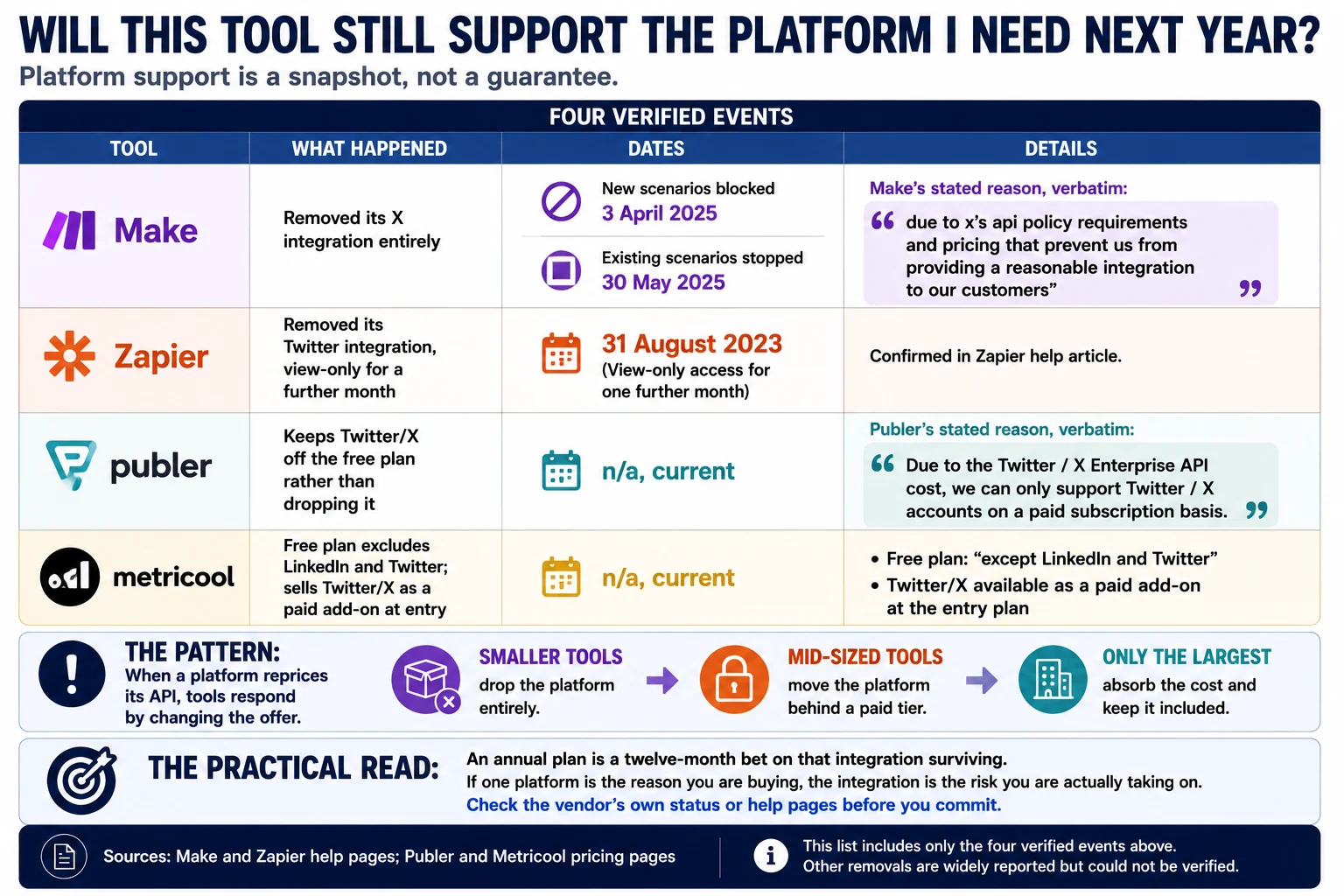
When a platform reprices its API, smaller tools drop it, mid-sized tools move it behind a paid tier, and only the largest absorb it. Sources: Make and Zapier help pages, Publer and Metricool pricing pages.
Sources: Make on removing Twitter/X, Zapier on its Twitter integration, Publer, Metricool.
What this page could not answer
Several things were researched, could not be verified to a source you can open, and are therefore not on this page rather than being included with a hedge.
Two vendors served local-currency pricing rather than US dollars during research. Their prices are omitted rather than converted, because a converted price is not the price they charge.
One vendor's pricing page renders no pricing at all. Its plan costs could not be read from its own site by any method we tried, so it is not priced here.
‼️ Claims about historical price rises and free plans being withdrawn are not on this page. They rest on web archive snapshots we could not open first-hand, and this page publishes only what was verified directly.
We could not verify how many times one integration was removed and restored, so only the single removal that is documented is stated.
⚠️ Prices change. Everything here was read off the vendors' own pricing pages, and vendors move prices, rename tiers and change what a plan includes without notice. Open the linked pricing page before you buy.
We sell a competing product, which is why this page gives you the vendors' own numbers and the arithmetic rather than a recommendation.
Researched and written by Prateek Singh. Every price on this page was read directly off the vendor's own pricing page, and where that page carries a monthly and annual toggle, both positions were read.

AI and Voice
Every social MCP connector reaches both platforms. That is not the hard part
We were going to write that connecting one assistant to both Twitter and LinkedIn was rare. It is not. More than twenty connectors do it and several are free, so channel coverage is table stakes and every roundup ranking them by it is measuring the wrong thing. Here is what actually differs between them, and the one thing we read enumerated tool lists for six of them to confirm nobody does at all.
11 min read

AI and Voice
Why your Claude writing skill doesn't sound like you
There are dozens of free Claude skills for writing, and almost all of them do the same thing: strip out phrases that read as machine-written. That is subtraction, and it leaves you sounding like nobody in particular rather than like yourself. The handful that actually learn a voice from your own writing have a fraction of the users. Here is the difference, why a skill cannot post anything no matter what it says, and where the file actually goes on every surface.
13 min read
AI and Voice
Hootsuite alternatives in 2026, priced from the vendors' own pages
Hootsuite starts at $99 per user a month, not $19. Here is what the realistic alternatives cost, read off each vendor's own pricing page in both billing positions, plus the clause in Hootsuite's terms that its pricing page does not mention.
10 min read

AI and Voice
Taplio alternatives in 2026, priced from the vendors' own pages
Four LinkedIn tools people move to from Taplio, priced from each vendor's own pricing page rather than from each other. Includes the arithmetic on Taplio's Pro tier, which does not add up, and one name still on every recommendation list that has quietly shut down.
11 min read
AI and Voice
Later alternatives in 2026, and the caps that actually move you up a tier
Later is one of the cheapest majors on headline price. What moves you up a tier is not the price, it is the 30-posts-per-profile cap and the user count. Here is what the alternatives cost, read off each vendor's own page in both billing positions.
10 min read