The short version
‼️ AI detectors do not detect authorship. They measure how predictable text is. In peer-reviewed testing, seven detectors wrongly flagged 61.22% of essays by non-native English writers, and 97.80% of those essays were flagged by at least one of them.
OpenAI withdrew its own detector in July 2023, in its words "due to its low rate of accuracy". It had measured it catching 26% of AI text while wrongly flagging human text 9% of the time.
‼️ Google does not penalize AI writing. Its guidance says "Appropriate use of AI or automation is not against our guidelines". What its spam policy targets is mass-produced pages, "no matter how it's created".
There is no universal rule about disclosing AI. Google, Amazon KDP and the ICMJE each answer it differently, and none of them agrees with the others.
‼️ Paying a ghostwriter does not transfer copyright. It vests initially in the author, and a transfer is invalid unless it is in writing and signed.
LinkedIn's User Agreement says "You will not share your account with anyone else", which is a problem for any arrangement built on handing over a password.
The most-cited LinkedIn hook dataset contradicts the hook advice printed beside it: its own numbers put question openers last.
‼️ The US Copyright Office will not register a work whose traditional elements of authorship were produced by a machine. The usual risk with AI text is not plagiarism. It is that you may not own it.
We sell a competing product, so weigh this accordingly. VoiceMoat is a personal brand operating system for Twitter and LinkedIn, which means we have a commercial interest in several of these answers, most obviously the one about getting AI to write in your voice. So every factual claim on this page links to the document it came from, and you can check it without trusting us. ‼️ Where an answer is our opinion rather than evidence, it is labelled as our opinion and carries no numbers.
Why does my writing get flagged as AI when I wrote it myself?
Because detectors measure how predictable your text is, not who wrote it. Plain, conventional prose reads as machine-like to them. In peer-reviewed testing, seven detectors wrongly flagged 61.22% of essays written by non-native English speakers, and 97.80% of those essays were flagged by at least one detector.
Testing of seven GPT detectors against 91 TOEFL essays written by humans, and against essays by native-speaking US eighth graders. Source: Liang et al., arXiv:2304.02819.
What was measured | Result |
|---|---|
Human-written essays by non-native English speakers wrongly flagged, averaged across the seven detectors | 61.22% |
Those same essays flagged by at least one of the seven | 97.80% |
Those same essays flagged by all seven detectors at once | 19.78% |
Native-speaker US eighth-grade essays, flagged before any change | 5.19% |
‼️ The same essays after only the word choice was simplified | 56.65% |
‼️ The last two rows are the whole finding. Nothing about those essays changed except word choice. Asking a model to "Simplify word choices as if written by a non-native speaker." moved them from 5.19% to 56.65% across the same seven detectors, and lowered the measured text perplexity.
Perplexity is the mechanism. Detectors score how surprising each next word is. Writing that is simple, direct and conventional scores as unsurprising, and unsurprising is what these tools treat as machine-like.
‼️ So the trait being punished is plainness, not dishonesty. Clear writing, a deliberately limited vocabulary, and English as a second language all push you the same way.
⚠️ The paper states its own limit: the sample sizes are relatively small. It is evidence that this failure happens, not a measurement of how often it will happen to you.
Our opinion, and it is only an opinion: the common advice to write more elaborately so you stop tripping detectors is bad advice. It makes your writing worse in order to satisfy a tool that the research says should not be making the decision in the first place.
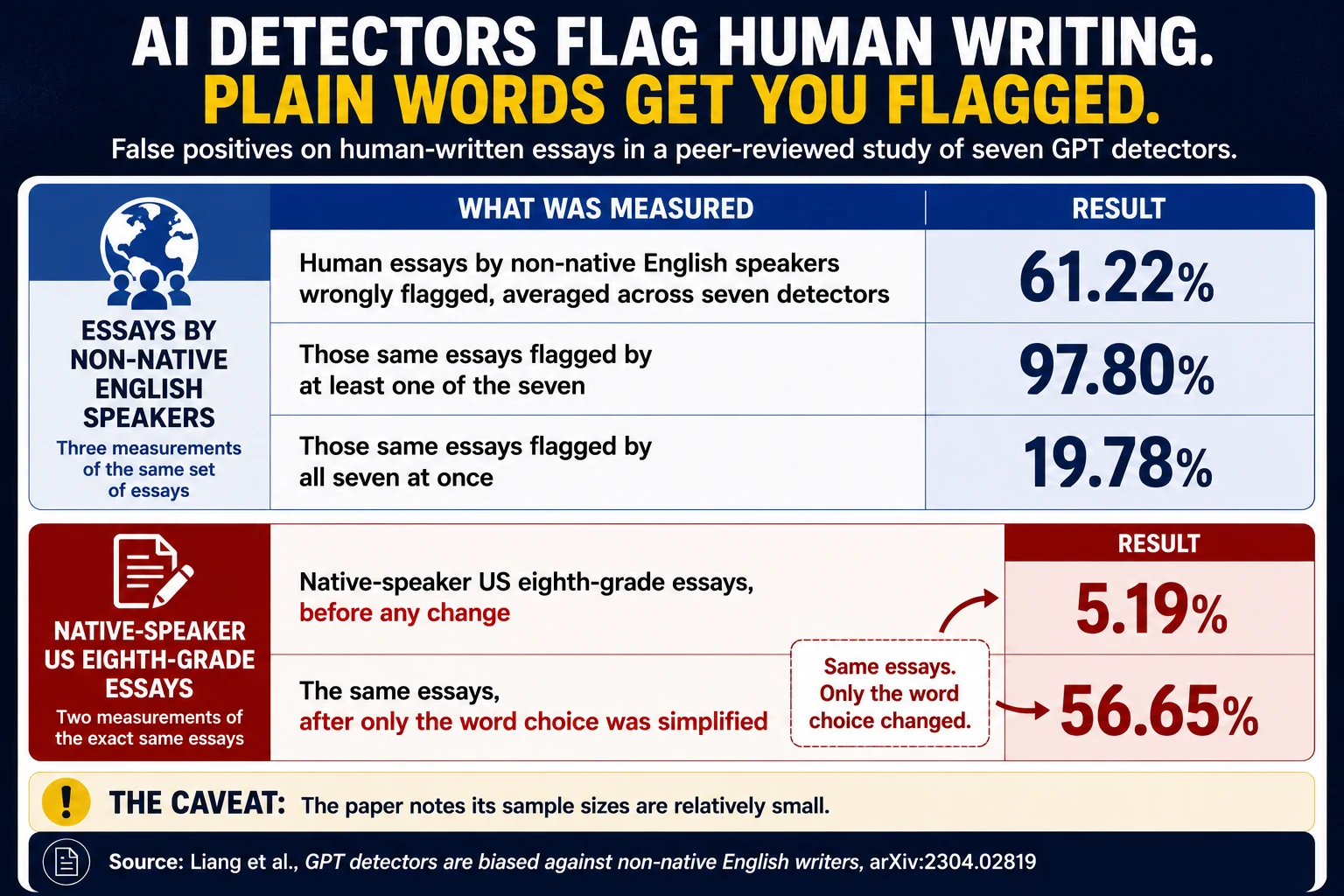
The last two rows are the same essays. Only the word choice changed. Source: Liang et al., GPT detectors are biased against non-native English writers, arXiv:2304.02819, published in Patterns.
If you have the opposite problem, the habits that make genuinely human writing read as machine-made, we keep a checklist at the AI tells writers should avoid.
Sources: Liang et al., GPT detectors are biased against non-native English writers, published in Patterns, doi:10.1016/j.patter.2023.100779.
How accurate are AI detectors?
Accurate enough to be wrong about you. Vendors publish figures above 95%, measured on their own test sets, and independent testing does not reproduce them. OpenAI withdrew its own detector in July 2023 because of what it called a low rate of accuracy, having measured it catching 26% of AI text.
What each party publishes about detector accuracy, and whose test produced it. Read the right-hand column before you read the number.
Source | The published figure | Whose test |
|---|---|---|
GPTZero | An "accuracy rate of 99% when detecting AI-generated text versus human writing" | Its own |
Turnitin | ‼️ Document false positives "less than 1%", but only "for documents with 20% or more AI writing". Its sentence-level rate is "around 4%" | Its own |
OpenAI, withdrawn | Caught 26% of AI text, and wrongly flagged human text 9% of the time | Its own |
Weber-Wulff et al., peer reviewed | Tools are "neither accurate nor reliable", with a bias towards calling output human-written | Independent |
‼️ The maker of the best-known model withdrew its own detector. OpenAI's page states: "As of July 20, 2023, the AI classifier is no longer available due to its low rate of accuracy." The same page had already warned that it "should not be used as a primary decision-making tool".
Turnitin's under-1% figure travels without its condition, and the condition is doing all the work. It applies to documents that are 20% or more AI-written. The sentence-level false positive rate on the same page is around 4%.
⚠️ The two failure directions are opposite, and both are real. The peer-reviewed testing found a bias towards wrongly calling AI text human. The study in the question above found human text wrongly called AI. One tool can do both, on different texts.
Human-written text is identified with "accuracy above 80%" in that same peer-reviewed testing, which sounds reassuring until you work out what one in five means across a body of work.
Our opinion: when the organization that built the underlying model withdrew its own detector for poor accuracy, treating a competitor's self-reported figure as decisive evidence about a specific person is a choice, not a measurement.
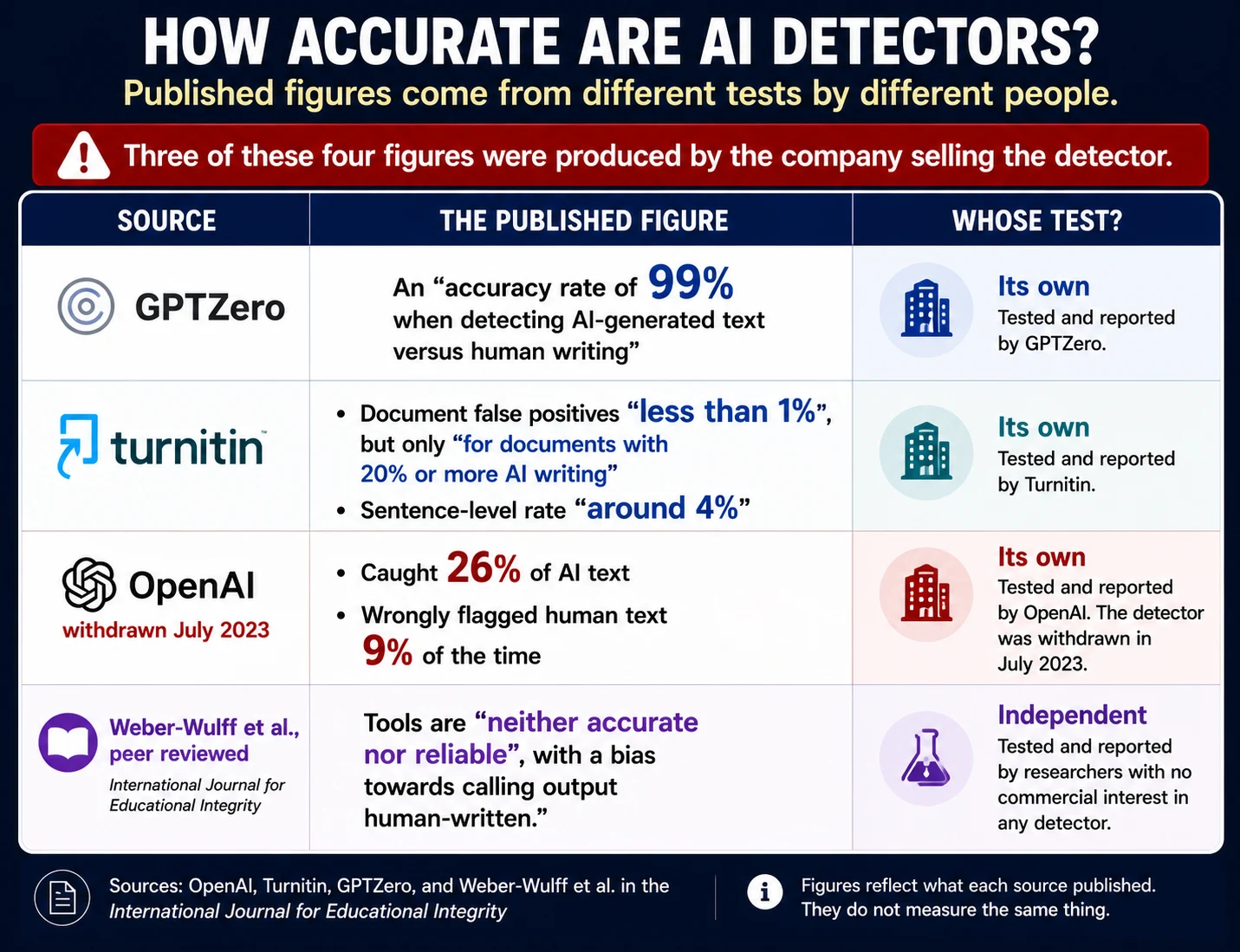
Three of the four figures were produced by the company selling the detector. The peer-reviewed finding in full: the tools are "neither accurate nor reliable and have a main bias towards classifying the output as human-written rather than detecting AI-generated text".
Sources: OpenAI on withdrawing its classifier, Turnitin on its false positive rate, GPTZero's accuracy benchmarking, Weber-Wulff et al., Testing of detection tools for AI-generated text.
Does Google penalize AI-written content?
No. Google's published guidance says appropriate use of AI or automation is not against its guidelines, and that AI content gets no special advantage either. What its spam policy targets is scaled content abuse, meaning pages mass-produced to manipulate rankings, and it states that this applies however the content was made.
The three claims you will meet most often, set against the wording on Google's own pages.
What ranking pages claim | What Google's own page says |
|---|---|
Google penalizes AI-written content | "Appropriate use of AI or automation is not against our guidelines." |
Google's systems detect AI writing | ‼️ Its systems "help us identify spam content, however it is produced" |
AI content ranks worse than human content | "Using AI doesn't give content any special gains. It's just content." |
‼️ Four words settle the question, and almost nobody quotes them. Google's sentence about SpamBrain reads: "We have a variety of systems, including SpamBrain, that analyze patterns and signals to help us identify spam content, however it is produced." The target is spam, not authorship.
The spam policy names the actual offence. Scaled content abuse is "when many pages are generated for the primary purpose of manipulating search rankings and not helping users", and the policy applies "no matter how it's created".
So the variables that matter are volume and intent, not whether a machine was involved. One carefully made AI-assisted page and one carefully made hand-written page are treated the same way.
⚠️ This answer is about search engines only. A social platform is a separate system with separate rules, and we answer the LinkedIn version of this question on our LinkedIn hub.
Our opinion: the studies claiming to measure how much AI content ranks are not usable as a group. Each used a different detector, none of them published, so their numbers do not describe the same quantity and cannot be compared with each other. We have not repeated any of their figures here.
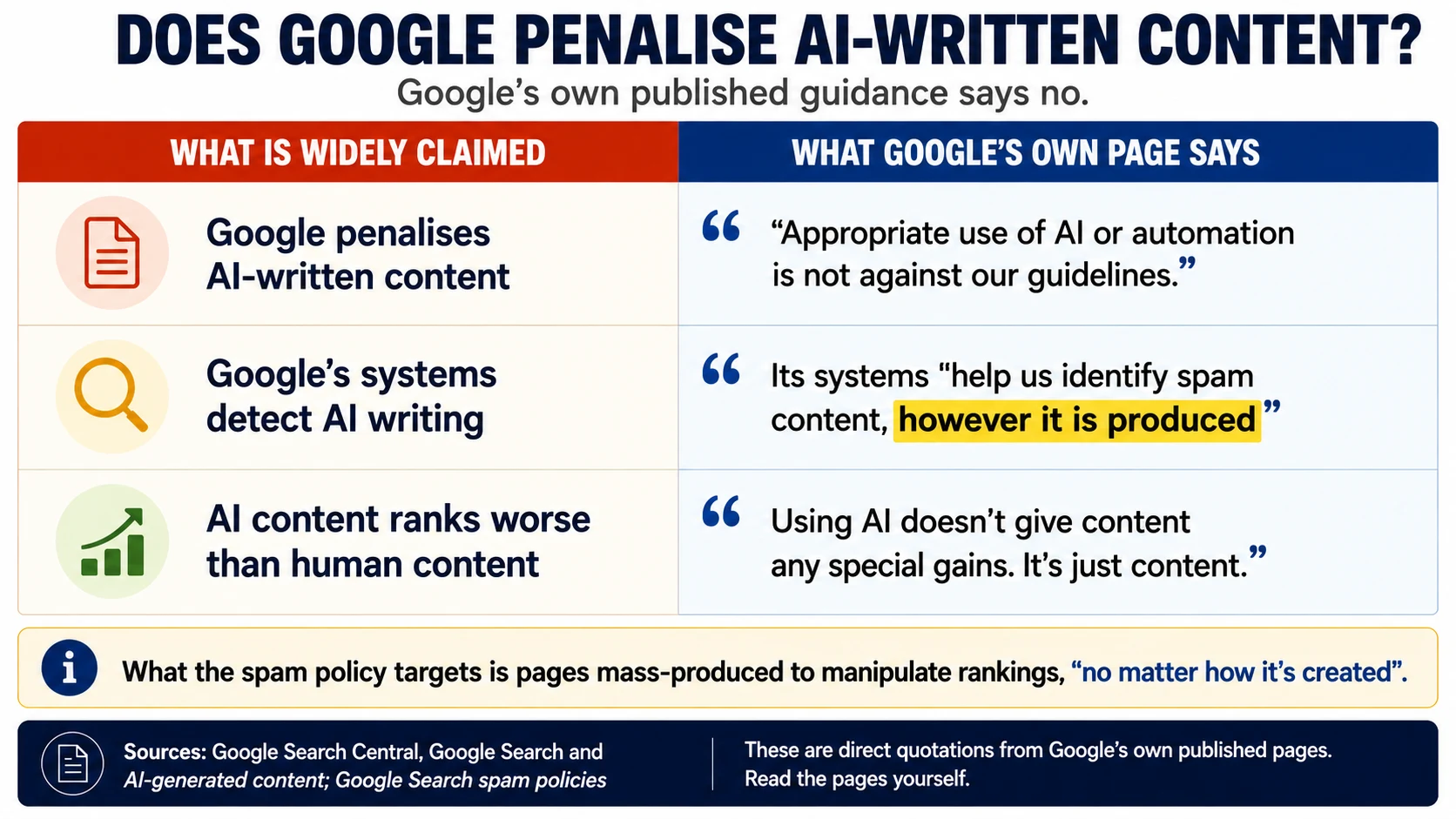
The load-bearing phrase is "however it is produced". Sources: Google Search Central on AI-generated content, and Google's search spam policies.
Sources: Google Search Central on AI-generated content, Google's spam policies.
Is using AI to write plagiarism?
Plagiarism means presenting someone else's work as your own, and AI output has no author to take it from. The sharper problem is ownership. The US Copyright Office will not register a work whose traditional elements of authorship were produced by a machine, so AI text can be neither plagiarized nor yours.
‼️ The Copyright Office is explicit: "If a work's traditional elements of authorship were produced by a machine, the work lacks human authorship and the Office will not register it."
It restates the older rule in the same guidance: the Office "will not register works produced by a machine or mere mechanical process that operates randomly or automatically without any creative input or intervention from a human author".
Human contribution is what remains registrable. Selection, arrangement and your own expression still count. A machine-produced draft you genuinely rewrote is a different case from a machine-produced draft you published.
‼️ So for most people the real exposure is not an accusation of plagiarism. It is discovering they cannot stop someone else reusing what they published.
⚠️ Plagiarism itself is defined by institutions, not by copyright law, and their rules differ from one another. Whether you must declare AI use is a separate question, answered next.
⚠️ This is US law, we did not verify how other jurisdictions treat it, and it is not legal advice.
Our opinion: "is it plagiarism" is usually the wrong question. The question with consequences attached is whether you own the result.
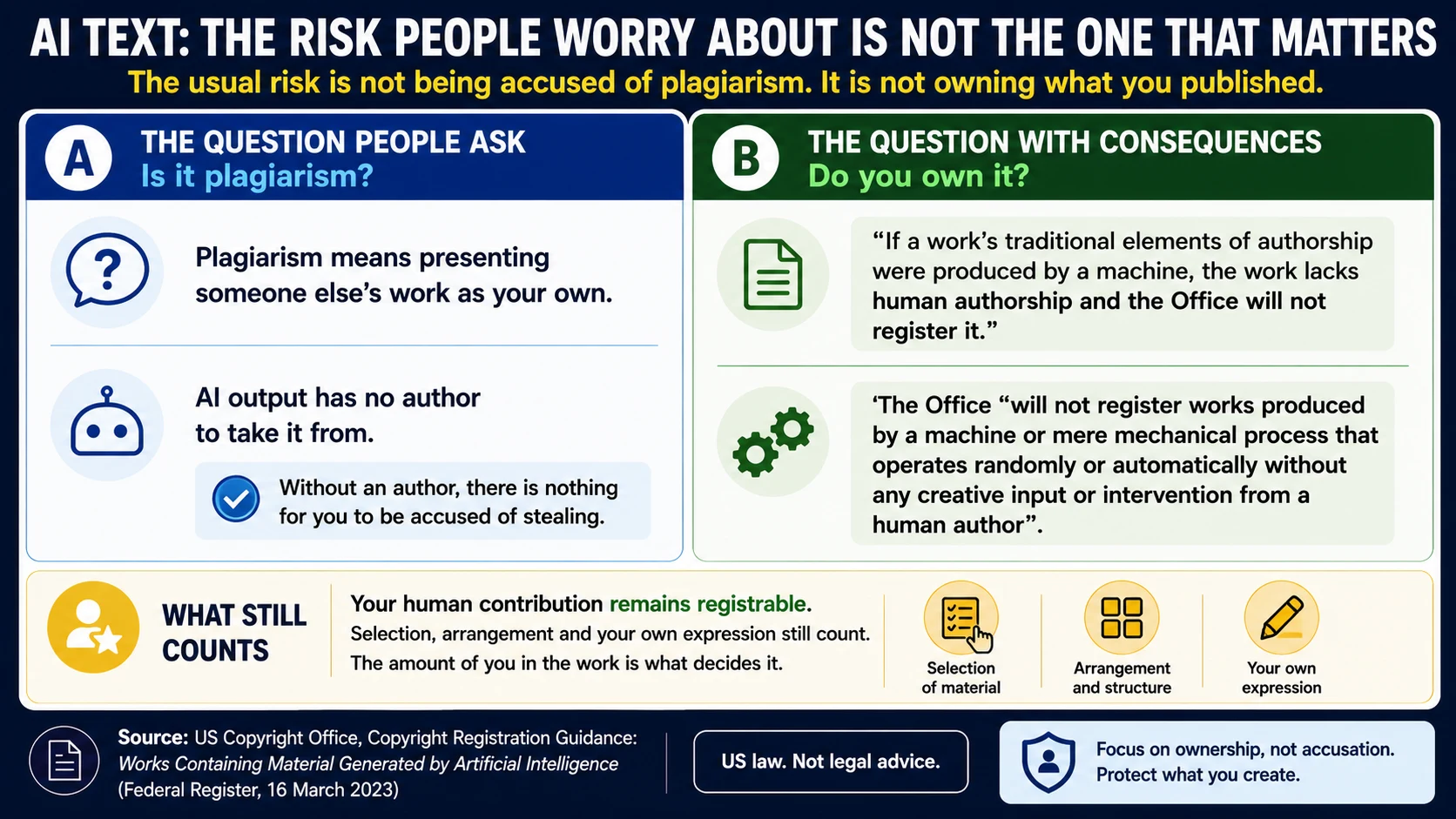
US law, and not legal advice. Source: US Copyright Office, Copyright Registration Guidance: Works Containing Material Generated by Artificial Intelligence.
Sources: US Copyright Office registration guidance for works containing AI-generated material, 17 U.S.C. § 201.
Do I have to tell anyone I used AI?
There is no universal rule, which is why you keep getting contradictory answers. Three named authorities each draw the line somewhere different: Google goes by reader expectation, Amazon KDP by whether the AI generated or merely assisted, and the ICMJE by requiring writing assistance to be acknowledged.
Three published rules, three different tests. None of them agrees with the others, and each governs a different setting.
Who | What they actually require | Where the line sits |
|---|---|---|
Google Search | Disclosures "are useful for content where someone might think 'How was this created?'. Consider adding these when it would be reasonably expected." | Reader expectation |
Amazon KDP | ‼️ "We require you to inform us of AI-generated content". Separately: "You are not required to disclose AI-assisted content" | Generated vs assisted |
ICMJE, medical journals | "writing assistance, technical editing, language editing, and proofreading" "do not qualify a contributor for authorship", and must be acknowledged | Authorship vs acknowledgment |
‼️ KDP's definition of "generated" is stricter than people expect. If you used an AI tool to create the actual content, "it is considered 'AI-generated,' even if you applied substantial edits afterwards".
Google addresses the byline question directly too: "Giving AI an author byline is probably not the best way to follow our recommendation to make clear to readers when AI is part of the content creation process."
Notice that Google's test is about the reader, not the tool. It asks whether someone would wonder how the thing was made. On a personal post published under your own name, many readers would.
⚠️ These are three specific bodies. Your employer, your client, or a platform you post on may have a rule of its own, and it will not necessarily match any of these three.
Our opinion: the generated-versus-assisted line that KDP draws is the most useful of the three in daily practice, because it maps onto a question you can honestly answer about your own draft. Did the machine produce the substance, or did it tidy up substance you produced?
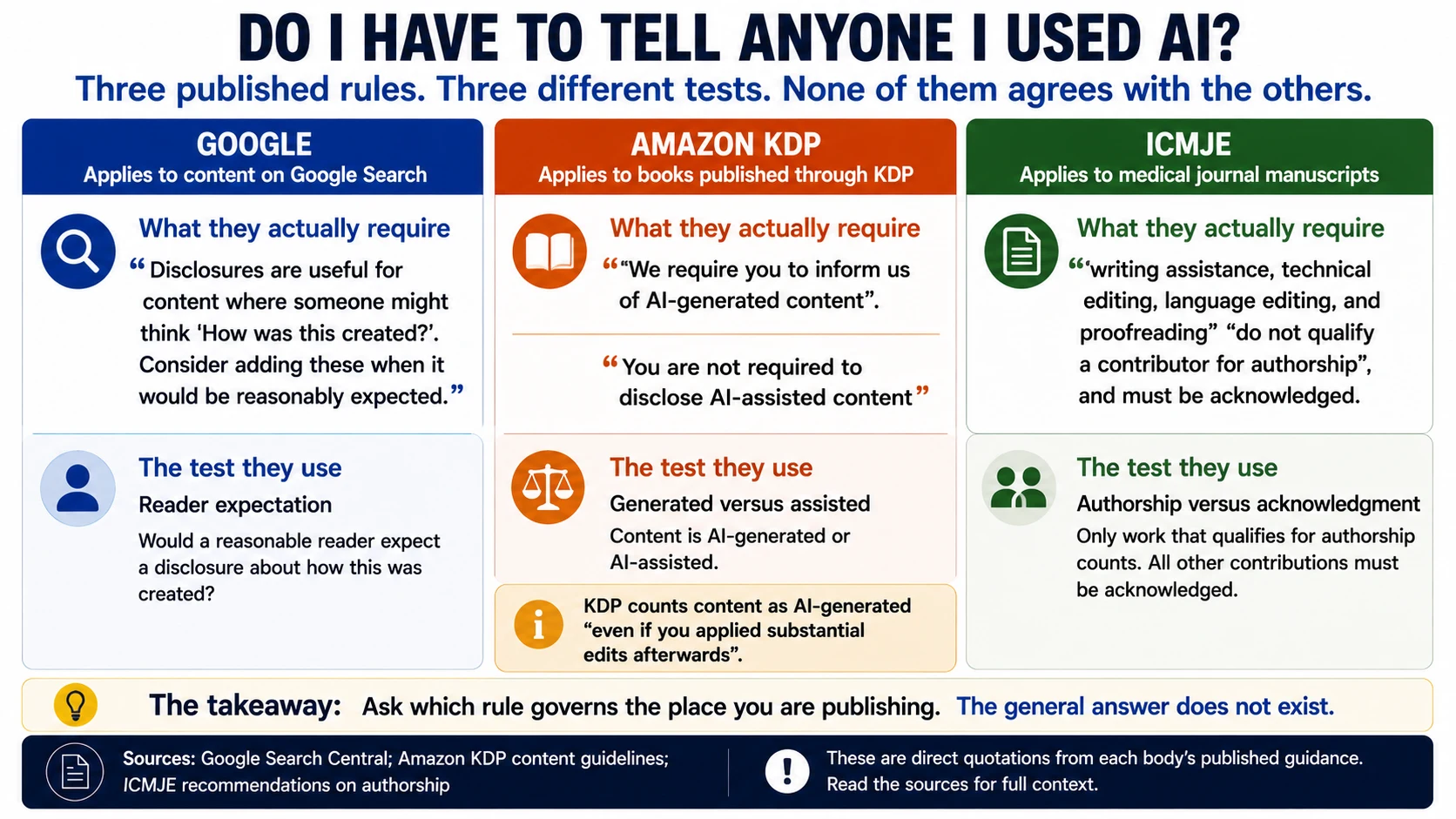
Three published rules, three different tests, and none agrees with the others. Google's own sentence begins "AI or automation disclosures are useful for content where someone might think 'How was this created?'".
Sources: Google Search Central on AI-generated content, Amazon KDP content guidelines, ICMJE on defining the role of authors and contributors.
How do I get AI to write in my voice?
By giving it your actual writing instead of describing your writing. Adjectives like "casual" or "punchy" describe thousands of people. What separates one writer from another is measurable surface behavior: sentence length, how much that length varies, word choice, punctuation habits, and what you refuse to say.
‼️ Description does not transfer. "Write like me, I am direct with a bit of humour" fits an enormous number of writers, and a model will hand you the average of all of them.
The detector research is accidental proof that surface habits carry identity. Changing nothing but word choice moved a set of essays from 5.19% to 56.65% misclassification across seven separate tools. Those tools were reading exactly the properties that make writing sound like one particular person.
‼️ Nobody publishes a real number for how many samples are needed. The pages that rank for this say five to ten, or "however many feel representative", and not one of them cites anything for it. We could not find a published figure either, so we are not inventing one.
Recency matters in one specific way: samples from several years ago describe a writer you may no longer be. Feeding old work teaches an old voice.
The check that costs nothing: read the output looking only for things you would never write. That list is more useful than any similarity score.
We make a tool that does this, so weigh this answer accordingly. Everything above works with a general-purpose assistant and a copy-paste, and requires buying nothing.
Our opinion: most disappointing results come from people describing their voice rather than pasting it. Paste twenty real posts before concluding the idea does not work.
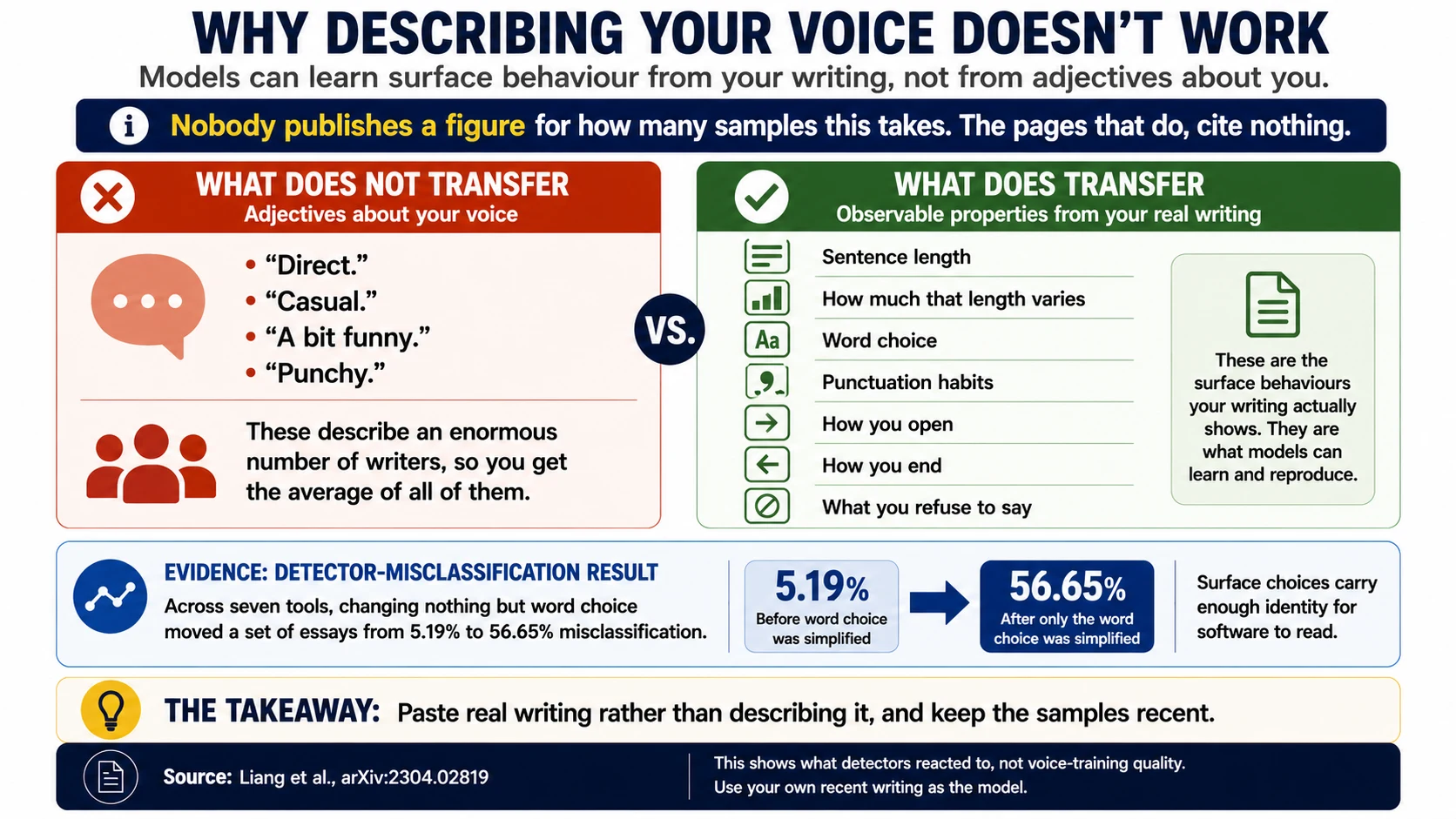
Nobody publishes a figure for how many samples this takes, and the pages that give one cite nothing. The 5.19% to 56.65% shift is a detector-misclassification result, not a measure of voice-training quality. Source: Liang et al., arXiv:2304.02819.
We have a longer walkthrough of the mechanics at how to train AI to write in your voice, a version aimed at a general assistant at making ChatGPT write in your voice, and the editing loop that goes with it at a hybrid human and AI writing workflow.
Sources: Liang et al., on how word choice alone changes machine classification.
How do I find my writing voice?
Stop treating it as something to discover and start treating it as something to observe. Voice shows up in properties you can count in work you have already written: how long your sentences run, how much that varies, which words you reach for repeatedly, and how you open and close.
‼️ Every page that ranks for this question defines voice in terms of itself. Your personality, your character, your passion. Those definitions are circular, and none of the pages we opened cites a single source for any of it.
Things you can actually observe in your own drafts: sentence length and how much it varies, the words you repeat across unrelated posts, your punctuation habits, how you open, how you end, and the moves you consistently refuse to make.
The evidence that these are real signals is indirect but strong. One instruction that changed only word choice altered how seven independent tools classified the same essays. Surface habits are measurable enough that software reads them.
⚠️ "Write like you talk" is contested, and has been for over a decade. It unlocks some writers and produces a mess for others, particularly anyone whose speech is more scattered than their prose. Treat it as one option, not as the rule.
Our opinion, and the exercise we would actually do: read twenty things you have already written and mark every sentence you would not have written if you had been imitating someone you admire. What survives that pass is the voice. It is usually smaller and more specific than people expect, and that is the point.
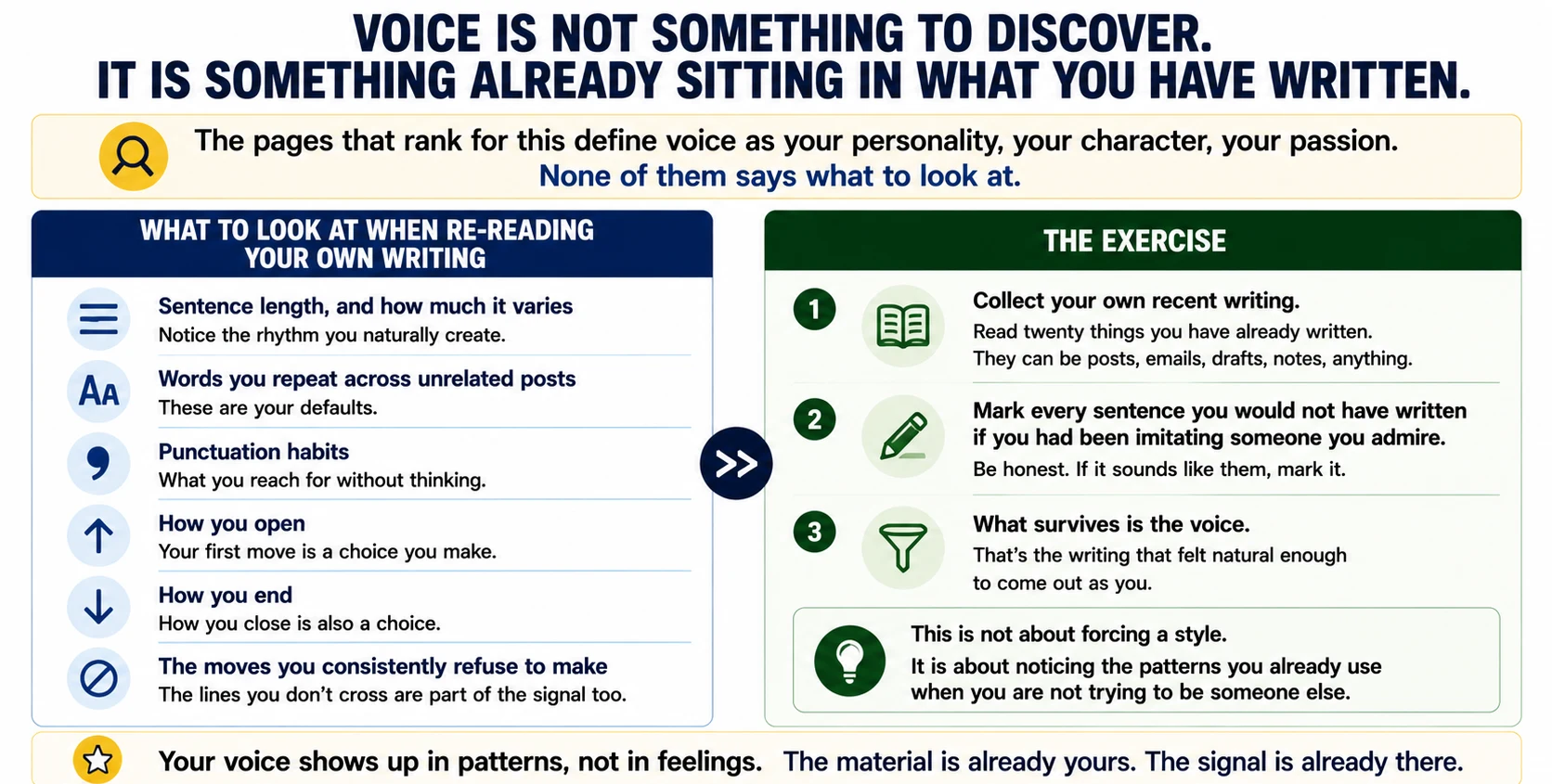
None of these are targets. They are things to look at. This checklist and this exercise are ours, not drawn from a published source.
We have a longer framework at the nine dimensions of a writing voice, a step-by-step version at how to find your writing voice, and the business version at a personal brand voice framework.
Sources: Liang et al., on measurable surface properties of text.
If I hire a ghostwriter, do I own what they write?
Not automatically, and not because you paid. Under US law copyright vests initially in the author, and a transfer is invalid unless it is in writing and signed by the person transferring it. Payment alone transfers nothing. Delivery alone transfers nothing. You need a signed assignment.
What buyers are commonly told, set against the text of the US Copyright Act. This is not legal advice.
The common assumption | What the statute says |
|---|---|
I paid for it, so I own it | ‼️ Copyright "vests initially in the author or authors of the work" (§ 201(a)) |
They delivered it, so it is mine | ‼️ A transfer "is not valid unless an instrument of conveyance, or a note or memorandum of the transfer, is in writing and signed" (§ 204(a)) |
We called it work for hire, so it is mine | Work made for hire covers employees, or commissioned work falling in specific listed categories, with a signed agreement |
‼️ Pages that sell ghostwriting tell buyers they own the work outright on delivery. That is not what the statute says, and it is the most consequential error we found anywhere in this category.
The work-made-for-hire doctrine is the thing that would change the answer, and it is narrower than the phrase suggests. Outside an employment relationship it applies only to commissioned works falling within specific enumerated categories, and it still requires a signed agreement.
A social media post is not one of those enumerated categories, so for social ghostwriting the ordinary rule applies: get an assignment in writing.
⚠️ This is US law. Other countries handle assignment and moral rights differently, and we did not verify them. None of this is legal advice.
Our opinion: put the assignment clause in place before the first draft rather than after a disagreement. The moment you need it is the moment it is hardest to get signed.
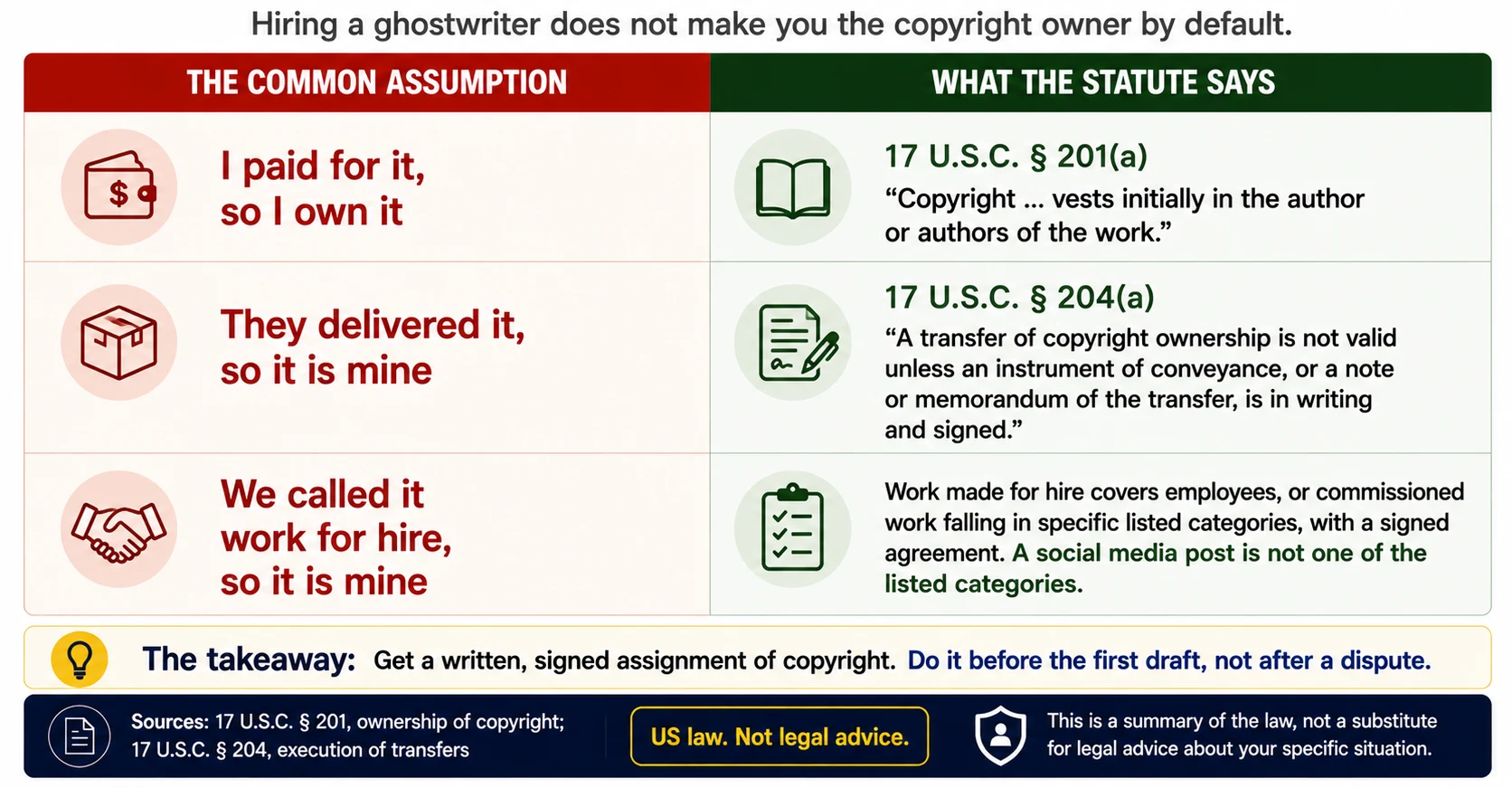
Payment alone transfers nothing, and delivery alone transfers nothing. § 204(a) in full excepts transfers "other than by operation of law", which is not what happens when you hire a writer. US law, and not legal advice.
Sources: 17 U.S.C. § 201, ownership of copyright, 17 U.S.C. § 204, execution of transfers.
Can a ghostwriter post from my account?
On LinkedIn, its User Agreement says you will not share your account with anyone else, and separately prohibits using another person's account, naming shared log-in credentials as the example. So handing over your password is against the agreement you accepted, whatever the service arrangement is called.
‼️ Section 2.2 is one sentence and it is not ambiguous: "You will not share your account with anyone else and will follow our policies and the law." The same section adds that members are account holders, and that you agree to protect against wrongful access to your account.
Section 8.2 covers it from the other side, prohibiting any attempt to "use another's account (such as sharing log-in credentials or copying cookies)".
This matters because posting and engaging on your behalf is sold as a standard part of many ghostwriting packages, and both things cannot be true at once.
The arrangement that avoids the problem entirely is the boring one: the ghostwriter writes, and you publish. Nothing about the writing relationship requires access to your account.
⚠️ We checked LinkedIn because its agreement is public and explicit on this point. Other platforms have their own terms, we did not verify them here, and you should read the one covering the account you actually use.
Our opinion: if a service asks for your password rather than offering to hand you a draft, that tells you something about how it treats the rest of its obligations.
The related question of whether connecting an authorized third-party tool puts an account at risk is answered on our social media tools hub, and the platform-specific rules sit on our LinkedIn hub.
Sources: LinkedIn User Agreement, sections 2.2 and 8.2.
Do hook formulas actually work?
The evidence is far thinner than the confidence around it. The largest dataset we could open contradicts the advice printed beside it: the same vendor that reports every hook guide telling you to open with a question found question openers finishing last in its own numbers.
‼️ A vendor claim, not an established fact. AuthoredUp reports analyzing 309,614 LinkedIn posts. The data is proprietary, there is no raw data, and there is no independent check.
What the advice says | What the same vendor's own data reports |
|---|---|
Open with a question | ‼️ "question hooks come dead last (2.16%)" by median engagement |
Open with a story | Story openers, drawn from 22,745 posts, at 2.60% |
End with a question to drive comments | A difference of "0.07 of a percentage point" |
‼️ Treat all three numbers as vendor claims. They come from a proprietary panel, the underlying posts are not published, and nobody outside the company can reproduce them.
⚠️ The page is also internally inconsistent. It is bylined "Published: Apr 1st, 2024" while stating that it analyzed posts "between December 2025 and May 2026", a window beginning well after its own publication date. It carries an August 2026 update stamp, which may explain it, but the page never says so.
The underlying argument is old. Formula-driven social openers have been mocked publicly since 2017, and the complaint has not changed since: the formula becomes recognizable, and once readers recognize it they discount whatever follows.
What nobody disputes is that the first line decides whether the rest gets read. The disagreement is entirely about whether a template is the right way to write it.
Our opinion: a hook is a promise about what the post delivers. A formula that makes a promise the post does not keep costs you more than a flat first line ever would, because readers learn to skip you. Write the post, then write the first line last, out of whatever the post actually turned out to be.
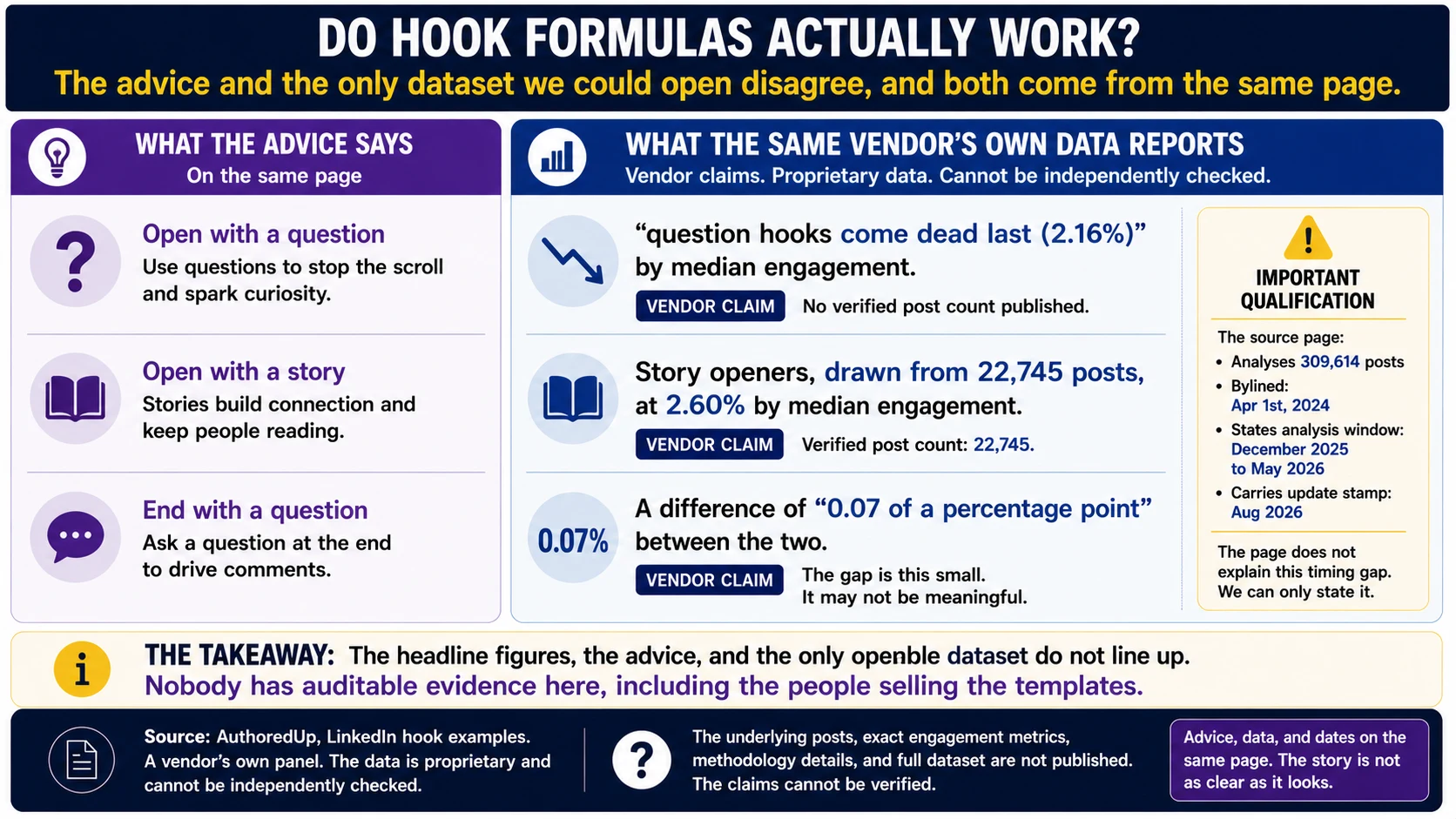
Every figure here is a vendor claim from a proprietary panel that cannot be independently checked. The source page reports analyzing 309,614 posts, is bylined April 2024, and states a December 2025 to May 2026 analysis window without explaining the gap.
We have a study of how three well-known writers open their posts at hook patterns from Naval, Paul Graham and Sahil Bloom.
Sources: AuthoredUp on LinkedIn hook examples.
What this page could not answer
Several things were researched, could not be verified against a document you can open, and are therefore left off this page rather than included with a hedge.
‼️ How much of page one is AI-written. Several widely cited studies claim to measure this. Each used a different detector, none of them published, so the figures do not describe the same quantity and cannot be compared. None is repeated here.
What ghostwriting costs. Every published price range we found comes from a party that takes a fee on the transaction it is pricing, and none could be verified independently.
‼️ A statistic about daily posting and burnout was traced to the two pages it is credited to, and appears on neither. It was produced by a search summary rather than by either source. It is not on this page, and it is a good reason to distrust any number that reaches you without a link.
The claim that human attention has fallen to eight seconds. The BBC traced it to a source that could not produce the underlying research. Not used.
How long it takes to form a writing habit. Every route we tried to the primary paper returned an error, so the figure that circulates is not repeated here.
Whether AI detectors behave the same way outside English. The testing we could open covers English, and we found nothing verifiable about other languages.
⚠️ The legal answers here are US law, and they are not legal advice. Read the terms and the statute that apply where you are.
We sell a competing product, which is why every claim above is linked to the document it came from rather than simply asserted.
Researched and written by Prateek Singh. Every quotation on this page was checked character for character against the primary document, fetched directly rather than through a search summary.

AI and Voice
Every social MCP connector reaches both platforms. That is not the hard part
We were going to write that connecting one assistant to both Twitter and LinkedIn was rare. It is not. More than twenty connectors do it and several are free, so channel coverage is table stakes and every roundup ranking them by it is measuring the wrong thing. Here is what actually differs between them, and the one thing we read enumerated tool lists for six of them to confirm nobody does at all.
11 min read

Industry
Can Claude post to Twitter? Yes, and here is the bill
X publishes three official MCP servers, and the one everybody installs cannot create a post. You can prove that from its OAuth scopes, which do not include write access to posts at all. Meanwhile every guide prices this as fifteen thousandths of a dollar per post, which is the sticker price and not the bill. A realistic assistant session costs two to eighteen times that, and the difference is mostly links.
13 min read
Industry
Does LinkedIn have an official MCP server? The answer changed in August
Every guide on this question says no, and every one of them is now out of date. Some time between 11 July and 5 August 2026, LinkedIn put a Develop with MCP link on its developer homepage, badged it New, and made it the first thing you see. It has documented that precisely nowhere. Here is what is verifiably there, what is still missing, and the install trap that catches people looking for an official server in the meantime.
11 min read
AI and Voice
Why your Claude writing skill doesn't sound like you
There are dozens of free Claude skills for writing, and almost all of them do the same thing: strip out phrases that read as machine-written. That is subtraction, and it leaves you sounding like nobody in particular rather than like yourself. The handful that actually learn a voice from your own writing have a fraction of the users. Here is the difference, why a skill cannot post anything no matter what it says, and where the file actually goes on every surface.
13 min read
Industry
Can Claude post to LinkedIn? Yes, and LinkedIn's own developer terms say it should not
Claude can publish to LinkedIn through a connector, using a permission LinkedIn hands out self-serve. The final item in LinkedIn's API Terms of Use is a flat ban on using the APIs to automate posting. Every guide we read cites the wrong document, and several sell scheduling while calling themselves the compliant option. Here is the clause, what Claude can and cannot actually publish, and why the connector most people recommend cannot work on claude.ai at all.
12 min read