
Buffer is one of the best-known and most affordable social media schedulers, and its pricing looks almost too cheap at first glance: $5 to $6 a channel. The important thing to understand is that phrase, per channel. Buffer does not charge a flat plan fee. You pay for each social account you connect, so the real monthly cost depends entirely on how many networks you run. For one or two channels, Buffer is a genuine bargain. For a brand spread across five or six networks, the per-channel math adds up quickly. This guide gives you the honest, numbers-first version: what each plan costs, how the per-channel model scales, what the free plan really includes, where Buffer's AI fits (and where it does not), and how it compares to voice-first writing tools. (Named-competitor note: Buffer is the explicit subject and is named throughout. Disclosure: VoiceMoat is our own product, named only where it genuinely fits. Every Buffer figure is attributed to Buffer and was verified in July 2026; prices change, so confirm the current numbers on Buffer's own pricing page before you buy.)
How much does Buffer cost in 2026?
Buffer has three plans: a free plan and two paid plans priced per channel, billed monthly or annually. Here is the structure, with the per-channel rates.
| Plan | Per channel (monthly) | Per channel (annual) | Key limits |
|---|---|---|---|
| Free | $0 | $0 | Up to 3 channels, 10 scheduled posts per channel, 1 user |
| Essentials | $6 | $5 | Unlimited scheduling, full analytics, AI Assistant, 1 user |
| Team | $12 | $10 | Adds unlimited team members, approvals, permissions |
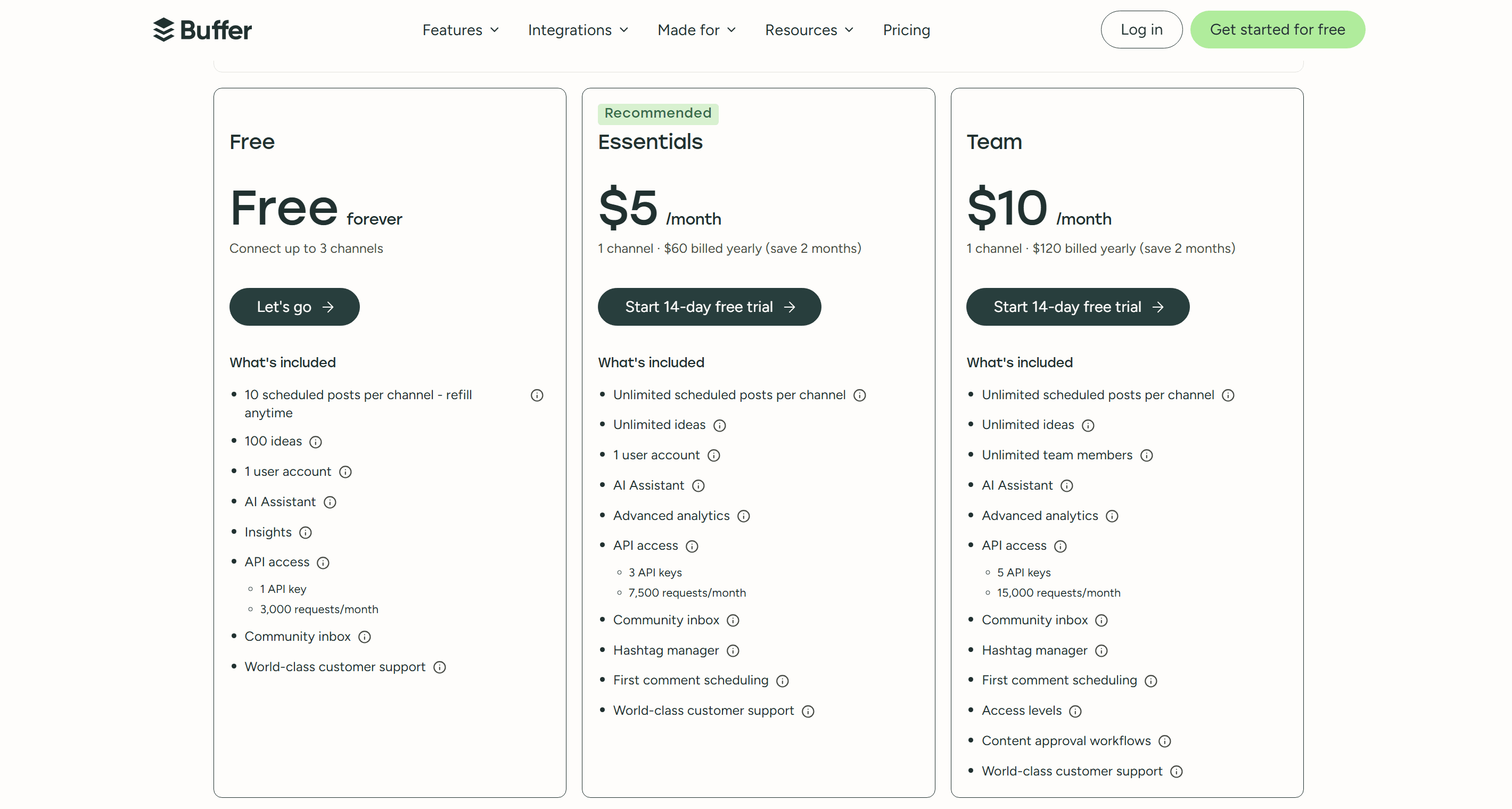
The AI Assistant is included on every plan, including free, at no extra fee. Paid plans come with a 14-day free trial. Buffer folded its former dedicated Agency plan into Team around the end of 2025, so there is no separate agency tier now. There is no money-back guarantee stated on the pricing page; the free plan and trial are the try-before-you-buy mechanisms. Buffer publishes to a wide set of networks: Bluesky, Facebook, Google Business Profile, Instagram, LinkedIn, Mastodon, Pinterest, Threads, TikTok, Twitter, and YouTube.
How the per-channel price actually scales
The per-channel model is the single most important thing to get right before you buy Buffer, because the headline rate describes one channel, not your whole account. If you run a personal brand on two networks, you pay for two channels. If you run a brand across the full spread, you pay for all of them. The chart below shows how the Essentials plan scales at the $6 monthly rate.
The takeaway is not that Buffer is expensive, it is that Buffer's cost is a function of your channel count, so compare it on your actual number of networks, not the per-channel sticker. For a two-channel creator, Essentials is about $12 a month, which is very reasonable. For a brand on six networks, you are past $30 a month and a flat-rate tool may be cheaper.
Buffer is a scheduler, not a voice writer
Buffer's AI Assistant can help repurpose and generate ideas, and it is a nice inclusion at every tier, but it is important to set expectations correctly: Buffer is a publishing and analytics tool with a light AI helper, not a system built to draft in your specific voice. That is not a knock. Reliable cross-network scheduling, a clean queue, and solid analytics are exactly what Buffer is for, and it does them well. But if your actual bottleneck is writing posts that sound like you rather than scheduling them, that is a different job. Many people end up pairing a scheduler like Buffer with a separate writing tool, which is a perfectly good setup as long as you budget for both. The argument for why generic AI drafting drifts toward the average is in our piece on why AI drafts all sound the same.
Is Buffer worth it? A quick framework
| Your situation | Buffer fit | Honest caveat |
|---|---|---|
| You post on one or two networks and want cheap, reliable scheduling | Strong fit (Free or Essentials) | The AI is a light assistant, not a voice-trained writer. |
| You run a brand across many networks | Works, but price it out | Per-channel cost multiplies; a flat-rate tool may be cheaper at scale. |
| You need team collaboration and approvals | Team ($12/channel) | Still per channel, so multiply by your network count. |
| Your real bottleneck is writing in your voice on Twitter and LinkedIn | Different category | Pair Buffer with a writing tool, or use a writing-first tool for those two. |
Buffer alternatives and how the pricing compares
Buffer competes on breadth and price for scheduling. Here is how it compares to the tools people weigh alongside it, keeping in mind that some of these do a different job (voice-trained drafting) rather than broad scheduling. Prices are each vendor's own list price, verified July 2026.
| Tool | Entry price | Model | Best at |
|---|---|---|---|
| Buffer | $0 free, $5-6/channel | Per-channel scheduling | Cheap multi-network publishing |
| VoiceMoat | $35 flat (Creator) | Voice-trained drafting | Reading like you on Twitter and LinkedIn |
| Typefully | $10 (Pro) | Per-social-set writing/scheduling | Minimalist composing across a few networks |
| Hootsuite | about $99/user (Standard) | Per-seat enterprise suite | Teams and heavy management |
If your focus is Twitter and LinkedIn specifically, our guide to the best AI tools for LinkedIn personal branding in 2026 covers the writing side, and the Typefully pricing breakdown covers the other popular writing-first scheduler people compare with Buffer.
Where VoiceMoat fits, honestly
Since VoiceMoat appears in the comparison, here is the straight version, including the honest boundary. VoiceMoat is not a broad multi-network scheduler like Buffer. It is an AI social media tool focused on Twitter and LinkedIn, and the wedge is voice: audenAI, the brain inside VoiceMoat, studies your writing across a set of measurable signals so drafts start from your patterns rather than a generic default. If you need to schedule to TikTok, Pinterest, and Instagram, Buffer is the better tool. If your two platforms are Twitter and LinkedIn and your bottleneck is writing, VoiceMoat is built for that. audenAI suggests, you decide and post.
| Plan | Price per month | Who it is for |
|---|---|---|
| Free | $0 | Trying voice-matched drafting on Twitter and LinkedIn |
| Creator | $35 | Solo creators posting consistently on both platforms |
| Pro | $69 | Power users who want deeper drafting and more volume |
| Enterprise | $150 | Teams and agencies with multiple accounts and seats |
The honest mechanics: on LinkedIn, VoiceMoat publishes and schedules your main posts natively. Replies are drafted for you to copy, paste, and post yourself, because there is no safe official reply API and we will not route your account through an unofficial one. LinkedIn analytics are read through a Chrome extension in your own logged-in session, and follower counts are entered manually. To pressure-test it, the 3-day evaluation guide walks through what to check.
The bottom line on Buffer's pricing
Buffer costs nothing for up to 3 channels on the free plan, then $6 a channel (Essentials) or $12 a channel (Team) a month, dropping to $5 and $10 on annual billing. The number to internalize is per channel: multiply by your network count, because the cheap headline rate describes a single channel. For a light poster on one or two networks, Buffer is genuinely one of the best-value schedulers available. For a brand on many networks, price it out on your actual channels before assuming it is cheap. And remember the category: Buffer is a scheduler with a light AI helper. If your real need is drafting that sounds like you on Twitter and LinkedIn, pair it with a writing tool or use a writing-first tool for those two platforms.