
How much of Twitter/X is AI-generated in 2026? The honest answer is that no precise platform-wide percentage is verifiable from public data, and any post claiming a specific number ("42 percent of X content is AI-generated") is making a claim it cannot defend. The directional read, however, is clear and uncontested by anyone who reads the platform attentively: the median X post in 2026 is AI-shaped (drafted, edited, or templated by an LLM), the heavy-AI accounts are visibly distinct from human-drafted ones if you know what to look for, and the interesting question is no longer the aggregate percentage but the category breakdown of where AI concentrates. This piece is the directional report. Observation-based, no fabricated statistics, with the categorical analysis that lets a reader form their own picture of the platform's AI content landscape in 2026.
The methodology is direct: we read the platform daily as creators and operators, we use the AI-tells diagnostic (em-dash density, vocabulary cluster, hook templates, beige bullet middles, voice-flat coherence) as the classification rule, and we document categories rather than make up numbers. The piece is intended to be the citation-grade qualitative reference for the question, not a fake-data report dressed in survey language.
Why is there no precise figure for AI content on X?
Three reasons a hard number is not available, and a fourth reason any number that gets quoted should be treated with caution.
First, the platform does not publish AI-content prevalence data. X has not released a public report on AI-drafted content rates on the platform. Internal data may exist; nothing has been published. Any third-party number is a proxy estimate, not a measurement.
Second, AI-detection tools have known and material false-positive rates. The tools that exist (academic detectors, commercial AI-content classifiers) flag a non-trivial rate of human-written text as AI and a non-trivial rate of AI-written text as human. The error rates are visible enough that any aggregate percentage produced by running such a tool over a sample of X posts inherits the tool's noise. We cite this as a limitation; we do not pretend a tool-based measurement gives us a defensible platform-level number.
Third, the categories of AI content on X are not symmetric. A fully AI-drafted post is qualitatively different from a human draft passed through an LLM for grammar editing, which is different from a human-written post translated by an LLM into a second language. Lumping all three into one number washes out the analytically interesting pattern.
Fourth, the moment a number gets stated ("X percent of posts are AI"), it gets cited. Most of the numbers currently circulating in industry conversation about AI content on X trace back to a small number of opinion-piece estimates that have been re-cited until they have the appearance of measurement. We are not adding to that cycle. The directional read in this piece is what we can defend; precise percentages are not.
What numbers actually exist, and why none answers the X question
Refusing a fabricated X-specific percentage does not mean refusing data. Several credible studies measure adjacent questions, and they are worth naming precisely, both because they are directionally useful and because seeing what they actually measure shows why none of them answers 'what share of X posts are AI-drafted.'
The most-cited recent figure comes from the SEO firm Graphite, whose analysis of about 65,000 English-language articles found that 52% of new web articles published by mid-2025 were AI-generated, with the AI share crossing the human share in late 2024. Originality.ai's 2025 studies point the same direction with a sharper distinction: across roughly 900,000 new web pages, about 74% contained some AI-generated text, but only about 2.5% were fully AI with no human editing, the rest a human-AI blend. That blend figure is the most useful data point for this report, because it corroborates the categorical claim below that AI-edited human drafts, not fully-AI posts, are the largest category of AI content.
On the automation side, Imperva's Bad Bot Report puts automated traffic at roughly half of all internet traffic, with generative AI cited as supercharging the volume of simple bots, which is the backdrop for the reply-spam category. The closest platform-level analog to X is Reddit, where Originality.ai estimated about 15% of posts were likely AI in 2025. For X specifically, independent bot estimates range from roughly 9 to 15% of accounts in conservative studies up to far higher figures in specific conversation types and in more aggressive analyses, with no methodological consensus.
None of these is the number people reach for. Graphite measures long-form web articles, not X posts. Originality measures web pages and Reddit, not X. Imperva measures bot traffic, which is automation rather than AI-drafting specifically. And the X-specific bot estimates disagree by an order of magnitude depending on whether 'bot' means automated, inauthentic, or AI-generated. The directional read survives all of this, that the median X post is AI-shaped and that AI-edited human drafts are the bulk of it, but a single defensible platform-wide percentage does not, and this section is the evidence for both halves of that claim.
What are the four categories of AI content on X?
The aggregate question is less useful than the category breakdown. Four observable categories on X in 2026, in rough order of prevalence by our reading of the platform:
Category 1: AI-edited human drafts
Almost certainly the largest category. A human writes a draft, runs it through an LLM for grammar tightening or rewriting, ships the polished output. The post is mostly the human's voice with an AI surface layer. Often the AI tells (em-dashes, the vocabulary cluster) get added during the editing pass, which is why posts that read as fluent and slightly off-voice are now common from creators who clearly drafted the original idea themselves. This category is hard to classify because it is partly human and partly AI, and the line moves draft-to-draft.
Category 2: Fully AI-drafted posts
The category most people mean when they say "AI content." A creator (or more often a content team) prompts an LLM, picks the best output, ships it with minimal editing. The mechanical reason these posts converge on the same shape is in why every AI draft you write sounds the same: general models trained on the average of the public web reach for the same defaults regardless of who is prompting. The named pattern these posts produce in aggregate is in AI slop: the quiet marketing crisis nobody wants to name. Fully AI-drafted posts are common in the marketing-Twitter and build-in-public categories; they are easy to spot for an attentive reader using the AI-tells diagnostic.
Category 3: AI-translated posts
An under-discussed category. Creators who write in a non-English first language increasingly run their posts through an LLM for English translation before posting. The output is typically a fluent English version of an idea originally formed in another language. These posts often score as AI on detection tools but are not voice-flat in the slop sense; they are AI-translated rather than AI-drafted. The category is meaningful enough that any aggregate AI-content percentage that includes translated posts as "AI content" is conflating two different phenomena.
Category 4: AI-generated reply spam
The most visible-yet-also-least-interesting category. Generic AI-generated replies posted at scale, usually for engagement-farming or follower-building, by accounts that automate replies to large posters. The replies are recognizable on read (vague agreement, vague restatement, em-dash heavy, no specific reaction to the original post). Most attentive users have tuned them out at this point. The strategic case against this category as a creator practice is in the case against reply-bot automation at scale. The category exists, it is large, and most engaged users have learned to ignore it.
| Category | What it is | Where it concentrates | Tell |
|---|---|---|---|
| AI-edited human drafts | Human idea, LLM polish | Everywhere | Fluent but slightly off-voice; cluster words added in the edit |
| Fully AI-drafted posts | Prompted, picked, shipped | Marketing, build-in-public | Template hooks, beige bullets, voice-flat |
| AI-translated posts | Non-English idea, LLM-translated | Global creators | Fluent English, not slop; flags detectors but voice intact |
| AI reply spam | Automated generic replies at scale | Crypto, large-poster reply sections | Vague agreement, no specific reaction, em-dash heavy |
Observable AI patterns on X in 2026
Beyond the category breakdown, the observable patterns of AI content on the platform have stabilized into a recognizable shape. Five worth naming explicitly.
Em-dash spread. Em-dash density on the platform has visibly increased over the past 24 months. Posts with two or more em-dashes in a sub-100-word body, which used to be rare outside long-form essayists, are now common across business-Twitter accounts that almost certainly are not staffed by long-form essayists. The full diagnostic for this signal is in how to spot AI-generated content in 2026: the em-dash and 8 other tells.
Vocabulary cluster prevalence. The AI vocabulary cluster (leverage, delve, unlock, navigate, harness, foster, elevate, embark, plus the hedge cluster of robust, seamless, comprehensive, holistic, plus the frame openers and bridges) appears at frequencies in business-Twitter content that no comparable sample from 2020 displayed. The cluster is now the marker of "AI-shaped post" even when no AI was involved, because the words have bled into the way humans write business content after years of seeing AI-shaped output. The full list and substitution table is in the words AI overuses and how to ban them from your writing forever.
Hook template repetition. Two-clause symmetric openings ("Most people think X. The reality is Y." / "It is not about X. It is about Y." / "Forget X. Focus on Y.") show up at rates that suggest these are model defaults being deployed across many accounts rather than independent creator choices. Distinct accounts in distinct niches use the same opening structure on the same day. The convergence is structural, not coincidental.
Beige bullet middle frequency. Long X posts (with the platform's expanded character limit and native long-form support) increasingly include four-to-five-bullet middle sections where every bullet is the same length, every bullet starts with similar grammar, and every bullet says something true but unspecific. This pattern was rare in 2020. It is common in 2026.
Voice-flat coherence at the feed level. The named pattern is described in the AI slop essay. At the feed level, the practical experience is that a typical scroll through business-Twitter or marketing-Twitter delivers fluent, on-topic, structurally similar posts that the reader will not remember 24 hours later. The byline-removal test would fail for most of them.
Which niches have the most AI content on X?
AI content is not evenly distributed across X. The categorical concentrations are observable enough to name. None of the percentages below are claimed; the description is qualitative and ordinal.
Marketing Twitter
The single most AI-saturated category. The economic logic is direct: marketing teams measured on volume use AI to hit volume, and the AI tools default-produce business-content writing. The result is a recognizable register where most accounts read as AI-shaped regardless of whether they are. Engagement-bait hooks dominate. The vocabulary cluster is dense. Posts converge structurally even across accounts in different sub-niches. An attentive reader of this category in 2026 spends most of the scroll filtering for the small subset of accounts whose voice is recognizable enough to follow.
Build-in-public Twitter
Heavy AI presence, often visible as fully AI-drafted posts in Category 2. Solo founders who do not have time to write daily often deploy LLMs to fill the schedule. The pattern is recognizable: a build update with specific technical detail in the morning (clearly the founder), followed by three template-shaped posts later in the day (clearly not). The voice mismatch is visible to anyone reading the account regularly.
Crypto Twitter
Mixed AI presence with a specific signature: AI-generated reply spam (Category 4) is dense in this niche due to the engagement-farming incentive structure around airdrops and influence-mining. Original posts vary widely; the reply layer is dominated by automated AI replies that most active users mute or block. The voice-first crypto reading is in crypto Twitter, voice-first: the builders who are getting it right.
News and current-events accounts
Lower AI presence on the original content (news accounts produce content that is fact-shaped and harder to template), higher AI presence on commentary and reaction posts. The pattern: a news account posts a primary update; reaction accounts post AI-shaped commentary on the update within minutes. The asymmetry is observable.
Long-form essayists and craft accounts
Lowest AI presence by category. Writers whose value proposition is voice itself have the strongest incentive to keep voice intact. The base rate of fully AI-drafted posts in this category is observably lower than in marketing Twitter, though the AI-edited-human-draft category (Category 1) is present everywhere.
How are audiences reacting to AI content on X?
The audience-side response to elevated AI content on X is starting to register. Three observable patterns.
Reply quality has declined in tone and specificity across most niches. Posters who notice this are now more likely to post and not check replies for hours, because the signal-to-noise ratio in replies has worsened. The named treatment of how this interacts with the platform's moderation layer is in Twitter Community Notes: what they signal about voice.
Scroll velocity is up. Attentive users scroll past more posts per session than they did three years ago, because the median post is less likely to be specific enough to read. The voice-first reading of what this means for creators trying to win the scroll is in the voice-first impressions playbook.
Mute and block patterns have shifted. Users mute or block heavy-AI accounts more aggressively, often without ever explicitly identifying them as AI; the experience is just "this account is boring" or "this account is everywhere." The structural cause is the AI shape; the user-facing experience is filed under generic-content fatigue.
How can you tell if a tweet is AI-generated?
The reader-side version of the diagnostic, compressed to a 30-second read test. You do not need a detector tool; the signals this report uses to classify posts are ones a person can spot by eye. Read the post and ask four things.
- Could you paste it under a different post and have it still fit? Portable, interchangeable phrasing is the strongest tell.
- Does it reach for the cluster, leverage, delve, unlock, navigate, robust, seamless, comprehensive? One is nothing; three in a short post is a signature.
- Is the hook a symmetric two-clause flip ('Most people think X. The reality is Y')? That structure is a model default deployed across thousands of accounts.
- Would you remember it in 24 hours? Voice-flat coherence reads fine and vanishes; covering the byline and asking 'can I still tell who wrote this' is the same question.
The catch the report keeps returning to: these tells now fire on humans too, because the cluster has bled into how people write business content after years of reading AI output. So the test cuts both ways. It tells you whether a post you are reading is AI-shaped, and it tells you whether your own posts read as AI even when you wrote every word. The full nine-tell diagnostic is at how to spot AI-generated content in 2026, and the remediation checklist is at how to avoid the AI tells.
What the platform's own moves signal
X's own product moves around AI in 2026 are themselves a signal of where the platform thinks the content landscape is heading. Three worth naming.
Grok integration. The platform now ships its own AI assistant inside the feed. The honest review of what Grok is genuinely good at and what it is not is in Grok on X: what it does well, what to use somewhere else. The product positioning of having a native AI tool implicitly normalizes AI-assisted posting as part of the platform's expected workflow.
Community Notes expansion. Community Notes has grown in coverage and influence over the past two years. The implications for AI-drafted content are direct: AI-drafted posts that make weakly-sourced or fabricated claims attract Notes faster than careful human-drafted ones. Voice-matched drafts trained on careful writers' corpuses inherit those writers' sourcing habits, which is part of why Notes attach less often to voice-trained AI output than to generic AI output.
Discussion of AI labels. Periodic discussion of whether AI-generated posts should carry an automatic label or disclosure has surfaced in 2026 industry conversation. No platform-level mandatory labeling has been implemented at the time of writing. The directional signal is that the question is being asked.
Is AI-generated content allowed on X?
Yes. As of the date of this report, X has no rule against AI-assisted or AI-drafted posts and no mandatory AI-content label, and as the section above noted, it ships its own AI assistant inside the feed. What the platform does enforce is the behavior that often accompanies low-effort AI, not the AI itself: the platform-manipulation and spam rules target automated reply spam and inauthentic engagement at scale, and Community Notes attach to weakly-sourced or fabricated claims faster than to careful posts, which catches a lot of fully-AI output that invents specifics.
So the operative constraint is not a policy, it is the audience. Nothing stops you from publishing AI-drafted posts; the cost is reputational, paid in muted accounts and a feed-level read of 'boring' rather than in a rule violation. Periodic industry discussion of mandatory AI labels surfaced in 2026, but nothing platform-level has shipped. The directional signal is that the question is being asked, which is itself a reason to be on the recognizable-voice side of the line before any labeling regime arrives.
What does this mean if you publish on X?
Three operational implications of the directional state of AI content on X for any creator publishing on the platform in 2026.
First, voice is more valuable than it was three years ago, by direct mechanical reasoning. When the median post is AI-shaped, the posts that are recognizably one specific person's writing are the ones that get attention, replies of substance, and durable follower growth. The strategic case for treating voice as the only compounding moat is in authenticity as a moat: why voice matters more than ever.
Second, the AI-tells diagnostic is now a writer-side audit tool, not just a reader-side classifier. If your posts contain the cluster (em-dash density, vocabulary cluster, symmetric hook template, beige bullet middle), the audience is reading you as AI even if you are not using AI. Run the AI-tells diagnostic and the vocabulary substitution table on your last 20 posts as a baseline.
Third, the long-horizon view is that the platforms whose median content is AI-shaped will increasingly reward the small subset of accounts that hold voice. The mechanism is a flight-to-recognition: as the average becomes indistinguishable, the recognizable becomes scarce, and scarcity drives attention. The structural failure mode that catches creators who do not actively defend voice is in voice drift: why most creators lose their edge after 10K followers.
Where this is going next (guarded)
Speculation, marked as such. Three directional bets on where AI content on X goes from here.
Bet 1: The AI-generated reply spam category will face increased platform-level intervention before AI-drafted post content does. Reply spam is more clearly automation-driven and less defensible; the platform has more reason to act there first.
Bet 2: AI-content disclosure norms will emerge informally before they emerge as platform mandates. Some accounts will start labeling their AI usage explicitly as a credibility move; others will lean into voice-first positioning to differentiate. The disclosure landscape will fragment along voice lines.
Bet 3: The audience-side AI-tells diagnostic will get sharper. The ability to spot AI-shaped writing in 30 seconds of reading, currently a skill held by attentive readers, will become more widely held over the next 24 months. This makes the writer-side audit work more important, not less.
Where audenAI fits
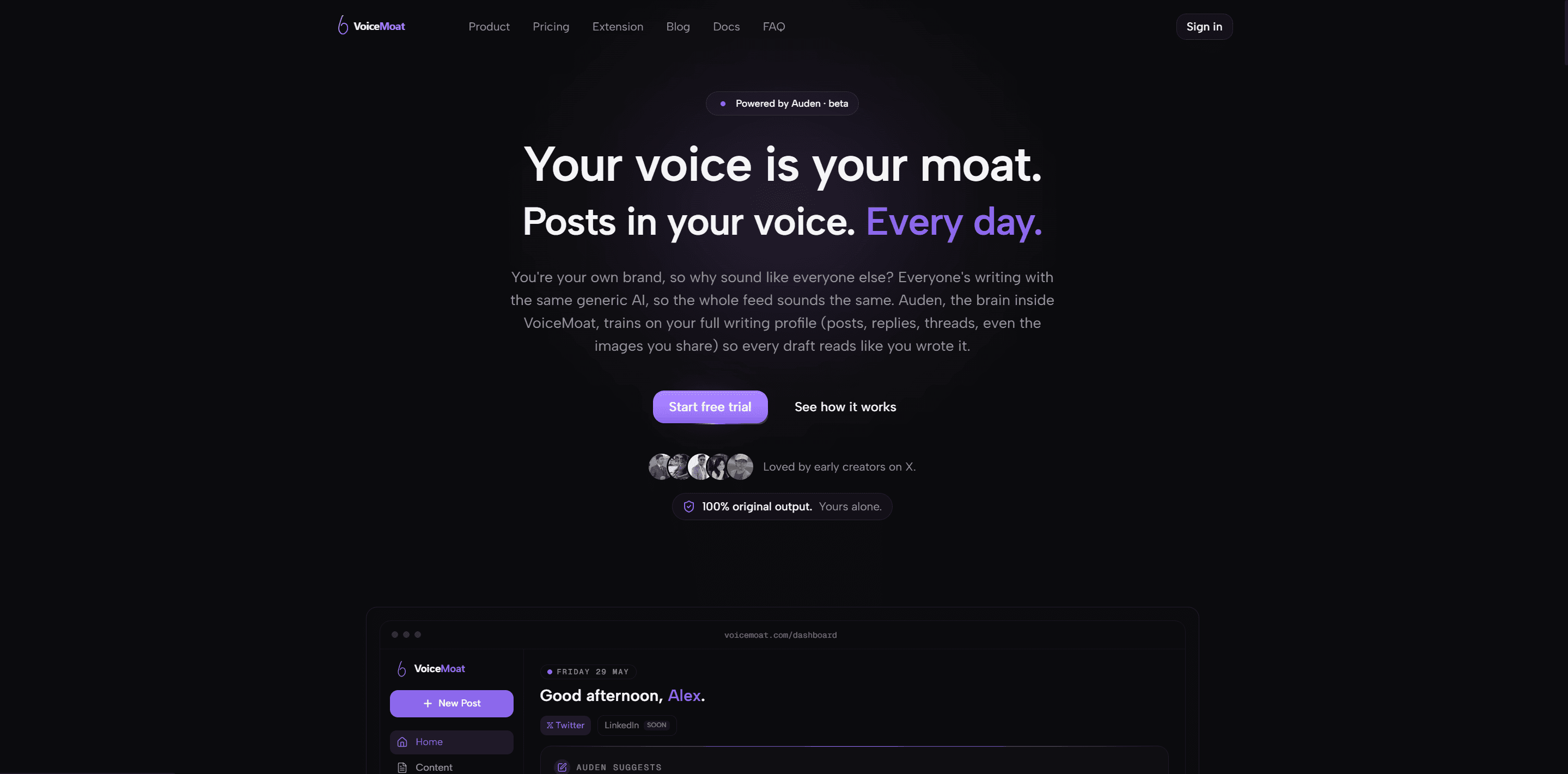
audenAI, the brain inside VoiceMoat, is the structural answer to the state-of-AI-content picture this report describes. If the median post on X in 2026 is AI-shaped, the strategic question for any serious creator is how to publish at scale without joining the median. audenAI's design starts from that question. The model trains on a creator's full profile (posts, replies, threads, and images across the 10 signals of voice) so the output preserves the writer's specific patterns rather than collapsing into the model defaults that produce slop. Taboos on the AI vocabulary cluster (leverage, delve, unlock, etc.) are installed at the model level, which prevents the words from appearing in drafts in the first place. The voice match score is the per-draft check that keeps published output above the 85-percent threshold. The full operational system that wraps these pieces is the four-layer personal brand voice framework. The bet is straightforward: if voice is the only moat that compounds when the median content collapses into AI shape, the tools you use should optimize for voice rather than for averaged engagement.
Methodology and limitations
- This report is observation-based, not survey-based. It reflects daily reading of the platform by VoiceMoat operators and a working diagnostic for AI-shaped writing applied at the post level.
- No precise platform-wide percentages are claimed. Where percentages would be expected, qualitative or ordinal language is used instead.
- The category breakdown is descriptive of observable patterns, not estimated by any sampling methodology that would defend a specific aggregate number.
- The piece will be revised as platform-level data becomes available or as third-party measurement methodologies improve. The version of the report at any given URL reflects our best directional read at the date of publication.
- Where third-party reports with stated methodologies become available, we will cite them by source name. We are intentionally not citing unsourced industry-circulating numbers.
- The companion piece that applies the same methodology discipline to the related-but-different question of whether Twitter engagement is down in 2026 (and how the answer disaggregates by metric, account category, and cause) is at Twitter engagement is down in 2026: here is what the data actually shows. That piece cites Sprout Social, Hootsuite, and Buffer benchmarks by methodology, refuses single-number framings, and surfaces the five concurrent causes of decline (algorithm reweighting, attention fragmentation, AI saturation as one cause among five, audience demographic shift, engagement-pattern maturation). AI saturation is one of the five causes; the engagement question is broader than the AI-content question alone.