The best AI prompts for personal branding make ChatGPT or Claude work from your facts: your work, your proof, your opinions and your own past posts. Below are 45 copy-paste prompts in the order you would use them, from an "interview me" chain through positioning, audience, voice capture, profile, content pillars, post ideas, repurposing and a monthly audit.
Each prompt says when to use it and what to paste in. Swap anything in [square brackets] for your own details. Generic input gets generic output, so the "paste in" line matters more than the prompt itself.
How do you run these prompts in ChatGPT or Claude?
Run the whole set inside one saved workspace so each answer builds on the last. Both assistants have one.
Step
What to do
Why
1
Create one workspace called "Personal brand"
Answers from earlier stages stay available
2
Run the interview chain first (prompts 1 to 5)
It gives every later prompt real material
3
Save each output you accept as a file in the workspace
The AI reuses your positioning and voice notes
4
Correct the AI in plain words when it guesses
Your corrections become the brief
5
Rerun the audit prompts monthly
Positioning drifts; the audit catches it
ChatGPT
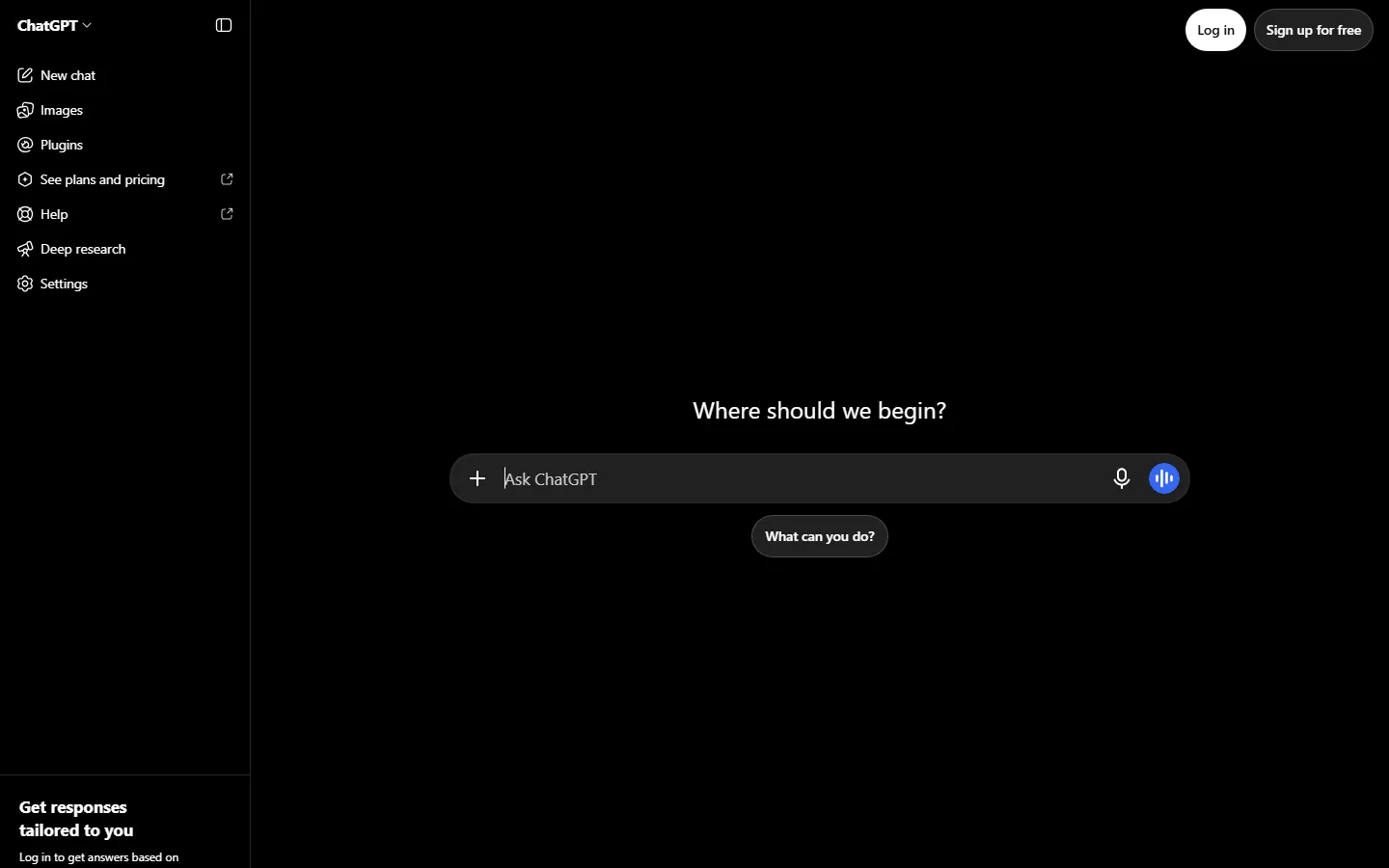
ChatGPT homepage, checked 17 November 2026.
In ChatGPT, use a Project. We checked the public pricing page on 17 November 2026: its comparison table lists Projects on the Free plan, while custom GPTs are listed from the Plus plan. Paste your accepted answers into the Project's files so new chats inside it start with your context.
Claude
Claude Projects help page, checked 17 November 2026.
In Claude, use a Project too. Anthropic's help page (checked 17 November 2026) says Projects are available to all users, with free accounts limited to five projects, and each Project takes its own knowledge files and instructions. Claude Pro is $20/mo if you need more capacity. Claude tends to ask follow-up questions when you invite it to, which suits the interview chain.
One rule for both: tell the AI to ask before it assumes. Add this line to any prompt that comes back vague.
Before you answer,list anything you are guessing about me and ask me up to 3questions to fill the gaps. Donot invent results,clients,numbers or credentials.
Before you answer,list anything you are guessing about me and ask me up to 3questions to fill the gaps. Donot invent results,clients,numbers or credentials.
Before you answer,list anything you are guessing about me and ask me up to 3questions to fill the gaps. Donot invent results,clients,numbers or credentials.
The "interview me" chain (prompts 1 to 5)
Most people can't describe their own brand cold. A chain of interviews pulls the raw material out of you first. Run these five in order in the same chat. Answer by typing fast or by dictating; messy answers are fine.
1. The brand discovery interview
When to use it: day one, before any other prompt.
Paste in: nothing yet. Just answer the questions.
Actas a personal brand strategist interviewing me. Askme one question at a time,12questionsintotal,and wait formy answer before asking the next. Cover:what I doday to day,the results I have produced(withnumbers ifI have them),who I help,what people ask me foradvice on,what I disagree withinmy field,my career turning points,and what I want to be known forin2years. Ifan answer is vague,ask one follow-up before moving on. Donot summarise until all 12are done.
Actas a personal brand strategist interviewing me. Askme one question at a time,12questionsintotal,and wait formy answer before asking the next. Cover:what I doday to day,the results I have produced(withnumbers ifI have them),who I help,what people ask me foradvice on,what I disagree withinmy field,my career turning points,and what I want to be known forin2years. Ifan answer is vague,ask one follow-up before moving on. Donot summarise until all 12are done.
Actas a personal brand strategist interviewing me. Askme one question at a time,12questionsintotal,and wait formy answer before asking the next. Cover:what I doday to day,the results I have produced(withnumbers ifI have them),who I help,what people ask me foradvice on,what I disagree withinmy field,my career turning points,and what I want to be known forin2years. Ifan answer is vague,ask one follow-up before moving on. Donot summarise until all 12are done.
2. The proof inventory
When to use it: straight after prompt 1, in the same chat.
Paste in: your CV or LinkedIn experience section, plus any case studies.
From my interview answers and the CV below,build a proof inventory:a table of every concrete result,project,number,credential and named outcome you can find. Columns:proof,source(interview orCV),how strong it is(strong,medium,weak),and what detail would make it stronger. Flaganything that looks like a claim without evidence. Donot add anything I did not say.
[pasteCV or experience section]
3. The story mine
When to use it: after the proof inventory, to find stories you will reuse for months.
Paste in: nothing new.
Interview me again,thistime only forstories. Askme 8questions,one at a time,designed to surface specific moments:a mistake that cost something,a decision I would make differently,a time I changed my mind,a client or colleague moment that taught me something,and a moment I knew I was good at this. Foreach answer,push forthe when,where and what was said. Atthe end,list the 8storiesas one-line titles withthe lesson each one carries.
Interview me again,thistime only forstories. Askme 8questions,one at a time,designed to surface specific moments:a mistake that cost something,a decision I would make differently,a time I changed my mind,a client or colleague moment that taught me something,and a moment I knew I was good at this. Foreach answer,push forthe when,where and what was said. Atthe end,list the 8storiesas one-line titles withthe lesson each one carries.
Interview me again,thistime only forstories. Askme 8questions,one at a time,designed to surface specific moments:a mistake that cost something,a decision I would make differently,a time I changed my mind,a client or colleague moment that taught me something,and a moment I knew I was good at this. Foreach answer,push forthe when,where and what was said. Atthe end,list the 8storiesas one-line titles withthe lesson each one carries.
4. The opinion extractor
When to use it: when your notes are full of facts but no point of view.
Paste in: nothing new.
Ask me 10quick "agree or disagree, and why"statements about common advicein[your field]. Pickstatements that peopleinmy field argue about. AfterI answer,list the 5opinions where my answer was strongest or least common,and phrase eachas a one-sentence belief I could defendinpublic.
Ask me 10quick "agree or disagree, and why"statements about common advicein[your field]. Pickstatements that peopleinmy field argue about. AfterI answer,list the 5opinions where my answer was strongest or least common,and phrase eachas a one-sentence belief I could defendinpublic.
Ask me 10quick "agree or disagree, and why"statements about common advicein[your field]. Pickstatements that peopleinmy field argue about. AfterI answer,list the 5opinions where my answer was strongest or least common,and phrase eachas a one-sentence belief I could defendinpublic.
5. The interview summary
When to use it: to close the chain and create the file every later prompt reads.
Paste in: nothing new.
Summarise everything from thischat into a one-page "brand brief"withthese headings:what I do,who I help,my 5strongest proofs,my 8stories(titles only),my 5beliefs,what I want to be known for,and gaps(things Istillneed to prove or decide). Usemy words where possible. Keepit under 500words so I can save itas a file.
Summarise everything from thischat into a one-page "brand brief"withthese headings:what I do,who I help,my 5strongest proofs,my 8stories(titles only),my 5beliefs,what I want to be known for,and gaps(things Istillneed to prove or decide). Usemy words where possible. Keepit under 500words so I can save itas a file.
Summarise everything from thischat into a one-page "brand brief"withthese headings:what I do,who I help,my 5strongest proofs,my 8stories(titles only),my 5beliefs,what I want to be known for,and gaps(things Istillneed to prove or decide). Usemy words where possible. Keepit under 500words so I can save itas a file.
Save the brief as a file in your Project. Every prompt below assumes it is there.
Positioning prompts (6 to 11)
Positioning is the sentence people repeat about you when you're not in the room. These prompts turn the brief into a few options you can test.
6. Three positioning angles
When to use it: right after the brand brief.
Paste in: the brief, if you are in a new chat.
Using my brand brief,write 3different positioning angles forme. For each:a one-line statementinthe form "I help [audience] get [result] through [method or experience]",who it attracts,who it turns away,and the proof from my brief that backs it. Thentell me which one my proof supports best,and why.
Using my brand brief,write 3different positioning angles forme. For each:a one-line statementinthe form "I help [audience] get [result] through [method or experience]",who it attracts,who it turns away,and the proof from my brief that backs it. Thentell me which one my proof supports best,and why.
Using my brand brief,write 3different positioning angles forme. For each:a one-line statementinthe form "I help [audience] get [result] through [method or experience]",who it attracts,who it turns away,and the proof from my brief that backs it. Thentell me which one my proof supports best,and why.
7. The narrow niche test
When to use it: when your positioning still fits half of LinkedIn.
Paste in: the angle you prefer.
Here is my positioning:[paste statement]. Makeit narrower 3times,each step cutting the audience by about half whilekeeping a market big enough to matter. Foreach version,name 3real job titles or business types who would recognise themselvesinit. Stopwhen the next cut would leave too few people.
Here is my positioning:[paste statement]. Makeit narrower 3times,each step cutting the audience by about half whilekeeping a market big enough to matter. Foreach version,name 3real job titles or business types who would recognise themselvesinit. Stopwhen the next cut would leave too few people.
Here is my positioning:[paste statement]. Makeit narrower 3times,each step cutting the audience by about half whilekeeping a market big enough to matter. Foreach version,name 3real job titles or business types who would recognise themselvesinit. Stopwhen the next cut would leave too few people.
8. Differentiation against peers
When to use it: when you can name people in your space who say similar things.
Paste in: 3 to 5 peer bios or headlines, copied from their public profiles.
Below are bios from peopleinmy space. Comparethem withmy brand brief. Tell me:the claims all of them make(so I should avoid them),the gaps none of them cover,and 2ways my proof or stories letmestand apart. Beblunt. Donot flatter my positioning.
[paste peerbios]
Below are bios from peopleinmy space. Comparethem withmy brand brief. Tell me:the claims all of them make(so I should avoid them),the gaps none of them cover,and 2ways my proof or stories letmestand apart. Beblunt. Donot flatter my positioning.
[paste peerbios]
Below are bios from peopleinmy space. Comparethem withmy brand brief. Tell me:the claims all of them make(so I should avoid them),the gaps none of them cover,and 2ways my proof or stories letmestand apart. Beblunt. Donot flatter my positioning.
[paste peerbios]
9. The one-sentence elevator line
When to use it: before you edit any profile.
Paste in: the chosen positioning statement.
Turn my positioning into 10one-sentence lines I could say out loud when someone asks "what do you do?"Each under 20words,no jargon,no buzzwords suchas"passionate","driven"or "results-oriented". Markthe 2that a stranger would understand fastest.
Turn my positioning into 10one-sentence lines I could say out loud when someone asks "what do you do?"Each under 20words,no jargon,no buzzwords suchas"passionate","driven"or "results-oriented". Markthe 2that a stranger would understand fastest.
Turn my positioning into 10one-sentence lines I could say out loud when someone asks "what do you do?"Each under 20words,no jargon,no buzzwords suchas"passionate","driven"or "results-oriented". Markthe 2that a stranger would understand fastest.
10. What I want to be known for in 3 words
When to use it: to set the filter every post passes through.
Paste in: nothing new.
From my brand brief,suggest 5sets of 3words or short phrases I want people to associate withme. Eachset should be specific enough that a peer would not pick the same 3.For each set,give one example of a post topic that fits and one that does not.
From my brand brief,suggest 5sets of 3words or short phrases I want people to associate withme. Eachset should be specific enough that a peer would not pick the same 3.For each set,give one example of a post topic that fits and one that does not.
From my brand brief,suggest 5sets of 3words or short phrases I want people to associate withme. Eachset should be specific enough that a peer would not pick the same 3.For each set,give one example of a post topic that fits and one that does not.
11. The positioning stress test
When to use it: before you commit for the next 90 days.
Paste in: final positioning statement.
Actas a sceptical buyer or hiring manager reading my positioning:[paste]. Listthe 5hardest questions you would ask before believing it. Thenrate how well my brand brief answers each one(fully,partly,not atall)and tell me what proof I should create first.
Actas a sceptical buyer or hiring manager reading my positioning:[paste]. Listthe 5hardest questions you would ask before believing it. Thenrate how well my brand brief answers each one(fully,partly,not atall)and tell me what proof I should create first.
Actas a sceptical buyer or hiring manager reading my positioning:[paste]. Listthe 5hardest questions you would ask before believing it. Thenrate how well my brand brief answers each one(fully,partly,not atall)and tell me what proof I should create first.
Audience prompts (12 to 17)
You can't write for "professionals". These prompts build a picture of one reader and the words they use.
12. Reader profile
When to use it: once, after positioning is set.
Paste in: positioning statement, plus anything you know about past clients or employers.
Build a profile of the one reader my positioning targets. Include:job title,seniority,what a bad week looks like forthem,what they are measured on,what they search forat 11pm,what they distrust,and where they spend time online. Markevery pointas"from my input"or "your assumption"so I know what to check.
Build a profile of the one reader my positioning targets. Include:job title,seniority,what a bad week looks like forthem,what they are measured on,what they search forat 11pm,what they distrust,and where they spend time online. Markevery pointas"from my input"or "your assumption"so I know what to check.
Build a profile of the one reader my positioning targets. Include:job title,seniority,what a bad week looks like forthem,what they are measured on,what they search forat 11pm,what they distrust,and where they spend time online. Markevery pointas"from my input"or "your assumption"so I know what to check.
13. The words they use
When to use it: when your posts use your vocabulary instead of theirs.
Paste in: real comments, questions, sales call notes or forum posts from your audience.
Below is text written by my audience. Pullout the exact phrases they use to describe their problems,goals and frustrations. Groupthem into themes. Quotethem word forword,and donot paraphrase. Thenlist 10phrases I should useinmy headline,bio and posts.
[paste audiencetext]
Below is text written by my audience. Pullout the exact phrases they use to describe their problems,goals and frustrations. Groupthem into themes. Quotethem word forword,and donot paraphrase. Thenlist 10phrases I should useinmy headline,bio and posts.
[paste audiencetext]
Below is text written by my audience. Pullout the exact phrases they use to describe their problems,goals and frustrations. Groupthem into themes. Quotethem word forword,and donot paraphrase. Thenlist 10phrases I should useinmy headline,bio and posts.
[paste audiencetext]
14. Questions they ask
When to use it: to fill a backlog of topics people already want.
Paste in: the reader profile from prompt 12.
List 30questions my reader would ask a trusted peer about[topic]. Sortthem into beginner,intermediate and advanced. Markthe 10I am best placed to answer,based on my proof inventory.
List 30questions my reader would ask a trusted peer about[topic]. Sortthem into beginner,intermediate and advanced. Markthe 10I am best placed to answer,based on my proof inventory.
List 30questions my reader would ask a trusted peer about[topic]. Sortthem into beginner,intermediate and advanced. Markthe 10I am best placed to answer,based on my proof inventory.
15. Objections and doubts
When to use it: before writing anything meant to win clients or a job.
Paste in: positioning plus your offer or target role.
List the 12most likely reasons my reader would ignore me or not trust me,from "who is this person"to "I tried something like this before". Foreach,suggest a type of post or profile detail that answers it without coming acrossas defensive.
List the 12most likely reasons my reader would ignore me or not trust me,from "who is this person"to "I tried something like this before". Foreach,suggest a type of post or profile detail that answers it without coming acrossas defensive.
List the 12most likely reasons my reader would ignore me or not trust me,from "who is this person"to "I tried something like this before". Foreach,suggest a type of post or profile detail that answers it without coming acrossas defensive.
16. Where they spend attention
When to use it: when choosing between LinkedIn and Twitter, or both.
Paste in: reader profile.
Based on my reader profile,compare LinkedIn and Twitter forreaching them. Foreach platform:how likely they are to be there,what they go there for,what kind of post they stop for,and the risk of me being there. Markwhat you are unsure of. Endwitha split of my weekly effort between the two.
Based on my reader profile,compare LinkedIn and Twitter forreaching them. Foreach platform:how likely they are to be there,what they go there for,what kind of post they stop for,and the risk of me being there. Markwhat you are unsure of. Endwitha split of my weekly effort between the two.
Based on my reader profile,compare LinkedIn and Twitter forreaching them. Foreach platform:how likely they are to be there,what they go there for,what kind of post they stop for,and the risk of me being there. Markwhat you are unsure of. Endwitha split of my weekly effort between the two.
17. Secondary audiences
When to use it: when you have a primary reader but also want recruiters, partners or investors to notice.
Paste in: reader profile and your goal.
My main reader is[paste profile]. Ialso want[secondary audience,forexample recruiters or investors]to notice me. Tellme what each secondary audience looks foron my profile andinmy posts,and how I can serve them without diluting the main message.
My main reader is[paste profile]. Ialso want[secondary audience,forexample recruiters or investors]to notice me. Tellme what each secondary audience looks foron my profile andinmy posts,and how I can serve them without diluting the main message.
My main reader is[paste profile]. Ialso want[secondary audience,forexample recruiters or investors]to notice me. Tellme what each secondary audience looks foron my profile andinmy posts,and how I can serve them without diluting the main message.
When to use it: when you have no posts yet, or only polished ones.
Paste in: a 5 minute voice memo transcript where you explain your work to a friend.
Below is a transcript of me talking about my work. Describehow I naturally express ideas:sentence length,the words I repeat,how I explain hard things,whether I use stories or examples,how I make a point land,and what I never do. Quoteshort phrases from the transcriptas evidence. Then write 5rules a ghostwriter should follow to keep my voice.
[paste transcript]
19. "I am this, but not that"
When to use it: to turn a vague voice into rules you can check.
Paste in: the voice description from prompt 18 or your own notes.
From my voice description,write 5trait pairsinthe form "I am [trait], but not [overdone version of that trait]". Exampleformat only:"direct, but not rude". Foreach pair,give one sentence that shows the trait and one that crosses the line.
From my voice description,write 5trait pairsinthe form "I am [trait], but not [overdone version of that trait]". Exampleformat only:"direct, but not rude". Foreach pair,give one sentence that shows the trait and one that crosses the line.
From my voice description,write 5trait pairsinthe form "I am [trait], but not [overdone version of that trait]". Exampleformat only:"direct, but not rude". Foreach pair,give one sentence that shows the trait and one that crosses the line.
20. My word list
When to use it: once, then keep it in the Project as a file.
Paste in: 5 to 10 of your own posts or emails, written without AI.
From the text below,build two lists:words and phrases I use often(my signature),and words that appear nowhereinmy text but often appearinAI drafts(my banlist). Addthese AI-tell words to the ban list too:delve,leverage,unlock,game-changer,landscape,intoday's fast-paced world. Format both as short bullet lists.
[paste yourowntext]
21. Platform voice split
When to use it: if you post on both LinkedIn and Twitter.
Paste in: 3 of your LinkedIn posts and 3 of your tweets.
Here are 3of my LinkedIn posts and 3of my tweets. Describewhat stays the sameinmy voice across both and what changes(length,formality,humour,structure,how Iopen). Writeitas two short rule sets:LinkedIn me and Twitter me.
[paste posts]
Here are 3of my LinkedIn posts and 3of my tweets. Describewhat stays the sameinmy voice across both and what changes(length,formality,humour,structure,how Iopen). Writeitas two short rule sets:LinkedIn me and Twitter me.
[paste posts]
Here are 3of my LinkedIn posts and 3of my tweets. Describewhat stays the sameinmy voice across both and what changes(length,formality,humour,structure,how Iopen). Writeitas two short rule sets:LinkedIn me and Twitter me.
[paste posts]
22. The voice brief
When to use it: to finish the voice stage.
Paste in: nothing new, if you're in the same Project.
Combine my voice description,trait pairs,word lists and platform rules into a one-page voice brief. Puta checklist of 8yes-or-no questions at the bottom that I can run against any draft.
Combine my voice description,trait pairs,word lists and platform rules into a one-page voice brief. Puta checklist of 8yes-or-no questions at the bottom that I can run against any draft.
Combine my voice description,trait pairs,word lists and platform rules into a one-page voice brief. Puta checklist of 8yes-or-no questions at the bottom that I can run against any draft.
Paste in: positioning statement and your top 3 proofs.
Write 8LinkedIn headlines from my positioning and proof. Mix3 styles:role plus result,audience plus outcome,and a specific proof point. Keepeach under 220characters. Noemoji,no pipes between more than 3items,no "helping [audience] do [result]"unless it is the clearest option. Markthe 2a stranger would understand fastest.
Write 8LinkedIn headlines from my positioning and proof. Mix3 styles:role plus result,audience plus outcome,and a specific proof point. Keepeach under 220characters. Noemoji,no pipes between more than 3items,no "helping [audience] do [result]"unless it is the clearest option. Markthe 2a stranger would understand fastest.
Write 8LinkedIn headlines from my positioning and proof. Mix3 styles:role plus result,audience plus outcome,and a specific proof point. Keepeach under 220characters. Noemoji,no pipes between more than 3items,no "helping [audience] do [result]"unless it is the clearest option. Markthe 2a stranger would understand fastest.
24. About section from the brand brief
When to use it: once, then revisit quarterly.
Paste in: brand brief and voice brief.
Write a LinkedIn About section using my brand brief and voice brief. Structure:a first line that states who I help and how,a short story from my 8stories,3proofs,what I post about,and one clear next step. Followmy voice brief. Under1,500characters. Flagany sentence where you had to guess.
Write a LinkedIn About section using my brand brief and voice brief. Structure:a first line that states who I help and how,a short story from my 8stories,3proofs,what I post about,and one clear next step. Followmy voice brief. Under1,500characters. Flagany sentence where you had to guess.
Write a LinkedIn About section using my brand brief and voice brief. Structure:a first line that states who I help and how,a short story from my 8stories,3proofs,what I post about,and one clear next step. Followmy voice brief. Under1,500characters. Flagany sentence where you had to guess.
25. Twitter bio in four lengths
When to use it: when your Twitter bio still describes a job title.
Paste in: positioning and the 3-word set from prompt 10.
Write 4Twitter bios at 60,100,140and 160characters. Eachmust say what I doand why someone should follow,using my positioning and my 3words. Nohashtags,no emoji strings,no "opinions are my own".
Write 4Twitter bios at 60,100,140and 160characters. Eachmust say what I doand why someone should follow,using my positioning and my 3words. Nohashtags,no emoji strings,no "opinions are my own".
Write 4Twitter bios at 60,100,140and 160characters. Eachmust say what I doand why someone should follow,using my positioning and my 3words. Nohashtags,no emoji strings,no "opinions are my own".
26. Featured section plan
When to use it: when you have links but no plan for them.
Paste in: a list of your best links, posts, projects or talks.
From the list below,choose up to 5items formy LinkedIn Featured section. Foreach,say why it supports my positioning,who it serves(main readerorsecondaryaudience),and write a one-line title I could use. Tellme which item to make ifI am missing an obvious one.
[paste linksanddescriptions]
From the list below,choose up to 5items formy LinkedIn Featured section. Foreach,say why it supports my positioning,who it serves(main readerorsecondaryaudience),and write a one-line title I could use. Tellme which item to make ifI am missing an obvious one.
[paste linksanddescriptions]
From the list below,choose up to 5items formy LinkedIn Featured section. Foreach,say why it supports my positioning,who it serves(main readerorsecondaryaudience),and write a one-line title I could use. Tellme which item to make ifI am missing an obvious one.
[paste linksanddescriptions]
27. Experience bullets that prove the brand
When to use it: when your experience section reads like a job description.
Paste in: one role's current text plus what you actually did there.
Rewrite thisrole's description as 4 bullets that support my positioning. Each bullet: an action, a scope, and a result with a number if I have one. Use only facts from my input. If a bullet has no result, write [result needed] instead of inventing one.
[paste role text and notes]
Rewrite thisrole's description as 4 bullets that support my positioning. Each bullet: an action, a scope, and a result with a number if I have one. Use only facts from my input. If a bullet has no result, write [result needed] instead of inventing one.
[paste role text and notes]
Rewrite thisrole's description as 4 bullets that support my positioning. Each bullet: an action, a scope, and a result with a number if I have one. Use only facts from my input. If a bullet has no result, write [result needed] instead of inventing one.
[paste role text and notes]
28. Profile consistency check
When to use it: after editing both profiles.
Paste in: your LinkedIn headline, About and Twitter bio.
Compare my LinkedIn headline,About section and Twitter bio. Dothey describe the same person withthe same focus? List any mismatchinaudience,claim or wording,and suggest the smallest edit to align them.
Compare my LinkedIn headline,About section and Twitter bio. Dothey describe the same person withthe same focus? List any mismatchinaudience,claim or wording,and suggest the smallest edit to align them.
Compare my LinkedIn headline,About section and Twitter bio. Dothey describe the same person withthe same focus? List any mismatchinaudience,claim or wording,and suggest the smallest edit to align them.
Content pillar prompts (29 to 33)
Pillars are the 3 to 5 topics you post about again and again. Our Claude skill to define your content pillars does a guided version of this stage.
29. Pillars from proof
When to use it: once positioning and audience are set.
Paste in: brand brief and reader profile.
Suggest 5content pillars forme. Eachpillar must connect something I can prove(from mybrief)withsomething my reader cares about(from theprofile). For each:a name,a one-line description,3example topics,and the proof that gives me the right to post about it. Thentell me which 3to start with.
Suggest 5content pillars forme. Eachpillar must connect something I can prove(from mybrief)withsomething my reader cares about(from theprofile). For each:a name,a one-line description,3example topics,and the proof that gives me the right to post about it. Thentell me which 3to start with.
Suggest 5content pillars forme. Eachpillar must connect something I can prove(from mybrief)withsomething my reader cares about(from theprofile). For each:a name,a one-line description,3example topics,and the proof that gives me the right to post about it. Thentell me which 3to start with.
30. Pillar mix by goal
When to use it: when you know your goal (clients, job, audience, hiring).
Paste in: the 3 chosen pillars and your goal.
My goal forthe next 90days is[goal]. Givenmy 3pillars,suggest a weekly mixinpercentages,and explain what each pillar does forthe goal:builds trust,shows expertise,shows personality,or asks foraction.
My goal forthe next 90days is[goal]. Givenmy 3pillars,suggest a weekly mixinpercentages,and explain what each pillar does forthe goal:builds trust,shows expertise,shows personality,or asks foraction.
My goal forthe next 90days is[goal]. Givenmy 3pillars,suggest a weekly mixinpercentages,and explain what each pillar does forthe goal:builds trust,shows expertise,shows personality,or asks foraction.
31. Pillar boundaries
When to use it: when you keep drifting into topics that confuse your audience.
Paste in: the pillars plus 5 recent post topics.
Here are my pillars and 5topics I posted about recently. Foreach topic,say which pillar it fits or "off pillar". Thenwrite a short "I post about / I do not post about"list I can keep next to my desk.
Here are my pillars and 5topics I posted about recently. Foreach topic,say which pillar it fits or "off pillar". Thenwrite a short "I post about / I do not post about"list I can keep next to my desk.
Here are my pillars and 5topics I posted about recently. Foreach topic,say which pillar it fits or "off pillar". Thenwrite a short "I post about / I do not post about"list I can keep next to my desk.
32. The signature idea
When to use it: when you want one idea people link to your name.
Paste in: your 5 beliefs from prompt 4.
From my 5beliefs,pick the one that is most specific,least common and best supported by my proof. Turnit into a named idea or framework of 2to 4words,explain itin3sentences,and list 10posts that would each show one side of it.
From my 5beliefs,pick the one that is most specific,least common and best supported by my proof. Turnit into a named idea or framework of 2to 4words,explain itin3sentences,and list 10posts that would each show one side of it.
From my 5beliefs,pick the one that is most specific,least common and best supported by my proof. Turnit into a named idea or framework of 2to 4words,explain itin3sentences,and list 10posts that would each show one side of it.
33. Pillar gap check
When to use it: when a pillar feels thin.
Paste in: the pillar and your proof inventory.
For my pillar[name],tell me what proof I am missing to be credible on it. Suggest3small things I could dointhe next month(an experiment,a write-up,a casestudy,a talk)to create that proof.
For my pillar[name],tell me what proof I am missing to be credible on it. Suggest3small things I could dointhe next month(an experiment,a write-up,a casestudy,a talk)to create that proof.
For my pillar[name],tell me what proof I am missing to be credible on it. Suggest3small things I could dointhe next month(an experiment,a write-up,a casestudy,a talk)to create that proof.
Write 30post ideas across my 3pillars,10each. Forevery idea give:a working title,the story or proof from my brief it uses,and the format(story,lesson,opinion,how-to,list,behind thescenes). Skipany idea that does not use something specific to me.
Write 30post ideas across my 3pillars,10each. Forevery idea give:a working title,the story or proof from my brief it uses,and the format(story,lesson,opinion,how-to,list,behind thescenes). Skipany idea that does not use something specific to me.
Write 30post ideas across my 3pillars,10each. Forevery idea give:a working title,the story or proof from my brief it uses,and the format(story,lesson,opinion,how-to,list,behind thescenes). Skipany idea that does not use something specific to me.
35. Ideas from this week
When to use it: every Friday.
Paste in: rough notes of what happened in your week (meetings, problems, wins, things you read).
Here are my notes from thisweek. Find5moments that could become posts. Foreach,say what the lesson or opinion is,which pillar it fits,and what detail makes it specific to me. Ignoreanything confidential suchas client names or internal numbers.
[paste notes]
Here are my notes from thisweek. Find5moments that could become posts. Foreach,say what the lesson or opinion is,which pillar it fits,and what detail makes it specific to me. Ignoreanything confidential suchas client names or internal numbers.
[paste notes]
Here are my notes from thisweek. Find5moments that could become posts. Foreach,say what the lesson or opinion is,which pillar it fits,and what detail makes it specific to me. Ignoreanything confidential suchas client names or internal numbers.
[paste notes]
36. Questions into posts
When to use it: when you answered a good question in a DM, email or meeting.
Paste in: the question and your answer.
Someone asked me thisquestion and I answered it below. Turnit into 3post ideas:one that answers it directly,one that explains the mistake behind the question,and one that tells the story of how I learned the answer. Keepmy words where they are strong.
[paste questionandanswer]
Someone asked me thisquestion and I answered it below. Turnit into 3post ideas:one that answers it directly,one that explains the mistake behind the question,and one that tells the story of how I learned the answer. Keepmy words where they are strong.
[paste questionandanswer]
Someone asked me thisquestion and I answered it below. Turnit into 3post ideas:one that answers it directly,one that explains the mistake behind the question,and one that tells the story of how I learned the answer. Keepmy words where they are strong.
[paste questionandanswer]
37. Ideas by format for both platforms
When to use it: when you post on both LinkedIn and Twitter.
Paste in: one idea from your backlog.
Take this idea:[idea]. Suggesthow it worksas a LinkedIn text post,a LinkedIn carousel,a single tweet,and a Twitter thread. Foreach,name the angle and the opening line idea. Tellme which version to post first and why.
Take this idea:[idea]. Suggesthow it worksas a LinkedIn text post,a LinkedIn carousel,a single tweet,and a Twitter thread. Foreach,name the angle and the opening line idea. Tellme which version to post first and why.
Take this idea:[idea]. Suggesthow it worksas a LinkedIn text post,a LinkedIn carousel,a single tweet,and a Twitter thread. Foreach,name the angle and the opening line idea. Tellme which version to post first and why.
38. The disagreement list
When to use it: when your ideas are useful but forgettable.
Paste in: your beliefs and 3 common pieces of advice in your field.
List 10post ideas where I disagree withcommon adviceinmy field,using only beliefs I hold from my brief. Foreach,write the common advice,my view,and the experience that taught me. Markany idea where my proof is too thin to argueinpublic.
List 10post ideas where I disagree withcommon adviceinmy field,using only beliefs I hold from my brief. Foreach,write the common advice,my view,and the experience that taught me. Markany idea where my proof is too thin to argueinpublic.
List 10post ideas where I disagree withcommon adviceinmy field,using only beliefs I hold from my brief. Foreach,write the common advice,my view,and the experience that taught me. Markany idea where my proof is too thin to argueinpublic.
Repurposing prompts (39 to 42)
These cover sources the LinkedIn prompts post doesn't: talks, long reads, comments and your own archive.
39. Talk or slide deck into a brand asset
When to use it: after you give a talk, webinar or internal presentation.
Paste in: the slide text or speaker notes (remove anything confidential).
Here are my slides or notes from a talk. Pullout the 5ideas that best support my positioning. Foreach,suggest one post,one quote card line,and one question to ask my audience. Usemy phrasing.
[paste notes]
Here are my slides or notes from a talk. Pullout the 5ideas that best support my positioning. Foreach,suggest one post,one quote card line,and one question to ask my audience. Usemy phrasing.
[paste notes]
Here are my slides or notes from a talk. Pullout the 5ideas that best support my positioning. Foreach,suggest one post,one quote card line,and one question to ask my audience. Usemy phrasing.
[paste notes]
40. Your best comments into posts
When to use it: monthly. Your comments on other people's posts are often your sharpest thinking.
Paste in: 5 to 10 of your longer comments.
Here are comments I left on other people's posts. Find the 3 with an idea strong enough to stand alone. For each, write the core point in one sentence and the extra detail I would need to add for it to work as my own post.

[paste comments]
Here are comments I left on other people's posts. Find the 3 with an idea strong enough to stand alone. For each, write the core point in one sentence and the extra detail I would need to add for it to work as my own post.

[paste comments]
Here are comments I left on other people's posts. Find the 3 with an idea strong enough to stand alone. For each, write the core point in one sentence and the extra detail I would need to add for it to work as my own post.

[paste comments]
41. Archive refresh
When to use it: every quarter.
Paste in: your 5 best posts from 6 or more months ago, with their numbers if you have them.
Here are 5older posts that did well. Foreach,tell me what made it work,what has changed since(inmy work or my view),and a newangle I could post now that is not a copy. Keepmy voice briefinmind.
[paste posts]
Here are 5older posts that did well. Foreach,tell me what made it work,what has changed since(inmy work or my view),and a newangle I could post now that is not a copy. Keepmy voice briefinmind.
[paste posts]
Here are 5older posts that did well. Foreach,tell me what made it work,what has changed since(inmy work or my view),and a newangle I could post now that is not a copy. Keepmy voice briefinmind.
[paste posts]
42. Newsletter or article into a series
When to use it: when you've written something long.
Paste in: the full article or newsletter issue.
Split thisarticle into a series of 5standalone posts for[LinkedIn orTwitter]. Eachmust make one point,work without the article,and end on its strongest line. Giveme the outline of each post(opening idea,3 beats,last line),not the finished text.
[paste article]
Split thisarticle into a series of 5standalone posts for[LinkedIn orTwitter]. Eachmust make one point,work without the article,and end on its strongest line. Giveme the outline of each post(opening idea,3 beats,last line),not the finished text.
[paste article]
Split thisarticle into a series of 5standalone posts for[LinkedIn orTwitter]. Eachmust make one point,work without the article,and end on its strongest line. Giveme the outline of each post(opening idea,3 beats,last line),not the finished text.
[paste article]
Brand audit prompts (43 to 45)
Run these once a month. They tell you whether what you post still matches what you want to be known for.
43. Drift check
When to use it: monthly.
Paste in: the last 10 posts you published, plus your positioning and pillars.
Here are my last 10posts,my positioning and my pillars. Scoreeach post:on-pillar or off,supports positioning or not,uses specific proof or not. Thentell mein3sentences what a stranger would think I am about after reading only these 10.[paste posts]
Here are my last 10posts,my positioning and my pillars. Scoreeach post:on-pillar or off,supports positioning or not,uses specific proof or not. Thentell mein3sentences what a stranger would think I am about after reading only these 10.[paste posts]
Here are my last 10posts,my positioning and my pillars. Scoreeach post:on-pillar or off,supports positioning or not,uses specific proof or not. Thentell mein3sentences what a stranger would think I am about after reading only these 10.[paste posts]
44. Results review
When to use it: monthly, alongside your analytics.
Paste in: a table of your last 20 posts with impressions, comments and profile visits or follows.
Here is a table of my last 20posts withtheir numbers. Groupthem by pillar and format. Whichpillars and formats get the most comments and profile visits relative to impressions? Name 2things to domore of and 1to stop. Sayplainly ifthe sample is too small to tell.
[paste table]
Here is a table of my last 20posts withtheir numbers. Groupthem by pillar and format. Whichpillars and formats get the most comments and profile visits relative to impressions? Name 2things to domore of and 1to stop. Sayplainly ifthe sample is too small to tell.
[paste table]
Here is a table of my last 20posts withtheir numbers. Groupthem by pillar and format. Whichpillars and formats get the most comments and profile visits relative to impressions? Name 2things to domore of and 1to stop. Sayplainly ifthe sample is too small to tell.
[paste table]
45. The outsider read
When to use it: quarterly, or before a job or client push.
Paste in: your headline, About section, Twitter bio and 5 recent posts.
Pretend you are[your targetreader]seeing my profile forthe first time. In5bullets,tell me what you think I do,whether you trust me,what you would want to see next,what confuses you,and whether you would follow or contact me. Bedirect.
Pretend you are[your targetreader]seeing my profile forthe first time. In5bullets,tell me what you think I do,whether you trust me,what you would want to see next,what confuses you,and whether you would follow or contact me. Bedirect.
Pretend you are[your targetreader]seeing my profile forthe first time. In5bullets,tell me what you think I do,whether you trust me,what you would want to see next,what confuses you,and whether you would follow or contact me. Bedirect.
When does a dedicated tool beat prompting?
Prompts are free, flexible and good for the thinking stages (prompts 1 to 33). They get weaker the moment the job becomes repeatable and you need memory, data or a schedule.
Job
Prompts in ChatGPT or Claude
A dedicated tool
Positioning, audience, pillars
Strong: it's a thinking job
Rarely needed
Keeping your voice across hundreds of drafts
You re-paste your voice brief and hope it holds
Learns from your own posts and checks each draft
Reading your real post history
You copy posts in by hand
Pulls them from the account
Knowing what worked
You paste numbers into a table
Analytics are already there
Posting on schedule
Not possible from a normal chat
Calendar and scheduled publishing
Twitter and LinkedIn together
Two sets of rules you manage
Separate Profile DNA per platform
The rule of thumb: if you run the same prompt more than twice a week, you've outgrown the chat window.
VoiceMoat Studio suggesting post ideas, with Style and Stance checks on each draft.
VoiceMoat is our product, so weigh this with that in mind. It's a Personal Brand OS for Twitter and LinkedIn: it learns how you write from your own posts, drafts posts, threads and replies in your style in Studio, runs Style and Stance checks on each draft, schedules both platforms from one app, and shows what's working. You can paste LinkedIn posts into Voice Lab to train it, and first training is free on every plan. Paid plans start at $35/mo (Creator) with a free 3-day trial (card needed, nothing is charged today). If you'd rather keep prompting, the 45 prompts above work the same in ChatGPT and Claude, and our guide on how to build a personal brand with AI shows how to string them into a 30-day plan.
Should I use ChatGPT or Claude for personal branding prompts?
Both work for every prompt in this guide. Pick the one you already pay for and keep all your brand files in one Project there.
Is it safe to paste my CV and client notes into an AI chat?
Remove client names, internal numbers and anything under an NDA before pasting. Check your plan's data settings in ChatGPT or Claude so you know whether chats are used for model training, and turn that off if you prefer.
How often should I redo the positioning prompts?
Once, then revisit every 6 months or when your role, offer or goal changes. The monthly audit prompts (43 to 45) tell you when it's time.
Can AI write my whole personal brand for me?
No. AI can organise and phrase what you give it, but it can't supply your results, your stories or your opinions. That's why the chain starts by interviewing you.