Key takeaways
Claude Duet is Anthropic's always-on personal agent, launched on 21 October 2026 as a waitlist research preview for US Claude Pro and Max subscribers. It runs on its own cloud computer, sends a morning brief, checks your connected apps every few hours and asks before it sends, pays, signs or deletes.
OpenAI Dots launched on 29 September 2026 for ChatGPT Pro and Business Premium. Dots live inside ChatGPT, Slack and Teams, take voice calls, and let you watch or take over their computer.
The biggest practical differences are price and access. Duet comes with a Claude plan that starts at about $20 a month but is US-only and waitlisted. A dot needs a plan that starts at about $100 a month, and Pro is not offered in the EEA, UK or Switzerland.
No one has published a head-to-head test. The one hands-on comparison so far (Every) found Duet stronger at proactive suggestions and documents, and Dots stronger at email drafts.
Neither one publishes regular LinkedIn or Twitter posts out of the box. Both can draft content, and both hold anything that publishes for your approval.
Claude Duet is Anthropic's answer to OpenAI Dots: a personal AI agent that runs on its own cloud computer, keeps working when your phone and laptop are off, and checks in with you instead of waiting to be asked. It launched on 21 October 2026 as a research preview, by waitlist, for Claude Pro and Max subscribers in the US. OpenAI got there first with Dots on 29 September, and Meta's Muse came before both on 8 September.
This guide covers what Duet does, what Anthropic claims and what it admits it can't do yet, then puts it side by side with OpenAI Dots on price, access, approvals, usage limits and safety. Every fact below comes from Anthropic's and OpenAI's own pages unless we name who reported it. (Disclosure: we make VoiceMoat, the Personal Brand OS for LinkedIn and Twitter. Neither Duet nor Dots competes with it directly, and it appears once near the end.)
What is Claude Duet?
Claude Duet is a separate app from the main Claude app, for iPhone and Android, also available on claude.ai. You talk to it in one main thread, by typing or by voice, and it works in the background on its own virtual machine with its own browser.
Anthropic's announcement, 21 October 2026. Source: claude.com
What Anthropic says it does:
Morning brief. A daily summary across your email and calendar, plus follow-ups on threads that went quiet.
Checks in on its own. It looks at your connected apps "every few hours" and messages you only when something needs you. Anthropic chose that rhythm to protect your plan's usage limits; it is not real-time monitoring.
Takes on real work. Anthropic's examples run from scheduling meetings to dashboards, sales forecasts, financial models, prototypes and small web apps, plus payroll prep, contracts ready to sign and chasing unpaid invoices.
Keeps your files in one place. A Make tab holds the documents it builds (briefs, models, decks, dashboards), and a Tasks tab tracks what it is working on. Only you can mark a task done.
Brings your Claude setup with it. Memory, skills and connectors you set up in Claude carry over, and it can search your past Claude chats.
Connects widely. Anthropic says Duet reaches "over 6,000 connectors and plugins", naming Gmail, Slack, QuickBooks, Stripe, Gusto, LinkedIn, Docusign, HubSpot, Canva and Shopify. It pays through Link (a one-time virtual card per purchase) and Shop Pay, and 1Password sign-in is coming soon.
Runs on Claude Opus 5.5. You can't pick the model; Duet decides how much effort each job needs.
What it will not do, even if you approve: trade securities, move money between accounts, or use someone else's account.
What Anthropic says it can't do yet:
Show you its browser or let you take it over.
Make phone calls or send texts (it can send email from connected accounts, with approval).
Change your Claude work. It can read it, but not edit it.
Personal errands such as tickets and trips work less well, because it was built around work.
It may misread a thread or misjudge urgency, and it can miss things that arrive between check-ins.
Who can get it: US Claude Pro and Max subscribers, through a waitlist, with invites going out in waves. It costs nothing extra during the preview, but it shares your plan's 5-hour and weekly limits, and the background checks count too. Anthropic is giving admitted users one full limit reset, usable until 30 November 2026. Team and Enterprise plans are not included yet.
What are OpenAI Dots?
OpenAI calls dots "always-on agents". Each dot has its own cloud computer and browser, works between your conversations, follows up, and learns from your feedback. Dots run on GPT-6 Astra.

OpenAI's announcement, 29 September 2026. Source: openai.com
What OpenAI says dots do:
Work where you already talk. You reach your dot in ChatGPT (desktop, web and mobile), in Slack and Microsoft Teams, and by voice call. Texting is coming soon.
Research on their own, read-only. When you're not working with it, a dot does "proactive research" using your connected apps with read-only tools, so it can't send messages, change app content or drive a browser while doing it.
Show their work. You can open your dot's computer to watch it, take over the mouse and keyboard, or connect your own computer.
Run several projects. One dot can keep several projects going, start Codex and ChatGPT Work tasks, and run background agents in parallel.
Connect widely. OpenAI says dots connect to more than 4,000 apps through plugins. Its docs name Gmail, Google Drive and GitHub.
Grow into teams. OpenAI plans more dots per person and "specialist dots" for organisations, with Microsoft Agent 365 governance coming.
Who can get them: ChatGPT Pro users (outside the EEA, UK and Switzerland) and Business Premium users in all supported regions. Enterprise, Edu and Healthcare workspaces get a beta once an admin switches it on. Free, Go and Plus plans do not get a dot. Your first dot is included at no extra cost, and you create it in the ChatGPT desktop app or a desktop browser before using it on mobile.
Claude Duet vs OpenAI Dots at a glance
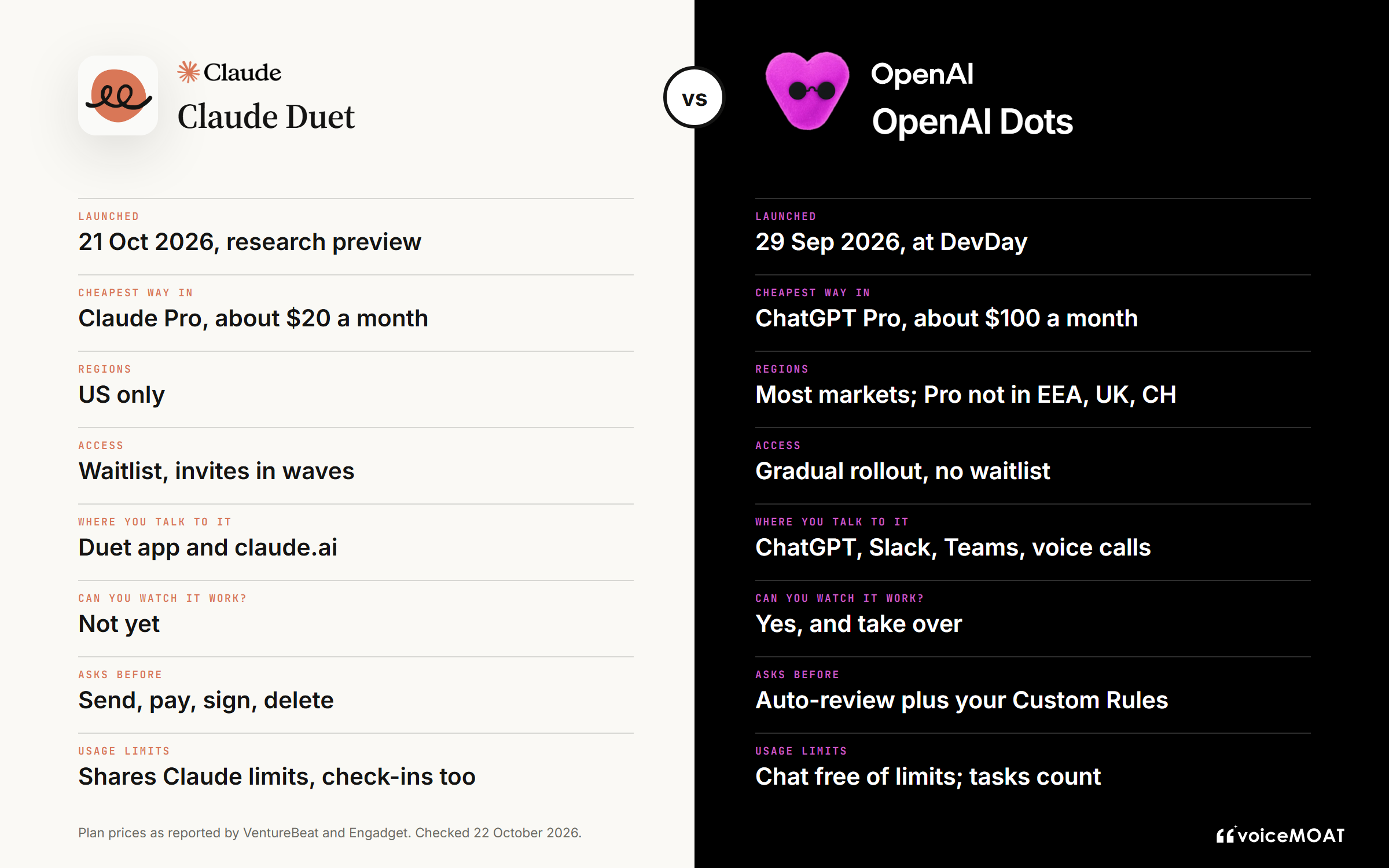
The eight differences that matter most. Logos belong to Anthropic and OpenAI.
Claude Duet | OpenAI Dots | |
|---|---|---|
Launched | 21 Oct 2026, research preview | 29 Sep 2026, at OpenAI DevDay |
Plans | Claude Pro and Max | ChatGPT Pro and Business Premium; Enterprise, Edu and Healthcare beta |
Cheapest way in | Claude Pro, about $20 a month (reported) | ChatGPT Pro, about $100 a month (reported) |
Regions | US only | Pro: everywhere eligible except the EEA, UK and Switzerland. Business Premium: all supported regions |
Access | Waitlist, invites in waves | Gradual rollout, no waitlist |
Model | Claude Opus 5.5, no choice | GPT-6 Astra |
Where you talk to it | Duet app (iOS, Android) and claude.ai | ChatGPT (desktop, web, mobile), Slack, Teams, voice calls |
How often it checks | "Every few hours" | No fixed rate; it decides, or follows a schedule or trigger you set |
Can you watch it work? | Not yet | Yes, and you can take over |
Connectors | Over 6,000 | More than 4,000 |
Asks before | Sending, paying, signing, deleting | Whatever Auto-review flags, plus your own Custom Rules |
Never does | Trade securities, move money between accounts, use other people's accounts | Changing passwords and moving money always handed back to you |
Usage limits | Shares Claude limits, background checks included | Chatting is free of limits; tasks in Codex or ChatGPT Work count |
Published metrics | None | None for dots |
Prices are the plan prices reported by VentureBeat and Engadget; neither company charges separately for the agent.
Price and usage limits
Duet is the cheaper way in, and Dots are the cheaper way to keep using it.
Duet: included in Claude Pro (about $20 a month, or $200 a year) and Max (from about $100 a month), as reported by VentureBeat and Engadget. But everything Duet does, including the morning brief and its check-ins, draws on the same 5-hour and weekly limits as your chats, "at the same rate as chat". Bigger jobs such as financial models and decks use more.
Dots: ChatGPT Pro comes in $100, $200 and $500 tiers, and Business Premium is $125 a seat a month (or $100 billed yearly) with a two-seat minimum, according to Engadget and pricing roundups. Talking to your dot doesn't count toward ChatGPT limits. Tasks it starts in Codex or ChatGPT Work do. The plan also includes "an allowance for deeper work", extended for the first month, but OpenAI has not said how big that allowance is or what happens after month one.

The access and usage terms OpenAI published at launch. Source: openai.com
What this means in practice: a Claude Pro user who lets Duet run all day may hit limits sooner than before. A ChatGPT Pro user pays five times as much to start, but can chat with a dot without watching a meter.
Access: who can actually use each one today
You are | Claude Duet | OpenAI Dots |
|---|---|---|
On Claude Pro or Max in the US | Join the waitlist | Need a ChatGPT Pro or Business Premium plan |
On ChatGPT Plus | Need a Claude plan | Not available on Plus |
In the UK or the EU | Not available | Business Premium only (Pro excludes the EEA, UK and Switzerland) |
On a Team or Enterprise plan | Not yet; Anthropic says later | Enterprise, Edu and Healthcare beta, if your admin enables it |
Outside the US, elsewhere | Not available | Pro or Business Premium, where ChatGPT is supported |
For most people outside the US, the choice is already made: dots are available and Duet isn't.
Safety and approvals: two different ideas of control
Both companies give the agent its own cloud computer, keep your passwords away from the model, and stop before anything that can't be undone. The difference is who draws the line.

Duet uses a short fixed list; Dots use a reviewer plus your own rules.
Claude Duet uses a short fixed list. It reads, drafts and prepares on its own, then shows you exactly what it will do and waits before it sends a message, makes a payment, signs a document or deletes anything. If you can't approve right away, it carries on with other work. It cites the email, file or sheet behind any number it gives you.
Passwords: handled with the same design as Claude Managed Agents, so Duet never directly sees your passwords or sign-in tokens. You type them into a separate form that goes straight to its cloud browser.
Actions: approved by Anthropic's auto mode classifier, the same check used in Claude and Claude Code.
Sensitive data: a dedicated classifier checks every message; card numbers and government IDs are designed to be blocked, and health and money details are shared only when you ask.
Testing: prompt-injection defences from Anthropic's browser research, internal and external red teams, and a public bug bounty. Anthropic's help center adds that no defence is perfect.

How Anthropic describes Duet's safeguards. Source: claude.com
OpenAI Dots use a reviewer plus your own rules. An automatic check called Auto-review looks at any action that could affect your accounts or share information, and either lets it run, asks you, or hands it to you. On top of that, Custom Rules let you set each kind of action to act without asking, act only when told, ask first, or hand off to you.
Always handed back: changing a password and moving money.
Drafts are not sends: asking for a draft reply does not give the dot permission to send it.
Proactive research is read-only.
Monitoring: if OpenAI's system spots a safety concern, it can pause or stop the dot.
Records: an Activity View shows what the dot did, and Enterprise compliance logs tag its actions.

How OpenAI describes the safeguards on dots. Source: openai.com
Which approach is safer? Nobody knows yet. VentureBeat called Duet's protections described safeguards rather than proof, and the same is true of Dots: no independent test of either has been published. Duet's fixed list is simpler to understand. Dots give you more control and let you watch, which matters if you want to see a mistake before it lands. In the run-up to Dots, OpenAI also held back a GPT-6.1 Astra update after it failed safety tests, according to TNW and Axios, so dots ship on the earlier model. (The platform side of the risk is in our guide to using AI safely on LinkedIn and Twitter.)
Is there a head-to-head test?
No. As of 22 October 2026, no one has run the same tasks on Duet and Dots and published the results. Neither Anthropic nor OpenAI has published task success rates or productivity numbers for its agent; the figures on Duet's product page are mock dashboards. VentureBeat noted the same gap on launch day, and Every's comparison page says it has not run the same jobs on every product.
What exists instead:
Source | What they did | What they found |
|---|---|---|
Every (Dan Shipper), Vibe Check, 21 Oct | About two weeks with early Duet access, after using a dot | Duet better at proactive suggestions, organisation and documents; Dots better at email drafts; his dot had dropped a tax task without saying so. One person, and Anthropic gave early access |
Geeky Gadgets, Neoteo, eesel (Dots only) | One-day tests and desk reviews | Useful follow-up, but slow at times, stopped by CAPTCHAs and account checks, and memory can't be edited item by item |
Hacker News (Duet) | Early impressions | One commenter, relaying a video preview, found Duet slow |
Treat all of it as early impressions, not results. Some third-party "scores" for dots exist, but they come from separate tests with different tasks, and none includes Duet.
Advantages and disadvantages
Claude Duet
Advantages | Disadvantages |
|---|---|
Comes with a Claude plan from about $20 a month | US only, waitlist only, Pro and Max only |
Morning brief and check-ins are built in | Background checks use up your Claude limits |
Short, clear approval list and hard bans on trading and moving money | You can't watch or take over its browser yet |
Over 6,000 connectors, and your Claude memory, skills and connectors carry over | Checks every few hours, so it can miss what arrives in between |
Payments through a one-time virtual card | No Microsoft 365 yet, per Anthropic's help center |
Builds documents, models and decks in its own Make tab | Can't make calls or send texts; a separate app from Claude |
Early review rates it strong on proactive suggestions and documents | Weaker on personal errands, by Anthropic's own account |
OpenAI Dots
Advantages | Disadvantages |
|---|---|
Available in far more countries, plus an Enterprise beta | Starts at about $100 a month; no Plus access |
Lives in ChatGPT, Slack, Teams and voice calls | ChatGPT Pro is not offered in the EEA, UK or Switzerland |
You can watch its computer and take over | The usage allowance has no published numbers, and terms after month one are unannounced |
Custom Rules let you decide what it does alone | First setup needs the desktop app or a desktop browser |
Chatting with a dot doesn't count toward limits | Reviewers hit slowness, CAPTCHAs and memory you can't edit item by item |
Early review rates it stronger on email drafts | One dot per person at launch; extra dots at unannounced prices |
Which one should you pick?
If you | Lean towards |
|---|---|
Already pay for Claude Pro in the US and want a morning brief | Claude Duet (join the waitlist) |
Work in Slack or Teams all day | OpenAI Dots |
Want to see every click the agent makes | OpenAI Dots |
Live in the UK or EU | OpenAI Dots on Business Premium (Duet isn't available) |
Mostly want documents, forecasts and dashboards built | Claude Duet, on early reviews |
Mostly want email handled | OpenAI Dots, on early reviews |
Want to try a personal agent for free | Meta Muse (US only) |
None of these is a permanent call. Duet is a preview, dots are weeks old, and both companies say more is coming. If you only need an assistant for content, our Claude vs ChatGPT for content comparison is the better read.
And Meta Muse?
Meta launched Muse on 8 September 2026, before both, for US adults. It runs on its own cloud computer too, keeps working after you close the app, and asks before sending email, buying or sharing. It is aimed at everyday life rather than work: errands, shopping, travel and goals. It is on iOS, Android, the web and WhatsApp, and has a free tier with a weekly cap, with paid tiers reported at $20 and $100 a month while Meta tests subscriptions. Sensor Tower estimates (reported by PPC Land and Yahoo Finance) put it at about 10.9 million downloads in its first weeks. If you want to try the idea without paying, Muse is the one to try.
What Duet and Dots mean for LinkedIn and Twitter creators
If you post on LinkedIn or Twitter, here is what each one can do for you today:
Question | Claude Duet | OpenAI Dots |
|---|---|---|
Can it post to LinkedIn? | Anthropic names one LinkedIn use: drafting a job post and posting it once you edit and approve it. Nothing on regular feed posts | Not mentioned by OpenAI. Reviewers found the ChatGPT LinkedIn plugin only looks up profiles |
Can it post to Twitter? | Not mentioned | Not mentioned |
Can it draft posts? | Yes, as general writing; it can also use Canva for campaigns | Yes. OpenAI's own creator example says a dot "learns your voice" and drafts social posts for your approval |
Would publishing wait for you? | Yes, sending and posting are approval steps | Yes, drafts are not sends |
Can it watch your comments and DMs? | Only through connected apps; no LinkedIn or Twitter inbox connector is named | Only through supported apps; no LinkedIn or Twitter trigger is named |
Does it say how it matches your style? | No | No method published |
The short version: both are general assistants that can draft content, not publishing tools for your personal brand. They are good at the work around your content (research, briefs, inbox, scheduling meetings with the people your posts bring in). Neither says how it learns what makes your posts yours, and neither reads your LinkedIn or Twitter numbers. If you want to post straight from the assistants themselves, see can ChatGPT post to LinkedIn and Twitter?
Where VoiceMoat fits
Disclosure: this is what we build. VoiceMoat is the Personal Brand OS for LinkedIn and Twitter. audenAI, the brain inside VoiceMoat, learns from your own posts, separately for each platform, so the content it helps you make reads like you. It checks drafts for Style and Stance, shows your numbers on both platforms, and publishes or schedules only when you say so.
VoiceMoat also has a connector (an MCP server) that works in Claude and ChatGPT, so you can ask either assistant to pull your voice profile, check a draft or schedule a post (how to connect Claude to LinkedIn and Twitter). We have not tested it inside Duet or Dots yet. Anthropic says connectors set up in Claude carry over to Duet, but one early reviewer found Duet's scheduled runs can't reach custom connectors, so treat it as untested until we report back. More on the connector: the VoiceMoat MCP.
What to watch next
Duet's wider launch: when it opens beyond the US waitlist, and whether Team and Enterprise plans get it.
Dots' real price: how big the "deeper work" allowance is after month one, and what extra dots cost.
Independent tests: the first same-task comparison of Duet, Dots and Muse.
Social posting: whether either company adds LinkedIn or Twitter publishing, and on what terms.
Safety detail: Anthropic says more is coming soon; OpenAI has published no catch rate for Auto-review.
The short version
Claude Duet is the cheaper, simpler, US-only agent: a morning brief, check-ins every few hours, a short list of things it always asks about, and your Claude setup carried over. OpenAI Dots cost more but reach more countries, live in Slack and Teams, and let you watch and take over. No one has measured which does more of the work well. If you have Claude Pro in the US, join the waitlist; if you're elsewhere, dots are the one you can use today.
Frequently asked questions
How do I get Claude Duet?
Join the waitlist on Anthropic's site. Duet is a research preview for Claude Pro and Max subscribers in the US, and invites go out in waves. Access is tied to the email you joined with and the Apple or Google account you set up on your phone.
Is Claude Duet free?
There is no extra charge during the preview, but you need Claude Pro or Max, and Duet uses the same usage limits as your chats, including its background check-ins. Admitted users get one full limit reset, usable until 30 November 2026.
Is Claude Duet available outside the US?
Not yet. The preview is for US Claude accounts only, and Anthropic has not given a date for other countries.
Can ChatGPT Plus users get a dot?
No. Dots are for ChatGPT Pro and Business Premium, with an Enterprise, Edu and Healthcare beta that admins switch on. Free, Go and Plus plans don't include one.
Are OpenAI Dots available in the UK and Europe?
Only through Business Premium. ChatGPT Pro users in the EEA, UK and Switzerland can't get a dot, while Business Premium is rolling out in all supported regions.
Which is better, Claude Duet or OpenAI Dots?
No head-to-head test exists yet. The one hands-on comparison, by Every, found Duet better at proactive suggestions and documents and Dots better at email drafts. Pick on price, country and where you work: Duet for US Claude users, Dots for Slack and Teams users and anyone outside the US.
What is the difference between Claude Duet and Meta Muse?
Muse launched earlier, on 8 September 2026, is free to start, and is aimed at everyday errands, shopping and travel. Duet needs a paid Claude plan and is built around work: email, calendar, documents, finance and small-business tools. Both are US-only for now.
Can Claude Duet or OpenAI Dots post to LinkedIn or Twitter?
Not as a standard feature. Anthropic's only LinkedIn example is posting a job ad after you approve it, and OpenAI names no social posting. Both can draft posts, and both wait for your approval before anything publishes.
Do Duet and Dots use up my usage limits?
Duet does: everything it does, including background checks, counts toward your Claude limits. Chatting with a dot doesn't count toward ChatGPT limits, but tasks it starts in Codex or ChatGPT Work do.
Is it safe to give an AI agent access to my accounts?
Both keep your passwords away from the model and ask before sending, paying or deleting, and both refuse some money actions. But their safeguards are described, not independently tested, and both companies say mistakes can happen. Connect only what you need and keep approvals on.
AI disclosure
Written and fact-checked by Prateek Singh, founder of VoiceMoat. VoiceMoat is the publisher's own product and is disclosed as such. Claude Duet and OpenAI Dots details are from Anthropic's and OpenAI's own pages, and reported details are credited to the outlet that reported them; all read on 22 October 2026. Logos belong to Anthropic and OpenAI.
Keep reading

Industry
Connect Claude to LinkedIn and Twitter: setup, tools and limits
Claude has no built-in LinkedIn or Twitter connection, so every route runs through a connector. How to add one in each Claude app, the permissions to set before the first post, what each platform allows and charges, and fixes for the usual errors. Checked in October 2026.
15 min read
·

Industry
Can ChatGPT post to LinkedIn and Twitter? Every route in 2026, and what each one allows
ChatGPT cannot post to LinkedIn or Twitter by itself. Five routes can, from a reviewed plugin to Zapier, and which one works depends on your ChatGPT plan and each platform's rules. Every route, checked in October 2026.
14 min read
·

Brand
What is a Personal Brand OS? The five jobs it has to do
A Personal Brand OS is one system that runs the five jobs of a personal brand on LinkedIn and Twitter, from one shared memory of how you write and what has worked. What it means, what each job involves, what the platforms allow, and how to tell a real one from a stack of tools.
20 min read
·

AI and Voice
Is It Safe to Use AI on LinkedIn and Twitter? Detection, Reach, and the Rules in 2026
Is it safe to use AI on LinkedIn and Twitter? Separate the three real risks, reach suppression, reputation, and account trouble, learn the 2026 flagging rules, and get a recovery playbook for a flagged post.
21 min read
·

AI and Voice
Claude vs ChatGPT for writing in 2026: plans, prices and which fits each job
Claude is usually the better partner for long, careful prose and editing; ChatGPT for fast outlines, research and images in one app. Both have free plans and a $20 main plan, with prices rechecked on 21 October 2026. Here is the job-by-job comparison and a 20-minute test to settle it on your own writing.
9 min read
·
From the Twitter algorithm series
The Twitter/X algorithm in May 2026: why voice wins under the new transformer
Read ›