Key takeaways
Post as yourself, not as the company page. In RevBoss's 2026 benchmark of 1,202 LinkedIn posts, founder accounts got a median of 520 impressions per post against 244 for company pages.
What to post: the problems your customers bring you, the decisions you make and why, numbers from building, mistakes, and your view on your market. Product news last.
Where: LinkedIn first if you sell to businesses, hire, or raise. Twitter first if your buyers are builders, developers or early adopters. Both if you need both, with each post rewritten for its network.
How often: two to five LinkedIn posts a week (the range Buffer found reached furthest per post), and one Twitter post a day, spread out, plus replies.
Time: about three hours a week covers both, if you capture ideas as they happen and draft in batches.
Personal branding for founders means posting as yourself, regularly, about the problem your company solves, so the people you need (customers, hires, investors) know who you are before you ask them for anything. In 2026 that usually means LinkedIn two to five times a week and Twitter most weekdays, about three hours a week in all.
The rest of this page covers the three questions every founder asks next: what to post, where, and how often. Every number on it comes from a source we could trace, linked where it's used. Where a popular statistic had no traceable source, we left it out.
We make VoiceMoat, the Personal Brand OS for LinkedIn and Twitter, so we have a stake in founders posting. The plan below works with any tool, or with none.
Why the founder, not the company page
People follow people. On both networks, a person's account gets more reach than a company page posting the same kind of thing, and a founder is the most credible person to talk about the problem the company exists to solve.
There's now data on how big the gap is. RevBoss tracked 1,202 LinkedIn posts from 30 founder and executive accounts and 3 company pages at 28 B2B companies, from January to August 2026:
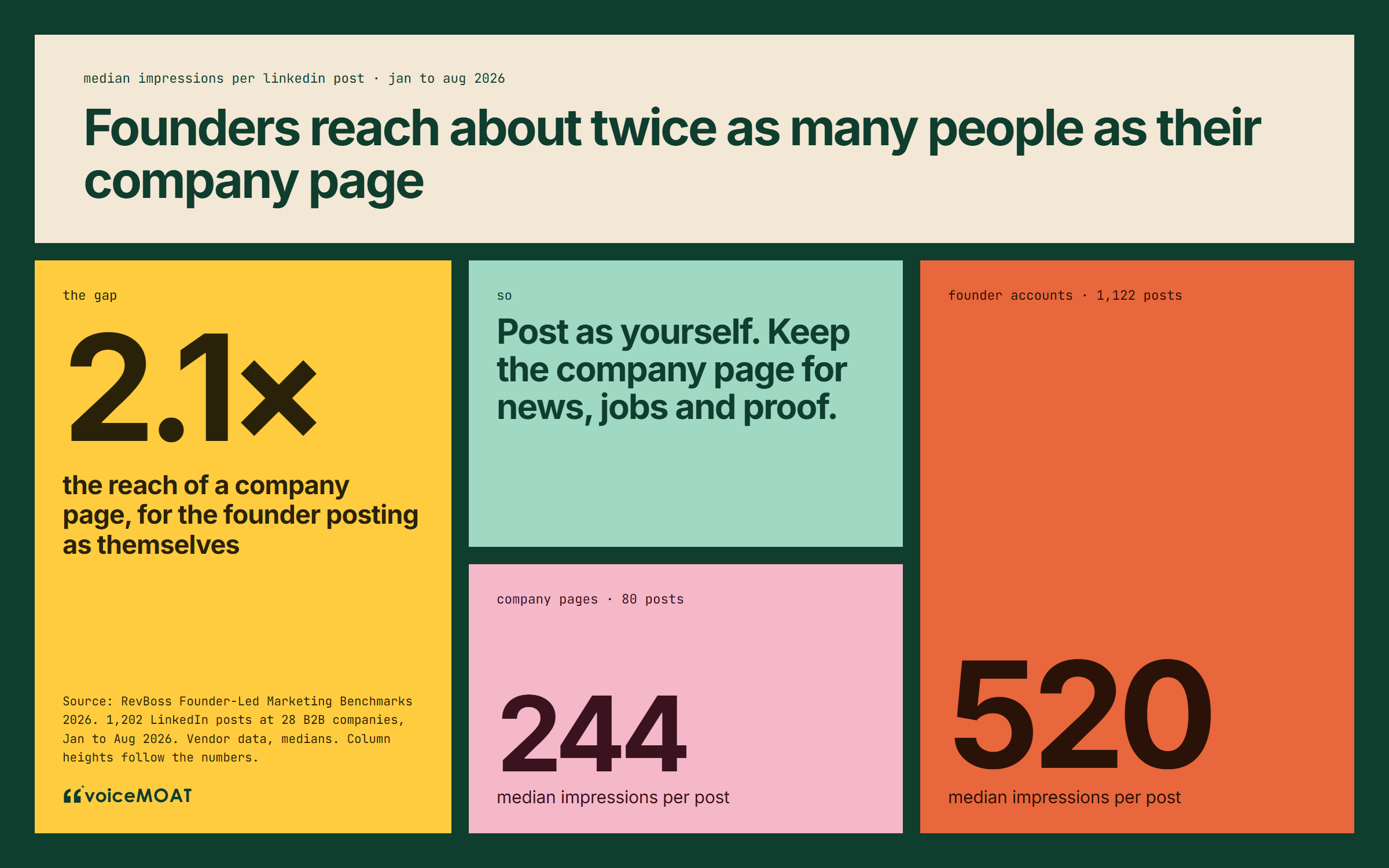
Source: RevBoss, Jan to Aug 2026, 28 B2B companies. Vendor data, medians.
Founder accounts: a median of 520 impressions per post.
Company pages: a median of 244. That's 2.1 times less.
The catch: it's one vendor's own client data, and the company-page sample is small (80 posts). Treat it as a direction, not a law.
The same data shows why consistency matters more than any single post. The top 5% of posts drove 66% of all impressions. You can't predict which post will be the one that travels, so the founders who win are the ones still posting when it happens.
Keep the company page. Use it for announcements, jobs and proof. But the reach, the replies and the trust come through you.
What to post: six kinds of founder posts
The founders worth following don't post "content". They post what they see while building. Six kinds of post cover almost everything:

Most weeks, the first five. Product news when there is some.
A customer problem. What someone told you on a call this week, and what it says about your market. Leave out names unless you have permission.
A decision and why. A price change, a feature you cut, a hire you didn't make. Decisions show judgement, which is what people are really following.
Numbers from building. Signups, revenue, churn, response times: whatever you're comfortable sharing. Real numbers, including bad weeks, are the core of building in public.
A mistake and the lesson. Specific beats humble: what you did, what it cost, what you do now.
A view on your market. Something you believe that others in your space don't, with your reason. One clear opinion does more than five safe observations.
Product news. Launches and changes, when there are some. Keep them the minority; a feed of announcements reads like the company page.
A few rules make any of these work:
Be specific. A number, a date, a quote from a customer (with permission) or a screenshot does more than an adjective.
One idea per post. If you need a second idea, it's a second post.
Write the way you talk. If a sentence would sound strange said out loud to a customer, rewrite it.
Don't fake it. LinkedIn's own rule is that "it's ok to use AI to help you write, but your posts and comments need to represent your voice and your perspectives." In August, LinkedIn said content it classifies as AI slop now gets 40% fewer views. On Twitter, posts that ask for likes, reposts or tags read as bait.
On LinkedIn, format matters less than people think. In RevBoss's data, text-only posts were by far the most common (690 of 1,202) and had a median of 508 impressions. Multi-image posts did better (1,042), but from only 34 posts. Post the format that fits the idea.
Which network first: LinkedIn or Twitter?
Start where the people you need already read. For most founders, that question has a clear answer:

Start where the people you need already read.
LinkedIn first | Twitter first | |
|---|---|---|
You sell to | Businesses: managers, buyers, executives | Builders: developers, other founders, early adopters |
You also need | Hires, partners, investors in traditional sectors | Investors and talent in tech, AI and crypto |
What travels | Clear stories, lessons, decisions, with substance | Short, sharp takes, threads, numbers, build-in-public updates |
How reach works | Your network sees most posts; suggested reach is matched by topic | Replies and reposts reach your followers; original posts can reach non-followers |
What hurts | Engagement pods, automated comments, generic AI posts | Engagement bait, posting in bursts, spammy replies |
If you need both audiences, use both, and don't copy and paste. The same idea works on both networks, but the post doesn't:
On LinkedIn, give the idea room: a few short paragraphs, the story behind it, and what you'd do differently.
On Twitter, cut it to the sharpest line, or break it into a short thread.
That's also why the two networks rarely share a posting time or a format, as our posting schedule guide shows.
How often to post on LinkedIn
Two to five times a week. Buffer's analysis of more than 2 million posts, comparing each account with its own quieter weeks, found reach per post rose with frequency: posting 2 to 5 times a week brought 1,182 more impressions per post than posting once a week.
Most founders post less. The median founder in RevBoss's data posted 1.7 times a week. Those who posted more than the median added about 737 followers in six months, against 373 for those below it. RevBoss calls that directional, not causal, and so do we.
Two things matter as much as the count:
Reply to comments. In Buffer's study of 72,000+ LinkedIn posts, posts where the author replied to comments saw about 30% more engagement.
Comment on other people's posts. Since July, LinkedIn ranks comments by relevance to each reader, so a comment that adds something can be seen by people who never saw the original post. Automated comments are banned.
Our guide to LinkedIn's 2026 feed changes goes deeper.
How often to post on Twitter
One original post a day on weekdays is a good start, spread out, plus a short reply session most days. Twitter's ranking code, which is public, explains why spreading and replying matter:
Spread your posts. In one person's feed, a second post from the same author scores 62.5% of its value and a third 43.75% (code defaults). Three posts at once compete with each other.
Your first two hours count. Original posts from accounts under 50,000 followers get a lift while they're under 2 hours old and under 200 views. After 48 hours, a post drops out of ranking.
Replies are worth more than likes. In the ranking weights, a predicted reply is worth 5 and a like 0.66. Answer the people who reply to you.
Replies reach your followers; original posts reach strangers. Replying to bigger accounts builds relationships, but new people find you through your own posts.
Our breakdown of the October 2026 algorithm update shows each rule in the code. For a Twitter-only plan, see how SaaS founders build a Twitter brand while shipping.
How much time it takes: a founder's week
About three hours a week covers both networks, if most of it happens in short blocks. Here's one way to lay out the week:
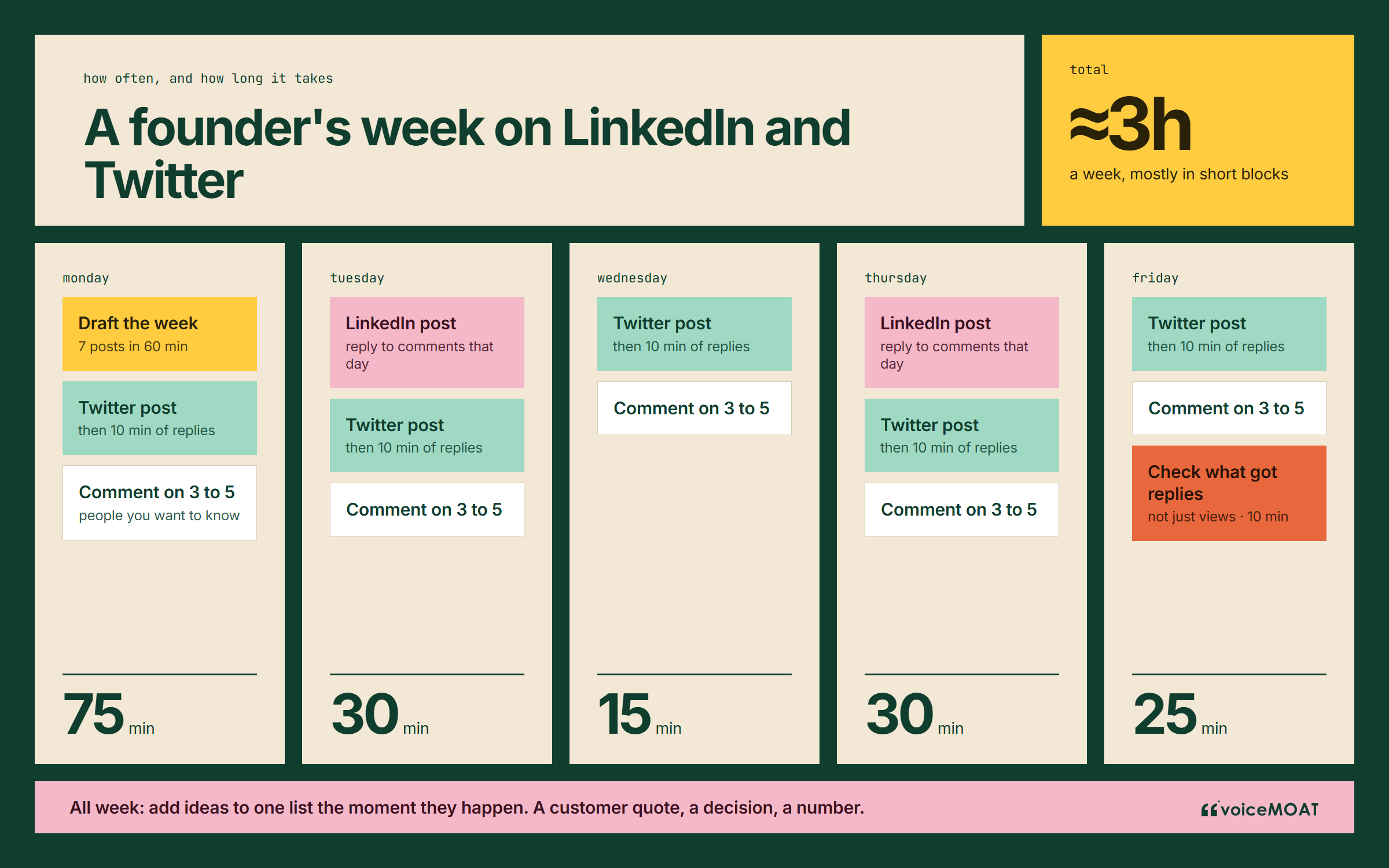
About three hours a week, most of it in short blocks.
When | Time | ||
|---|---|---|---|
During the week | Capture ideas as they happen: a customer quote, a decision, a number | Same list | 2 to 3 minutes each |
Monday | Draft two posts from the list | Draft five short posts from the same list | 60 minutes |
Tuesday and Thursday | Publish one post, reply to comments that day | One post | 15 minutes |
Weekdays | Comment on 3 to 5 posts from people you want to know | One post, then 10 minutes of replies | 15 minutes |
Friday | Look at what got replies, not just views | Same | 10 minutes |
Three habits make the week hold up:
Capture, don't brainstorm. The best founder posts come from the week itself. Keep one list on your phone and add to it the moment something happens.
Draft in one sitting. Writing seven short posts in an hour is easier than finding ten minutes seven times.
Judge by replies. Views swing wildly (the top 5% of posts drive two thirds of impressions). Replies from the people you want to reach are the better signal.
Mistakes that waste a founder's time
Posting only when you launch. A feed that wakes up for launches reads like an ad. The people you need saw nothing for months.
Sounding like the company page. "We're excited to announce" gets less attention than "Here's why we changed our pricing".
Chasing followers instead of the right followers. A thousand people in your market are worth more than ten thousand who aren't.
Engagement bait. "Comment YES for the guide" and engagement pods are against LinkedIn's rules, and bait reads badly on Twitter.
Letting someone (or something) else be you. A ghostwriter or AI tool can help with drafts, but if the posts stop sounding like you, people notice, and so does LinkedIn's AI slop filter.
Quitting at month three. Reach on both networks compounds. Most of the payoff comes after the point where most founders stop.
Where VoiceMoat fits
We built VoiceMoat for founders who want this plan without losing their evenings to it. It's the Personal Brand OS for LinkedIn and Twitter:
audenAI, the brain inside VoiceMoat, learns your voice from your own posts, then drafts posts and replies that read like you, for each network.
It schedules to both networks from one calendar.
It drafts replies and comments for you to edit and post yourself. On LinkedIn, you always press Comment.
It isn't the only way to run this plan. A notes app, a calendar and an hour on Monday will do it too. If you want to try it, the Creator plan is $35 a month, with a 3-day trial for $1.
The short version
Post as yourself.
Post what you see while building: problems, decisions, numbers, mistakes, opinions.
Start where your people read: LinkedIn for business buyers, Twitter for builders.
LinkedIn two to five times a week, Twitter once a weekday, spread out, with replies on both.
Three hours a week, mostly in short blocks, for months, not weeks.
Frequently asked questions
Should founders build a personal brand?
Yes, if you need customers, hires or investors to trust you before they talk to you. Founder accounts reach more people than company pages: in RevBoss's 2026 benchmark of 1,202 LinkedIn posts, founder accounts got a median of 520 impressions per post against 244 for company pages.
Should a founder start on LinkedIn or Twitter?
Start where the people you need already read. LinkedIn first if you sell to businesses or hire and raise in traditional sectors. Twitter first if your buyers are developers, other founders or early adopters. Use both if you need both, and rewrite each post for its network.
How often should a founder post on LinkedIn?
Two to five times a week. Buffer's analysis of more than 2 million posts found that posting 2 to 5 times a week brought 1,182 more impressions per post than posting once a week.
How often should a founder post on Twitter?
One original post a day on weekdays is a good start, spread out across the day, plus a few minutes of replies. Twitter's ranking code scores a second post from the same author in one feed at 62.5% and a third at 43.75%, so bunching posts works against you.
How much time does a founder personal brand take each week?
About three hours a week for both networks: an hour on Monday to draft, then 15 to 30 minutes on most days to publish, reply and comment. Capturing ideas during the week, as they happen, is what keeps it to three hours.
Can founders use AI or a ghostwriter for their posts?
Yes, as long as the posts still sound like you and say what you think. LinkedIn's rule is that "it's ok to use AI to help you write, but your posts and comments need to represent your voice and your perspectives." Generic AI posts lose reach: LinkedIn said in August that content it classifies as AI slop gets 40% fewer views.
Is a personal profile better than a company page?
For reach, yes. People follow people, and in RevBoss's 2026 data founder accounts got about twice the median impressions of company pages. Keep the company page for announcements, jobs and proof, and do the talking on your own profile.
How long until a founder personal brand works?
Expect months, not weeks. Reach is uneven: in RevBoss's data the top 5% of posts drove 66% of impressions, so results arrive in jumps. Founders who posted more than the median added about 737 followers in six months, against 373 for those who posted less.
AI disclosure
This article was drafted with AI assistance and edited by Prateek Singh. Every number comes from a source linked in the text, read on 3 November 2026. Statistics we couldn't trace to a primary source were left out.
Keep reading

Growth
LinkedIn algorithm changes in 2026: every update, dated, and what it means for your reach
LinkedIn rebuilt its feed in March 2026, began cutting the reach of generic AI-written posts beyond your network from May, and started ranking comments in July. Every change, dated and sourced, sorted into what LinkedIn said, what the data shows and what has no source.
15 min read
·

Brand
What is a Personal Brand OS? The five jobs it has to do
A Personal Brand OS is one system that runs the five jobs of a personal brand on LinkedIn and Twitter, from one shared memory of how you write and what has worked. What it means, what each job involves, what the platforms allow, and how to tell a real one from a stack of tools.
20 min read
·

Growth
Personal brand posting schedule for Twitter and LinkedIn in 2026
How often should you post on Twitter and LinkedIn in 2026? The answer is a system, not a magic number: a frequency you can hold at quality, strong time slots, a content mix per platform, and consistency. This guide covers frequency and timing tables, why the big frequency studies disagree, what the public Twitter ranking code says about posting more, a five-step way to set your own cadence, a sample weekly calendar and a 4-week ramp.
16 min read
·

Growth
AI Twitter for SaaS founders: how to build a personal brand while shipping in 2026
AI Twitter for SaaS founders in 2026 is the workflow that lets you ship product at full velocity while building a personal brand on Twitter in parallel: mine your continuous shipping cadence for content seeds, draft in your own voice with voice-trained AI (a per-user model across 10 signals of voice, with a Style and Stance check on your drafts), and hold voice fidelity over the multi-month SaaS sales cycle. Three structural differences from the generalist founder pattern, the build-in-public seeds that compound, and observable patterns from Naval, Pieter Levels, Sahil Bloom, and DHH.
16 min read
·

Brand
The 10-step personal branding guide, voice-first: 3 principles do the work, the other 7 are filler
The standard 10-step personal branding guide reads as a complete list, but three steps do most of the work for social media creators. This guide covers those three, how the usual Twitter personal brand playbook changes when voice comes first, and the three personal branding mistakes that actually break credibility, with a 20-minute audit.
9 min read
·
From the Twitter algorithm series
The Twitter/X algorithm in May 2026: why voice wins under the new transformer
Read ›