
The best AI Twitter tool for founders who don't have time to post is the tool that compresses the per-post operational time from forty minutes down to four minutes without compressing the voice fidelity below the audience-detection threshold. Most founders running a real company in 2026 are time-starved at the unit-of-work level: the hour you spend on a single X thread is the hour you do not spend on a customer call, a product decision, or a hire, and the documented cost of context-switching makes the true price of that hour higher than the clock time. The right tool is not the cheapest tool, the most-featured tool, or the most-recommended tool. The right tool is the one whose per-post time compression is real and whose voice-fidelity output passes the audience-detection threshold the founder's specific audience applies. This piece is the empathetic-and-tactical read on which tools meet that bar in 2026, why most general AI tools do not, and the operational workflow that works for sustained founder content at the time budget a founder can actually defend.
Founders are not debating whether to use AI for content anymore; the category has moved on. Roughly 80% of marketers now use AI in content creation, 42.5% of them extensively, per HubSpot's 2026 State of Marketing. The binding question for a founder is narrower and harder: which tool compresses the time cost without flattening the voice, because for founder content the voice is the product. A flattened-voice post does not just underperform; it quietly reclassifies the account in the audience's mind from founder to brand, and that reclassification is expensive to reverse.
The companion long-horizon read on why founder-voice converts on X specifically while brand-voice does not is at Twitter for ecommerce founders: why founder-voice converts and brand-voice doesn't; the framework generalizes to founders in any sector. The structural argument for why voice is the only creator-economy moat that compounds in 2026 (and why founder content specifically loses asymmetric value when voice flattens) is at authenticity as a moat. The dedicated founder use-case landing page at voicemoat.com/for/founders covers the product-level workflow.
The four-minute vs forty-minute math
The forty-minute version of a founder X post looks like this. Open a draft tab. Stare at the cursor. Type three opening lines that feel wrong. Delete two. Look at notes from yesterday's customer call for an angle. Find one. Write the thread out longhand. Get to tweet four and lose the throughline. Restart. Get to tweet six this time. Read the whole thread. Notice three sentences that sound off. Rewrite them. Read it again. Notice the hook is generic. Rewrite the hook. Publish. The total time, honestly tallied, is forty minutes to an hour for one thread, on a day with no interruptions. Most founder days have interruptions.
The four-minute version of the same post looks like this. Capture the seed from yesterday's customer call as a voice note when it happens (zero added time; the call was already happening). At drafting time, paste the seed into the voice-trained AI tool. Read the draft. Edit the two sentences that need editing. Read the voice match score; ship if it clears the founder's baseline. Total time, honestly tallied, is three to five minutes from seed to publish.
The 10x compression is real if and only if two conditions hold. First, the seed-capture step happens continuously throughout the founder's week (the full case for capture-continuously-not-on-demand is at the hybrid human-AI writing workflow that actually works in 2026; the failure mode is on-demand seed-generation by prompting the AI for ideas, which converges on category-default posts). Second, the AI tool drafts in the founder's specific voice rather than the helpful-assistant default. The 10x compression collapses to 1.5x or 2x if the tool produces drafts that need to be substantially rewritten to sound like the founder; the founder is still doing thirty minutes of editing on a thirty-second draft.
| Stage | The forty-minute way | The four-minute way |
|---|---|---|
| Find the angle | Open a blank draft, stare, mine yesterday's notes for a hook | Pull a seed captured live during the call that sparked it |
| First draft | Write longhand, lose the throughline by tweet four, restart | Paste the seed into the voice-trained tool; draft returns in under 2 minutes |
| Revisions | Rewrite three off-sounding sentences and a generic hook | Edit the two sentences that genuinely need it |
| Voice check | Re-read twice and hope it sounds like you | Read the voice match score; ship if it clears your baseline |
| Publish | Hit send. 40 to 60 minutes gone | Ship live or queue. 3 to 5 minutes total |
What do founders actually need from an AI Twitter tool?
Four operational requirements that bind specifically for founders, in roughly the order they bind.
- Voice fidelity at the founder's specific register. Founder content lives or dies on whether the audience reads it as the founder writing or as a brand voice writing. Generic AI tools produce helpful-assistant register that audiences pattern-match as not-the-founder within seconds in 2026. The voice-fidelity bar for founder content is materially higher than the bar for brand content because the audience is reading for the founder specifically.
- Per-post time compression to under five minutes. The forty-minute version of a post is incompatible with running a company. The four-minute version is the only version that survives the weekly time audit. Tools that compress per-post time below five minutes WITHOUT compressing voice fidelity are the category-correct fit; tools that compress time at the cost of voice fidelity fail the founder use case.
- Reply workflow at sustained cadence. Founder growth on X is heavily reply-driven (the open-sourced X ranking algorithm weights reply engagement heavily); the smart reply guy strategy covers the operational discipline (5 to 10 voice-rich replies a day across three concentric circles). For founders specifically, the reply workflow has to be inline (on x.com itself) because switching tabs to draft a reply is the friction that kills the cadence.
- Operational simplicity at the tool level. Founders do not have time to learn complex multi-feature platforms; the tool's onboarding-to-first-voice-rich-draft has to be under an hour, and the daily workflow has to be a small number of steps. Heavy-platform tools with 30-feature surfaces fail the simplicity test even when individual features are excellent.
| What founders need | Why it binds for founders | What fails it |
|---|---|---|
| Voice fidelity at your register | The audience reads for you; brand-voice reads as not-you in seconds | General LLMs and structural-mimicry rewriters |
| Under five minutes per post | Forty-minute posts are incompatible with running a company | Tools that compress time by sacrificing voice |
| Inline replies on x.com | Founder growth is reply-driven; tab-switching kills the cadence | Tools with no native on-platform reply surface |
| Operational simplicity | No time to learn a 30-feature platform | Heavy suites with broad feature surfaces |
The 7 best AI Twitter tools for founders in 2026, compared
We scored each tool on the four founder-binding criteria above, not on total feature count. The order is founder-weighted: a tool that drafts in your voice and keeps the reply loop on x.com outranks a tool with a larger feature surface, because for a time-starved founder the binding constraints are voice fidelity and per-post time, not breadth. Pricing is the starting paid tier as commonly listed in mid-2026; confirm the current number on each tool's own site before you buy, since these change often.
| Tool | Voice fidelity | Time to draft | Inline replies on x.com | Best for | From |
|---|---|---|---|---|---|
| VoiceMoat (audenAI) | Trained on your full profile | Under 2 min | Yes, Chrome extension | Founders whose moat is their voice | Free, then $35/mo |
| Tweet Hunter | Structural mimicry of viral tweets | Fast | Limited | Studying what formats work | $29/mo, $23 billed yearly |
| Hypefury | General-LLM flavored | Fast | No | Scheduling and monetizing a queue | $6/mo, $5 billed yearly |
| Typefully | Light, UX-first | Medium | No | Writing and shipping clean threads | ‼️ Disputed, see below |
| Postwise | Generic ghostwriter register | Fast | Limited | Bulk drafts and viral rewrites | ~$37/mo |
| Buffer | Basic AI assist | Medium | No | The simplest, cheapest scheduler | Free, then $6/channel, $5 billed yearly |
| ChatGPT / Claude | Helpful-assistant default | Fast | No | A general baseline you edit heavily | ~$20/mo |
‼️ These seven are not ranked best to worst. They are grouped by what each one is actually for, with the general assistants last because they are not social tools. We make one of them, VoiceMoat, and it sits fourth rather than first, which is deliberate: a roundup that crowns its own publisher is the main reason readers stop trusting pages like this one. The per-tool notes say what each is genuinely good at and where it falls short for founder content specifically, including ours.
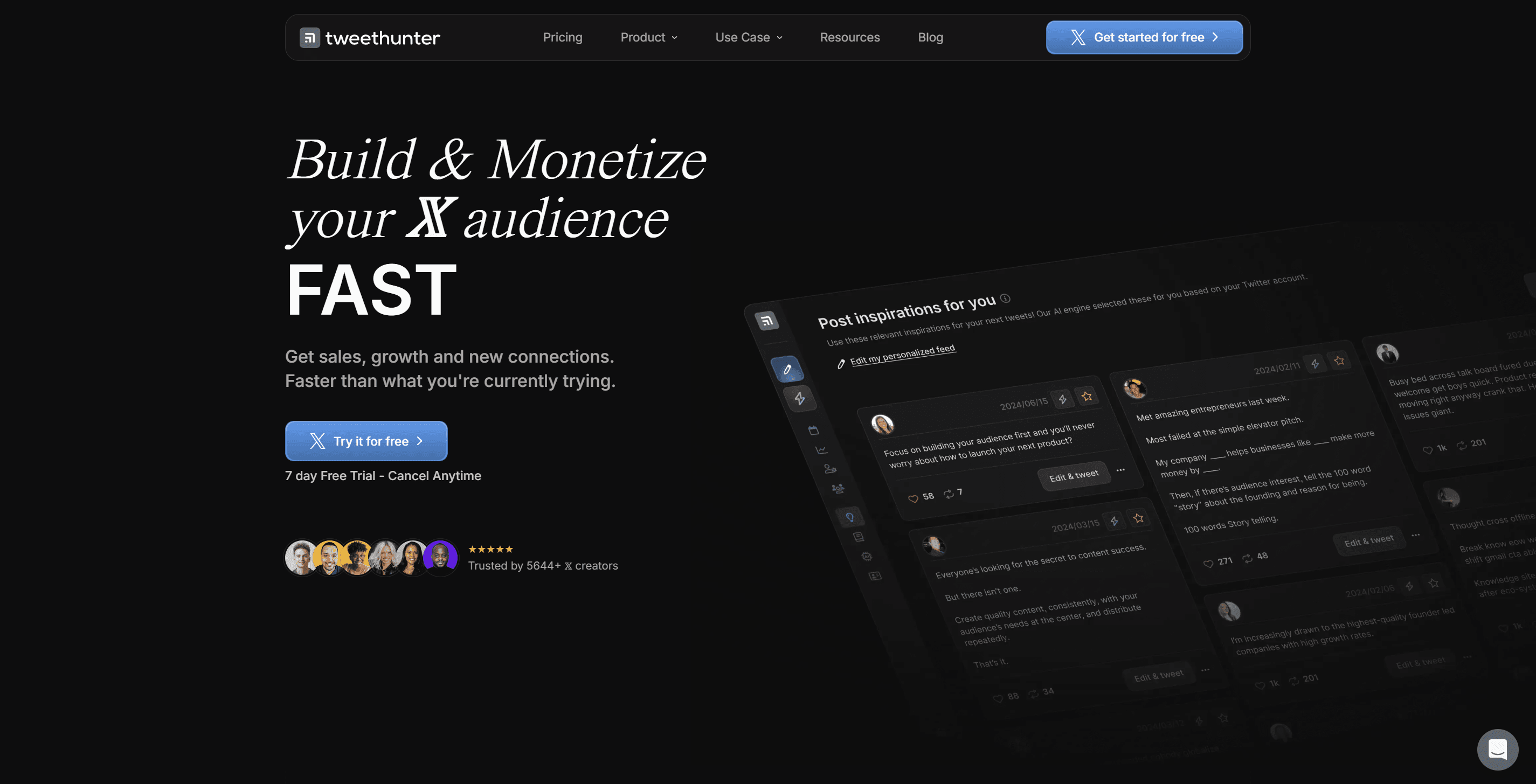
1. Tweet Hunter: the viral library
Tweet Hunter pairs one of the largest libraries of high-performing tweets with an AI writer and a light CRM. For a founder, the library is genuinely useful for breaking out of your own hook patterns and seeing which structures travel. The limitation is the one that binds: the AI rewrites toward the structural style of tweets that already went viral, not toward your specific voice, so founder drafts come back sounding like high-performing-tweet register rather than like you. Treat it as a structure-and-inspiration layer you edit heavily, not as a voice engine. Starts around $49 a month.
2. Hypefury: the monetization queue
Hypefury is built for scheduling and monetizing a queue: evergreen recycling, auto-retweets, and the Autoplug feature that appends a promo to a tweet once it clears an engagement threshold. For founders who already have voice-rich material and want to recycle and monetize it, that machinery is real and well-built. Its AI drafting, though, is general-LLM flavored, so it does not close the founder voice-fidelity gap on its own, and some of its growth machinery (engagement-pod-adjacent tactics) is voice-corrosive if you lean on it. Use it for distribution, not for finding your voice. Starts around $19 a month on annual billing.

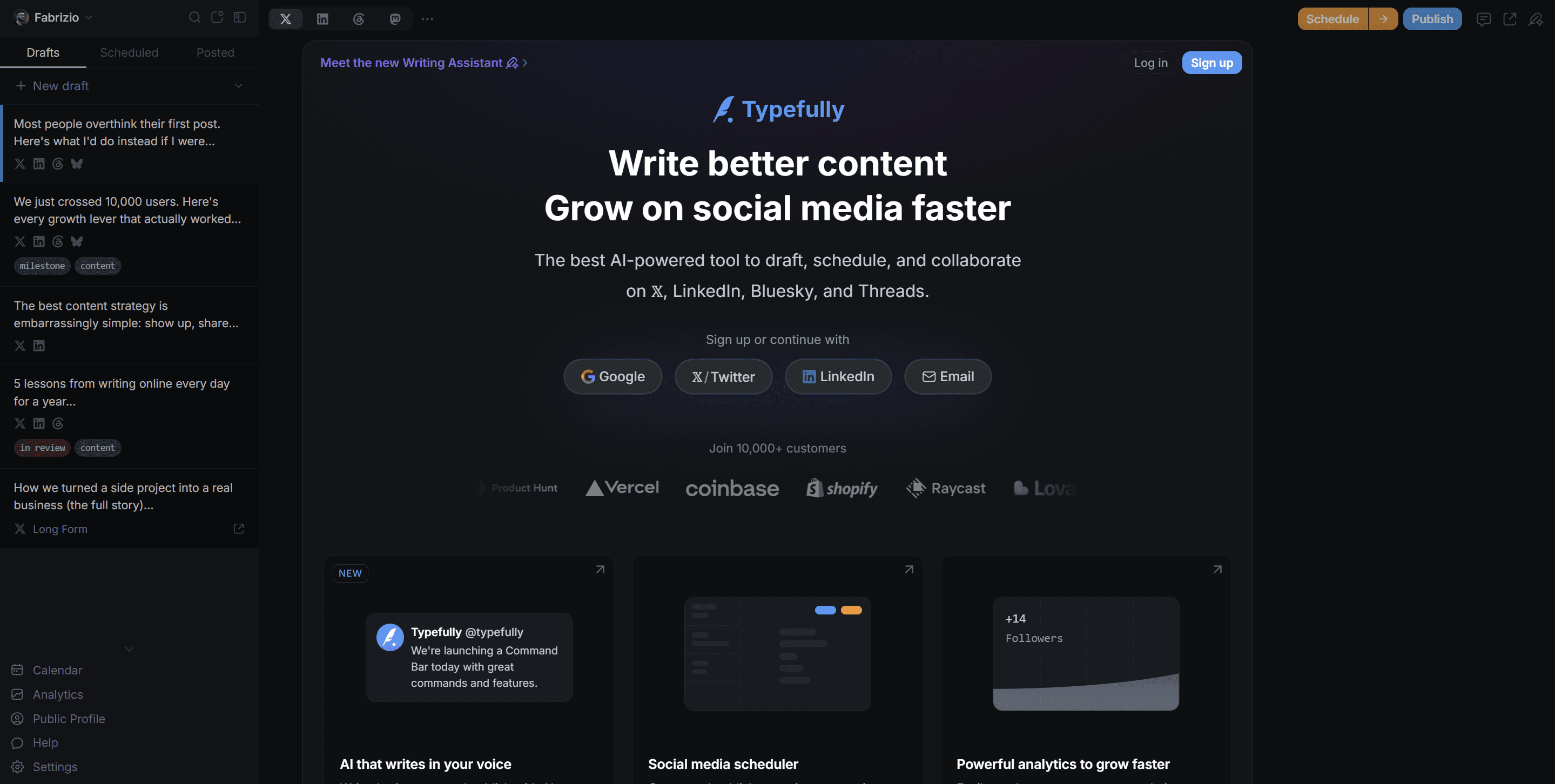
3. Typefully: the thread-writing UX
Typefully is the cleanest writing-and-scheduling surface in the category: a distraction-free composer, natural-language scheduling, real-time thread previews, and built-in analytics. Founders who already write in their own voice and just want a frictionless place to draft and ship threads are well served. The trade-off is depth of AI: Typefully is UX-first, not AI-first, so its style assistance is lighter than the dedicated writers here. It will not draft in your voice from a seed; it makes your own writing faster to ship. Free tier, paid from about $12.50 a month.
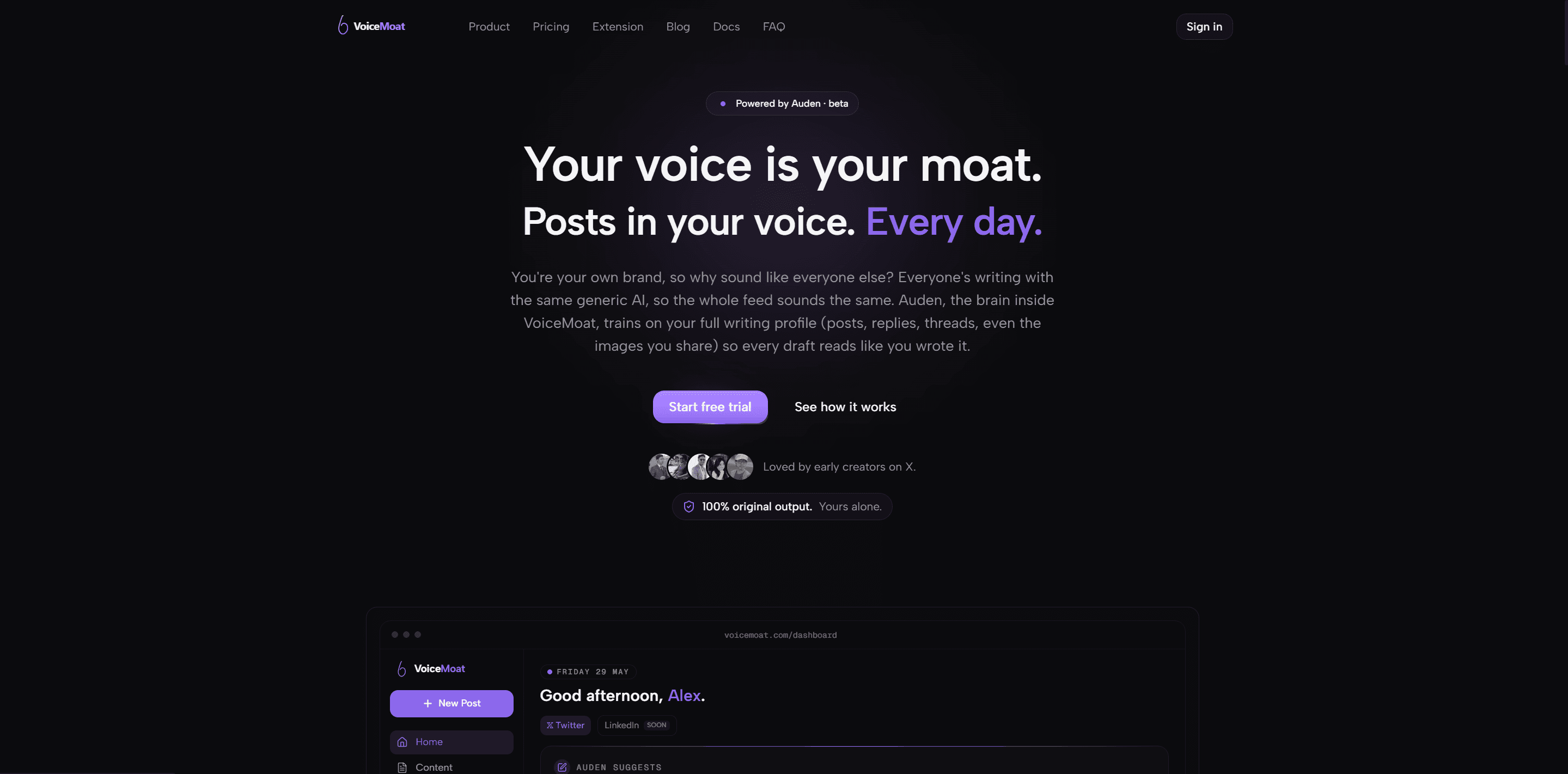
4. VoiceMoat (audenAI): the voice-first option
VoiceMoat is the only tool here built around voice fidelity as the binding constraint rather than as a feature. Its writing partner, audenAI, trains on your full profile (posts, replies, threads, and images across 10 signals of voice) and drafts from your own seed in your own register, then returns a voice match score on every draft as a hard gate against drift. The Chrome extension surfaces reply drafts inline on x.com, so the reply loop never costs a tab switch. It is the wrong pick if you want a 30-feature growth suite or the cheapest possible scheduler. It is the right pick if your distribution advantage is that the account reads unmistakably like you. A paid trial from $1, then from $35 a month.
5. Postwise: the ghostwriter
Postwise is an AI ghostwriter for X, LinkedIn, and Threads that generates multiple tweet variations and viral rewrites quickly. For batching, it is fast and produces usable raw material. The founder-relevant limitation is voice: the variations come back in a generic ghostwriter register tuned for engagement, which an attentive founder audience reads as not-you, so the editing burden to bring drafts into voice is high. Good for volume and idea spread, weaker on the fidelity founder content lives on. Starts around $37 a month. The named head-to-head on voice training is at VoiceMoat vs Postwise in 2026.

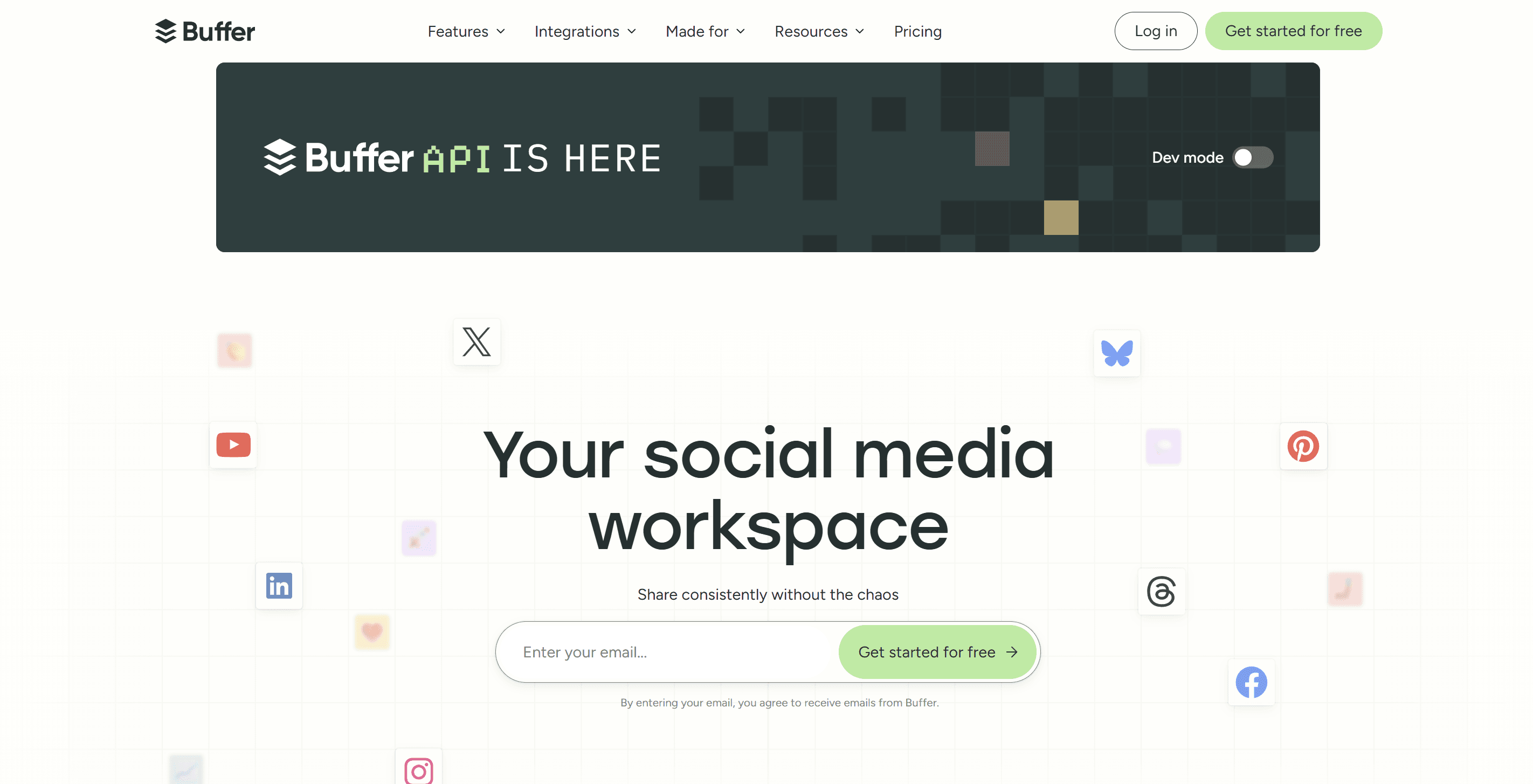
6. Buffer: the simple scheduler
Buffer is the simplest, most affordable scheduler in the category, with a genuinely useful free tier and an AI Assistant that adapts a post per platform. For a founder who wants a no-friction queue and basic AI rewrites at the lowest price, it is hard to beat on cost. It is not a voice-matching tool: the AI Assistant does light tone adjustment, not full-profile voice training, so it sits in the stack as distribution plumbing rather than as the drafting brain. Free for three channels, then around $5 a month per channel.
7. ChatGPT and Claude: the general baseline
ChatGPT and Claude are where most founders start, and they are excellent for thinking, outlining, and research. As founder-voice writers they fail at the default level, because their training optimizes for helpful-assistant register, which is the opposite of voice. You can push them closer with custom instructions and a pasted voice sample, but then you are doing the voice work by hand on every draft, which reintroduces the editing time the four-minute workflow is supposed to remove. The full side-by-side is at Claude vs ChatGPT for content writing in 2026.
‼️ A note on pricing, and it changed this page. These figures are no longer "commonly listed" numbers. Every one was read off the vendor's own pricing page on 27 August 2026, with the monthly and the annual position of the toggle both checked. Two tools turned out to be cheaper than they are usually published, including on the earlier version of this page. Prices still move, so confirm the current number before subscribing.
Two of these tools are cheaper than they are usually listed
Quick answer
‼️ Tweet Hunter and Hypefury are both published at the wrong entry price across this category, and this page had it wrong too. Tweet Hunter is commonly listed from $49 a month. Its cheapest plan is $29 monthly and $23 billed yearly. Hypefury is commonly listed from $19. Its cheapest plan is $6 monthly and $5 billed yearly.
| Tool | Commonly listed from | Its actual cheapest plan |
|---|---|---|
| Tweet Hunter | ~$49/mo | ‼️ $29/mo, or $23 billed yearly (Discover) |
| Hypefury | ~$19/mo | ‼️ $6/mo, or $5 billed yearly (Flexible, 1 channel) |
| Postwise | ~$37/mo | $37/mo (Basic). Correct as published |
| Buffer | ~$5/channel | $6/channel monthly, $5 billed yearly. Correct on annual only |
- ‼️ Tweet Hunter's own page title is where the $49 comes from. The title reads "Tweet Hunter Pricing - Plans from $49/mo" while the cheapest plan on that same page is $29 monthly and $23 yearly. $49 is its middle tier. Checked in both toggle positions, so this is not the annual discount.
- Hypefury's $19 is its Full plan, which includes all channels. Its Flexible plan is $6 a month for one channel, with each additional platform charged at 6 USD a month.
- Both are the same mistake in opposite directions from the same cause: somebody copied a headline figure instead of opening the plan table, and everyone downstream copied them. We were downstream.
- ⚠️ Typefully could not be verified at all. Its pricing page renders a nav and a footer and no prices, and Typefully's own comparison article states a figure that does not match what we captured in July. It is excluded from the chart rather than guessed at, and the detail is in our Typefully pricing breakdown.
- The general assistants are excluded from the price chart because a general chat subscription and a social publishing tool are not the same purchase, and putting them on one axis implies they are.
Sources: Tweet Hunter pricing, Hypefury pricing, Postwise pricing, Buffer pricing.
Why do general AI tools fail for founder content?
General AI tools (ChatGPT, Claude, Gemini, and the wrappers built on top of them) fail the founder use case at the voice-fidelity requirement before they get to the other three. The mechanical reason is that general-LLM training objectives optimize for helpful-assistant register, which is the opposite of voice; the deeper case is at why all AI-written tweets sound the same. For founders specifically, the failure is sharper because founder audiences read for the founder; a helpful-assistant register reads as brand-voice within seconds and the founder's audience downgrades the account from founder-account to brand-account in their mental model.
The named-LLM comparison between ChatGPT and Claude for content writing (and why both share the helpful-assistant default register limitation at the founder-content level) is at Claude vs ChatGPT for content writing in 2026: an honest side-by-side. The piece walks the six design-decision differences and lands on the conditional answer; neither tool is built for founder voice-fidelity at the default level, and both require substantial editing for founder use cases.
The other tools in the category (Hypefury, Tweet Hunter, Typefully) each fail the founder use case at a different point. Hypefury fails on voice fidelity (AI features are general-LLM-flavored). Tweet Hunter fails on voice fidelity at the structural-mimicry layer (the rewrite produces output in the structural style of high-performing tweets, not in the founder's specific voice). Typefully fails on AI depth (the AI features are lighter than the other tools; the product is UX-first not AI-first). The 4-way ranking with full reasoning is at Hypefury vs Tweet Hunter vs Typefully vs VoiceMoat in 2026: the honest 4-way comparison.
The voice-trained AI Twitter tool workflow at founder cadence
The workflow that meets the four-minute target while preserving voice fidelity has four operational steps. The shape is observable across founders who have settled into sustained X cadence in 2026.
- Capture seeds continuously throughout the founder's week. Voice notes during commutes, captured observations after customer calls, retrospective angles after product decisions. Zero added time because the source events were already happening. The result is a running list of seed-level observations the founder can pull from at drafting time without needing to generate ideas on demand.
- Draft in the voice-trained AI tool from the seed. The tool produces a draft in the founder's specific voice (trained on the founder's full profile of posts, replies, threads, and images across 10 signals of Voice DNA). Per-draft time at this stage is under two minutes.
- Edit and score against the founder's voice baseline. The voice match score is the hard gate; drafts above the founder's baseline ship, drafts below get another edit pass or get killed. The deeper read on the score as a measurement layer is at voice match score explained. Per-draft time at this stage is one to two minutes.
- Publish from the platform itself or schedule the small set of posts that genuinely benefit from scheduling. The voice-first read on what to schedule and what to ship live is at Twitter scheduling tools 2026. For founders specifically, most posts ship live; scheduled posts are reserved for time-zone optimization, launch announcements, and the small set of genuinely-evergreen reference content.
The total per-post time across the four steps is three to five minutes. The cadence math at this time budget: three voice-rich posts per week plus five to ten voice-rich replies per day, sustained over months, produces founder-content compounding that the forty-minute-per-post workflow cannot sustain because the founder runs out of time within weeks.
A founder's week on the four-minute cadence
The math is abstract until it lands on a calendar. Here is a representative week running the four-minute workflow: three voice-rich posts and a daily reply habit, with every seed captured from work that was already happening. No content blocks were added to the week. The posts are a byproduct of the work the founder was doing anyway.
| Day | Seed (from real work) | Output | Time |
|---|---|---|---|
| Monday | A hard tradeoff from sprint planning | One build-in-public thread on the decision | 4 min |
| Tuesday | A question that came up on three sales calls | Replies across three concentric circles | 10 min of replies |
| Wednesday | A blunt line a customer said on a call | One short single tweet, shipped live | 3 min |
| Thursday | A pattern across this week's support tickets | Replies plus one quote-tweet take | 10 min of replies |
| Friday | A retrospective angle after shipping | One reflective thread | 5 min |
Across the week that is three posts and a sustained reply habit for well under an hour of dedicated writing time. The forty-minute-per-post founder cannot match this, not because they write worse, but because they run out of hours by Wednesday. Sustained cadence, not peak quality on any single post, is what compounds on X, and sustained cadence is a time-budget problem before it is a writing problem.
When is four minutes a day enough?
The four-minute-per-day budget is enough when three conditions hold. First, the founder has built up a back catalog of posts that voice training can learn from. With a thin back catalog, the voice-training output drops in fidelity and the four-minute workflow does not deliver the voice-rich drafts that make the compression valuable. Founders with a thin back catalog should treat the first thirty to sixty days as corpus-building (write more, in voice, without the AI tool) and add the AI tool once the corpus is dense enough.
Second, the founder's content discipline is in place at the editorial layer. The four-minute workflow assumes the founder still does Stages 1 (ideation), 3 (edit), and 5 (publish judgment) of the hybrid workflow; the AI handles Stage 2 (drafting in voice) and Stage 4 (voice match scoring as audit). If the founder skips Stages 1, 3, or 5, the workflow collapses into the AI-drafted-and-shipped failure mode and the voice-flat output the audience pattern-matches against the founder.
Third, the founder is using the tool as a partner, not as an autocompleter. The audenAI framing of this is one sentence: audenAI suggests; you decide. The founder who outsources the publishing decision to the tool produces the kind of voice-flat output that costs audience trust in months and cannot be recovered in weeks.
Beyond the AI tool: the rest of the founder content stack
The AI tool is one component of the founder content stack. The full stack at the four-minute-per-day cadence: a voice-trained AI tool for drafting (Stage 2), a continuous seed-capture practice (notes app, voice memos, retrospective notes after customer calls), the voice doc and taboo list that anchor the voice training, the voice match score as the per-draft hard gate, the Chrome extension for inline reply drafting on x.com itself, and a small set of scheduling for the legitimately-evergreen posts (launches, time-zone optimization, signature reference threads).
| Layer | Role | Example |
|---|---|---|
| Seed capture | Catch observations as the work happens | Voice memos, notes after calls |
| Voice-trained drafting | Turn a seed into an on-voice draft (Stage 2) | audenAI in VoiceMoat |
| Voice baseline | The anchor the training holds to | Your voice doc and taboo list |
| The hard gate | Reject drafts that drift (Stage 4) | Voice match score |
| Inline replies | Keep the reply loop on-platform | Chrome extension on x.com |
| Selective scheduling | Queue only the genuinely evergreen | Launches, time-zone optimization |
Three things the stack deliberately does not include. First, an engagement pod or growth automation layer (voice-corrosive; the deeper case is at how to grow on X without buying followers or engagement pods). Second, AI ghostwriter agencies in the mid-thousand-dollar range (the cost-vs-fidelity trade-off is at AI ghostwriter vs human ghostwriter in 2026: the honest ROI breakdown; the voice-trained AI tool at the upper tier is an order of magnitude cheaper). Third, a heavy multi-platform scheduler with cross-posting to five additional platforms (most founders are right to go deep on Twitter and LinkedIn rather than multi-platform-thin; the deeper case is at Bluesky vs X for social media creators).
Does AI-written founder content still sound authentic?
Yes, if the tool drafts in your voice and you stay the editor. The distinction is voice-not-cloning: a voice-trained tool does not impersonate anyone or invent a persona, it learns the patterns in your own writing (your cadence, vocabulary, hook habits, and the references you return to) and drafts from your own seed in those patterns. The published words are still yours: you supplied the observation, you edited the draft, and you made the publish call. Authenticity on X is about whether the post is the founder's actual thinking in the founder's actual register, and the voice-trained workflow keeps both in the founder's hands. The deeper read on what audiences actually detect is at can your audience tell you're using AI.
The inauthentic failure mode is real, and it has a specific shape: the founder who treats the tool as an autocompleter, pastes a generic prompt, and ships whatever comes back without editing. That output is voice-flat, and audiences pattern-match it as not-the-founder fast (the broader shift in how audiences engage with social content is tracked in sources like Sprout Social's social media benchmarks). The guardrail is the voice match score as an objective check on every draft, plus the discipline of editing before publishing. A draft below your baseline does not ship. The tool suggests; the founder decides. That one rule is the difference between scaling your voice and diluting it.
How to choose the right tool for your situation
The honest answer is conditional on your binding constraint. Map your situation to the column that actually limits you, not to the tool with the most features.
| If you are... | Your binding constraint | Start with |
|---|---|---|
| A founder whose audience reads for you | Voice fidelity at cadence | A voice-trained tool (VoiceMoat) |
| Already on-voice, want a clean queue | Frictionless shipping | Typefully or Buffer |
| Sitting on a backlog to recycle and monetize | Distribution and monetization | Hypefury |
| Stuck in your own hook patterns | Structural variety | Tweet Hunter |
| Batching high volume across platforms | Raw draft throughput | Postwise |
| Just experimenting, lowest cost | Budget | ChatGPT or Buffer free tier |
Most founders end up with a small stack, not a single tool: a voice-trained drafter as the brain, plus one lightweight scheduler for the handful of posts that genuinely benefit from queueing. The mistake is buying the heavy suite first and discovering the voice gap later, after the audience has already started reading the account as a brand.
What is the best AI Twitter tool for founders in 2026?
The best AI Twitter tool for founders is the tool whose per-post time compression is real (four minutes vs forty minutes) and whose voice-fidelity output passes the audience-detection threshold the founder's specific audience applies. The 10x time compression collapses to 1.5x if the tool produces helpful-assistant register that the founder has to substantially rewrite to sound like themselves. The voice-trained workflow (seed capture continuously, draft in the voice-trained tool, edit and score against voice baseline, publish or schedule) is the operational shape that meets the four-minute target while preserving voice fidelity. The cadence at four minutes per post is three voice-rich posts per week plus five to ten voice-rich replies per day, sustained over months. That is the math founders can defend at the weekly time audit.
If you want a voice-trained writing partner that drafts in your specific voice from your seed, scores every draft against your baseline as the hard gate, and surfaces inline reply drafts on x.com so the reply workflow holds at sustained cadence without leaving the platform, audenAI, the brain inside VoiceMoat, is built for exactly this workflow. The dedicated founder use-case page at voicemoat.com/for/founders covers the product-level operations. audenAI suggests. You decide. If your situation is more specific, three companion reads go deeper: AI Twitter for SaaS founders for the continuous-shipping cadence, best AI tools for crypto Twitter KOLs for the higher-stakes CT audience, and how to build a Twitter content workflow using AI (step-by-step 2026) for the screen-by-screen build of the four-minute workflow.