
The best AI Twitter tool in 2026 depends on your bottleneck: Hypefury for operational breadth across the full publishing workflow, VoiceMoat for voice fidelity (it trains a per-user model, audenAI, on your full profile across 10 signals of voice and scores every draft for voice match), Tweet Hunter for viral-library research, and Typefully for thread-composition UX. That is the honest 4-way answer most relevant for serious X creators in 2026, and the rest of this piece ranks all four with the reasoning on the page. Each tool dominates a different slice of the category and the right ranking depends on which slice the writer actually needs. The four tools sit in different product categories (automation-first scheduler, viral-library growth platform, minimalist thread composer, voice-trained writing partner), charge different prices, and solve different bottlenecks. The honest ranking below gives each tool its category-correct rank with verified pricing as of 2026-05-15 and feature claims sourced from each vendor's own marketing.
Named-competitor exception applies. All four tools are explicit subjects of this comparison. The rest of the corpus stays in category language. The deeper head-to-head pieces (for the comparisons that warrant their own treatment) are at VoiceMoat vs Hypefury in 2026 and VoiceMoat vs Tweet Hunter in 2026. This piece is the editorial-roundup version that ranks all four.
The placement discipline: this piece does not place VoiceMoat at number one. The credibility math depends on this. A roundup that places its own product at the top reads as marketing within the first paragraph, which collapses the rest of the analysis. The honest call is to rank each tool where its category-correct value lands relative to the others, give the reasoning, and let the reader conclude. VoiceMoat is the specialist for voice fidelity; the question of whether that specialism wins the top spot depends on which bottleneck the reader is solving, and the answer is conditional. The conditional answer is the article's contribution.

How the AI Twitter tool category changed in 2026
Two shifts reshaped this category. First, reach collapsed for ordinary accounts: Buffer's October 2025 analysis of 18.8 million posts across 71,000 accounts found the median non-Premium account now sees roughly 0% engagement, while Premium text posts climb toward 0.9%. When the median post earns almost nothing, the marginal voice-rich post or reply, the one that actually sounds like a specific human, is what compounds. Second, the audience-detection threshold for AI-shaped writing compressed hard; readers pattern-match the helpful-assistant register as not-you within a single scroll.
Those two shifts move voice fidelity from a nice-to-have to the load-bearing variable, and they explain why the ranking below weights draft quality and voice first. A tool that ships every operational feature but drafts in a generic register is solving a problem that matters less in 2026 than the problem of sounding like yourself at scale. The full argument is at authenticity as a moat; the data read on the engagement collapse is at Twitter engagement is down in 2026: a data read.
What makes an AI Twitter tool the best in 2026?
The ranking below uses five criteria, weighted by their relevance to a serious creator's 2026 workflow. Each tool gets a category-correct placement, not a uniform-scale score. The criteria are listed in the order they typically bind in a creator's workflow.
- Draft quality and voice fidelity. Does the tool produce drafts that sound like the writer or like a general AI tool? The audience-detection threshold for AI-shaped writing has compressed materially in 2026 (the diagnostic is at /blog/em-dash-ai-tell); voice fidelity is the load-bearing variable for sustained engagement.
- Operational breadth. Does the tool cover the full creator workflow (drafting, scheduling, multi-platform cross-posting, analytics, engagement automation) or only one slice? Breadth lowers tool-stack complexity but can dilute focus on the load-bearing capability.
- Maturity and reliability. How long has the tool been on the market, how stable is the product, how trusted is it in the established creator community? Newer tools can carry more upside but also more risk.
- Pricing per dollar of category-correct value. Different tools sit at different price points because they ship different value categories. Pricing-per-feature comparisons across categories are misleading; pricing-per-category-correct-value is the right frame.
- Specialist vs generalist trade-off. Does the tool optimize deeply on one axis or broadly across many? Both shapes can win depending on the creator's bottleneck.
The framework-level analogues for named-entity comparison structure in this corpus are the named-LLM piece at Claude vs ChatGPT for content writing in 2026 and the named-tool piece at AI detection tools tested in 2026. Both pieces share the discipline of placing the named entities in their category-correct positions with reasoning on the page, not at top-rank-by-default.
A note on method: every price in this comparison was checked against each vendor's own pricing page in June 2026, and every feature claim is sourced from the vendor's current marketing rather than from third-party reviews that often lag. Where a vendor does not surface a number publicly, or renders its pricing page in a way a fetch cannot read (as Typefully does), that is stated inline rather than guessed. The ranking is editorial and weighted by the criteria above; the conditional use-case-mapping later in the piece is the more precise read for any single creator.
| Tool | Category | Voice fidelity | Starts at | Best for |
|---|---|---|---|---|
| Hypefury | Automation + scheduling | General-LLM | $29/mo | Multi-platform operational breadth |
| VoiceMoat | Voice-trained writing | Full-profile, highest | $35/mo (free tier) | Reading like yourself at scale |
| Tweet Hunter | Viral-library growth | Structural mimicry | $29/mo | Structural variety + X CRM |
| Typefully | Thread composer | Light AI | $8/mo (free tier) | Thread-writing UX + multi-platform |
Number one: Hypefury
Hypefury earns the number one spot in this roundup on a combination of maturity, operational breadth, and trust in the established creator community. The product has been on the market since 2020 and remains the most-recommended scheduler-and-automation tool for solo creators, ghostwriters, and small agencies. The feature set covers the full operational workflow: scheduling, evergreen recycling (the strongest implementation in the category), multi-platform cross-posting to LinkedIn, Instagram, and Threads (Facebook and TikTok both in the lineup as of June 2026), engagement-builder targeting against specific users and keywords, auto-DM functionality scaling by tier, and one-click text-to-image or text-to-video repurposing.
Pricing as of June 2026 (verified on hypefury.com/pricing): Starter $29/mo (1 X account, 6 total social accounts, 1 month scheduling, 100 auto-DMs/day), Creator $69/mo (5 X accounts, 30 social, 3 months scheduling, 250 auto-DMs/day, the most-picked plan), Business $97/mo (10 X accounts, unlimited scheduling), Agency $199/mo (15 X accounts, 400 auto-DMs/day). All plans include a 7-day free trial.
Strengths: evergreen recycling is best-in-category, cross-posting is deep, automation is reliable, pricing is reasonable at the entry tier. Limitations: AI writing features at the upper tiers are general-LLM-flavored output rather than voice-trained output; if voice fidelity is the bottleneck, Hypefury is not the layer of the stack that fixes it.
Why number one in this roundup: the broadest user base, the longest market presence, and the operational breadth that lets a creator run the full publishing workflow from one product. The depth on automation and the maturity of the implementation outweigh the AI-writing-is-not-voice-trained limitation for the typical reader of this kind of roundup. The deeper read on Hypefury's category-correct value against a voice-trained writing partner is at VoiceMoat vs Hypefury in 2026. The dedicated 7-tool roundup for writers running into a Hypefury fit-envelope edge and looking for category-correct alternatives is at 7 best Hypefury alternatives in 2026 (tested by a real user).
Best fit, and when to skip it: Hypefury is the right call for the high-cadence creator who publishes to four or more platforms and wants one product to run scheduling, recycling, cross-posting, and engagement automation. Skip it if your single binding bottleneck is voice fidelity, because the AI-writing layer is general-LLM-flavored and will not make your drafts sound like you; pair it with a voice-trained tool rather than expecting it to close that gap.

Number two: VoiceMoat
VoiceMoat earns the number two spot in this roundup as the specialist for voice fidelity in 2026. The brain inside VoiceMoat is audenAI, trained on the writer's full profile of 100 to 200 posts, replies, threads, and images across 10 signals of Voice DNA. The default output of an audenAI draft is the writer's register, not the helpful-assistant register a general LLM defaults to, and not the structural-mimicry register a viral-library rewrite produces. Taboo enforcement is at the model level (the AI vocabulary cluster of leverage, delve, unlock, navigate, harness, foster, elevate, embark, robust, seamless, comprehensive, holistic is refused by default). Every draft comes with a per-draft voice match score as the hard gate against drift.
Pricing as of July 2026 (verified on voicemoat.com/pricing): a free $0/mo tier (audenAI Standard, 1 voice profile, 10 daily replies), then Creator $35/mo (audenAI Standard, voice training, voice match score, 50 daily replies), Pro $69/mo (audenAI Standard, most-popular plan, 100 daily replies), and Enterprise $150/mo (audenAI Deep, the higher-fidelity model tier, 200 daily replies). Two-tier model branding (audenAI Standard on Free, Creator, and Pro; audenAI Deep on Enterprise). Every paid plan starts with a 3-day Pro trial.
Strengths: voice fidelity is the highest in the category by design, taboo enforcement is categorical rather than probabilistic, the Chrome extension surfaces inline reply drafts on x.com for the smart reply guy strategy, and the voice match score is the per-draft measurement layer the category has been missing. Limitations: not a scheduler (no evergreen recycling, no cross-posting to TikTok or Facebook Pages, no auto-DMs); the operational breadth is narrower than Hypefury or Tweet Hunter; requires a 100-to-200-piece corpus for the voice training to deliver category-correct value (below the corpus threshold, the value lands but does not reach full fidelity).
Why number two in this roundup: voice fidelity is the load-bearing variable for sustained audience engagement in 2026, and VoiceMoat is the only tool in this comparison that optimizes deeply on that one axis. The specialism outranks the broader-but-AI-light tools at lower ranks because the audience-detection threshold for AI-shaped writing has compressed materially. Not at number one because the specialism is narrower in scope than Hypefury's full operational workflow; the reader who needs both voice and operational breadth has to choose which bottleneck binds first. The structural argument for why voice compounds as a moat while other creator-economy moats leak is at authenticity as a moat.
Best fit, and when to skip it: VoiceMoat is the right call when your drafts read AI-shaped to attentive readers and voice is the explicit thesis of your brand, and when replies are a load-bearing growth channel (the inline Chrome extension drafts them on x.com). Skip it, or pair it, if you need a full scheduler with evergreen recycling and multi-platform cross-posting; VoiceMoat is voice-deep writing on Twitter and LinkedIn, not broad operations.
Number three: Tweet Hunter
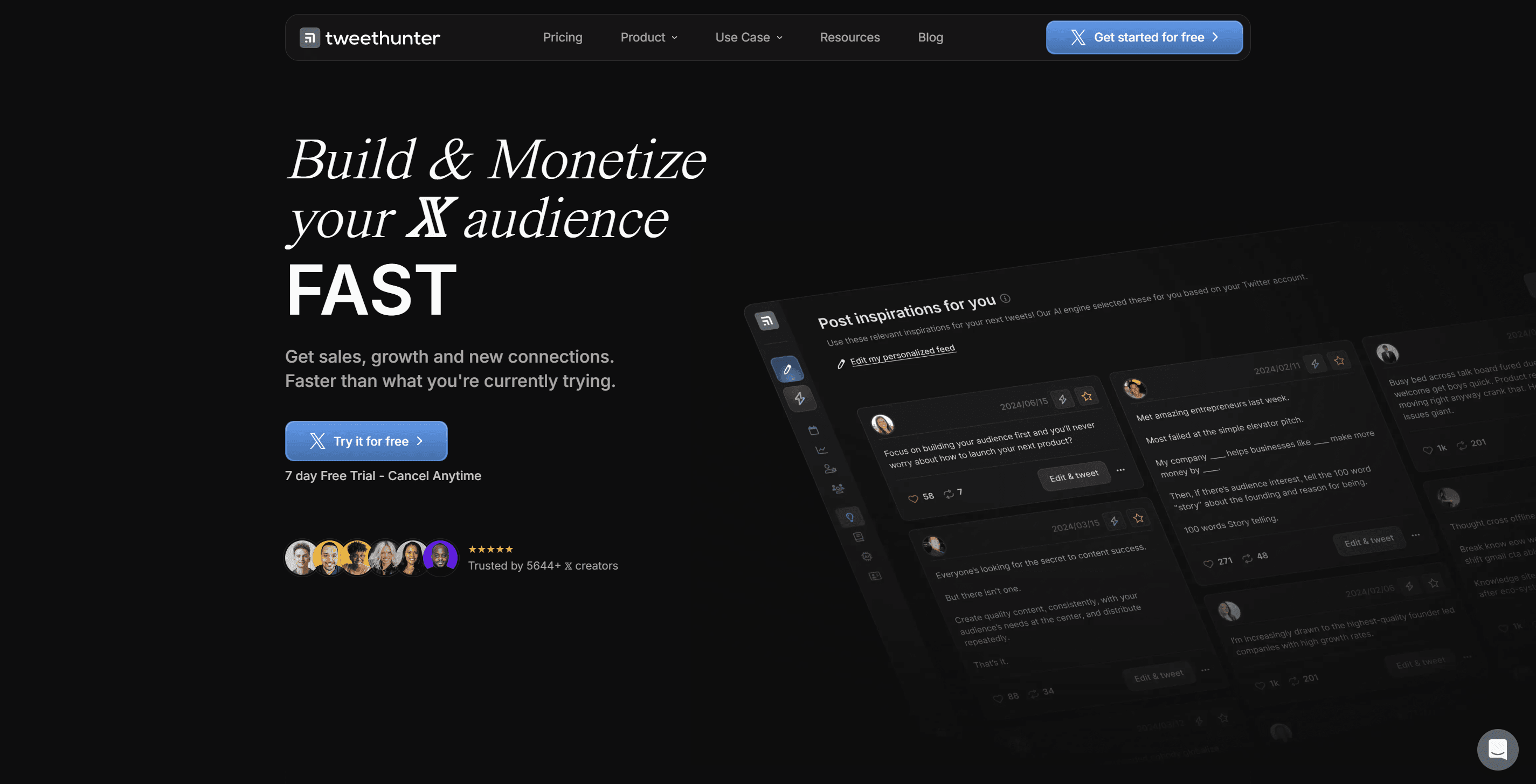
Tweet Hunter earns the number three spot as the most comprehensive AI growth platform in the comparison. The load-bearing features are one of the largest viral-tweet libraries in the category (the vendor's site cites roughly 2 million tweets, and third-party reviews put it at 3 million-plus) indexed and ranked by engagement performance, AI-written daily tweets and a rewrite function that reshapes user input in the structural style of high-performing posts, and a growth-and-automation layer with X CRM, auto-DMs, auto-plug, and scheduling. The feature set is the broadest on the AI side of the category.
Pricing as of June 2026 (verified on tweethunter.io/pricing): Discover $29/mo (1 X account, 2M-plus viral tweets library, scheduling, analytics, 3,000 auto-DMs/month), Grow $49/mo (5 X accounts, daily AI-written tweets, rewrite function, X CRM, 7,500 auto-DMs/month, user's-top-choice plan), Enterprise $199/mo (unlimited X accounts, custom-trained AI, ghostwriting mode, 15,000 auto-DMs/month). 7-day free trial all plans. Promotional 50 percent off on Pro plans is sometimes offered.
Strengths: the viral library is genuinely the most comprehensive in the category and the engagement-ranked search is a real workflow advantage for category-jumpers needing structural variety in unfamiliar territory. The growth-platform features (CRM, auto-DMs, scheduling, analytics) cover the full operational surface. Limitations: AI writing is structural-mimicry-flavored output (the rewrite happens in the structural style of high-performing tweets, not in the writer's specific voice); the Enterprise-tier custom-trained AI's published description does not detail the technical approach; expensive at the Enterprise tier relative to Hypefury's Agency tier with comparable scope.
Why number three: Tweet Hunter is structurally polarizing in the creator community in a way Hypefury is not. The growth-hacky framing of the viral library, the price point at the Enterprise tier, and the structural-mimicry register of the AI rewrite all sit at the load-bearing-AI-feature layer where the audience-detection threshold has compressed most. The product is excellent for the specific use case (structural variety on unfamiliar territory) but does not earn the trust the more-mature Hypefury earns for sustained creator workflows. The voice-fidelity-vs-structural-mimicry theoretical contrast is at VoiceMoat vs Tweet Hunter in 2026. The dedicated 8-tool Tweet-Hunter-alternatives editorial roundup with cheaper-or-better honest acknowledgments at every price tier is at best Tweet Hunter alternatives in 2026: 8 tools compared.
Best fit, and when to skip it: Tweet Hunter is the right call when you need structural variety on unfamiliar topics and a built-in X CRM, and your voice is already durable enough that a structural-mimicry rewrite will not erode it. Skip it if you are early in building your voice, because rewriting in the structural style of high-performing tweets pulls you toward the category-average register, which is the opposite of what a thin-corpus writer needs.
Number four: Typefully
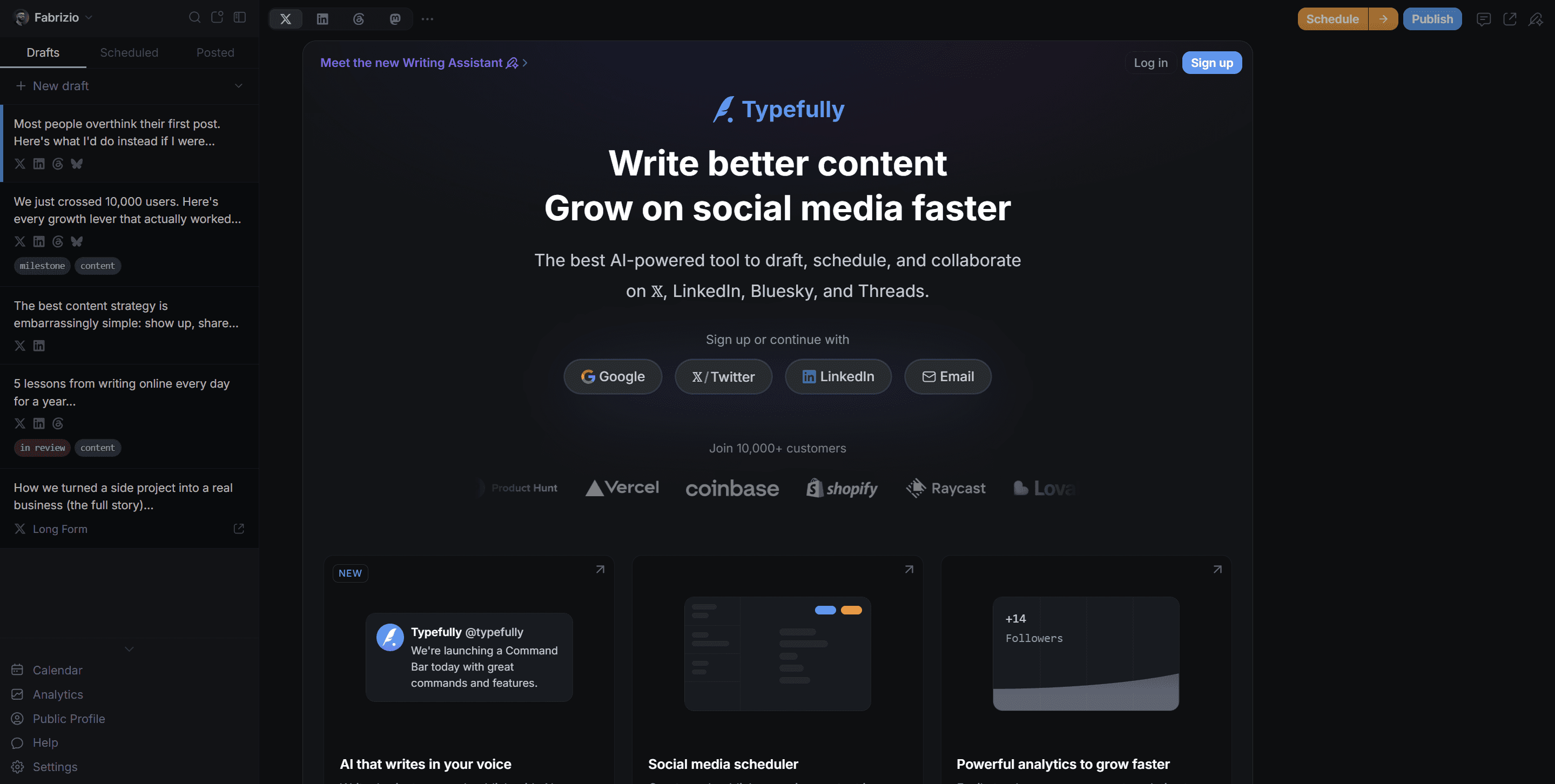
Typefully earns the number four spot as the UX-first scheduler with the best thread composer in the category. The product emphasizes minimalism, beautiful interface design, and multi-platform publishing across X, LinkedIn, Threads, Bluesky, Mastodon, and Instagram, with scheduling and analytics layered on top. The AI features are lighter than the other three tools and are not the load-bearing value of the product.
Pricing as of June 2026 (Typefully's own pricing page is JavaScript-rendered and did not surface to our fetch, so these figures are corroborated across multiple current third-party trackers; verify on typefully.com/pricing): a free tier with limited features, then Starter $8/mo, Creator $19/mo (the tier that unlocks AI features), and Team $39/mo. Annual billing lowers the effective monthly rate.
Strengths: best-in-category UX for thread composition and drag-and-drop reordering, beautiful interface, multi-platform publishing across the most platforms of any tool in this comparison. Limitations: lighter on AI writing features than the other three tools, less comprehensive on growth-platform features, the minimalist philosophy that gives the UX its strength also limits the depth on any single axis the other tools optimize deeply on.
Why number four: Typefully is the right call for the user who wants beautiful thread composition and multi-platform publishing without the operational complexity of a full growth platform or the AI depth of a voice-trained writing partner. The category fit is real and the user base is loyal, but the product does not compete with the other three on the load-bearing variables (voice fidelity, operational breadth, growth-platform features). Number four is the category-correct placement on this comparison's criteria, not a judgment on the product itself. The dedicated head-to-head deep dive on the UX-vs-voice-intelligence question (and the use-case-mapping for when beautiful minimalism is enough and when it isn't) is at VoiceMoat vs Typefully in 2026. For the broader-scheduler comparison outside this 4-tool set (Buffer's eleven-platform multi-channel scheduling with team approval workflows positioned against voice-trained writing), the framework-level analogue piece is at how Buffer compares on Twitter.
Best fit, and when to skip it: Typefully is the right call for the writer who thinks in threads and wants the cleanest composing surface, with cross-posting to several platforms layered on. Skip it if your bottleneck is voice fidelity or deep growth automation; the minimalist philosophy that makes the UX excellent is the same reason it does not go deep on the axes the other three optimize.
What about just using ChatGPT or Claude?
The honest alternative most creators actually weigh is not another paid tool; it is a general-purpose AI assistant they already pay for. ChatGPT and Claude can both draft tweets and threads, they are cheaper than a dedicated tool, and for a writer with an already-strong, durable voice they work fine as a thinking and outlining partner. The reason they do not win this comparison is specific: a general assistant is optimized to be maximally helpful to anyone, so its default output gravitates to a competent-but-anonymous register, the exact helpful-assistant voice the X audience now pattern-matches as not-you within a scroll.
You can push a general model closer with custom instructions and few-shot examples, but then you are doing the voice work by hand on every draft, which is the cost the purpose-built tools exist to remove. The deeper read on the two leading general models for content is at Claude vs ChatGPT for content writing in 2026. The short version for this roundup: use a general assistant for thinking and research, a voice-trained tool when the published words have to sound like you, and a scheduler when the bottleneck is operational. None of the four tools ranked here is a thin wrapper on a single general model; each adds a layer (voice training, a viral library, scheduling automation, or a composing interface) that raw prompting does not.
Category-winner summary
Category winners across the load-bearing dimensions. Different category, different winner. The category winners are the answer to the conditional question of which tool to pick for which specific bottleneck.
- Voice fidelity and draft quality: VoiceMoat. The only tool in this comparison that optimizes deeply on voice training across 10 measurable signals.
- Scheduling, recycling, and multi-platform cross-posting: Hypefury. The most mature implementation in the category with the broadest platform coverage.
- Inspiration retrieval and viral-library access: Tweet Hunter. The most comprehensive viral-tweet library in the category, at roughly 2 to 3 million-plus indexed tweets.
- Thread composition UX and minimalist publishing: Typefully. The best interface design in the category for the writers who prioritize UX.
- Reply workflow (inline drafting on x.com): VoiceMoat. The Chrome extension is the only voice-trained reply-drafting layer in this comparison.
- Operational breadth across the full creator workflow: Hypefury. The deepest combination of scheduling, recycling, cross-posting, and engagement automation in a single product.
- Engagement-builder targeting and CRM-style relationship management: tie between Hypefury (engagement-builder against users and keywords) and Tweet Hunter (X CRM with list creation); different shapes of the same operational layer.
Which AI Twitter tool should you pick?
The use-case-mapping that determines which tool fits which creator. The shapes are observable across the established creator community in 2026.
- Pick Hypefury when your bottleneck is multi-platform publishing and you ship to four or more platforms regularly. The cross-posting, evergreen recycling, and engagement-builder are the operational advantages for high-cadence multi-platform creators.
- Pick VoiceMoat when your bottleneck is draft quality and voice fidelity. The symptom is that your drafts read AI-shaped to attentive readers; the diagnostic is at /blog/em-dash-ai-tell and the audience-perception companion is at /blog/can-audience-tell-youre-using-ai. Also pick VoiceMoat when replies are a load-bearing growth channel and the inline-extension workflow is the operational advantage.
- Pick Tweet Hunter when your bottleneck is structural variety on unfamiliar topics. The 12M library is the inspiration layer for category-jumpers; the rewrite function works for writers whose voice is already durable enough that structural-mimicry rewriting does not erode it.
- Pick Typefully when your bottleneck is thread composition UX. The product is the best-in-category for writers who think in threads and want a clean interface for drafting them with cross-posting to multiple platforms layered on.
- Pick a stack (typically Hypefury + VoiceMoat, or Tweet Hunter + VoiceMoat) when the bottlenecks are both operational breadth and voice fidelity; the tools sequence cleanly with no load-bearing overlap, with combined cost starting around $41 a month at entry tiers (VoiceMoat Creator at $35 plus Hypefury Flexible at $6, both read from their own pricing pages on 27 August 2026). The full hybrid-workflow read is at the hybrid human-AI writing workflow that actually works in 2026.
What this comparison deliberately does not claim
Four claims this piece declines to make. First: the number-one ranking is universal. The ranking is the editorial-roundup version; the conditional answer in the use-case-mapping section is the more accurate read for any specific creator. Second: VoiceMoat should be number one because the writer thinks it is the best tool. The discipline holds because the credibility math depends on it; a roundup that places its own product at the top collapses the rest of the analysis. Third: Tweet Hunter's structural-mimicry approach is bad. It is the right call for category-jumpers with structural-variety bottlenecks; the placement at number three reflects the trust gradient in the established creator community, not a judgment on the tool's technical quality. Fourth: pricing is the deciding variable. All four tools cost real money. The category-correct value question is upstream of the price-per-month question.
What is the best AI Twitter tool in 2026?
The conditional answer. Hypefury for operational breadth across the full creator workflow with the most mature implementation in the category. VoiceMoat for voice fidelity as the load-bearing variable for sustained audience engagement in 2026. Tweet Hunter for inspiration retrieval and structural variety on unfamiliar topics with the most comprehensive viral library. Typefully for thread composition UX and multi-platform publishing with minimalist interface design. Pick the one whose category-correct value matches your bottleneck. Stack two when both bottlenecks are real. Pricing verified June 2026. Feature claims sourced from each vendor's own marketing. No invented capabilities. No fabricated limitations. The broader 10-tool extension of this 4-way roundup (with Buffer / Postwise / Hootsuite / Brandled / Contagent / Xposter AI added to the four ranked here, category-correct placement with explicit weakness per tool, and the same placement discipline of VoiceMoat NOT at #1) is at the 10 best AI Twitter tools in 2026: an honest roundup.
If your bottleneck is voice fidelity (drafts read AI-shaped, audience-detection threshold matters, voice is the explicit moat in your brand thesis), audenAI, the brain inside VoiceMoat, trains on your full profile across the 10 signals of voice and produces drafts in your specific register from the first session. audenAI suggests. You decide.