Twitter Blue no longer exists. X Premium replaced it with three tiers: Basic ($3/month, edit posts, long-form, bookmark folders), Premium ($8/month, blue checkmark, priority replies, ad-revenue-sharing eligibility, AI access), and Premium+ ($40/month web, ad-free, largest reply boost, advanced AI). The standard advice picks Premium for 3+ posts-per-week creators and Premium+ for 50K+ follower accounts. Reasonable, and missing the voice-first prior question.
The honest version: X Premium is an amplifier, not a 10x growth hack. X publishes a tiered reply boost (small, larger, largest), not a reach percentage, so treat any specific 'X percent lift' number, including the 10 to 15% often quoted, as an estimate rather than a published figure. The platform-level data looks bigger (Buffer puts Premium reach at roughly 10x free), but most of that gap is free accounts being deprioritized to near-zero rather than Premium being an engine. Either way the logic is the same: if your voice can convert the lift into something the audience comes back for, the subscription pays for itself many times over; if it can't, the lift produces marginally more impressions on content that doesn't compound. The decision is downstream of voice, not upstream of it.
This piece answers the practical questions in order: what changed from Twitter Blue to X Premium, how much each tier costs in 2026, whether the subscription actually boosts your reach, how the monetization works, and whether it is worth it for you specifically. The frame throughout is voice-first, because the subscription is a multiplier and the thing it multiplies is whether your posts sound like a specific human the audience comes back for. The engagement context that makes that frame load-bearing is in Twitter engagement is down in 2026; the short version is that the platform now deprioritizes generic content hard enough that an amplifier on generic content is close to a rounding error.
What changed from Twitter Blue to X Premium?
Twitter Blue launched in June 2021 as a minor $2.99-a-month add-on: undo tweet, custom app icons, a reader mode, bookmark folders. No verification, no reach effect, no monetization. It was a power-user convenience subscription, and almost nobody felt they needed it.
X Premium, the post-acquisition rebrand, is a different product wearing the same subscription slot. The center of gravity moved to two things Blue never touched: the verification checkmark (which shifted from a vetted-identity badge to a paid-subscriber badge) and creator monetization (ad revenue sharing, subscriptions, and the reply boost that ties into ranking). The price climbed and split into tiers, and the pitch changed from 'handy extras' to 'pay to be seen and pay to get paid.' That is the real Twitter-Blue-versus-X-Premium difference: Blue was a convenience, Premium is a distribution-and-monetization play, which is exactly why the voice-first prior question matters more now than it ever did for Blue.
How much is X Premium in 2026?
X Premium has three consumer tiers plus an organization tier. The web prices, which are the lowest because they skip app-store fees, are below; subscribing through the iOS or Android app costs roughly 25 to 30% more for the same tier. Prices also vary by region, so treat these as the United States web baseline and confirm the current number on X before subscribing.
| Tier | Price (web) | Reply boost | Best for |
|---|---|---|---|
| Free | $0 | None | Casual use; reach now deprioritized to near-zero |
| Basic | $3/mo ($32/yr) | Small | Editing and longer posts; no checkmark |
| Premium | $8/mo ($84/yr) | Larger | Most active creators; checkmark plus monetization eligibility |
| Premium+ | $40/mo ($395/yr) | Largest | Ad-free and ad-revenue accounts; about 2x Premium's boost |
| Verified Organizations | $1,000/mo | Org-level | Brands and companies |
One number worth flagging because it is widely miscited: Premium+ launched at $16/month in 2023, rose through 2024, and now sits at $40/month on the web. A lot of 'is X Premium worth it' content still quotes the old $16 figure, which makes the top tier look less than half its real cost. Basic and Premium have held at $3 and $8 since launch.
The voice-first decision framework by tier
- Pre-monetization tier (0 to 500 followers). Skip Premium. The modest lift on a small follower base produces marginal impressions, and the $3 to $8 monthly cost is better spent on building voice first. Re-evaluate at 500 followers.
- Voice-clarifying tier (500 to 3,000 followers). Basic ($3) for the editing feature if you want it. Premium only if you genuinely want the blue checkmark for trust signaling in a category where it matters (FinTwit, legal, certain corporate adjacents). The reach lift is small at this audience size; it's the trust signal that does the work.
- Compounding tier (3,000 to 15,000 followers). Premium ($8) is usually correct. The reply boost (X publishes no reach percentage, so treat the often-quoted 10 to 15% as an estimate, not a fact) produces meaningful incremental impressions on this audience and surfaces your replies to others' audiences, which is where most of the value lands. Ad-rev-sharing eligibility kicks in here for some accounts.
- Platform-features tier (15,000 to 100,000 followers). Premium ($8) is the default. Premium+ ($40) only if ad revenue sharing is real for your account and the ad-free experience matters for your own use of the platform.
- Compound tier (100,000+ followers). Premium+ ($40) is usually correct because ad revenue at this scale easily covers the cost; the extra $32 over Premium is marginal once payouts are flowing.
What Premium actually changes (and doesn't)
- Verification checkmark. Trust signal in some categories (legal, finance, journalism); aesthetic in others. The 'people don't take checkmarks seriously anymore' framing is overstated; a category-specific account still gets the trust lift.
- Reply boost. Modest but real. Your substantive replies on large accounts get slightly more visibility. For voice-first reply strategy accounts that ship 5 to 10 voice-rich replies a day, this is the most-valuable Premium feature.
- Ad revenue sharing eligibility. Requires Premium plus 500 followers plus 5M impressions/3 months. Most accounts don't clear the impressions threshold; for those that do, the revenue is meaningful but not life-changing without much larger audiences.
- Edit posts. Useful for correcting typos before they cement; not a growth feature.
- Long-form posts. Useful for specific content (long-form essays inside X); irrelevant if your work is thread-shaped or off-platform. The voice-first reading of long-form posts on X covers when the format is worth using and how to write the 280-char hook without bait.
- Fewer ads. Premium roughly halves the ads you see; Premium+ removes them. A quality-of-life feature for your own use of the platform, not a growth lever.
- Grok access. Premium includes the in-feed AI assistant with higher usage limits; Premium+ raises them further. Useful for research and summaries, not a substitute for voice-trained drafting, because a general assistant defaults to the same AI-shaped register the audience scrolls past.
- Longer video and posts. Uploads up to a few hours and posts up to 25,000 characters. Relevant only if your format actually needs the length; for most thread-and-reply creators it never binds.
- Analytics, undo, and bookmark folders. Minor conveniences. The analytics are more granular than the free view, undo catches a post in the few seconds before it sends, and bookmark folders organize research. None is a reason to subscribe on its own.
What Premium doesn't change: your voice, your niche, your audience quality. The features amplify what's there. They don't manufacture what isn't.
Does X Premium actually boost your reach?
This is the question the subscription is really sold on, so it deserves the honest answer. X's published benefit is a reply boost that scales by tier (small on Basic, larger on Premium, largest on Premium+, roughly double Premium's at the top), plus priority in replies and search and eligibility for the For You recommendations. There is no published 'your reach goes up X percent' figure; the boost is real but X does not quantify it, which is why the specific percentages floating around are estimates rather than facts.
The most-cited data point comes from Buffer's analysis of millions of posts: Premium accounts see roughly 10x the reach of free accounts, on the order of 600 median impressions per post versus under 100 for free. Taken at face value that sounds like a 10x growth hack, which is the wrong read. Most of that gap is the other side of the engagement collapse this platform went through: free, unverified accounts are now deprioritized so hard that the median one sees almost nothing, so 'Premium gets 10x' is largely 'free gets throttled to near-zero.' Premium buys you back into the floor of normal distribution; it does not lift you above a voice-flat ceiling. The fuller data read is at Twitter engagement is down in 2026.
So the honest framing is the one this piece opened with: Premium is an amplifier. On an account whose posts already earn replies and reads, the reply boost and the end of free-account deprioritization compound into meaningfully more reach. On a voice-flat account, the same boost produces marginally more impressions on content the audience was already scrolling past. The reach question is real; the answer is conditional on whether there is anything to amplify.
Does the X verification checkmark still mean anything?
The checkmark is the feature people argue about most, so it is worth separating the signal from the noise. Before the 2022 change, a blue check meant X had vetted you as a notable real person or organization. Now it means you pay for Premium. That shift genuinely diluted the badge as an identity signal, and the 'nobody takes the checkmark seriously anymore' take grew out of that real change.
But the conclusion is overstated. In categories where readers actively want a credibility cue, finance, legal, journalism, health, the checkmark still does work, because the alternative (an unverified account making claims in a trust-sensitive field) reads as riskier. The badge no longer proves identity, but it does signal that the account is invested enough to pay, which filters out the lowest-effort impersonators and throwaway accounts. Outside trust-sensitive niches the check is mostly aesthetic, and buying Premium for the badge alone is a weak reason. Inside them it can be the single justification on its own.
The Premium-as-substitute trap
The most common failure mode at the 1,000 to 5,000 follower range: upgrading to Premium expecting it to fix the underlying voice problem. The modest lift on a voice-flat account produces marginally more impressions on content the audience already wasn't engaging with. The math doesn't change; the cost does.
A concrete version of the trap: an account at 3,000 followers averaging 200 impressions a post upgrades to Premium, sees posts climb to maybe 230, and concludes the subscription is not working. It is working exactly as designed; 230 is the modest lift applied to a post the audience was not stopping for. The same account that fixes the post, so that 200 of those impressions turn into reads, replies, and a few profile visits, would compound with or without Premium, and compound faster with it. Premium multiplies the conversion you already have; it does not create one.
If your account isn't compounding without Premium, Premium won't fix it. The fix is voice work (and possibly niche sharpening). The voice-killing mistakes the standard playbooks recommend covers the diagnostic.
When to downgrade
Premium is worth keeping if the math works. The signs that it's not working for you and you should downgrade or cancel:
- You've been Premium for 6 months and your impression count hasn't lifted meaningfully (more than 10 to 15%). The product is doing what it advertises; the audience isn't there to amplify.
- Your ad revenue is below $20/month and stable. Below break-even on the subscription.
- You're considering Premium+ purely for ad-free experience and you don't have a real ad revenue case. The $32/month upgrade over Premium isn't worth ad-free for most.
- You signed up to 'try it' and never noticed a difference. Cancel; the marginal value isn't there.
There's no shame in downgrading. The subscription is a tool for accounts whose underlying voice is doing the work. If your account is in a build-the-voice phase, the $8/month is better spent on time or other tools that build the voice.
How do you make money with X Premium?
The native path is ad revenue sharing, and the eligibility bar is specific: an active Premium (or Premium+) subscription, at least 500 followers, and 5 million organic impressions across your posts in the last 3 months. Most accounts never clear the impressions threshold, which is the quiet part of the 'get paid to post' pitch. The other quiet part, from X's own terms: you are paid based on ads shown to other verified Premium users who engage with your content, not on your whole audience, so the monetizable surface is smaller than the headline impressions suggest.
Public earnings figures are mostly self-reported and vary wildly, so treat them as directional, not as a rate card: third-party write-ups put accounts in the 50,000 to 200,000 follower range at roughly $50 to $200 a month from ad sharing, and accounts with millions of followers at a few thousand a month, very roughly on the order of $0.50 to $1 per 1,000 qualifying impressions. The qualifying-impressions caveat above means real payouts often come in below the simple math, which is why the section below treats native monetization as a modifier rather than the engine.
Ad sharing is not the only native path. Premium also unlocks creator subscriptions (followers pay a monthly fee for subscriber-only posts), tipping, and ticketed or monetized Spaces. These can matter for an account with a dedicated base, but they have the same shape as ad sharing: they convert an already-engaged audience, so they reward accounts whose voice has earned that engagement and do little for accounts that have not. The subscription is the toll to enter the monetization system, not the thing that makes the audience want to pay.
Premium and the broader monetization picture
The native Premium features (ad revenue sharing, subscriptions, ticketed Spaces) are the platform's version of creator monetization. As covered in creator monetization, voice-first version, the native features rarely produce the bulk of an account's revenue. Off-platform paths (consulting, products, services) do. The Premium-tier decision is the lowest-leverage of the monetization choices; the audience-tier and voice-asset decisions are where the real numbers live.
If you want the realistic numbers by tier on each monetization path, how to make money on Twitter by audience tier covers it. Premium fits into that picture as a small modifier, not as the central decision.
Is X Premium worth it for businesses and brands?
Most of this piece is written for individual creators, but the brand decision is different in two ways. First, the unit that matters is often Verified Organizations at $1,000/month, which adds the gold organization checkmark, affiliate badges for staff accounts, and priority support; for a company running a real X presence the cost is rounding error against the headcount already pointed at social. Second, brands weight the trust signal and the reduced deprioritization more than the monetization, since most are not chasing ad-revenue payouts.
The same amplifier logic still holds. A brand account posting templated, voice-flat content will not outperform a smaller account posting something worth engaging with, regardless of the gold check; Premium and Verified Organizations buy distribution and credibility, not relevance. The brands that win on X in 2026 are the ones whose account sounds like a specific person rather than a committee, which is a voice problem the subscription cannot solve. For a small business or solo operator, plain Premium at $8 is almost always the right tier; Verified Organizations is for companies with multiple affiliated accounts to manage.
X Premium versus spending that money elsewhere
Because Premium is an amplifier, the honest comparison is not 'Premium or nothing,' it is 'Premium or the next-best use of $8 to $40 a month.' For an account whose voice already lands, Premium is usually the highest-return option at that price: nothing else buys back the reach the platform took from unverified accounts. For an account still finding its voice, the same money often does more elsewhere, a voice-training tool that fixes the thing the audience actually responds to, a scheduler that makes a sustainable cadence possible, or simply the time the subscription does not buy. The mistake is treating the $8 as a growth purchase in isolation; it is a multiplier on whatever your posting is already worth, and if that number is near zero, any multiple of it is still near zero.
Is X Premium worth it?
The one-line answer, by creator type. If you are an active creator whose posts already earn replies and reads, Premium at $8 a month is an easy yes: the reply boost and the end of free-account deprioritization compound, and ad-revenue eligibility is a bonus if you clear the bar. If you are in a trust-sensitive niche (finance, legal, journalism), the checkmark alone can justify Premium regardless of the reach math. If you are still building voice under a few thousand followers, it is a no for now: the $8 buys marginally more impressions on content that is not yet compounding, and the same money or time is better spent on the voice work. Premium+ at $40 is worth it only when ad revenue covers it or the ad-free experience genuinely matters to you; for most creators it is not.
The decision is small either way. Premium is the lowest-leverage choice on the whole X stack; whether your voice is recognizable enough to convert attention into a following is the high-leverage one, and no subscription tier changes that. Buy Premium when you have something for it to amplify. Build the something first when you don't.
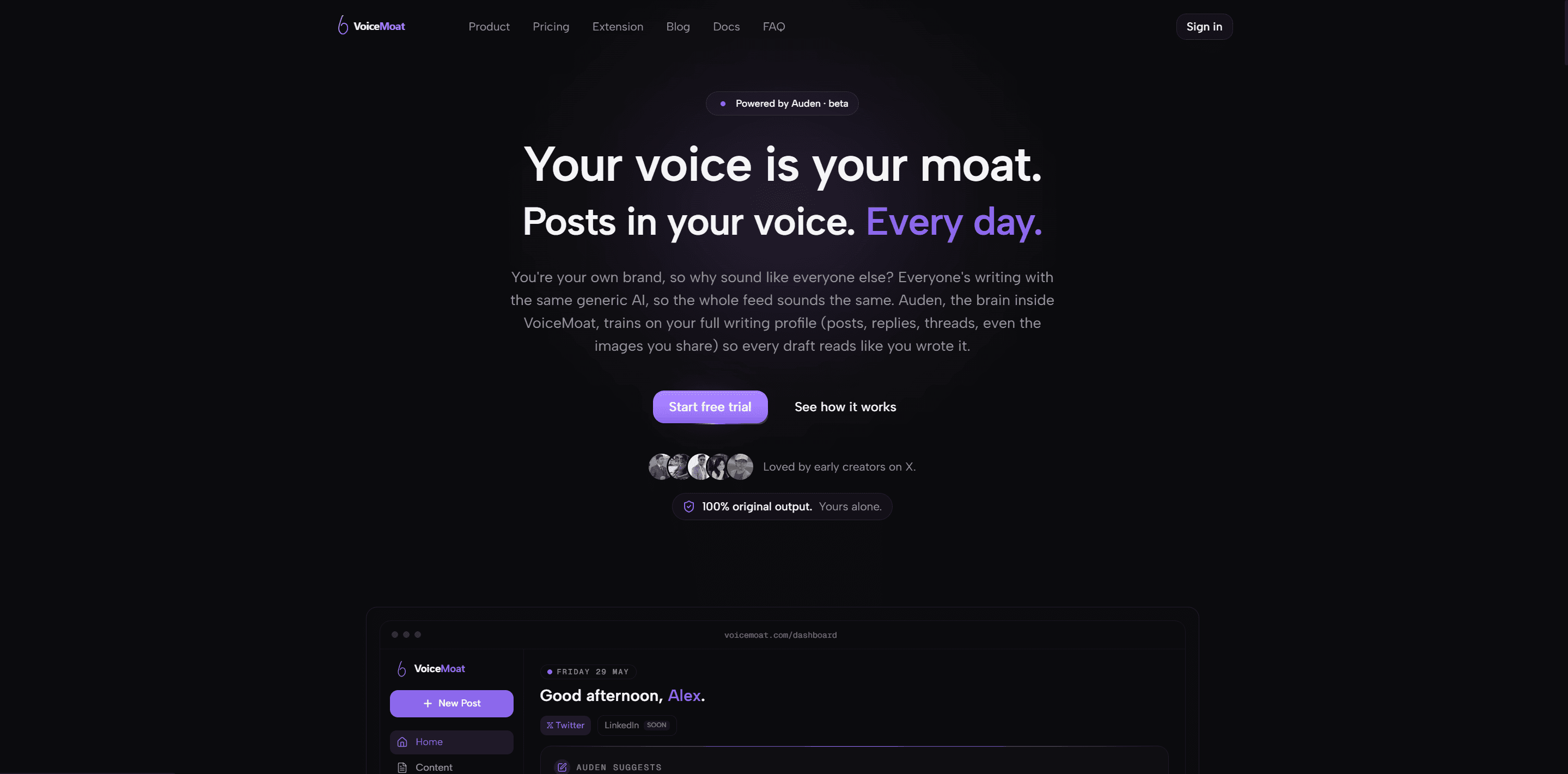
Auden, the brain inside VoiceMoat, is built for the prior question: it trains on your full profile across the 10 signals of voice and drafts in your specific register, so the posts Premium amplifies read as recognizably yours rather than as the AI-shaped median the audience scrolls past. Premium boosts reach; voice is what converts it. Auden suggests. You decide.