"Recency boost" is the single most repeated piece of X algorithm advice on the platform itself. It survived the 2023 algorithm release, which mostly killed the heuristic-weighted recency curve the 2020 era was built on. It survived the 2026 rewrite, which removed the recency multiplier from home-mixer/scorers/weighted_scorer.rs entirely. What stayed is a recency window, not a recency multiplier, and the distinction reshapes every cadence playbook creators rely on. Posts are either in the window or out of it, with separate retrieval mechanics for each side. This article walks the Thunder retention layer, the three-layer impression-bloom architecture, the tweet-mixer age cutoff, and the cadence playbook that respects both the 48-hour reality and the diversity scorer's per-author caps. Companion to A1: the May 2026 X algorithm and A7: why X feeds reject your third post of the day on cadence-and-diversity.
The recency-boost myth and where it came from
The 2020 Twitter ranker, before the heavy ML rewrite, weighted recency explicitly in the final score. A post one hour old scored higher than a post three hours old, all else equal, because the ranker multiplied candidate scores by a decay function over time. That mechanic produced the "post at the right time" advice that every Twitter growth resource through 2022 internalised: time of day matters, post when your audience is online, fresh content has a built-in scoring edge.
The 2023 release softened the decay considerably and folded most of the recency signal into the ranker's learned representations. The 2026 release removes the recency multiplier from the weighted scorer entirely. There is no RECENCY_WEIGHT constant. There is no decay function multiplying candidate scores by age. The Phoenix transformer in phoenix/recsys_model.py conditions every prediction on the viewer's history sequence, but it does not have a "this post is fresh" feature in its inputs in the public source.
What it has instead is a binary window. Inside the window, posts are in the in-network candidate pool. Outside, they are removed from that pool entirely and can only re-surface via the out-of-network retrieval lane. The window is implemented as a retention TTL in the Thunder service, not as a scoring adjustment in Phoenix.
Thunder's 48-hour window
thunder/ is the post-store service that maintains the in-network candidate pool. Per-user in-memory stores hold three post categories (originals, replies and reposts, video posts) with an age-based trim. The default retention window, per thunder/post_store.rs, is two days. After that, posts fall out of Thunder's stores and out of the in-network candidate pool for any subsequent feed request.
Practical implication: a post you ship today is eligible to surface in your followers' feeds for approximately 48 hours via the in-network retrieval path (home-mixer/sources/thunder_source.rs). After 48 hours, the in-network path does not see it. The post can still appear via the out-of-network retrieval path (the the three Phoenix retrieval sources walked in A3), but only if its embedding similarity to the viewer's history sequence clears the OON top-K threshold.
The asymmetry matters. In-network posts surface to followers who already have a relationship with the creator. OON posts surface to unfollowed viewers based purely on embedding similarity. A post that performed well in the 48-hour window with its follower audience is not guaranteed to perform well in the OON lane after the window closes. The followers' history sequences include the creator's many prior posts; OON viewers' history sequences do not. The two retrieval lanes have categorically different evaluation criteria.
Post lifecycle in the 2026 ranker
Stage | Time after publish | Retrieval lane | Notes |
|---|---|---|---|
Publish (documented) | 0 | in-network (thunder_source.rs) | ingested by Thunder, joined to per-user in-memory store |
Active window (documented) | 0 to ~48h | in-network primarily, OON secondarily | highest impression velocity, dominant retrieval lane is in-network |
Late window (inferred) | ~24 to 48h | in-network declining, OON ramping | as Thunder's per-user trim begins, OON share of impressions rises |
Post-window (documented) | beyond 48h | OON only | removed from Thunder; only Phoenix retrieval can surface |
Long-tail (documented) | weeks to months | OON only, gated by MAX_POST_AGE | tweet_mixer_source.rs applies its own age cutoff to OON candidates |
Source: thunder/post_store.rs + home-mixer/sources/
Per-author caps inside the window
Even inside the 48-hour window, Thunder applies per-author caps to the number of posts retained in each user's in-memory store. The source code references three caps: MAX_ORIGINAL_POSTS_PER_AUTHOR, MAX_REPLY_POSTS_PER_AUTHOR, MAX_VIDEO_POSTS_PER_AUTHOR. Numeric values are not in the public source. The structural property is that each viewer's Thunder store holds at most some bounded number of recent posts from any one author. Past that boundary, even within the 48-hour window, the oldest posts from that author for that viewer fall out first.
The interaction with posting cadence is direct. A creator shipping ten posts in a 24-hour window crosses the per-author cap quickly, and the viewer's in-memory store only retains the most recent K of them. The earlier posts in that ten-post burst are evicted from the viewer's Thunder store, even though they are nominally inside the recency window.
For a follower-side intuition: the experience of "I follow this person but I only see their posts sometimes" maps onto a combination of per-author caps plus the diversity scorer (A7 walks the decay in detail). The creator is not invisible; their posts are bounded by how many of them can be in the candidate pool at any time, and only some of those bounded candidates clear the diversity decay during final ranking.
The three-layer impression bloom
Once a post is served to a viewer, the platform records that serving in an impression-bloom filter to avoid re-serving the same post in the same session. The 2026 source has three such filters:
The three impression-bloom filters and their stages
Filter | What it tracks | Stage |
|---|---|---|
previously_seen_posts_filter.rs (documented) | posts the viewer has already seen in recent sessions | pre-scoring |
previously_served_posts_filter.rs (documented) | posts that have been served to the viewer (regardless of whether they were viewed) | pre-scoring |
previously_seen_backup filter (inferred) | redundant tracking layer (presence inferred from source-inventory references) | pre-scoring |
Source: home-mixer/filters/
The three-layer approach makes serving the same post twice unlikely even if one layer misses. For a creator, the practical implication is simple: each follower sees each of your posts at most a small number of times. After the bloom filter triggers, the post is removed from that viewer's candidate pool for subsequent requests.
Combined with the 48-hour Thunder window, this gives each post a finite total impression budget per viewer. The post is eligible for at most 48 hours, during which the viewer makes some bounded number of feed requests, of which the post is served at most a small handful of times. That bound is the structural ceiling on how much reach a single post can earn from any one follower.
MAX_POST_AGE in tweet_mixer
home-mixer/sources/tweet_mixer_source.rs applies an additional MAX_POST_AGE cutoff on candidates flowing through its auxiliary mixing pool. The cutoff is longer than Thunder's 48-hour window but still bounded. Posts older than MAX_POST_AGE are excluded from this source entirely. The specific value is not in the public release; community observation of the platform's behaviour suggests the order of magnitude is days to a small number of weeks, not months, but this is widely-believed-not-documented territory.
The cutoff is the secondary age boundary creators occasionally encounter as "evergreen content that suddenly stops surfacing." A post old enough to have fallen out of Thunder is still potentially retrievable via the OON Phoenix lane and via the tweet-mixer source, but only until MAX_POST_AGE. Past that, the post is effectively ineligible for any in-platform recommendation surface, regardless of how well it performs on similarity to a viewer's history. Direct profile visits and pinned-post slots remain, but those are not feed retrieval; they are deterministic surfaces tied to specific viewer actions.
A subtle implication: posts on X have a categorically shorter usable life than posts on LinkedIn or YouTube, where retrieval is not gated by a hard age cutoff in the same way. Creators porting evergreen-style content strategies from those platforms run into this boundary frequently. The fix is not to force evergreen on X; the fix is to recognise the platform's recommendation architecture is built for window-bounded retrieval and to optimise inside that frame.
A day-by-day walkthrough for a single post
To make the architecture less abstract, here is what happens to one post over its lifecycle. Assume a creator with 8,000 followers ships a post at hour zero. The numbers below are illustrative; specific values depend on audience composition and per-account history.
Hours 0 to 6. Thunder ingests the post and joins it to per-user in-memory stores across the follower base. The post becomes eligible for in-network candidate selection on every feed request from any follower. Phoenix scores it against each viewer's history sequence. The first wave of impressions arrives, primarily from followers who open the app in this window. Some posts in this wave fire the dwell heads, the favorite head, occasionally the reply or quote head. The predicted-action mix updates the per-creator history pattern for those followers.
Hours 6 to 24. The in-network impression rate continues but plateaus. Followers who already saw the post are filtered out by the three-layer impression bloom on subsequent feed requests. The per-author cap inside Thunder begins to bind: as the creator ships any additional posts during this period, the new posts enter the per-user stores and push the oldest posts toward eviction. The original post may already be the second or third in any given follower's per-author store, depending on the creator's recent cadence.
Hours 24 to 48. Thunder's per-user trim accelerates. Some followers' stores no longer contain the original post at all because newer posts from the same author have displaced it. The OON retrieval lane begins to carry a larger share of the post's impressions: viewers who do follow the creator but whose Thunder store has rotated out the post encounter it (if at all) via OON. The post's surviving impressions in this window come increasingly from OON-similarity matching rather than follow-graph membership.
Hours 48 onward. Thunder evicts the post entirely. The in-network candidate pool no longer sees it. The post is now exclusively in the OON retrieval lane. The tweet-mixer source's MAX_POST_AGE cutoff is the next horizon; until that cutoff, the post can still be retrieved via OON if its embedding similarity to a specific viewer's history embedding is high enough to survive top-K. After MAX_POST_AGE, the post is removed from tweet-mixer too, and only Phoenix's general OON retrieval remains, increasingly constrained.
The aggregate impression curve over the full lifecycle is heavily front-loaded. Most of a post's total impressions arrive within the first 24 hours, with a long thin tail through 48 hours and a sparse re-surfacing pattern thereafter for embedding-distinct posts only.
The OON escape hatch
The one path by which an old post can still surface is the the out-of-network Phoenix retrieval lane covered in A3. Posts that score high enough on retrieval similarity to a specific viewer's history embedding can be retrieved through this lane even after Thunder has evicted them, subject to the MAX_POST_AGE cutoff from tweet-mixer.
This is the structural reason a strong-voice post can occasionally "go viral months later" while a generic engagement post cannot. The strong-voice post sits in a sparse region of the embedding space where local competition is low, so its retrieval similarity to matched viewers' history embeddings stays high over time. The generic post sits in the dense centre of the embedding space, where local competition is intense, so even if its absolute embedding similarity to some viewer is moderate, the top-K survival rate is near zero.
The OON escape hatch is the only path by which evergreen value compounds for a creator on the platform. It is gated entirely by embedding distinctiveness, not by any recency, frequency, or engagement signal.
The cadence playbook that survives both windows and decay
Posting cadence on X is constrained by two distinct mechanisms running in parallel. The Thunder window plus per-author caps bound how many posts from a creator can be in any viewer's candidate pool at one time. The diversity-scorer decay (walked in A7: why X feeds reject your third post of the day) multiplies repeated-author scores by an exponential decay during final ranking. Together they impose a structural ceiling on what high-volume posting can earn.
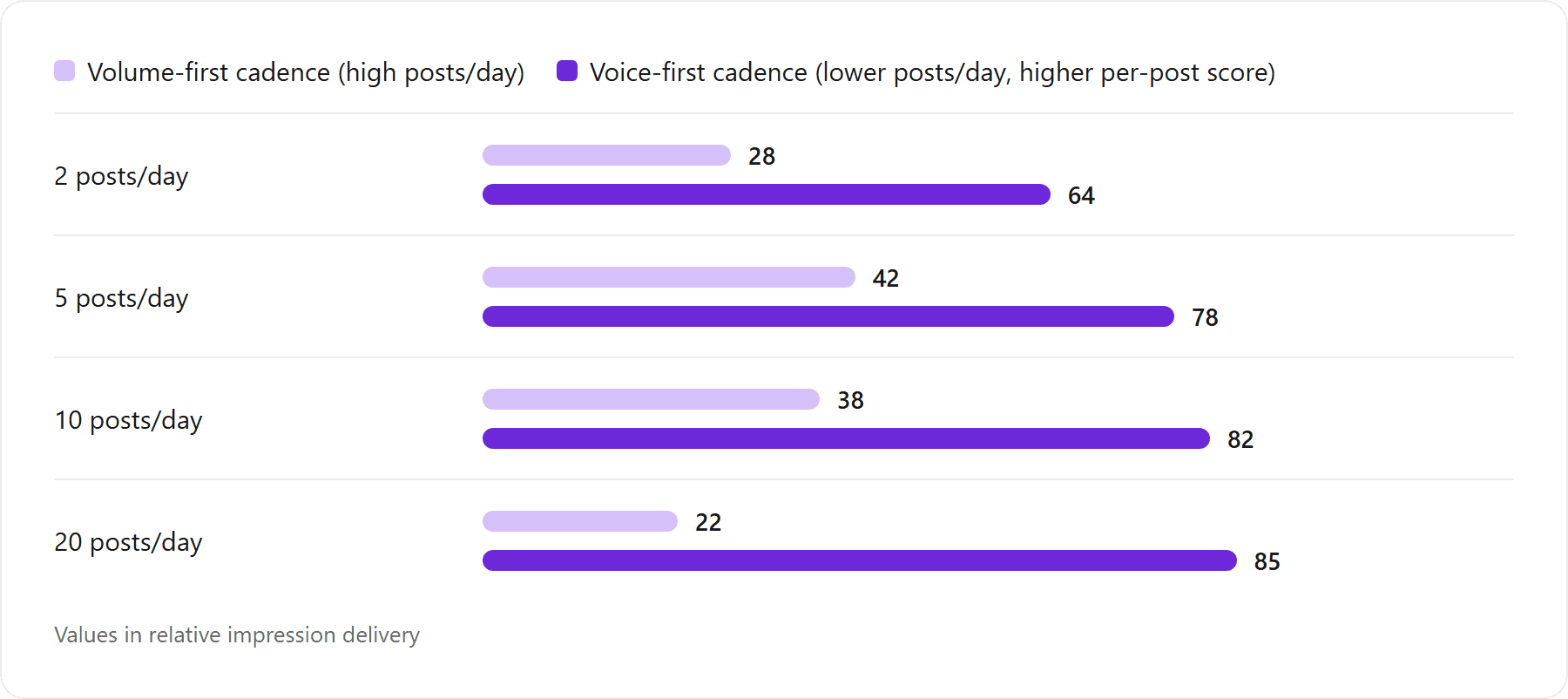
Unique daily impressions delivered to followers vs posts shipped, factoring per-author cap plus diversity decay
The chart sketches the qualitative shape. The volume-first curve rises and then flattens or declines because per-author caps and diversity decay bound additional posts' marginal impression delivery. The voice-first curve continues to rise modestly because per-post score quality remains high even at lower volume, and the per-post survival rate through the diversity layer stays above the decay floor.
The operational rule that drops out of the architecture: cadence optimisation past three to five high-quality posts per day stops producing meaningful additional impression delivery. The per-author cap inside the 48-hour window holds at some bounded number; the diversity decay multiplies posts at rank N by decay^N; the impression-bloom filters cap re-serves. The net effect is a saturation curve, not a linear one. The economic argument for shipping more is weaker than the economic argument for making each post embedding- distinct and dwell-firing.
What to do with this
Three operational moves drop out cleanly.
Treat the 48-hour window as the binary it is. Posts inside the window compete for in-network slot share; posts outside the window compete on OON retrieval similarity alone. Both lanes are valuable, but they reward different writing properties. In-network rewards voice-consistent posts in the historical pattern; OON rewards embedding-distinctive posts that survive the dot product.
Build for the OON escape hatch. The strongest investment a creator can make in evergreen reach is making each post embedding-distinct enough to survive in OON after Thunder's window closes. That property is unrelated to engagement counts inside the 48-hour window; it is a function of the post's distance from the broad-internet centroid covered in A8: your voice is an embedding.
Stop measuring cadence in absolute posts-per-day. Measure it in "posts that fired the dwell heads in your follower audience." Three of those per day compounds. Twelve generic posts per day saturate the per-author caps and the diversity decay and contribute less than three of those high-quality posts.
The recency model in 2026 X is a window, not a multiplier. The cadence playbook that respects the window respects the diversity decay simultaneously. Both lead to the same place: fewer, more embedding-distinct posts, anchored to the creator's voice cluster. That convergence is what the cornerstone of this series opened with. The slot-competition mechanics walked in A4: the five ways X steals your feed slots close the loop on what those posts are actually competing against when they reach the rendered feed.
Does the X algorithm give a recency boost?
No. There is no recency multiplier in weighted_scorer.rs. Recency is a window, not a boost: Thunder's post_store.rs retains posts for a default of about 2 days, after which they fall out of the in-network candidate pool. Timing matters for the window, not for any score bump.
What happens to a post after 48 hours on X?
It is evicted from Thunder's in-network store, but it can still surface through the three out-of-network Phoenix retrieval sources if its embedding similarity to a viewer's history is high enough to clear top-K. Strong, distinctive posts keep a longer tail; generic ones simply disappear.
How often should I post on X under the 2026 algorithm?
Roughly three to five high-quality posts a day is the architectural ceiling. Past that, per-author Thunder caps, author-diversity decay, and impression-bloom filters collectively saturate marginal delivery, so more posting mostly competes with your own earlier posts. This ceiling is inferred from the documented caps.
Why do I keep seeing the same posts on X?
Three impression-bloom filters track previously-seen, previously-served, and a backup layer, capping how often you are re-served the same candidate. Recency in 2026 is effectively binary: a post is either inside the retention window or out of it.
This article was drafted with AI assistance and human-edited by Prateek Singh. All technical claims are sourced to the xai-org/x-algorithm repository; file paths are cited inline.
More in the series

X Algorithm
The May 2026 X algorithm: why voice wins when the ranker becomes a transformer
In May 2026, X.AI open-sourced the next-generation recommendation algorithm under the xai-org/x-algorithm repository. It is not a re-host of the 2023 Twitter release. It is a complete rewrite. The 2023 stack of hand-engineered features, MaskNet heavy-ranker, SimClusters embeddings, TwHIN graph signals, and RealGraph follow-affinity scoring has been retired. In its place: a single Grok-derived transformer named Phoenix that predicts 19 separate engagement actions per candidate, conditioned on the viewer's history sequence, with a candidate-isolation attention mask. The implications for creators are structural, not tactical. Voice consistency now compounds at the ranker level because every candidate from a creator is independently scored against the viewer's per-creator history pattern. Voice drift collapses scoring across the entire follower base, not just the post that drifted. This cornerstone walks the architectural change, the new scoring math, and what it means for anyone choosing how to write on X in 2026.
13 min read
X Algorithm
Your voice is an embedding: how Phoenix encodes creator identity
Phoenix does not "see" your account as a username. It sees you as a hashed author ID combined with a post embedding, projected into a learned space. Every viewer who has interacted with you has a history sequence that contains those projections, paired with the action they took. When Phoenix scores any new candidate from you, the candidate-isolation mask lets that candidate attend to the viewer's full history but not to the other candidates in the batch. Net effect: your voice is encoded in two places: the author embedding itself, learned at training time, and the distribution of your posts in viewers' history sequences. Drift either of those and the model's prediction of you collapses. This article makes the math intuitive for a non-ML creator, and explains exactly what "voice fidelity" means in Phoenix-native terms: tight distribution in the post-embedding space, anchored by a stable author embedding.
17 min read
X Algorithm
Out of network is the new in-network: how Phoenix retrieval surfaces unfollowed creators
Three of the twelve home-mixer sources are dedicated to surfacing posts from accounts the viewer does not follow: phoenix_source.rs (general OON retrieval), phoenix_moe_source.rs (mixture-of-experts variant), and phoenix_topics_source.rs (topic-keyed retrieval). All three call a two-tower model that embeds user history and candidate posts into a shared space and returns the top-K via dot product. A single OON_WEIGHT_FACTOR in oon_scorer.rs rescales those candidates against in-network ones for the final blend. This article explains the two-tower math, why OON is no longer a small fraction of the feed, and how a creator gets surfaced to non-followers. We finish with a concrete playbook: write embedding-distinctive copy, not generic engagement copy. The OON retrieval lane is the largest single growth surface a creator has on X in 2026.
13 min read

X Algorithm
Why X feeds reject your third post of the day: author diversity and DPP
The home-mixer applies two diversity passes that no creator-facing article has explained. First, author_diversity_scorer.rs sorts candidates by weighted score, then walks the list applying an exponential decay multiplier per author occurrence: (1 - floor) * decay^position + floor. The first post from a creator gets the full score; the second gets decay; the third gets decay²; fast approaching floor. Second, vm_ranker.rs applies a Determinantal Point Process rerank at the top of feed when theta > 0, explicitly maximizing diversity-adjusted score across the visible top-max_selected_rank slots. Combined: a creator who posts 10 times a day has 7 of those posts hard-capped near the diversity floor. This article quantifies the decay curve, explains DPP in plain language, and rewrites the "how often to post" question into the right shape: post fewer times, with higher per-post voice distinctiveness.
12 min read

X Algorithm
The 5 ways X steals your feed slots before organic content gets ranked
Creators chase top-10 placement assuming there are 10 slots. There are not. Every rendered For You feed includes a who-to-follow module of up to 3 users, one or more ads spaced by MIN_POSTS_FOR_ADS, optional full-cover or half-cover prompts that take the top slot, optional push-to-home heroes if the user arrived from a notification, and cached-posts continuation slots from the prior session. By the time organic candidates are placed, the visible top-10 is often top-6 organic. This article inventories every non-organic source in home-mixer/sources/, the slot quotas where documented, and the safe-gap blending math from home-mixer/ads/safe_gap_blender.rs. We finish with a session-strategy section: when followers see your post, how much of the surrounding feed is theirs and not X's.
11 min read
The whole series
The X algorithm in May 2026: all ten articles