Algorithm advice on X is almost entirely additive. "Do this, ship that, post at this time, fire this signal." Read the actual scoring code and the picture inverts. The single most score-moving event the 2026 X ranker handles is not a like, a retweet, or a reply. It is a mute. And the math that processes it routes through a different branch of the scoring function entirely. This article walks the negative-signal economy: the four explicit negative weights, the implicit not-dwelled score, the asymmetric offset_score branch, the four hard-kill filters that run upstream of any scoring, and the off-voice-drift pipeline that turns voice inconsistency into predicted mutes. Companion to A1: the May 2026 X algorithm and A2: how Phoenix ranks every post, both of which establish the architecture and the head inventory this piece builds on.
The offset branch: a different scoring formula for net-negative posts
Recall the weighted scoring formula from home-mixer/scorers/weighted_scorer.rs:
The first line is the standard linear combination. The second is the load-bearing bit creators rarely hear about. offset_score is not the identity function. When the combined score is positive, the value passes through largely unchanged. When the combined score is negative, the formula rescales it:
The intuition: a post predicted to net-fire more negatives than positives is not just placed at a lower position. It is routed to a different scoring regime entirely. The numerator adds the sum of negative weights (a large negative number) to the already-negative combined score, then the denominator divides by the sum of all weights to normalise, then a final offset multiplier scales the result into a separate range. Production values for these constants are redacted (the params module is excluded from the public release), but the structural property is clear: the same combined score, sitting in net-positive vs net-negative territory, is treated as living in two different scoring universes.
The single practical implication: a post that nets a handful of likes but triggers a non-trivial predicted-mute probability does not just score lower than an unambiguously good post. It scores in a different regime, behind a non-linear transformation. The asymmetry is the mechanical reason "reach loss" feels sudden rather than gradual to creators whose posts cross from net-positive into net-negative.
The four explicit negative heads, side by side
The four explicit negative heads in weighted_scorer.rs, with 2023 leaked weights as directional reference
Head | UI gesture | 2023 leaked weight | 2026 status | Effect |
|---|---|---|---|---|
Not interested (documented) | long-press, "Not interested in this post" | minus 74 (2023 ref) | redacted | soft de-weight via offset branch |
Mute author (documented) | post menu, mute author | roughly minus 100 (2023 ref) | redacted | soft de-weight plus deterministic filter on next requests |
Block author (documented) | post menu, block author | roughly minus 100 (2023 ref) | redacted | soft de-weight plus deterministic filter, bidirectional |
Report (documented) | post menu, report for policy violation | not enumerated in leaks | redacted | soft de-weight plus policy escalation |
Source: home-mixer/scorers/weighted_scorer.rs + 2023 twitter/the-algorithm-ml SrcEngagementWeights
A note on the leaked 2023 magnitudes. The favorite weight in 2023 was 0.5. The mute weight was roughly minus 100. The ratio is 200 to 1. Translated into expected score: a Phoenix prediction of even 0.5 percent mute probability, applied to a weight of minus 100, contributes minus 0.5 on a single head. That contribution alone cancels the contribution of one full favorite at a hundred percent probability. A predicted mute probability of 5 percent, contributing minus 5, cancels the contribution of ten guaranteed favorites. None of these numbers carry over to 2026 unchanged, but the order-of-magnitude property (negatives outweigh positives per action by a factor in the dozens to hundreds) is structural to the formula's design and survives any specific weight adjustment.
Not-dwelled: the negative signal nobody opted into
There is a fifth negative signal that does not appear as a WEIGHT constant in home-mixer/scorers/weighted_scorer.rs. It lives in the PhoenixScores proto referenced by home-mixer/scorers/vm_ranker.rs, a parallel scoring path that uses a remote value model. The field name is not_dwelled_score, and its presence in the proto but absence in the simpler weighted scorer suggests one of two things. Either home-mixer/scorers/vm_ranker.rs is an experimental path running alongside the canonical scorer with at least one extra signal, or it is in fact the production path, in which case the simpler weighted scorer in the public release omits a signal that production uses.
The mechanism of not_dwelled_score is the same as the discrete dwell head, inverted. A viewer scrolling past your post without pausing fires the binary "not dwelled" condition. Unlike the four explicit negatives, this one requires no menu interaction, no decision, no friction from the viewer. Every impression that does not earn a dwell counts. For a creator, the practical implication is sobering: the negative-signal volume is dominated not by mutes and reports, which are rare events, but by the continuous stream of viewers scrolling past without engaging. The predicted-not-dwelled probability is what most off-target candidates move on.
This is the silent kingmaker of the negative side of the ledger. A2 walked the positive dwell heads; the absence of dwell is the corresponding negative signal, and it operates at scale because every non-dwelled impression contributes.
The hard-kill filter layer
Upstream of the scorer, four filter files in home-mixer/filters/ remove candidates deterministically before they ever reach Phoenix. These are not probabilistic predictions. They are boolean conditions: either the filter triggers and the candidate is dropped, or it does not.
The four post-selection and pre-scoring hard-kill filters
Filter | What it removes | Stage | Severity |
|---|---|---|---|
muted_keyword_filter.rs (documented) | candidates whose tokens match the viewer's muted-keyword list | pre-scoring | hard kill |
author_socialgraph_filter.rs (documented) | candidates from authors the viewer has blocked, muted, or otherwise excluded via social-graph relationships | pre-scoring | hard kill |
vf_filter.rs (documented) | candidates flagged by visibility filtering: deleted posts, spam, violence, gore, policy violations | post-selection | hard kill |
topic_ids_filter.rs (documented) | candidates whose Grox-classified topic IDs match the viewer's topic exclusions | pre-scoring | hard kill |
Source: home-mixer/filters/ + home-mixer/scorers/vm_ranker.rs context
The split is meaningful. The probabilistic layer (the four negative heads in the weighted scorer) handles "the viewer will probably want to mute this if served." The deterministic layer (the four filters above) handles "the viewer has already muted this author, or this content class." Both layers feed the same "less of this" intent, but they operate at different stages and on different signals.
Two consequences for creators. First, once a viewer mutes your account, they are removed from your impression base for that account entirely. The deterministic filter triggers on every subsequent request and your post is dropped before scoring. There is no recovery short of the viewer reversing the mute themselves. Second, mutes are not isolated events. They contribute to Phoenix's training signal across the follower base. A pattern of mutes from a creator's audience adjusts the predicted-mute probability for similar viewers next time.
The voice-drift to mute pipeline
The data flow that connects voice drift to actual mutes runs through five steps, each observable in the repo or directly in the model behaviour.
Step one. A creator's audience formed around a specific voice. The follow decision encoded "I want more of posts like the ones I already saw from this account." Every follower's history sequence now contains several to many of the creator's prior posts paired with the actions that follower took (favorite, dwell, reply, profile click). Phoenix has learned a per-creator distribution across the engagement heads for that follower.
Step two. The creator ships a post that deviates from their historical distribution. The deviation can be tonal (suddenly more formal or more casual), structural (a thread when the audience expects single posts), topical (a topic outside the historical surface area), or stylistic (template-shaped engagement copy when the audience expects unedited voice).
Step three. Phoenix scores the candidate against the viewer's history sequence. The candidate-isolation mask (explained in A1) means the candidate cannot rely on other posts in the same batch for support. The score depends on the candidate's own representation and how well it matches the viewer's per-creator history pattern. An off-voice candidate matches the pattern less well, and the predicted-positive probabilities (favorite, dwell, reply, profile click) shift downward.
Step four. Simultaneously, the predicted-negative probabilities shift upward. The model has implicitly learned that off-distribution posts from creators are the ones followers historically reacted to with mute or "not interested." A 1.5-percent predicted-mute probability that would have been 0.2 percent on an on-voice post, multiplied by the large negative weight, is enough to shift the combined score across the positive-to-negative boundary and into the offset_score rescaling branch.
Step five. The post serves to a smaller fraction of the audience. Of that smaller fraction, a few actually mute. Those mutes feed the training signal for the next pass. The creator's follower base now contains a slightly stronger prior for off-voice content triggering mute, which raises predicted-mute probability for similar future posts. Repeated drift accelerates the effect.
The pipeline is a compounding mechanism, not a single-event one. The voice-fidelity question is not "did this one post survive?" but "what did this post do to the predicted-mute prior across my follower base for the next ninety days?"
Voice drift score vs predicted mute rate
The relationship between voice-distance from a creator's historical distribution and predicted-mute rate is non-linear. Drift inside the historical envelope has near-zero impact. Drift outside it ramps fast. The chart below sketches the shape with illustrative numbers; production telemetry is not available.
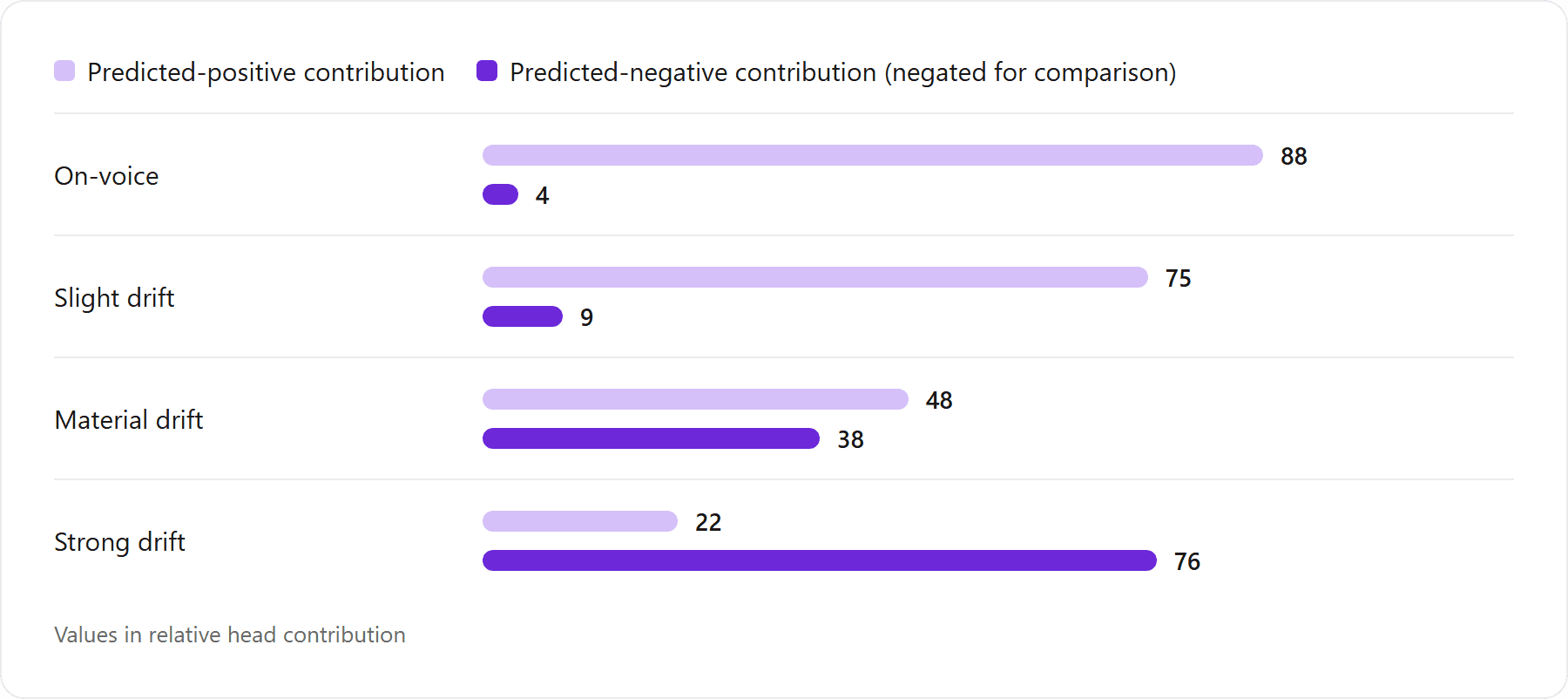
Voice-distance bucket vs predicted negative-signal contribution
Two readings of this chart matter. First, the on-voice bucket is not risk-free; there is a baseline negative contribution that comes from viewers who simply did not engage with the post. Second, the crossover where the right-column bar overtakes the left-column bar happens before the post would feel obviously off to the creator. The model is sensitive enough that drift well short of "this reads like a different person wrote it" is already shifting the predicted-action mix.
The shadowban myth, gently retired
A short detour worth making. "Shadowban" is the most common word used for what creators experience when negative signals catch up with them. The word implies a hidden flag, set by a human or a moderator, that silently throttles a specific account. That model does not match what the public 2026 source shows.
What the source shows is two layers operating in parallel. One is the probabilistic scorer described above, which produces a score that depends on the predicted-action mix per viewer. The other is the deterministic filter layer, which removes candidates based on viewer-set preferences (muted keywords, blocked or muted authors, excluded topics) or platform-enforced classifications (visibility filtering from home-mixer/filters/vf_filter.rs for policy violations). Neither layer references a hidden per-account flag. The probabilistic layer responds to model predictions that update from audience reactions. The deterministic layer responds to user-set or policy-set rules. Both are auditable in the open repo.
The lived experience of "shadowban" is the rate-of-change in those two layers. A surge of mutes from your audience pushes predicted-mute probability up across viewer histories. A keyword that lands in many viewers' muted-keyword lists pulls posts containing that keyword out of their candidate pool. A wave of reports that survive vf_filter review raises the policy classification on the creator's content class. None of these are "shadowban" in the hidden-flag sense. All of them produce the experience that is labelled shadowban. The mechanism is in the source, not in a moderator's spreadsheet.
The practical implication: chasing rumours about hidden flags is a waste. The right operational question is "what is my predicted-action mix doing across my audience?" Voice-fidelity is the strongest direct lever on that mix. Topic surface and policy-class drift are the next two. Everything else is downstream.
One documented exception is worth keeping, because it is the part of this that is not a myth. Search filtering is real, the platform publishes both the behaviours that cause it and the fact that limited posts carry an appealable label, and it is the one layer observable from outside. We cover what is actually documented in what a Twitter search ban is, and the free shadowban checker tests that single layer rather than guessing at the rest.
What this means for tools that do not measure voice
Three categories of writing tools fail the negative-signal test by construction. Template-based generators (most engagement-optimised products) fit voice to a category-default template; the output reads fluent but off-distribution for any specific creator. Scheduler-shaped tools (volume-first) ship whatever the creator writes, with no fidelity gate. Generic-LLM writing assistants (general-purpose models prompted with light context) produce helpful-assistant register that the audience pattern-matches as not-the-creator within a few posts.
All three categories have positive use cases. None of them protects against the negative-signal economy described above. The protection requires a voice-fidelity check between draft and publish that specifically scores the draft against the creator's historical distribution. That score is mechanically related to predicted-mute probability through the pipeline above, even though no model is yet shipped that maps the two scores directly. A10 of this series compares the four major writing tools against six 2026-algorithm criteria, with the negative-signal exposure one of them.
On the audenAI roadmap
audenAI's voice-fidelity check, inside VoiceMoat, runs the draft against the creator's training corpus across the 10 signals (A8 walks the embedding-level mechanism in depth) and surfaces a voice-distance score before publish. The roadmap addition VoiceMoat is currently rolling out is an "off-voice risk" preflight: when the voice-distance score crosses a threshold derived from the creator's own historical spread, the composer surfaces a soft warning rather than just a number. The threshold is per-creator because the spread itself is per-creator. Some voices are wide. Some are tight. The risk band scales with the historical envelope.
What to do with this
Two operational moves come out of the negative-signal economy mechanically.
Use voice as the gate, not the goal. The voice-distance score on a draft does not tell you the draft is good. It tells you it sits inside or outside your historical distribution. Inside is the necessary condition. Whether the draft is sharp, insightful, useful, that is a separate question your editorial judgment owns. The score gates risk; it does not promise upside.
Watch the velocity of mutes, not the absolute count. A creator with 50,000 followers expects some baseline mute rate per week. The signal that matters is the rate-of-change. If the weekly mute count is steady, the predicted-mute prior in Phoenix is steady. If the weekly mute count is climbing, the prior is climbing too, which means future posts will score lower by default. Public mute counts are not surfaced in X's own analytics; the proxy is reach loss on otherwise comparable content. A steady week-over-week reach drop on on-topic posts is the lagging indicator of the prior moving against you.
The negative-signal economy is the structural reason "voice as a moat" is not a marketing line. It is mechanically the only positive lever a creator has against a non-linear penalty that scales with audience size. The next article in this series, A8 on voice as an embedding, walks the embedding-level mechanism. The piece after that, on dwell, returns to the positive side of the ledger with the four dwell heads that on-voice content fires most reliably.
How much does one mute hurt your reach on X?
A predicted mute or not-interested can outweigh dozens of predicted likes. Net-negative posts run through a separate offset branch in weighted_scorer.rs that rescales the score as (combined + NEGATIVE_WEIGHTS_SUM) / WEIGHTS_SUM x NEGATIVE_SCORES_OFFSET, which makes the math subtractive rather than additive. For directional reference, the 2023 leaked mute and block weights were near -100 versus a like at +0.5.
Is shadowbanning real on X in 2026?
Shadowban is the wrong framing. The observed reach loss comes from the probabilistic scorer plus four deterministic hard-kill filters, both auditable in the open repo, not a hidden per-account flag. The four filters are muted_keyword_filter.rs, author_socialgraph_filter.rs, vf_filter.rs, and topic_ids_filter.rs.
What is the biggest driver of negative signals for creators?
Voice drift. When a post reads off-voice, it is scored against the audience's history of your consistent voice: positive probabilities shift down, negative probabilities like mute and not-interested shift up, and the actual mutes then feed the next training pass. This drift-to-mute pipeline is inferred from the documented scoring.
What is not_dwelled_score in the X algorithm?
It is an implicit negative signal present in vm_ranker.rs but not in weighted_scorer.rs. It fires on every impression where the viewer scrolled past without pausing, which makes it the highest-volume negative a creator faces, far more common than rare mutes or reports.
This article was drafted with AI assistance and human-edited by Prateek Singh. All technical claims are sourced to the xai-org/x-algorithm repository; file paths are cited inline.
More in the series

X Algorithm
The May 2026 X algorithm: why voice wins when the ranker becomes a transformer
In May 2026, X.AI open-sourced the next-generation recommendation algorithm under the xai-org/x-algorithm repository. It is not a re-host of the 2023 Twitter release. It is a complete rewrite. The 2023 stack of hand-engineered features, MaskNet heavy-ranker, SimClusters embeddings, TwHIN graph signals, and RealGraph follow-affinity scoring has been retired. In its place: a single Grok-derived transformer named Phoenix that predicts 19 separate engagement actions per candidate, conditioned on the viewer's history sequence, with a candidate-isolation attention mask. The implications for creators are structural, not tactical. Voice consistency now compounds at the ranker level because every candidate from a creator is independently scored against the viewer's per-creator history pattern. Voice drift collapses scoring across the entire follower base, not just the post that drifted. This cornerstone walks the architectural change, the new scoring math, and what it means for anyone choosing how to write on X in 2026.
13 min read
X Algorithm
How Phoenix ranks every post: a creator's guide to the 19 engagement heads
X.AI's open-sourced Phoenix model does not score posts on a single "engagement" number. It predicts 19 separate user actions in parallel, each paired with a WEIGHT constant in home-mixer/scorers/weighted_scorer.rs (FAVORITE_WEIGHT, REPLY_WEIGHT, and 17 more): favorites, replies, quotes, reposts, photo expands, clicks, profile clicks, video quality views, three share variants, two dwell variants, follow-author, plus four negative actions and an implicit not-dwelled signal. A final weighted sum decides feed position. This article walks each head from the phoenix/run_pipeline.py source: which UI gesture trains it, which weight it pairs with, and what content patterns light it up. By the end, a creator understands why a post that gets 500 likes can rank below one with 80 likes and a 12-second dwell. We close with a quick framework for designing posts that fire multiple heads, not one.
16 min read
X Algorithm
Your voice is an embedding: how Phoenix encodes creator identity
Phoenix does not "see" your account as a username. It sees you as a hashed author ID combined with a post embedding, projected into a learned space. Every viewer who has interacted with you has a history sequence that contains those projections, paired with the action they took. When Phoenix scores any new candidate from you, the candidate-isolation mask lets that candidate attend to the viewer's full history but not to the other candidates in the batch. Net effect: your voice is encoded in two places: the author embedding itself, learned at training time, and the distribution of your posts in viewers' history sequences. Drift either of those and the model's prediction of you collapses. This article makes the math intuitive for a non-ML creator, and explains exactly what "voice fidelity" means in Phoenix-native terms: tight distribution in the post-embedding space, anchored by a stable author embedding.
17 min read

X Algorithm
VoiceMoat vs Tweet Hunter, Typefully, Hypefury: which one writes for the 2026 algorithm
Three of the major AI tweet writers were built when the X ranker was a heuristic-plus-GBDT pipeline scoring each post on a single weighted scalar. Their templates, viral hooks, and engagement maximizers are calibrated to that world. In May 2026, X.AI open-sourced a Grok-derived transformer ranker that scores 19 separate engagement heads, applies negative-signal weights of equal magnitude, isolates candidates from each other in the attention mask, and conditions every score on the viewer's history sequence. The new moat is voice consistency across that history sequence, because consistency compounds per-creator across all 19 heads while drift triggers mute and not-interested with asymmetric penalty. This article compares Tweet Hunter, Typefully, Hypefury, and VoiceMoat against six 2026-algorithm criteria. The conclusion is structural, not feature-list: only one of the four is built on the voice-fidelity assumption the new algorithm rewards.
13 min read
The whole series
The X algorithm in May 2026: all ten articles